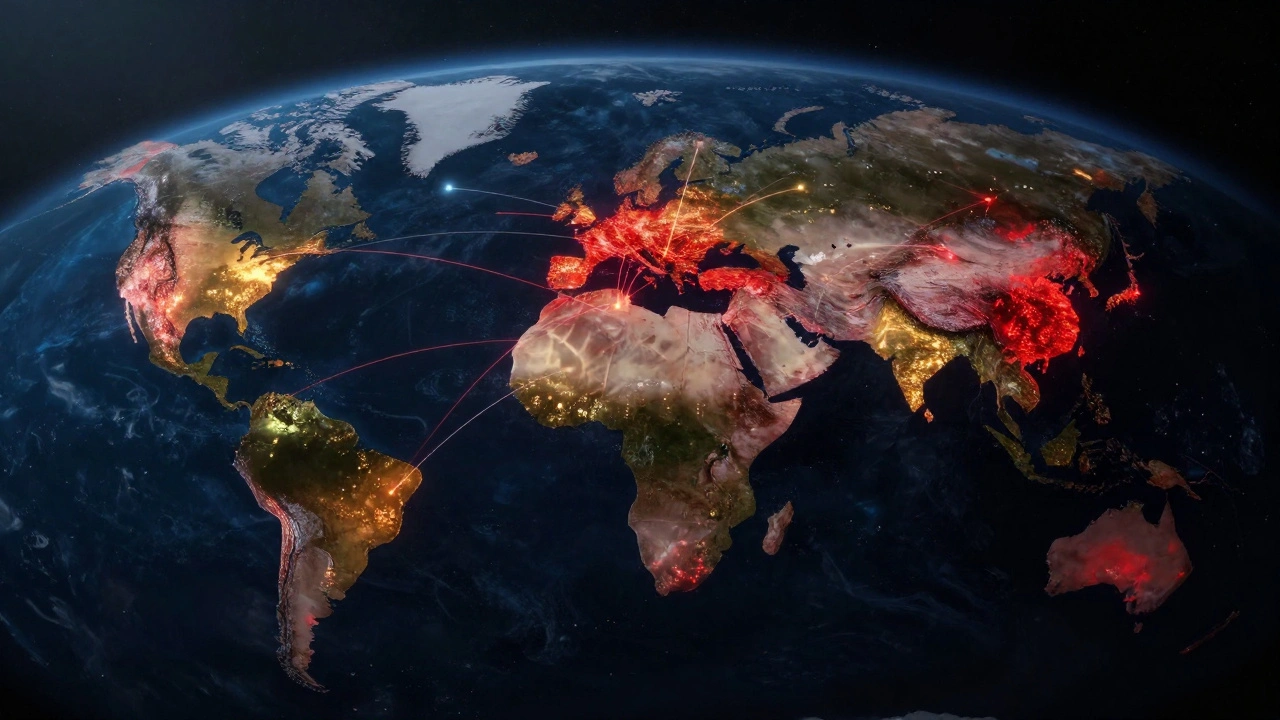
2026 Commodity Market Scenario Simulator
Adjust the global economic levers to see how different commodity sectors react based on Oxford Economics, Morgan Stanley, and Natixis 2026 forecasts.
Market Outlook
Global GDP Growth Easing...
Deflatization Factor:
Base CaseEnergy
Oil, Gas, Coal, LNGModerate oil prices due to supply glut. LNG disruptions driving higher coal costs.
Industrial Metals
Zinc, NickelVulnerable to cyclical demand destruction in automotive sectors.
Copper
Supply Constraints vs DemandTight physical market ($10.8k-$11k) supports prices despite softer demand.
Safe Havens
Gold, SilverGeopolitical risk premium drives central bank buying and investment inflows.
Soft Commodities
Grains, Cocoa, Palm OilHarvest stability offset by rising regulatory compliance costs (EUDR).
US Natural Gas
Structural OutperformerExpected outperformance driven by distinct structural support factors.
March 2026 has arrived, and the global marketplace isn't behaving according to any old playbook. If you think commodities are just raw materials traded on an exchange, you’re missing the bigger picture. We aren't just dealing with supply and demand anymore; we are navigating a security-first world where geopolitics dictates price tags. From the Gulf of Mexico to industrial hubs in China, the volatility we see today stems from a structural shift rather than temporary market blips. As we move deeper into this year, understanding these scenarios becomes critical for anyone holding assets or managing supply chains.
The landscape has shifted significantly since late 2025. Analysts point toward a bifurcated market where some sectors thrive while others stagnate under the weight of regulatory and geopolitical pressures. For instance, the broader index suggests a tough year ahead, yet specific pockets like natural gas and precious metals offer resilience. This divergence means your strategy can't rely on a single bet on 'commodities' as a whole asset class.
Macro Headwinds and Cyclical Challenges
Before drilling down into specific barrels of oil or tons of copper, we have to look at the economic engine driving the world. Oxford Economics provides a sobering baseline here. They forecast that global GDP growth is easing slightly in 2026. Why? Because tariffs and the fading front-loading of demand post-tariff announcements are creating a 'soft patch.' It's not a recession, but it subdues commodity demand enough to prevent a broad rally across the board.
This moderation is partly due to monetary policy. Goldman Sachs maintains a base case of sturdy global GDP growth supported by 50 basis points of Federal Reserve rate cuts in 2026. On paper, cheaper money should support top-down commodity returns. However, the structural headwinds-like slower industrial growth and trade fragmentation-are acting as a counterweight. The result is a tug-of-war between monetary support and cyclical weakness.
Investors often wonder if deflationary pressure will erase gains. That’s unlikely. While demand softens, the concept of 'deflatization' is emerging. This is where investors and central banks deliberately increase hard asset allocations to protect against currency debasement. It acts as a floor beneath prices, meaning downside risks are limited despite ample inventories in certain sectors.
Energy Market Dynamics and Price Trajectories
If there is one sector dominating the conversation right now, it is energy. The dynamics are complex, characterized by tension between abundant supply and the accelerating pace of the energy transition. Oil markets entered 2026 at a crossroads. Throughout 2025, crude supplies saw a growing glut, which depressed prices.
Morgan Stanley anticipates that prices will likely remain moderate in 2026. For industrial users, this offers relief. Lower fuel costs help ease global inflation, a crucial benefit for consumers still feeling the pinch of the mid-decade economic adjustments. However, looking solely at crude misses the second-order effects happening in the gas and coal sectors.
Here is the nuance: Marex identifies that these disruptions drive coal prices higher. While supply redirection from China has mitigated this in the short term, a prolonged disruption could tighten global coal markets significantly. Higher energy costs then feed back into commodity production expenses, reinforcing inflationary pressures throughout industrial supply chains. It is a chain reaction starting in the shipping lanes of natural gas but ending in the pricing of manufactured goods.
Natural gas itself stands out. Unlike the broader complex, US natural gas is expected to be a relative outperformer. It led price gains in 2025, and investor positioning has turned bullish heading into 2026. This isn't speculation; it reflects structural support factors distinct from the broader commodity weakness seen in agriculture or base metals.

Divergent Futures for Industrial and Precious Metals
The metals complex tells a story of two different worlds colliding. On one side, you have industrial base metals struggling against cyclical demand destruction. On the other, precious metals are riding the wave of safe-haven positioning and currency volatility.
| Metal | Forecast Scenario | Key Driver |
|---|---|---|
| Copper | Elevated ($10,800-$11,000/tonne) | Supply tightness vs. Demand weakness |
| Zinc | Bearish Pressure | Declining consumption in automotive |
| Nickel | Vulnerable | Cyclical demand outweighs supply constraints |
| Gold & Silver | Bullish Outperformance | Geopolitical risk premium & Central bank buying |
Copper remains the most watched metal. Natixis forecasts an average of $10,800 to $11,000 per tonne in 2026. These levels remain elevated by historical standards even amidst moderate pressure. BNEF highlights that a tight copper market signals potential supply-chain constraints for electrification projects. This creates a paradox: demand might be weak due to slowing manufacturing, but the physical reality of mining limits keeps prices high.
In contrast, zinc and nickel face a markedly bearish outlook. Marex notes these are more closely tied to cyclical demand, particularly in automotive manufacturing, which shows signs of weakness. Here, supply-side constraints exist but are currently outweighed by concerns over declining consumption. You have metals sitting around because factories aren't ordering them fast enough.
Precious metals exhibit fundamentally different dynamics. Gold and silver have retained their status as safe-haven assets during periods of heightened risk. Investors seek safety, and central banks are making substantial purchases. Baringa projects these trends should continue into 2026, establishing precious metals as the primary beneficiary of the geopolitical risk premium in the commodity complex.
Structural Trends Reshaping Volatility
Market behavior in 2026 cannot be explained by cycles alone. Two overarching themes are reshaping the landscape beyond simple quarterly fluctuations. The first is the ongoing 'deflatization' trend identified by Marex. As noted earlier, building hard asset allocations constrains outright bearish positioning. This means volatility remains elevated, but the bar for short positions is significantly higher. You simply cannot bet on permanent price collapse easily anymore.
The second theme is regionalization. Supply chain fragmentation has evolved from mere localization patterns. Disruptions, shifting alliances, and logistical bottlenecks haven't disappeared; they've changed focus. The emphasis has shifted heavily toward energy markets and logistics. This structural fragmentation continues to influence pricing, creating localized price differentials not evident in previous commodity cycles. A bushel of wheat or a barrel of oil might cost vastly different things depending on which political bloc you are trying to ship through.

Stabilization Amidst Regulatory Complexity
Agricultural commodities show marked improvement compared to the early 2020s. Morgan Stanley characterizes the outlook as cautiously optimistic. After years of chaos, many agricultural markets have entered a period of relative stability. Strong harvests, improved supply chain logistics, and adequate inventories have made food commodity prices more affordable in many regions. Specifically, global grain supplies like wheat and corn have been abundant, leading to softer prices and modest declines in 2025.
However, do not mistake price stability for risk elimination. New volatility drivers are emerging from regulation. The EU Deforestation Regulation (EUDR) is explicitly reshaping supply chains for coffee, cocoa, and palm oil. This regulation compels companies to adopt stricter traceability and sustainability measures. Compliance costs are rising, adding another layer of complexity to procurement strategies. What used to be a weather-driven market is now also a compliance-driven market.
Forward Expectations and Strategic Positioning
Where is the market heading after this initial stabilization? Forward price expectations suggest a gradual evolution. Goldman Sachs indicates that 2026 forwards have priced in expectations that ex-US inventories will decline approximately 450,000 tonnes. This aligns with sharp increases in speculative positioning. Prices are expected to edge down in the second half of 2026 and early 2027 once specific US policy shifts materialize.
Oxford Economics projects stabilization is expected by the second half of 2026, with expectation of a more meaningful upturn in prices in 2027. This suggests current pricing reflects temporary cyclical weakness rather than long-term structural deterioration. While Morgan Stanley frames the outlook increasingly optimistically, citing acceleration in investment for new energy sources, the timeline for widespread price appreciation is generally pushed toward the end of this fiscal year.
The consensus view balances risk asymmetry. Upside potential is capped by ample inventories in certain markets, while downside risks tied to prolonged geopolitical crises aren't fully priced in. Baringa documents that conflicts and sanctions create arbitrage opportunities, particularly in energy and metals. Commodity price scenarios diverge materially based on specific geopolitical escalation pathways.
What is the main driver of commodity volatility in 2026?
The primary driver is geopolitical fragmentation. Security-focused policies are reshaping supply chains, causing price differentials based on region rather than pure supply and demand fundamentals. Trade disputes, sanctions, and logistical bottlenecks create dislocation and asymmetric payoff structures in the market.
Are industrial metals like copper still viable investments?
Yes, but with caveats. Copper faces a tight market with supply constraints signaling higher price risk for electrification projects. However, zinc and nickel face more bearish scenarios tied to cyclically weak automotive demand. Copper remains elevated ($10k-$11k/tonne) while other base metals struggle.
How does the Federal Reserve impact commodity returns in 2026?
Fed policy acts as a support mechanism. Expected rate cuts of 50 basis points are supportive of top-down commodity returns. However, this monetary tailwind is being offset by structural economic slowdowns and tariffs that reduce actual physical demand for these commodities.
Which sector is predicted to outperform the S&P GSCI Index?
Natural gas and precious metals are the identified outperformers. Oxford Economics and other analysts specifically cite US natural gas and gold/silver as having structural support, contrasting with the projected 0.9% decline of the broader index.
What role does the EU Deforestation Regulation play in commodity pricing?
It introduces regulatory complexity and cost volatility. The EUDR requires stricter traceability for products like coffee, cocoa, and palm oil. This increases compliance costs for procuring companies, potentially passing costs to consumers and adding a non-cyclical volatility driver to agricultural markets.