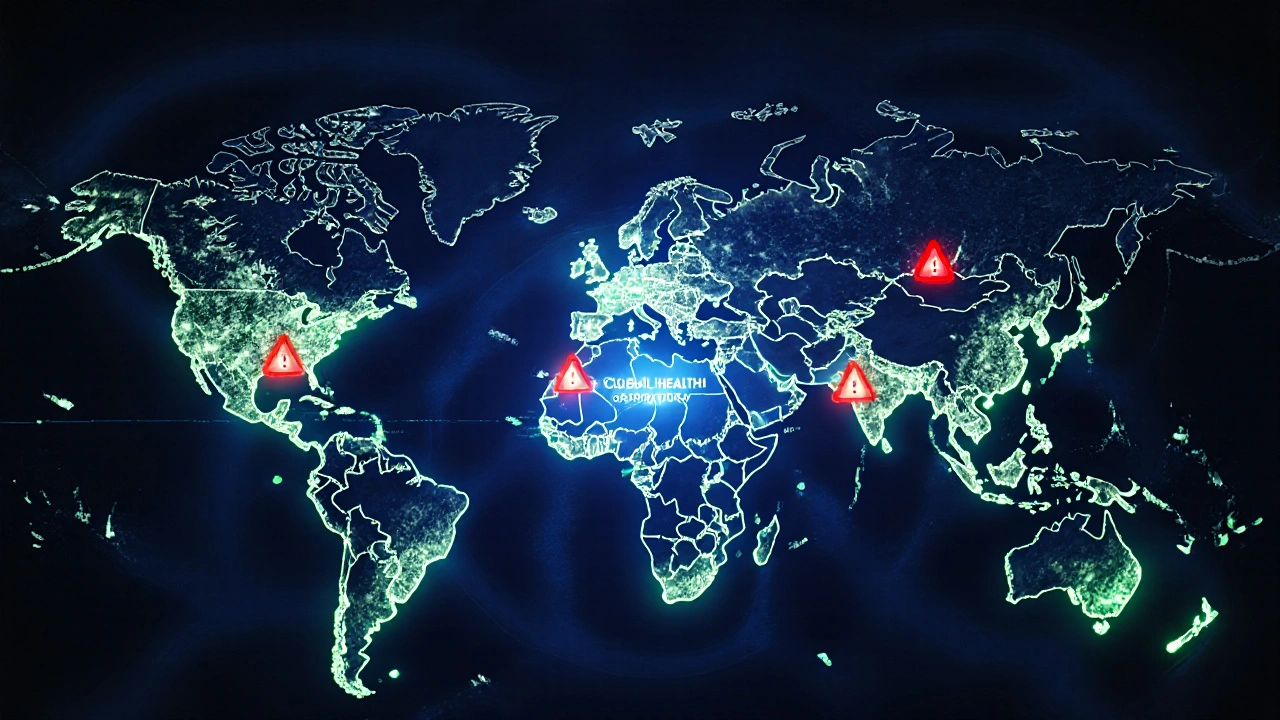
Pandemic Treaty Adoption Simulator
Experiment with negotiation strategies to estimate the future of the WHO Pandemic Agreement.
How much agreement do nations reach on sample sharing and benefits?
Number of governments approving changes quickly.
Projected Outcomes
Implementation Timeline
Select inputs to generate timeline projection...
Risk Analysis
Run simulation to score
The Stalled Engine: Why Global Pandemic Rules Remain Incomplete
Imagine agreeing to build a fire station but skipping the blueprints for the hose system. That's exactly where we stand with the WHO Pandemic Agreement, adopted by the World Health Assembly in May 2025. While 140+ member states approved pandemic prevention protocols, the critical component deciding who shares virus samples and gets fair compensation remains frozen. Think of it like approving a car engine but leaving the fuel tank empty.
PABS Annex: The Missing Puzzle Piece
Pathogen Access and Benefit Sharing (PABS) isn't just bureaucratic jargon. This annex determines whether a researcher in Brazil studying a rare virus gets credit when vaccines are made. The stalemate centers on three raw truths:
- Northern Hemisphere nations prioritize rapid sample access during outbreaks
- Southern Hemisphere nations demand guaranteed vaccine manufacturing rights
- No consensus exists on monetary vs. non-monetary benefit distribution
During January 2026 talks in Geneva, Brazilian co-chair Tovar da Silva Nunes revealed negotiators stayed until 11 PM nightly trying to bridge these divides. Even with technical teams mapping solutions, sovereignty concerns kept parties entrenched.
Negotiation Timeline: A Marathon With No Finish Line?
| Date | Key Development | Outcome |
|---|---|---|
| May 2025 | Main agreement adopted | Frozen pending PABS |
| Jan 20-22, 2026 | Text-based talks | Partial text alignment |
| Feb 9-14, 2026 | Extended midnight sessions | Gaps remain on benefit definitions |
| Mar 23-28, 2026 | Equity-focused deliberations | Negotiations extended to April |
| Apr 27-May 1, 2026 | Critical vote window | Decision point for WHA approval |
The ticking clock? WHO's legal team estimates 12-18 months for ratification after PABS approval. But with 60 national governments needing legislative changes, historical precedents suggest delays. Compare this to the 2009 International Health Regulations overhaul, which took four years from proposal to implementation.

Stakeholder Divides: North-South Equity Battle Lines
This isn't just about germ theory - it's about power asymmetry. During February 2026 sessions, South African official Precious Matsoso framed the debate starkly:
"Countries contributing genetic material deserve manufacturing capacity, not just profit-sharing royalties."
Developed nations counterargued through G20 statements emphasizing speed during crises. The compromise attempt? Proposing tiered contracts where high-income countries pay license fees while low-income nations gain technology transfer. Yet details remain murky, particularly around "benefit quantification formulas" mentioned in WHO briefs.
What Happens If Talks Collapse?
Three potential pathways loom:
- Limited Implementation: Core surveillance rules activate without PABS (like partial IHR adherence)
- Bilateral Deals: Countries negotiate individual pathogen-sharing contracts outside WHO framework
- Systemic Delay: Full treaty activation stalls past mid-2027 amid ongoing disputes
Historical context matters: When the Biological Weapons Convention faced similar deadlock in 1971, some states bypassed international mechanisms through separate agreements - creating fragmented compliance today.
Expert Voices on Breaking Gridlock
Suerie Moon from Geneva's Global Health Centre noted in March 2026: "The real test isn't signing ceremonies - it's whether the treaty creates enforceable obligations." Meanwhile, Harvard Law scholars published analysis suggesting two-track strategies: fast-tracking non-controversial provisions while continuing PABS talks. But WHO insists on package adoption, fearing dilution of equity principles.

Your Role as Observer: Tracking Next Milestones
For policymakers watching developments:
| Milestone | Target Date | Required Action |
|---|---|---|
| WHA Vote | May 2026 | PABS annex adoption |
| Ratification Phase | Mid-2027 | 60 member state approvals |
| Implementation Start | Early 2028 | Operationalize surveillance systems |
Track WHO's weekly IGWG reports for text revisions. Civil society groups like Health Policy Watch maintain public trackers showing country-by-country positions on contentious clauses.
Why This Matters Beyond Diplomatic Hallways
Every hour spent negotiating affects real-world readiness. Consider the 2022 MERS-CoV outbreak in Saudi Arabia - delayed sample sharing hampered diagnostics development. Without functional PABS, future variants might face similar bottlenecks. Conversely, successful implementation could transform pandemic responses from reactive scrambling to systematic preparation.
Five Questions You Might Ask About Treaty Progress
Why did the 2025 agreement freeze without full implementation?
Negotiators prioritized immediate preparedness frameworks but deferred complex PABS terms requiring separate consensus-building among diverse economies.
Can countries join the treaty before PANS completion?
No - the entire package must be finalized first, following the principle that all provisions interlock legally.
What happens if negotiations fail by May 2026?
Core monitoring protocols may operate independently while benefit-sharing remains unregulated, weakening collective security.
How does this differ from previous health pacts?
Unlike voluntary guidelines, this creates binding obligations with enforcement mechanisms for sample sharing and response coordination.
Are there alternatives if formal talks stall?
Regional blocs could develop bilateral arrangements, though global coherence would suffer significantly.