
Sovereign Risk Calculator
Debt-to-GDP Impact Calculator
See how changing debt and GDP levels affect sovereign risk and private borrowing in emerging markets
Risk Assessment Result
When a country borrows money from global investors, the price it pays isn’t just a number on a contract-it’s a signal. That signal, called sovereign risk repricing, changes every day based on how markets see its ability to pay back debt. For emerging markets, this isn’t just about government bonds. It’s about whether local businesses can get loans, whether factories can import equipment, and whether schools and hospitals keep getting funded. At the heart of this is one simple but powerful metric: debt-to-GDP.
What Sovereign Risk Repricing Really Means
Sovereign risk repricing is how financial markets suddenly change their minds about a country’s creditworthiness. It’s not a slow, bureaucratic process. It’s fast. It’s reactive. And it happens in real time. Investors don’t wait for official rating agencies to downgrade a country. They act before that happens.
How do they know? Through something called credit default swap (CDS) spreads. Think of CDS spreads like an insurance premium. If a country’s CDS spread jumps from 200 basis points to 500, it means investors now believe there’s a much higher chance the country might default. That doesn’t mean it will default. But it means they’re charging more to lend to it.
These spreads break down into two parts: the probability of default and the loss given default. The first asks: “How likely is this country to miss payments?” The second asks: “If it does default, how much will we actually recover?” The bigger the spread, the more expensive it becomes for that country to borrow-whether it’s the government or a local company trying to raise money.
Debt-to-GDP: The Core Driver
Among all the factors that influence sovereign risk, debt-to-GDP stands out. It’s not just about how much a country owes. It’s about how big its economy is compared to that debt. A country with $1 trillion in debt but a $2 trillion economy is in better shape than one with $500 billion in debt and a $400 billion economy.
Research from the Bank for International Settlements and the IMF shows a clear pattern: when debt-to-GDP rises above 60% for emerging markets, markets start reacting more sharply. Not always immediately-but consistently. In the 2004-2012 period, countries with rising debt-to-GDP ratios saw their CDS spreads increase by an average of 35% over the next 12 months, even if inflation and growth were stable.
Why? Because markets aren’t just looking at today’s numbers. They’re asking: “Is this path sustainable?” If a country keeps borrowing more each year just to pay interest on old debt, investors assume it’s heading toward a crisis. And they price that in.
How This Hurts Businesses-Even Healthy Ones
Here’s the catch: when sovereign risk spikes, it doesn’t just hurt the government. It drags down private companies too.
Imagine a textile factory in Indonesia that wants to borrow $10 million to buy new machines. Its balance sheet is solid. It has contracts, cash flow, and profits. But if Indonesia’s sovereign CDS spread jumps from 180 to 400 basis points, banks and bond investors start treating all Indonesian borrowers the same. Why? Because they fear:
- Capital flight-foreign investors pull money out of the whole country
- Currency collapse-making it harder to repay dollar-denominated loans
- Government default-raising the chance of capital controls or debt restructuring
So even a perfectly fine company gets priced as risky. Loan terms tighten. Interest rates rise. Or worse-banks simply say no.
Studies show that when sovereign spreads increase by 100 basis points, corporate borrowing in emerging markets drops by 12-18% within six months. That’s not a small ripple. It’s a shockwave through entire economies.

Global Risk vs. Local Reality
Not all sovereign risk is created equal. Two things drive CDS spreads: country-specific fundamentals and global risk appetite.
Country-specific factors include debt-to-GDP, inflation, trade balance, and institutional strength. These are things a government can control over time. Global risk appetite? That’s about whether investors worldwide are feeling bold or scared. When the U.S. Federal Reserve raises rates, or when a recession hits in Europe, global investors suddenly flee to safety-and emerging markets get hit hardest.
This creates a dangerous mismatch. A country might have stable debt-to-GDP and low inflation, but if global risk aversion spikes, its CDS spread still rises. And when that happens, businesses suffer-even though their fundamentals haven’t changed.
That’s why some countries, like Chile and Poland, manage to keep stable access to capital even during global turbulence. They’ve built credibility through consistent fiscal discipline. Investors trust them to handle shocks. Others, like Argentina or Egypt, see spreads explode even with modest debt increases because markets don’t believe their policies will hold.
Regional Differences Matter
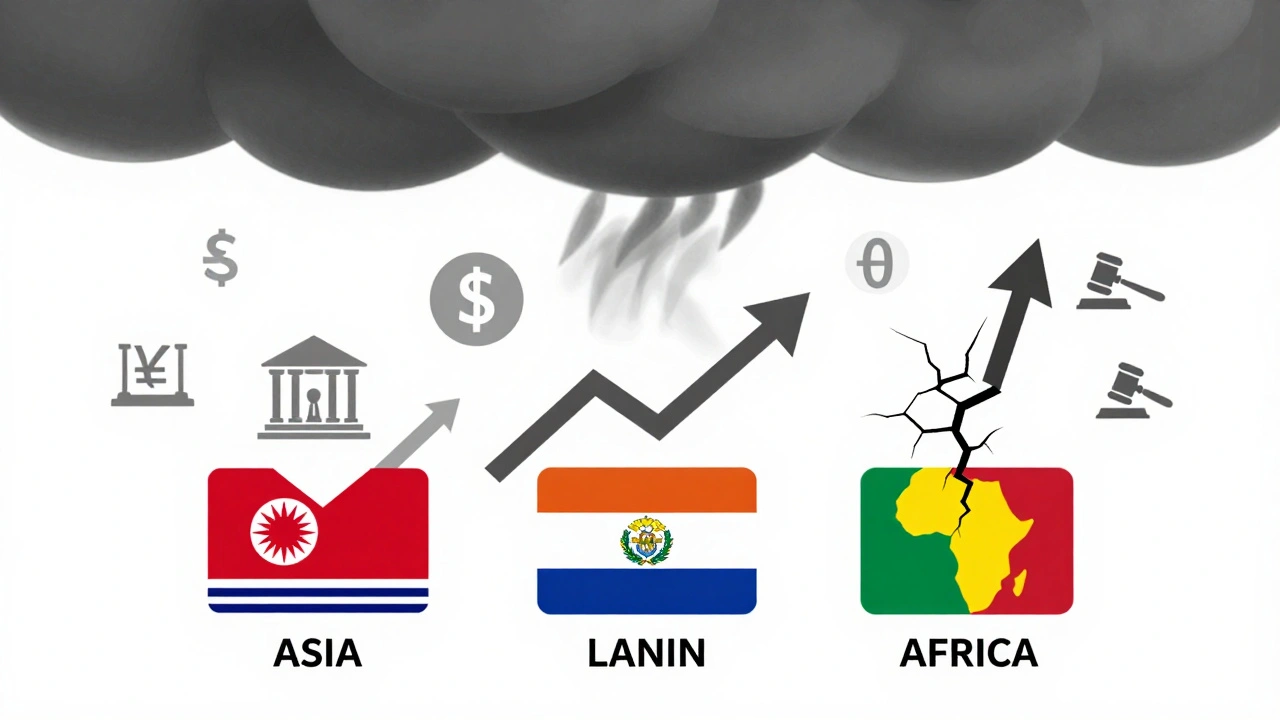
Debt-to-GDP doesn’t affect all emerging markets the same way. In Asia, markets are more forgiving. China, Korea, and Thailand have seen debt-to-GDP rise over the past decade-but their CDS spreads stayed low because investors believe their institutions can manage adjustment. In Latin America, the same debt levels trigger much sharper reactions.
Why? Because history matters. Latin America has had multiple debt crises. Asia hasn’t. So markets discount debt levels in Asia more heavily. But that’s changing. As more Asian countries take on foreign currency debt, the gap is narrowing.
Meanwhile, in Africa, where debt-to-GDP is often below 60% but governance is weak, markets still demand high premiums. Debt isn’t the only problem-it’s whether the government can collect taxes, enforce contracts, or stop corruption. That’s why state fragility scores are just as important as debt ratios.
When Markets Get Ahead of Ratings
Rating agencies like Standard & Poor’s move slowly. They meet quarterly. They issue reports months after data comes in. Markets? They react every minute.
Take the Philippines. In 2010, S&P kept its rating stable while the country’s debt-to-GDP climbed to 47%. But CDS spreads jumped 40% because markets saw fiscal slippage coming. Two months later, S&P downgraded it. The market had already priced it in.
That’s the power of real-time pricing. Markets don’t wait for official signals. They watch trade data, currency movements, central bank statements, and even social sentiment. If investors see a pattern of missed tax targets or rising import bills, they assume the debt burden is growing-and they act.
What This Means for Policymakers
For governments in emerging markets, the lesson is clear: you can’t hide behind low current debt. Markets look ahead. They care about trajectory.
- If your debt-to-GDP is rising, even slightly, you need to explain why-and show a credible plan to stabilize it.
- If you’re relying on foreign borrowing, you need strong foreign reserves and a clear strategy to manage currency risk.
- If institutions are weak, you need to fix them-because markets will punish you for it, even if your numbers look okay.
The most successful countries aren’t the ones with the lowest debt. They’re the ones with the most transparent, predictable, and credible policies. That’s what keeps spreads low and capital flowing-even when times get tough.
The Hidden Risk: Maturity and Recovery
Most models treat sovereign risk as one number. But that’s misleading. The length of a country’s debt matters. Short-term debt is riskier because it needs to be rolled over frequently. If markets turn, you can’t refinance.
And recovery rates? They’re not fixed. In some defaults, investors recover 70%. In others, they get 20%. Markets are starting to price this in-but slowly. Countries with strong legal systems and asset transparency get better recovery rates. Those with opaque systems? Investors assume the worst.
That’s why a country with 80% debt-to-GDP but strong rule of law can still access capital. And why another with 50% debt but no transparency can’t.
Final Takeaway
Sovereign risk repricing isn’t magic. It’s math. It’s psychology. And it’s brutally efficient.
Debt-to-GDP is the anchor. But it’s not the whole story. Markets combine it with inflation, external debt, institutional strength, and global sentiment. And they adjust faster than any government can react.
For emerging markets, the path to stable capital access isn’t about avoiding debt. It’s about managing expectations. It’s about building trust. It’s about proving, day after day, that you can handle the burden-and that you’re not just borrowing to survive, but to grow.
Those that do? They thrive. Those that don’t? They get priced out-even if their numbers look fine on paper.