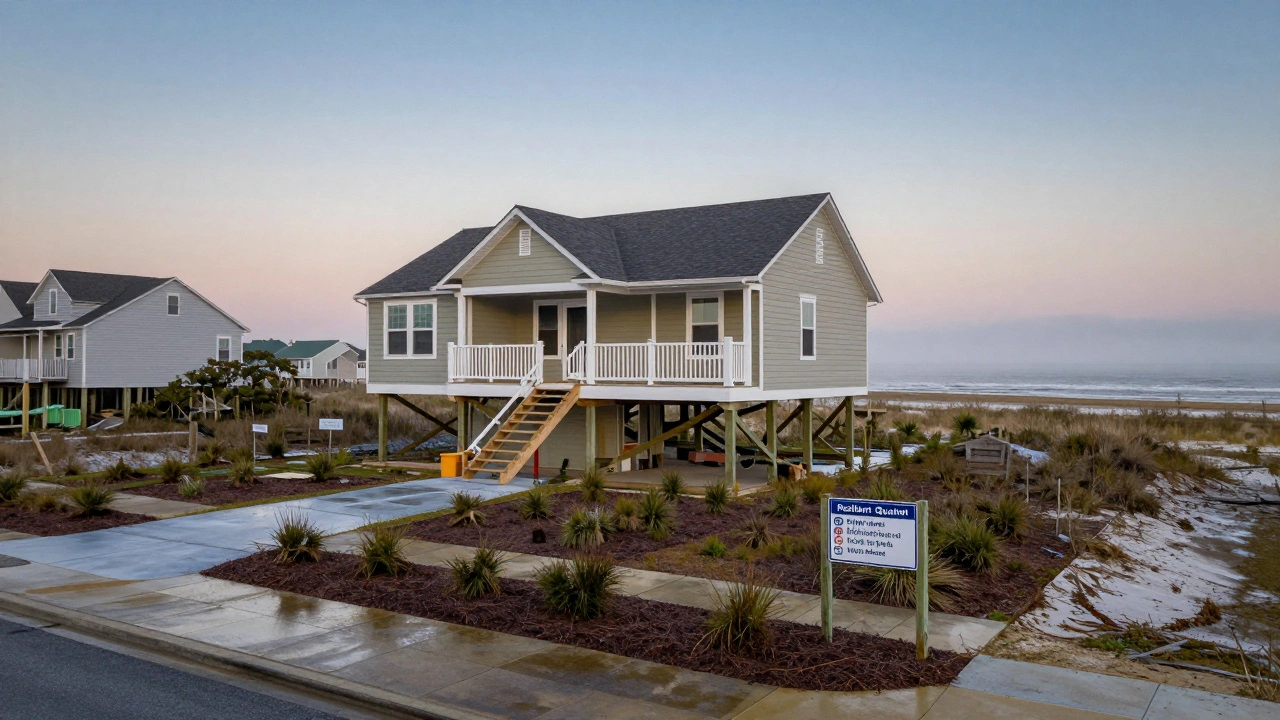
Coastal Insurance Cost Calculator
How much can you save on coastal insurance?
See the financial impact of climate adaptation measures on your flood insurance premiums. California's new law offers 15% discounts for properties with nature-based solutions.
Your Property Details
Adaptation Benefits
California's new law offers 15% discount for properties with verified adaptation measures. Federal data shows retreat costs ($287k avg.) are 47% cheaper than rebuilding after major floods.
Potential Savings
Why it works
Nature-based solutions like living shorelines and dune restoration deliver 2.3x the return on investment compared to seawalls. In Small Island Developing States, $1 spent on nature-based projects generates $13.20 in benefits.
Cost Comparison
| Strategy | Upfront Cost | Insurance Premium | Long-term Value |
|---|---|---|---|
| Seawall | $40,000 | $650/year | 5.80x ROI |
| Living shoreline | $15,000 | $550/year | 13.20x ROI |
| Managed retreat | $287,500 (avg. buyout) | $0 | Prevents future flooding |
Coastal communities are on the front lines of climate change. Rising seas, stronger storms, and eroding shorelines aren’t future threats-they’re happening right now. In places like Norfolk, Virginia, and coastal California, homes are flooding more often. Beaches are disappearing. Property values are dipping. And insurance is becoming unaffordable. The old way of building, rebuilding, and insuring coastal property is breaking down. Three strategies are emerging as the only realistic path forward: resilient zoning, managed retreat, and insurance reform. Together, they’re not just about avoiding damage-they’re about reshaping how we live with the ocean.
Resilient Zoning: Rewriting the Rules for Coastal Development
Resilient zoning isn’t about banning development. It’s about making sure new buildings don’t get built where they shouldn’t be. Traditional zoning treated the coast like a static line on a map. Today’s maps show sea levels rising 3.2 to 6.9 feet by 2100 in California alone. That’s not a prediction-it’s a planning baseline.
Take Norfolk, Virginia. In 2023, the city introduced a resilient quotient points system. Every new building in a coastal zone must earn at least 70 out of 100 points by using elevated foundations, flood-resistant materials, and green infrastructure like rain gardens and permeable pavement. The result? A 42% drop in new construction within 300 feet of eroding shorelines in just 18 months. That’s not luck. It’s policy.
California’s approach is even more rigid. By December 31, 2027, all 76 coastal jurisdictions must update their Local Coastal Programs to include sea level rise projections. If they don’t, the state takes over permitting. No exceptions. New buildings can’t use seawalls or riprap unless there’s literally no other option. The state also requires 0.5-meter resolution elevation data and integration with NOAA’s Sea Level Rise Viewer. This isn’t optional planning-it’s legal requirement.
What this means for homeowners: if you want to build or renovate in a high-risk zone, you’ll pay more upfront. But you’ll also pay less later. In Norfolk, business owners report 30% fewer flood claims despite 15-20% higher construction costs. The trade-off is clear: spend more now, or lose everything later.
Managed Retreat: When Moving Is the Smartest Choice
Not every home can be saved. Some places are simply too exposed. That’s where managed retreat comes in-not as a last resort, but as a planned, community-led strategy.
The Federal Emergency Management Agency (FEMA) has bought out over 12,800 homes since 2020 through its Hazard Mitigation Grant Program. The average cost? $287,500 per property. That’s 47% cheaper than rebuilding after a major flood. But it’s not just about money. It’s about safety.
In the Caribbean, the Resilient Coasts-Caribbean Sea project used community workshops called Living Labs to help 347 households relocate from unstable shores in Dominica and Saint Lucia. The cost? Just $82,000 per household-63% less than building seawalls or revetments. And it worked because locals designed the process.
But retreat has a dark side. A 2024 University of Hawai’i study found 38% of relocated households suffered serious emotional and cultural impacts. Among Indigenous communities, 67% reported losing connection to ancestral lands. That’s not just trauma-it’s a policy failure. Retreat can’t be top-down. It needs to be led by the people who live there.
And it’s not always successful. FEMA’s own audit in December 2025 found that 31% of buyout properties in New Jersey were redeveloped for commercial use within five years. That defeats the whole point. Retreat isn’t about making room for condos or parking lots. It’s about restoring natural buffers-wetlands, dunes, forests-that protect the rest of the coast.

Insurance Reform: Paying for What You Risk
If you’ve ever gotten a flood insurance bill that felt unfair, you’re not imagining it. For decades, the National Flood Insurance Program (NFIP) in the U.S. charged the same rate to someone in a 100-year floodplain and someone who just built on a dune. That’s changing.
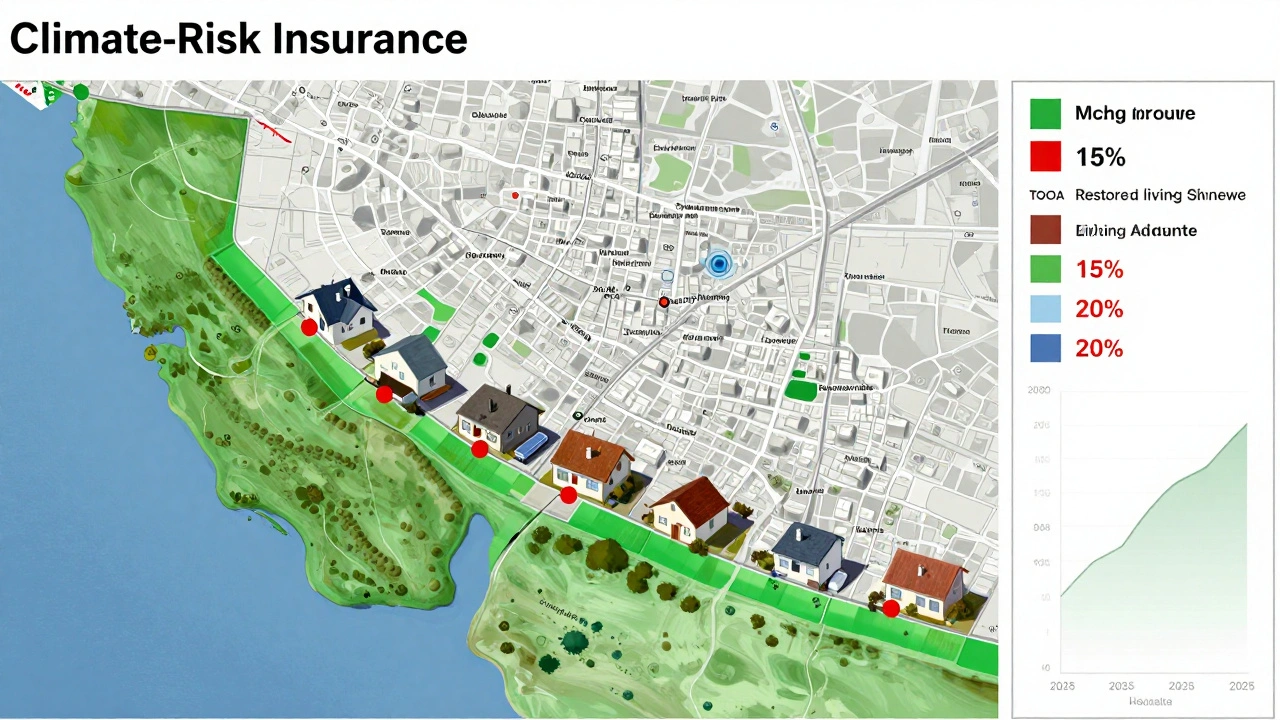
Starting January 1, 2026, California implemented climate risk surcharges on flood insurance. Properties in high-risk zones without adaptation measures now pay 18-32% more. But here’s the incentive: if you install a living shoreline, restore a dune, or elevate your home, you get a 15% discount. It’s not punishment-it’s reward.
Bermuda’s reinsurer Everest Re started a similar model in 2024 with adaptation credits. Communities that prove they’ve implemented verified resilience measures get up to 25% off premiums. Seventeen U.S. states have followed. The system uses FEMA’s Risk Rating 2.0, which considers 130 factors-elevation, construction type, proximity to wetlands-and updates premiums quarterly based on the latest shoreline data from the U.S. Army Corps of Engineers.
But the problem is massive. In the U.S., 68% of high-risk coastal properties are still covered by the NFIP, which doesn’t reflect real risk. The Congressional Budget Office estimates this creates $1.4 trillion in unfunded liability. Globally, only 22% of Small Island Developing States have functional coastal insurance markets. That means when a storm hits, there’s no safety net.
And it’s not just about money. Insurance reform is political. The 2025 Florida Coastal Insurance Reform Act was vetoed after 78% of real estate agents lobbied against it. Homeowners fear being priced out. One Reddit user in Virginia wrote: “My $387/month premium increase priced me out of my generational home.” That’s real pain. Reform must be paired with assistance-grants, low-interest loans, relocation support-to avoid turning climate adaptation into a class issue.
Why Integration Works Better Than Any Single Strategy
Trying to fix coastal risk with just one tool doesn’t work. Zoning alone? You’ll still have people living in danger because they can’t afford to move. Retreat alone? You’ll displace communities without funding them. Insurance alone? You’ll just make people pay more without giving them tools to adapt.
The World Bank looked at 142 coastal projects and found nature-based solutions-including retreat-delivered 2.3 times the return on investment compared to seawalls. For every dollar spent on dunes, wetlands, or living shorelines, you get $13.20 in benefits in Small Island Developing States. Seawalls? Just $5.80.
But integration is hard. California’s model is strong in dense urban areas like San Diego and Santa Cruz, but fails in remote places like Alaska’s Indigenous villages, where erosion rates are 63% higher because retreat planning didn’t account for cultural ties to land. The same goes for insurance: if you raise premiums without offering help, you’re punishing the poor.
Portugal got it right. In 2024, they tied premium surcharges directly to funding dune restoration. Every extra dollar collected from high-risk homeowners went into rebuilding natural barriers. That’s a feedback loop: pay more, get safer. It’s not charity. It’s smart risk management.
What’s Missing? Data, Workforce, and Equity
Even the best plans fail without the right tools. Sixty-three percent of U.S. coastal counties don’t have the 0.5-meter lidar mapping needed to plan retreat accurately. The NOAA Office for Coastal Management requires 200 hours of training for planners. Only 412 professionals nationwide hold the Certified Climate Adaptation Planner credential as of January 2026.
And equity? It’s the biggest gap. The Global Center on Adaptation reports that only 8% of World Bank’s nature-based funding reached Small Island Developing States in 2021. Even with improvements, many communities still can’t access grants, technical help, or insurance reform because they’re too remote or too poor.
Success stories exist. In Oahu, the Surfrider Foundation ran Coastal Reality Check workshops. 217 households participated. 89% implemented free adaptation measures-planting native grasses, moving driveways, installing rain barrels. No government mandate. Just community knowledge.
That’s the model: local, practical, and empowering.
What Comes Next?
The market is shifting fast. The global coastal adaptation market hit $38.7 billion in 2025. Resilient zoning software grew 34% last year. Climate risk modeling for insurers jumped 47%. The SEC now requires public companies to report coastal asset risks using 2080 scenarios. Corporations are waking up.
But the real test is whether these tools reach the people who need them most. Adaptation bonds. Coastal resilience taxes. Insurance-linked securities. These are promising ideas-but only if they’re designed with justice in mind.
By 2035, McKinsey predicts 78% of current adaptation strategies will need major updates as sea levels rise faster than expected. That’s not a reason to wait. It’s a reason to start now-with better data, better training, and better inclusion.
The ocean isn’t going to stop rising. But we can stop pretending we can build our way out of it. The future of coastal living isn’t about fighting the sea. It’s about living with it-wisely, fairly, and together.
What is resilient zoning and how does it help coastal communities?
Resilient zoning updates land use rules to account for rising seas and erosion. It restricts new construction in high-risk areas and requires buildings to meet standards like elevation, flood-resistant materials, and green infrastructure. In Norfolk, Virginia, it cut risky development by 42% in 18 months. In California, all coastal jurisdictions must update their plans by 2027 or lose permitting authority. The goal is to reduce future damage and lower insurance costs over time.
How does managed retreat work, and is it effective?
Managed retreat involves buying out homes in high-risk areas and relocating residents to safer ground. FEMA has bought over 12,800 properties since 2020 at an average cost of $287,500-47% cheaper than rebuilding. Projects like the Resilient Coasts-Caribbean Sea initiative relocated 347 households at 63% lower cost than seawalls. But effectiveness depends on community involvement. Without cultural sensitivity, retreat can cause trauma, especially in Indigenous communities where 67% report loss of ancestral connection.
Why is insurance reform necessary for coastal adaptation?
Current flood insurance often doesn’t reflect real risk. The U.S. National Flood Insurance Program subsidizes high-risk properties, creating $1.4 trillion in unfunded liability. Reform introduces risk-based pricing: premiums rise for unprotected homes and drop for those that adapt. California now offers 15% discounts for nature-based defenses. Bermuda’s Everest Re offers up to 25% off for verified resilience. This shifts incentives from rebuilding in danger to preparing for it.
What are the biggest challenges to implementing these strategies?
Three main challenges stand out: data gaps, workforce shortages, and equity. Over 60% of U.S. coastal counties lack high-resolution elevation data needed for planning. Only 412 professionals nationwide hold the Certified Climate Adaptation Planner credential. And without financial support, insurance hikes and relocation costs can push low-income families out of their homes. Retreat and zoning must be paired with grants and community-led planning to avoid creating climate inequality.
Are nature-based solutions better than seawalls?
Yes, according to the World Bank. Nature-based solutions-like dune restoration, wetland creation, and strategic retreat-delivered 2.3 times the return on investment compared to seawalls. In Small Island Developing States, each dollar spent on nature-based projects generated $13.20 in benefits versus $5.80 for engineered structures. They also provide habitat, reduce erosion long-term, and adapt naturally as sea levels rise. Seawalls, by contrast, often accelerate erosion elsewhere and require constant repair.
Can these strategies work in remote or Indigenous communities?
They can-but only if designed with them, not for them. A 2024 USGS study found erosion rates were 63% higher in Alaska’s Indigenous villages because retreat plans ignored cultural ties to land. Success comes from community-led processes like Oahu’s Coastal Reality Check workshops, where locals shared knowledge and chose adaptations themselves. Funding, technical support, and respect for traditional land use are essential. Top-down solutions fail. Co-designed ones work.