Portfolio Concentration Calculator
Assess how concentrated your portfolio is in AI-driven stocks. The article shows top tech stocks now make up 30% of S&P 500. Your portfolio may be at risk if your holdings mirror this concentration.
By early 2026, if you own a broad market index fund, you're not really invested in the whole market-you're invested in a handful of tech giants. Companies like Nvidia, Microsoft, and Apple now make up nearly 30% of the S&P 500. That’s not an accident. It’s the result of AI infrastructure spending, cloud adoption, and generative AI tools driving record profits and investor demand. But here’s the problem: when one small group of stocks moves, your whole portfolio moves with it. And when they stumble, your portfolio doesn’t just dip-it plunges.
Why AI Concentration Isn’t Just About Stock Picks
Most investors think diversification means owning 50 different stocks. But if those 50 stocks all rise and fall together because they’re tied to the same trend-like AI infrastructure, cloud computing, or semiconductor demand-you don’t have diversification. You have correlation risk. And that’s the hidden danger.Take last year’s Q4 earnings season. Nvidia’s revenue jumped 126%. Microsoft’s cloud division grew 28%. Meanwhile, the rest of the S&P 500 barely moved. That’s not normal. In 2020, the top 10 stocks accounted for about 20% of the index’s total return. By November 2025, that number hit 47%, according to Russell Investments. That means nearly half of your portfolio’s performance depends on whether a few tech companies hit their numbers. If one misses, the whole index drags.
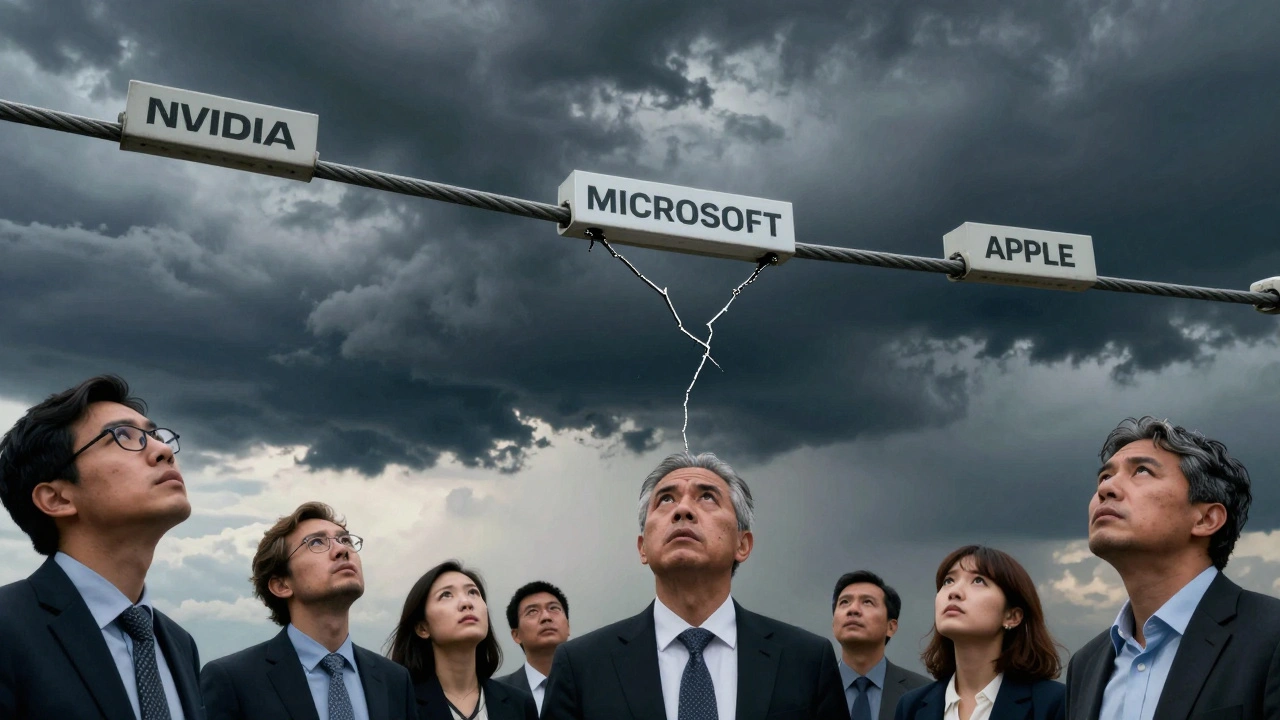
This isn’t about whether these companies are good. They are. It’s about how much weight they carry. Think of it like a bridge built with only three steel cables. Even if each cable is strong, if they’re all under the same stress, one failure could bring the whole thing down. That’s what happens when 30% of your portfolio is in AI-driven tech stocks.
How AI Itself Is Exposing the Risk
Ironically, the same technology that created this concentration is now helping us see it clearly. Platforms like AIO Logic’s AXIS and Keyway’s AI-driven analysis don’t just track stock prices. They map how assets behave under stress. For example, they can simulate: What happens if Nvidia’s chip supply chain gets disrupted? How much would your portfolio drop if Microsoft’s Azure growth slows by 5%? What if cap rates rise across all cloud data center REITs at once?These tools don’t look at individual companies. They look at how entire clusters of holdings move together. A portfolio might have 20 different tech stocks, 15 healthcare names, and 10 energy firms. But if all of them are tied to AI spending-whether through suppliers, cloud customers, or AI-powered automation tools-they’re still acting like one big bet. That’s the kind of risk traditional diversification metrics miss.
The Trap of Narrative Investing
Why does this concentration keep growing? Because investors aren’t just buying companies-they’re buying narratives. “AI is the future” sounds smart. So people pile in. Momentum builds. Fear of missing out kicks in. And valuations stretch beyond fundamentals.Omnis Investments’ 2026 analysis found that AI stock buying has shifted from rational growth investing to what they call “early-stage irrational exuberance.” That means investors are paying premium prices for companies with unproven monetization paths. Some are spending billions on AI infrastructure with no clear path to profit. Others are betting on software that hasn’t yet moved the needle for customers. When the narrative flips-when earnings disappoint or regulators step in-those overvalued stocks don’t just correct. They collapse.
And here’s the kicker: when one of these stocks drops, others in the cluster follow. Not because they’re weak-but because they’re linked. Investors sell the whole group. That’s why J.P. Morgan Asset Management warns that a single revenue slowdown at a top AI player could trigger a broader re-rating across the sector. It’s not about bad companies. It’s about bad correlation.

Managing Risk: The Core-Satellite Strategy
You don’t have to abandon AI to protect your portfolio. You just need to structure it differently. The Core-Satellite approach, used by State Street Global Advisors, is one of the most effective methods right now.Here’s how it works:
- Core (70-80%): Use low-cost index funds that track broad global markets-not just the U.S. This gives you exposure to Europe, Japan, Brazil, and emerging markets where AI adoption is growing but valuations are more reasonable.
- Satellite (20-30%): Actively pick AI-related stocks, but cap each position. Don’t let any single stock exceed 3% of your total portfolio. Prefer companies that benefit from AI without being the primary builders-like software firms using AI to cut costs, or logistics companies using AI for routing.
This way, you still get exposure to AI’s upside, but you’re not gambling your entire portfolio on whether Nvidia hits its next earnings target. You’re building a portfolio that can survive a tech correction.
Geographic Diversification Isn’t Optional Anymore
The U.S. dominates AI investment. But that’s exactly why you need to look elsewhere. Europe is investing heavily in sovereign AI infrastructure. Japan is pushing AI into manufacturing and robotics. Brazil’s fintech sector is using AI to bring banking to millions. China, despite regulatory headwinds, still leads in AI patent filings and hardware production.According to Russell Investments, portfolios with 25% or more exposure outside the U.S. saw 30% less drawdown during the 2025 tech correction than those focused solely on American tech stocks. That’s not because those markets are growing faster. It’s because they’re not tied to the same AI narrative. When U.S. tech stocks fall, they don’t always follow.
Look beyond the S&P 500. Add emerging market ETFs. Consider small-cap international funds. Even a 10% allocation to non-U.S. tech can reduce your portfolio’s sensitivity to a single region’s volatility.

Valuation Discipline Is Your Best Defense
It’s easy to get swept up in headlines about AI breakthroughs. But remember: no matter how revolutionary the technology, stock prices must eventually reflect earnings. Right now, many AI stocks trade at 50x, 70x, even 100x forward earnings. That’s not normal. Even during the dot-com boom, the average tech stock traded at 35x earnings.Use simple metrics to stay grounded:
- Price-to-Free-Cash-Flow: If it’s above 40, proceed with caution.
- Revenue Growth vs. Operating Margin: Is growth coming from real sales, or just spending?
- Debt-to-Equity: Companies with high debt and low cash flow are vulnerable if rates rise or demand slows.
If a company’s valuation doesn’t match its ability to generate real, sustainable cash, it’s not a long-term holding-it’s a timing bet. And timing bets are what get you hurt when the market turns.
AI Concentration Isn’t Going Away-But Your Risk Can Be Controlled
The AI revolution isn’t a fad. It’s real. And it’s changing how companies operate, compete, and make money. But that doesn’t mean you have to put all your money in the same few companies.The risk isn’t AI itself. It’s putting too much of your portfolio into the same small group of stocks that are driving the index. You can still benefit from AI’s growth without betting your entire retirement on it.
Build a portfolio that’s diversified not just by stock, but by region, sector, and valuation. Use tools to see how your assets behave under stress-not just how they’ve performed in the past. And never let narrative override numbers.
AI isn’t the problem. Overconcentration is. And that’s something you can fix.
Is AI equity concentration a new phenomenon?
No, concentration isn’t new-think of the dot-com bubble or the 1970s Nifty Fifty. But what’s different now is the speed and scale. AI-driven earnings growth has pushed a handful of tech stocks to represent nearly half of the S&P 500’s returns in under three years. That’s faster than any previous tech boom. The leverage is higher, the valuations are more extreme, and the global dependency on these firms is deeper.
Should I sell all my AI stocks?
No. AI is a structural shift, not a bubble. Instead of selling, rebalance. Reduce position sizes to 2-3% per stock. Shift some exposure to companies that use AI to improve efficiency-not build it. Consider ETFs that track AI applications outside the U.S. You don’t need to exit. You need to diversify.
How do I know if my portfolio is too concentrated?
Check your top 10 holdings. If they make up more than 30% of your portfolio, you’re exposed. Also, look at your sector weightings. If over 25% of your portfolio is in information technology, you’re heavily reliant on AI-driven growth. Use free tools like Morningstar or Portfolio Visualizer to run correlation analysis. If your assets move in lockstep during downturns, you have correlation risk.
Can ETFs protect me from AI concentration?
Only if they’re broad-based. Most AI ETFs are just repackaged U.S. tech stocks. Look for global equity ETFs with low tech exposure-like those tracking the MSCI World Index or the FTSE All-World Index. These include companies from Europe, Asia, and emerging markets that aren’t tied to U.S. AI giants. Avoid ETFs with names like “AI Power” or “NextGen Tech”-they’re often concentrated.
What role do interest rates play in AI concentration risk?
High interest rates hurt growth stocks most. AI companies often reinvest profits into R&D instead of paying dividends. When rates rise, their future cash flows are worth less today. That’s why many AI stocks dropped in 2022 and 2023. If rates stay elevated, even profitable AI firms can face multiple compression-meaning their stock prices fall even if earnings are strong. This makes valuation discipline even more critical.
Are there alternatives to tech stocks for AI exposure?
Yes. Look for companies that benefit from AI without building it: logistics firms using AI for routing, manufacturers using AI for predictive maintenance, or retailers using AI for inventory management. Also consider infrastructure plays-real estate investment trusts (REITs) that own data centers, or semiconductor equipment makers outside the U.S. These offer exposure to AI trends with lower valuations and less correlation to the big tech names.