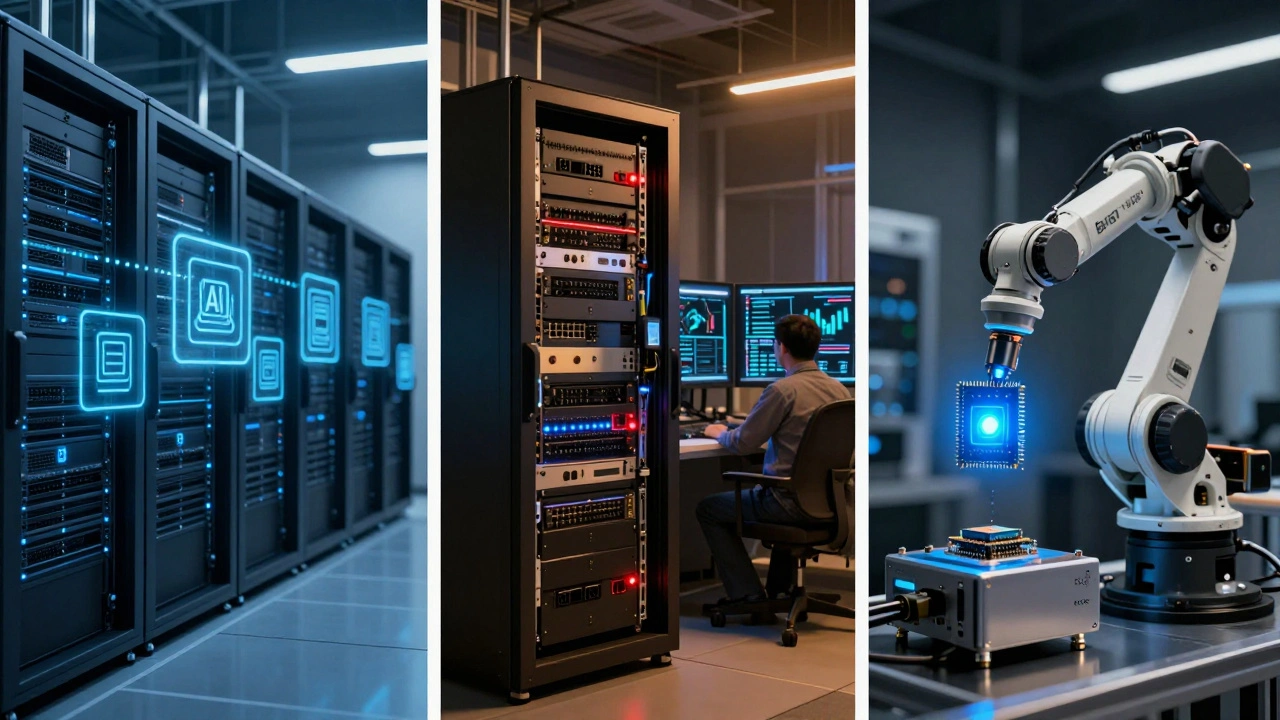
AI Infrastructure Cost Calculator
Infrastructure Cost Comparison
By 2026, the biggest question in AI isn't how to train better models-it's where to run them. Companies that assumed cloud-only was the answer are now facing hard truths: running inference at scale on third-party APIs is bleeding money. The shift from training to inference has flipped the script. What used to be a one-time cost-training a model-has become a 24/7 operational expense. And that changes everything about infrastructure.
Why Training Isn't the Main Cost Anymore
Five years ago, the focus was on building the biggest GPU clusters to train massive models. Today, training a top-tier model like Kimi K2 Thinking costs just $4.5 million-less than 1% of what it cost to train early GPT models. That’s not a fluke. Open-weight models, better efficiency, and smarter training techniques have slashed costs. But here’s the catch: once trained, these models don’t sit idle. They’re deployed, queried, and used continuously. A single enterprise AI assistant might process 50 million tokens per day. At $2.50 per million tokens (the cost for Kimi K2), that’s $125,000 a month in inference fees. Do that on a public cloud API, and you’re burning cash. Bring it in-house, and you’re looking at a fraction of that.The real cost isn’t in the training. It’s in the inference. And inference demands infrastructure that’s predictable, controllable, and optimized for sustained load-not bursty experiments.
Cloud AI: Best for Training, Not Production
Public cloud platforms like SiliconFlow and CoreWeave still dominate training. Why? Because training is unpredictable. You might run 10 experiments this week, then pause for two months. Cloud gives you instant access to thousands of H100s or B200s without waiting for hardware procurement. You don’t need to manage cooling, power, or rack space. You just click, train, and delete.But try to run production inference on the same cloud-especially at high volume-and the numbers turn ugly. You’re paying for idle time. You’re paying for bandwidth. You’re paying for API overhead. And you’re giving up control. What if your model needs to comply with GDPR? What if your data can’t leave your country? What if latency breaks your product? Cloud providers can’t solve those problems. They’re built for convenience, not control.
That’s why cloud is still the go-to for R&D, fine-tuning, and experimentation. But not for scale.
On-Prem: The Hidden Winner for Inference
If you’re running 10,000+ queries per minute, 24/7, the math is simple: own the hardware. On-prem infrastructure-private data centers with dedicated AI racks-cuts inference costs by 60-80%. Why? Because you’re not renting. You’re amortizing a capital expense over years.A single AI inference rack today runs 30-150 kilowatts. That’s 10x what a standard server rack uses. You need liquid cooling, dedicated power feeds, and space for redundancy. But the payoff? A fixed cost. No surprise bills. No vendor lock-in. You control performance, security, and compliance. You can optimize for your exact workload-whether it’s a small LLM for customer service or a multimodal model analyzing medical scans.
Companies like Siemens and Toyota have moved their real-time quality control AI on-prem. Why? Because a 50-millisecond delay in detecting a defect on a production line means thousands of dollars in scrap. Cloud latency doesn’t cut it. On-prem does.
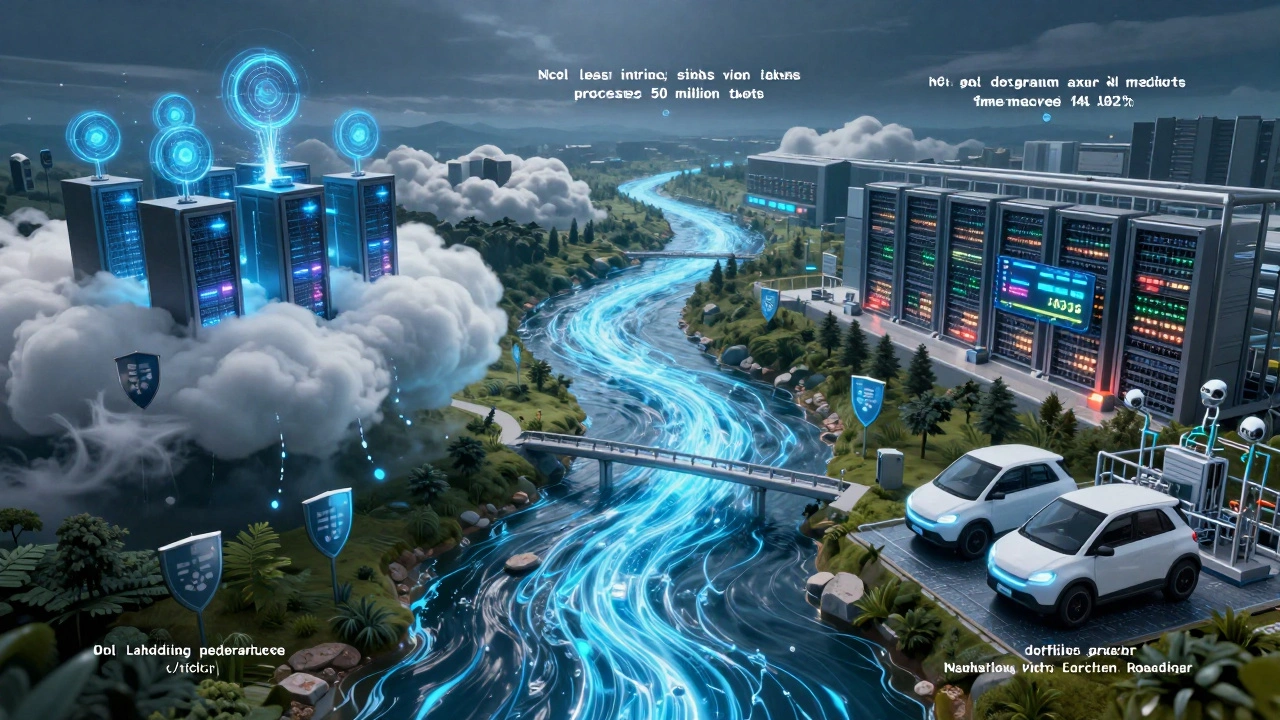
Edge: Where Latency Is Non-Negotiable
Some workloads can’t wait for a round-trip to a data center. Autonomous vehicles. Factory robots. Smart grid sensors. These need decisions in under 10 milliseconds. That’s not cloud. That’s not even on-prem. That’s edge.Edge AI in 2026 isn’t a buzzword anymore-it’s a requirement. Devices with AI ASICs (like Tenstorrent’s chips) now run lightweight models directly on sensors and machines. No network needed. No latency. Just instant action. The trade-off? Limited compute. You can’t train a 70B-parameter model on a robot arm. But you don’t need to. You deploy a distilled version of your model, fine-tuned for that specific task, and keep the heavy lifting elsewhere.
Edge isn’t replacing cloud or on-prem. It’s layering on top of them. A car’s AI might use edge for braking decisions, send sensor data to an on-prem cluster for model updates, and occasionally pull new weights from the cloud.
Hybrid Is the New Standard
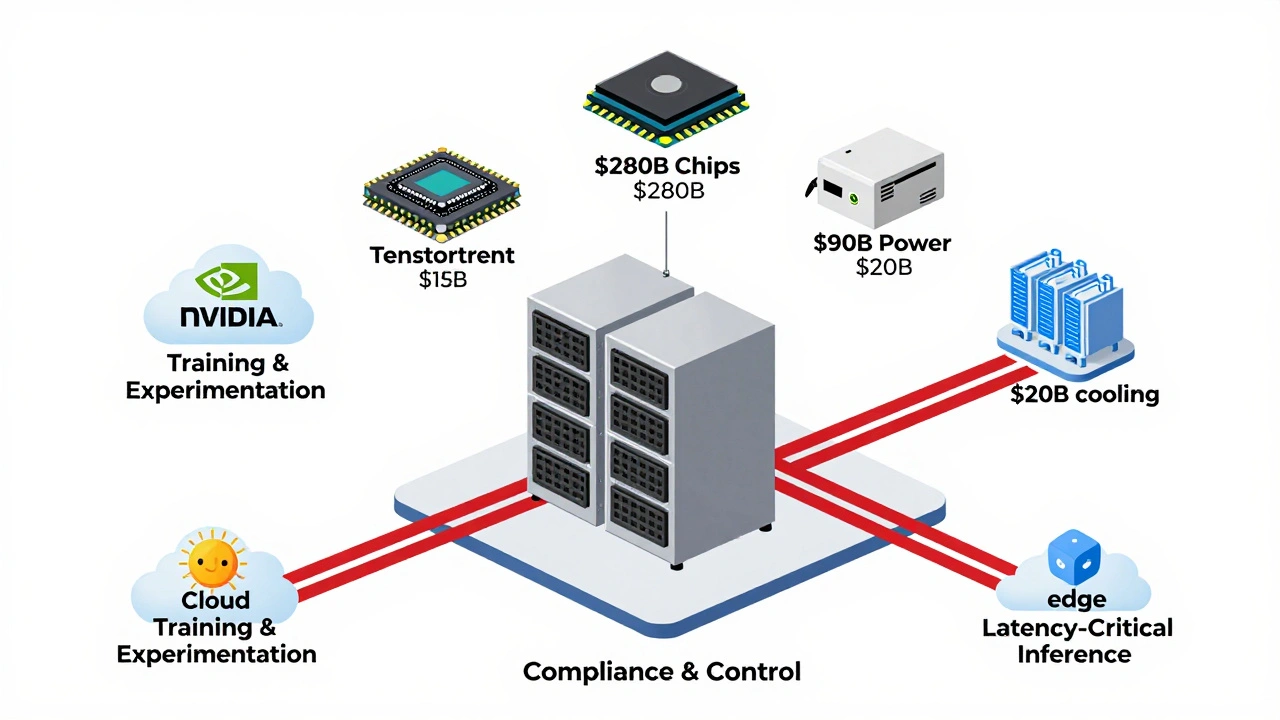
No single infrastructure works for all AI workloads. That’s why hybrid architectures are now the norm. By 2026, 38% of enterprises are already using hybrid setups-combining cloud, on-prem, and edge. The goal isn’t to pick one. It’s to match the workload to the right environment.Here’s how it breaks down:
- Training → Cloud (elastic, on-demand)
- High-volume inference → On-prem (fixed cost, full control)
- Latency-critical inference → Edge (zero delay)
- Compliance-heavy or regulated workloads → On-prem or private cloud
- Experimental models → Cloud (easy to spin up and kill)
Companies that succeed are not the ones with the most GPUs. They’re the ones who can move data and models seamlessly between these environments. That means robust data pipelines, unified monitoring, and orchestration tools that track where a model is running, how it’s performing, and where updates come from.
The Hardware Behind the Choices
Infrastructure isn’t just software. It’s silicon. And in 2026, the chip landscape is more fragmented than ever.NVIDIA still leads in GPU availability, but competitors are gaining. Tenstorrent’s AI ASICs deliver 40% more inference throughput per watt. Databricks bundles AI with data pipelines so you don’t have to move data between systems. SiliconFlow offers serverless inference with no data retention-critical for privacy-focused industries. CoreWeave’s $11.2B contract with OpenAI proves that private cloud infrastructure is now trusted for mission-critical AI.
The bottom line? You’re not just choosing a cloud provider. You’re choosing a chip architecture, a cooling solution, a power contract, and a compliance framework. Each decision cascades.
Costs Don’t Lie: The Numbers That Matter
Global AI infrastructure spending in 2026 is $420 billion. But here’s what you won’t hear in marketing brochures:- $280 billion goes to chips-GPUs, ASICs, and AI accelerators
- $90 billion goes to power infrastructure-transformers, substations, backup generators
- $50 billion goes to facility construction-data centers built for 1MW+ racks
- $20 billion goes to cooling systems-liquid cooling now standard for AI racks
That’s why location matters. A company in Norway might choose on-prem because electricity costs $0.03/kWh. A company in Texas might stick with cloud because power is $0.10/kWh and cooling is expensive. The cheapest infrastructure isn’t always the one with the most GPUs. It’s the one with the cheapest power and the right workload fit.
Regulations Are Changing the Game
The EU’s GPAI regulations in 2025 forced a rethink. If your AI model processes personal data from EU citizens, you can’t just train it in the U.S. and deploy it globally. Data residency rules now require models to be trained and inferred within regional boundaries. That kills the idea of one global cloud model. It forces companies to build multiple, region-specific deployments. On-prem or private cloud becomes the only way to comply.Same goes for healthcare, finance, and defense. No one trusts a third-party API with sensitive data. They need air-gapped systems. Dedicated networks. Full audit trails. That’s not cloud. That’s on-prem.
What Should You Do?
Stop asking: "Should I use cloud or on-prem?" Start asking:- Is this workload training or inference?
- How many queries per second will it handle?
- What’s the maximum acceptable latency?
- Where is the data stored? Can it leave its location?
- What’s the total cost of ownership over 3 years?
If you’re training models sporadically? Cloud. If you’re running a chatbot for 2 million users daily? On-prem. If you’re controlling a drone fleet? Edge. If you’re in healthcare or finance? Hybrid-with on-prem as the anchor.
The future of AI infrastructure isn’t about choosing one path. It’s about building a system that moves workloads like water-where they’re needed, when they’re needed, and at the lowest possible cost.