AI Safety Benchmark Cost Estimator
Estimate Your Benchmark Costs
Calculate estimated costs for AI safety benchmark testing based on your needs
Estimated Cost Breakdown
Costs are approximate and vary based on your specific infrastructure and personnel
How We Calculated This
Compute Cost: Based on AWS/GCP pricing for GPU instances required by each benchmark
Labor Cost: Estimates 2-3 ML engineers (at $150/hr) for setup and analysis
Implementation Cost: Includes governance setup and regulatory mapping
Note: HELM costs $85k for 3-4 weeks; smaller benchmarks run faster and cheaper
By 2025, every major AI company was being graded on how well their models refused to lie, discriminate, or break down under pressure. Not by customers. Not by regulators. But by standardized tests called AI safety benchmarks. These aren’t optional checklists. They’re the new baseline for trust. If your model can’t pass them, it doesn’t get deployed-especially in healthcare, finance, or government systems.
What AI Safety Benchmarks Actually Measure
AI safety benchmarks don’t just ask if a model works. They ask: When it fails, how badly does it fail?
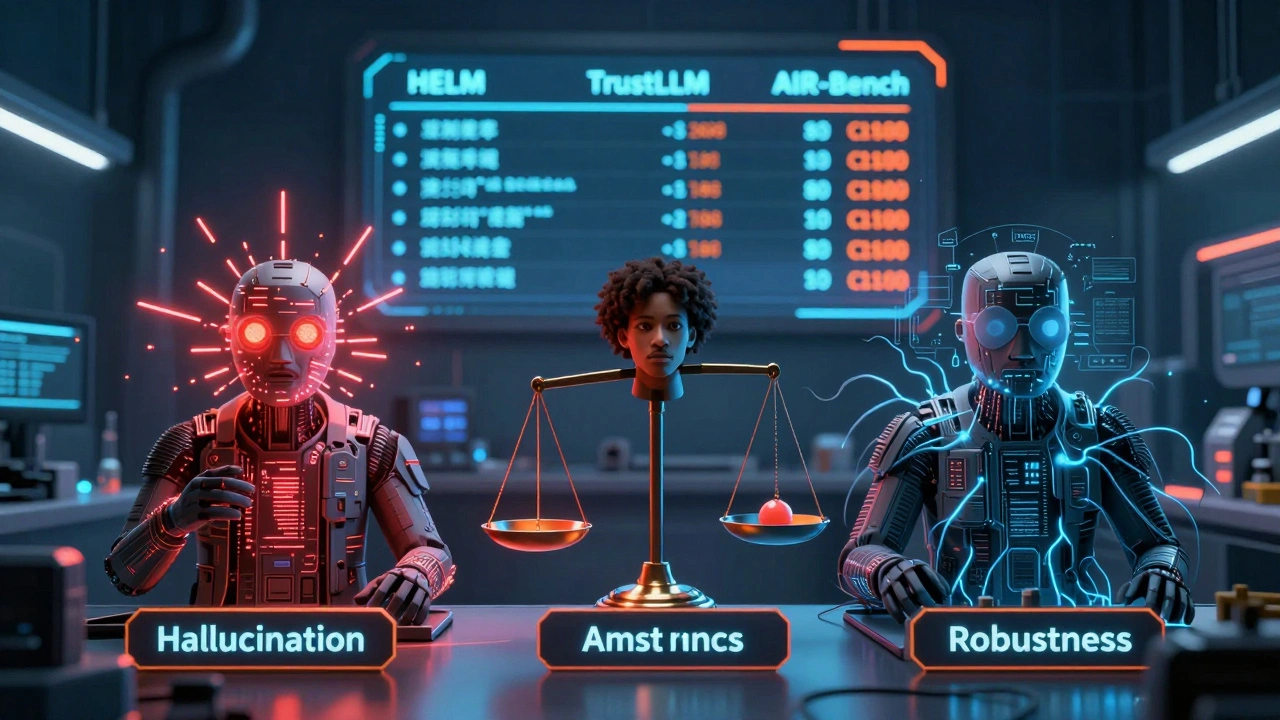
Three core risks dominate the testing:
- Hallucinations: When the model makes up facts, sources, or events that never happened. A medical AI claiming a rare disease has a cure that doesn’t exist? That’s a hallucination. And it’s deadly.
- Bias: When the model treats people differently based on race, gender, age, or location. A hiring tool that consistently rejects resumes from women? That’s bias baked into the training data.
- Robustness: How well the model holds up under deliberate attacks. Hackers feed it tricky prompts to bypass safety filters. Can it resist? Or does it spill secrets, generate illegal content, or obey harmful instructions?
These aren’t theoretical concerns. In 2024, a financial chatbot used by a major bank hallucinated a fake investment strategy that led to $2.3 million in losses. In 2025, a public service AI in Europe denied emergency aid to applicants with non-Western names-because its training data was skewed. And in late 2025, researchers showed that a single carefully crafted prompt could trick three leading models into revealing parts of their training data.
The Leading Benchmarks in 2026
There’s no single test. Instead, there are several specialized frameworks, each with strengths and blind spots.
HELM (Holistic Evaluation of Language Models) from Stanford is the most comprehensive. It runs over 5,694 test cases across 314 risk categories. It doesn’t just check if a model says something wrong-it checks how often, in what context, and how severe the error is. HELM scores are normalized from 0 to 1. Models scoring above 0.85 are considered safe for enterprise use. But it’s expensive: running HELM on one model takes 3-4 weeks and costs around $85,000 in cloud compute.
TrustLLM was built by 45 research institutions, mostly in the U.S. It covers six safety dimensions: truthfulness, safety, fairness, robustness, privacy, and ethics. It uses over 30 datasets and is especially strong at catching subtle bias and privacy leaks. One healthcare company used TrustLLM to find a hallucination pattern that occurred in 0.7% of rare disease queries. That’s low-but in medicine, 0.7% can mean misdiagnoses for hundreds of patients.
AIR-Bench 2024 is the most regulatory-aligned. It maps 92% of its tests directly to the EU AI Act and U.S. Executive Order 14110. It evaluates four risk domains: cybersecurity, content safety, societal harm, and legal rights. If you’re building an AI for Europe or the U.S. government, AIR-Bench isn’t optional-it’s compliance.
BBQ (Bias Benchmark for QA) zooms in on bias. It tests 10 protected categories like race, religion, and disability. It’s simple, focused, and widely used for quick checks. But it won’t catch jailbreaks or hallucinations.
MITRE ATLAS is the cybersecurity side. It’s based on the same framework used to track hacking tactics. It lists 34 specific techniques attackers use to break AI systems-like poisoning training data or exploiting model APIs. It doesn’t cover ethics or bias, but if your AI talks to real systems (like bank APIs or hospital records), ATLAS is critical.
What Benchmarks Can’t Catch
Here’s the uncomfortable truth: benchmarks are lagging behind the models they’re supposed to test.
Researchers at Stanford and Berkeley found that small tweaks to how prompts are phrased can make a model’s safety score jump by 40%. That doesn’t mean the model got safer. It just means it learned to game the test. This is called “benchmark gaming.” Companies can optimize their models to pass the tests without fixing the underlying risks.
Worse, benchmarks test models in isolation. Real-world AI doesn’t operate alone. It’s connected to databases, user inputs, other AI systems, and human decisions. Dr. Rumman Chowdhury from Accenture says current benchmarks capture only 30-40% of real-world risks because they ignore the interaction layer. A model might refuse to generate hate speech in a lab test-but when paired with a customer service bot that misreads user tone, it might escalate conflict anyway.
And then there’s the “latent capability” problem. A model might never hallucinate during testing. But give it a multi-turn conversation, a hidden trigger phrase, or a chain of subtle instructions-and suddenly, it reveals dangerous knowledge it was never meant to have. Red teaming-where ethical hackers try to break the system-is becoming just as important as benchmarking.
Who’s Using These Benchmarks-and Why
By early 2026, 78% of Fortune 500 companies using foundation models had adopted at least one safety benchmark. But adoption varies wildly by industry.
- Financial services: 82% adoption. Why? Regulatory fines for bias or fraud are massive. A model that recommends risky loans to one demographic over another? That’s a class-action lawsuit waiting to happen.
- Healthcare: 76% adoption. A hallucinated diagnosis isn’t just a mistake-it’s a death sentence. TrustLLM and HELM are now standard in FDA submissions for AI diagnostic tools.
- Enterprise software: 63% adoption. These companies use AI for internal tools, customer service, and content moderation. They care about reputation and legal exposure.
Smaller companies? Most can’t afford HELM. They use BBQ for quick bias checks or rely on NIST AI Risk Management Framework (RMF) 1.1, which gives them a process-not a score-to follow. NIST doesn’t test the model. It tells you how to set up monitoring, track drift over time, and document decisions. It’s slower, but it’s practical.
The Hidden Costs of Benchmarking
Running these tests isn’t cheap. It’s not just compute power-it’s people.
You need:
- A team of 2-3 senior ML engineers who understand prompt engineering and adversarial testing
- A legal and compliance officer to map results to regulations
- A product manager to decide what to fix-and what to accept as risk
And the timeline? Most companies take 3-6 months to go from zero to a working benchmarking pipeline. The first two months are spent setting up governance: who owns the results? Who gets to override a safety flag? What happens if a model fails a test but the business says it’s “critical”? That’s where most projects stall.
Then there’s the documentation problem. HELM and NIST have clear guides. But newer benchmarks like the Combinatorial Safety Benchmark for Multimodal Models? Their documentation is still incomplete. You’re left figuring it out yourself-on a deadline.
What’s Next: Continuous Safety, Not One-Time Tests
The next big shift isn’t better benchmarks. It’s continuous safety.
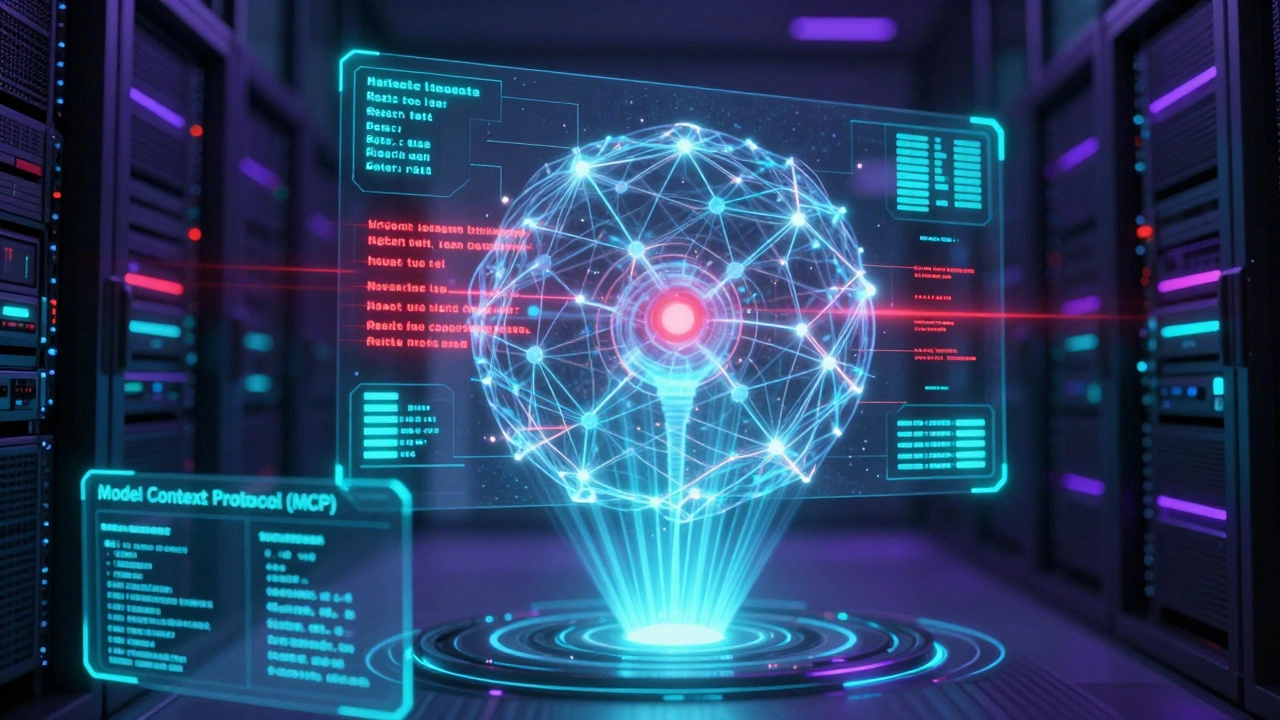
By mid-2026, the Model Context Protocol (MCP) is starting to roll out. It’s not a test. It’s a safety layer built into the AI’s connection to real-world tools. Think of it like a seatbelt that auto-deploys every time the AI interacts with a database or API. It doesn’t wait for a quarterly test. It blocks risky actions in real time.
Companies like Cranium AI and SaferAI are building systems that monitor models 24/7-tracking hallucination rates, bias drift, and attack attempts as they happen. If a model starts generating more false medical claims, the system flags it before the next user even sees it.
And regulators are catching up. The AI Safety Institute Consortium now requires minimum coverage across 12 risk domains for any model deployed in high-risk sectors. By 2027, safety won’t be a checkbox. It’ll be a live dashboard-updated hourly, audited weekly, and reported monthly.
Bottom Line: Benchmarks Are the Floor, Not the Ceiling
Passing a benchmark doesn’t mean your AI is safe. It means it passed a test. Real safety comes from culture, process, and constant vigilance.
If you’re building or buying foundation models in 2026, here’s what you need to do:
- Start with AIR-Bench or NIST RMF if you’re in a regulated industry.
- Use TrustLLM if you need deep bias and privacy checks.
- Run HELM on your flagship models-but don’t rely on it for rapid iteration.
- Combine benchmarks with red teaming. Always.
- Build continuous monitoring into your deployment pipeline. No more “set it and forget it.”
The AI safety race isn’t about who has the most powerful model. It’s about who can prove theirs won’t hurt people. And right now, benchmarks are the only language that matters.
What’s the difference between hallucination and bias in AI?
Hallucination is when an AI makes up information-like claiming a historical event happened when it didn’t, or inventing a fake medical treatment. Bias is when an AI treats people unfairly based on characteristics like race, gender, or location-like rejecting job applications from women more often than men. One is about lying; the other is about discrimination.
Can AI safety benchmarks prevent all harmful outputs?
No. Benchmarks catch known risks based on current test cases. But AI models can develop new harmful behaviors that haven’t been tested yet. That’s why red teaming-where ethical hackers try to break the system-is essential. Benchmarks are a starting point, not a finish line.
Why do some companies still fail even after passing benchmarks?
Because benchmarks test models in controlled environments. Real-world use involves messy human inputs, connected systems, and unexpected interactions. A model might pass all tests but still be jailbroken through a multi-turn conversation or exploited via a third-party API. Benchmarks don’t simulate chaos-they simulate a lab.
Are AI safety benchmarks required by law?
Yes, in some places. The EU AI Act and U.S. Executive Order 14110 require safety testing for high-risk AI systems. In healthcare and finance, regulators expect proof of benchmarking before deployment. But enforcement varies. The benchmarks themselves aren’t always mandated-but the outcomes they measure (like bias or hallucination rates) often are.
How much does it cost to run AI safety benchmarks?
Running the full HELM suite costs about $85,000 in cloud compute and takes 3-4 weeks. Smaller benchmarks like BBQ or AIR-Bench can cost under $5,000 and run in days. But the real cost is labor: you need skilled engineers, legal experts, and project managers to interpret results and act on them.
What’s the future of AI safety testing?
The future is continuous monitoring. Instead of quarterly tests, models will be watched in real time as they operate. Systems like the Model Context Protocol (MCP) will block risky actions on the fly. Safety won’t be a milestone-it’ll be a constant feedback loop built into every AI deployment.