Capital Allocation Calculator
Scenario Planning Tool
Calculate your optimal strategic cash reserve based on economic uncertainty scenarios
Buyback Optimizer
Determine if your stock is undervalued for buybacks
Capex Assessment Tool
Evaluate projects using strategic capital allocation filters
Key Insights
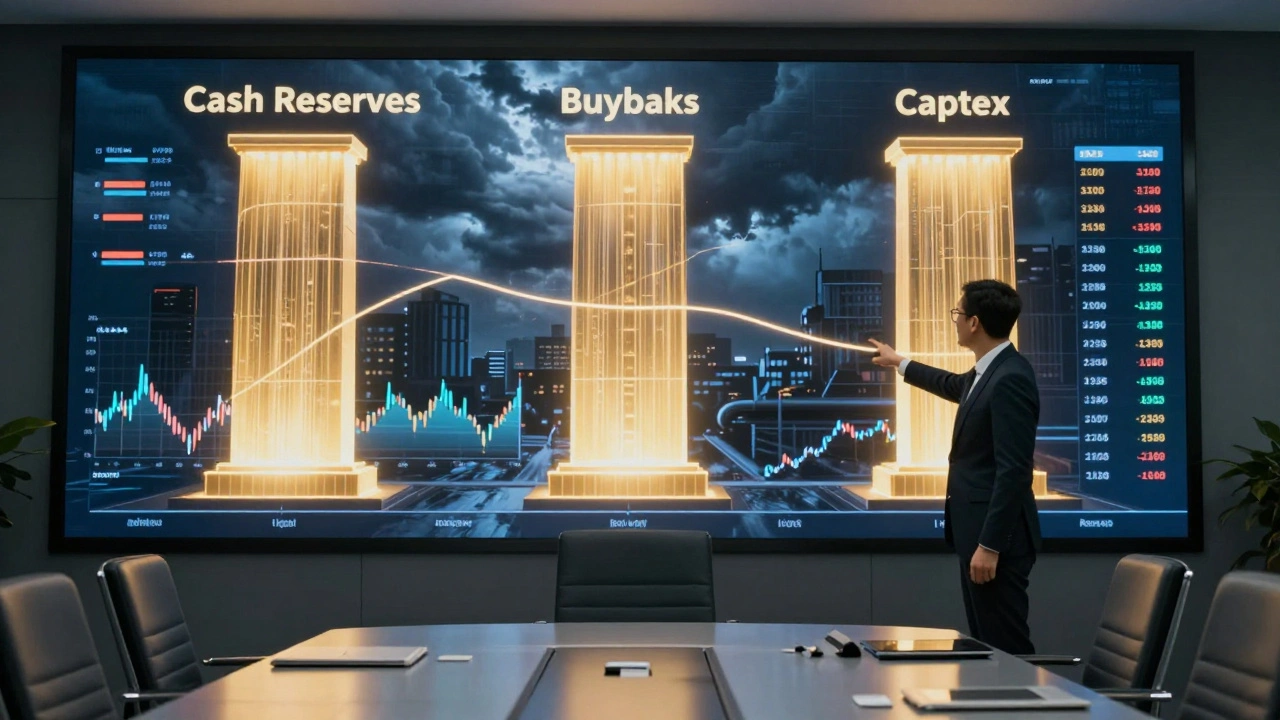
Smart companies allocate capital systematically across three pillars: strategic cash reserves, disciplined buybacks, and capex discipline. This tool helps you evaluate your current allocation against these principles.
When the economy feels like it’s spinning out of control - interest rates jumping, supply chains breaking, inflation flaring up - what do you do with your company’s cash? Most leaders panic. They either hoard cash like it’s gold, or they throw it at everything hoping something sticks. But the best companies? They don’t react. They allocate.
Capital allocation during uncertainty isn’t about guessing the future. It’s about building a system that works no matter what happens. And that system has three pillars: strategic cash reserves, disciplined share buybacks, and ruthless capex discipline. Get these right, and you don’t just survive volatility - you outperform it.
Why Cash Isn’t Just Sitting There
Companies today are holding more cash than ever. Morgan Stanley found that corporate cash balances as a percentage of revenue have jumped over one-third since 2019. But here’s the problem: 67% of those companies couldn’t fund all their planned projects in 2020, even with all that cash on hand. That’s not prudence. That’s mismanagement.
Strategic cash isn’t about keeping money in a checking account. It’s about structuring liquidity so it’s available when you need it - and earning a return while it waits. Global firms with operations in 10+ countries don’t just pile cash in New York. They use notional pooling, multi-currency concentration accounts, and targeted repatriation rules to keep cash where it’s needed and reduce FX risk. Bank of America says companies that automate these processes cut funding shortfalls by up to 40% during supply chain shocks.
Think of cash like oxygen in an airplane. You don’t need it all at once. But if you lose pressure at 30,000 feet, you better have masks ready. Smart companies set cash targets based on scenario planning: What if rates spike 2%? What if a key supplier goes dark? What if a country freezes capital outflows? They don’t wait for disaster to strike. They build buffers for each possible scenario.
Buybacks: The Discretionary Trap
Share buybacks are the most misunderstood tool in corporate finance. Investors love them. CEOs love them. But they’re also the most volatile form of capital return - Morgan Stanley found buyback volatility is nearly six times higher than dividends. Why? Because companies treat them like discretionary bonuses, not commitments.
When times are good, they buy back shares. When things get rough, they pause. That creates a terrible cycle: stock prices fall, management says “we’re preserving cash,” and investors lose confidence. The best allocators do the opposite. They set a fixed annual buyback budget - say, 3% of market cap - and stick to it through up and down cycles. That signals discipline. It builds trust.
And here’s the kicker: buybacks should only happen when the stock is undervalued. Not because it’s cheap today, but because the company’s intrinsic value is higher than the market says. Goldman Sachs’ investment team warns: “Don’t adjust your portfolio based on rare market events.” That applies to buybacks too. If you’re buying back shares at $50 because the market crashed, but your company’s true value is $80, you’re creating long-term value. If you’re buying at $50 because you’re scared of a recession, you’re just hiding.

Capex Discipline: Stop Investing in Ghosts
Capital expenditures used to be the engine of growth. Now, they’re the graveyard of ambition. BCG’s research shows companies that over-invest in low-return projects - especially in mature markets - destroy shareholder value faster than almost anything else. Yet 80% of CFOs admit their capital allocation processes need improvement.
The fix? Stop judging projects by IRR alone. That metric is broken in uncertain times. A 15% IRR on a plant in Mexico might look great - until tariffs hit, labor costs double, and the project gets delayed by 18 months. Instead, top performers use three filters:
- Strategic fit - Does this project strengthen our core competitive advantage?
- Market tailwinds - Are we investing in a growing market, or one that’s fading?
- Capital efficiency - Can we get the same outcome with less spending? Can we lease instead of buy? Can we partner instead of build?
Companies like Rio Tinto use central investment committees that meet monthly, not weekly. They bundle decisions. They force tradeoffs. If you want to spend $200M on a new mine, you have to give up another $200M elsewhere. That’s how you avoid the “egalitarian trap” - where every division gets a little, and nothing gets enough.
And don’t ignore intangibles. Morgan Stanley found that companies now spend 13.4% of sales on intangible investments - software, R&D, branding, talent - up from 10.2% in 1970. That’s not fluff. That’s the new capex. A company that spends $100M on AI tools to reduce supply chain waste is investing more wisely than one spending $150M on a factory that might be obsolete in five years.
The Framework That Works
The best capital allocators don’t wing it. They follow a repeatable framework:
- Define your strategic portfolio - What businesses are you in? Which ones are core? Which are non-core? Assign each a capital allocation priority.
- Set guardrails - Minimum cash buffer? Max buyback %? Capex ceiling? These aren’t suggestions. They’re rules.
- Use governance - Create a small, independent committee (not the CFO alone) that reviews all major capital decisions. Their job? Say no.
- Measure outcomes, not inputs - Don’t track how much you spent. Track how much value you created. Did the new warehouse cut logistics costs by 18%? Did the software reduce customer churn? If not, why did you spend?
Companies that follow this approach are 3x more likely to outperform their peers on total shareholder return, according to BCG. And here’s the surprise: they don’t need to be giants. A mid-sized manufacturer in Ohio with $500M in revenue used this exact model to increase its cash return by 22% in 18 months - without taking on debt or selling assets.

The Cost of Getting It Wrong
When capital allocation fails, the damage isn’t obvious at first. It shows up in slow growth, declining margins, and investor frustration. The real cost? Lost opportunity.
Consider this: in 2023, over 56% of CFOs said their capital allocation strategy needed a complete overhaul. Why? Because they spent too much on low-return projects, held too much cash with no plan, and used buybacks as a smoke screen instead of a strategy. The result? Shareholders got tired of waiting. They sold. Stock prices dropped. The company became a takeover target.
And the irony? The companies that failed were often the ones with the strongest cash flows. They had the resources. They just didn’t have the discipline.
What Comes Next
The future of capital allocation isn’t just about surviving uncertainty. It’s about using it as leverage. ESG isn’t just a buzzword anymore - it’s a capital filter. Companies that factor in carbon cost, supply chain ethics, and workforce resilience are seeing better returns. Why? Because investors now see sustainability as a risk mitigator, not a charity.
Automation is another game-changer. Treasury systems that auto-rebalance cash across currencies, flag liquidity gaps, and simulate stress scenarios are no longer luxury tools. They’re table stakes. Companies that still use Excel sheets and manual forecasts are already behind.
And the biggest shift? Investors are starting to reward companies that say no. That’s right. When management says, “We’re not spending on that project because it doesn’t fit our strategy,” shareholders cheer. Because they know that discipline beats desperation.
Capital allocation in uncertain times isn’t about predicting the future. It’s about building a system so strong, it doesn’t need prediction. It’s about knowing what to keep, what to cut, and what to double down on - no matter what the headlines say.