Climate Disclosure Compliance Calculator
Company Profile
Required Disclosures
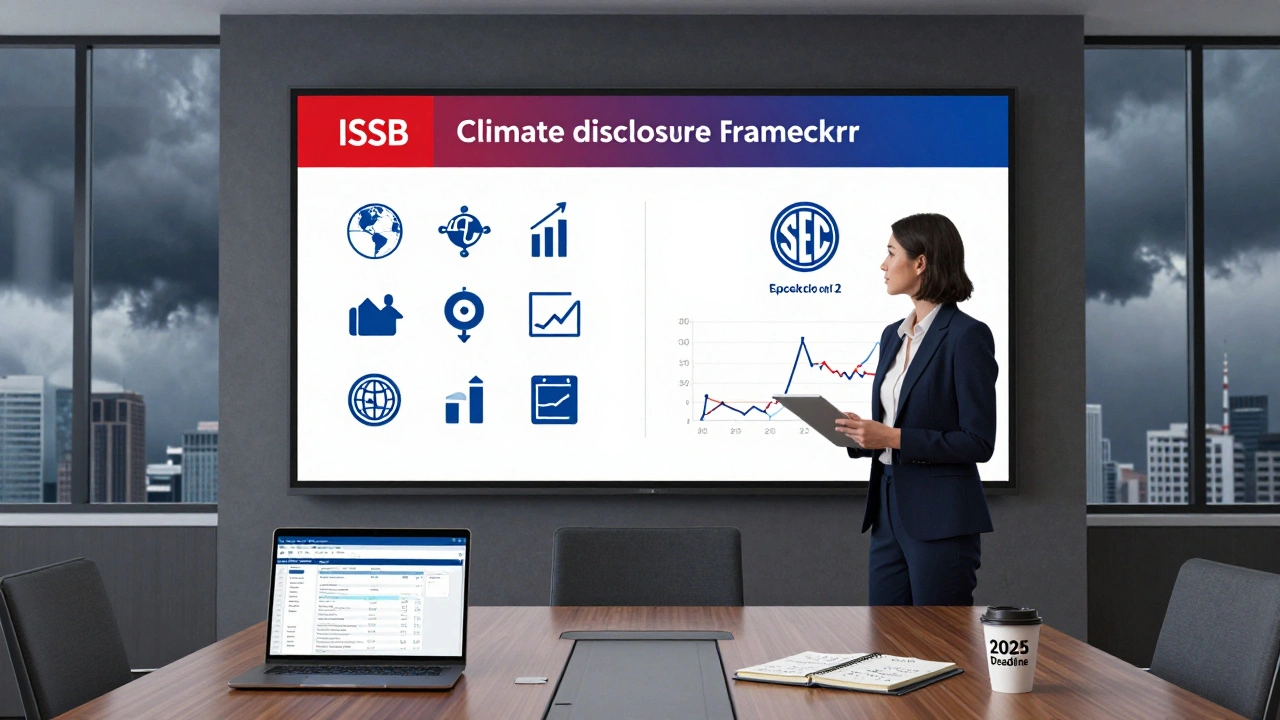
Companies today aren’t just reporting profits-they’re being asked to show how climate change could hit their bottom line. If you’re managing financial reporting, investor relations, or sustainability strategy, you’re likely facing a new reality: climate risk disclosure is no longer optional. Two major rules now drive what you need to report: the ISSB standards (International Sustainability Standards Board standards, launched in July 2023, providing global baseline requirements for sustainability disclosures) and the SEC climate rule (U.S. Securities and Exchange Commission final rule issued March 6, 2024, mandating climate-related disclosures for public companies). Both demand clear, measurable, and decision-useful data-but they’re not the same. And getting it wrong could mean regulatory penalties, investor distrust, or missed capital opportunities.
What You Must Disclose Under the SEC Rule
The SEC’s final rule, effective for fiscal years starting in 2025, isn’t asking for general environmental updates. It’s demanding specific, material information tied to financial outcomes. For large accelerated filers (LAFs)-think big public companies with over $700 million in market value-this means reporting four core areas:
- Climate-related risks: Physical risks like floods or wildfires disrupting operations, and transition risks like policy changes or shifting consumer demand.
- Board oversight: How your board monitors climate risks. Do they get regular briefings? Is climate risk part of board agendas?
- Management’s role: Who’s responsible for managing these risks? Is there a dedicated team? Are climate goals tied to executive compensation?
- Climate targets: Any science-based or internal goals that affect financial performance-like net-zero pledges or emissions reduction targets.
And here’s the kicker: if those targets impact revenue, costs, or asset values, you must explain how. A company that’s shifting away from fossil fuels and seeing lower sales from old products? That’s material. A plant in Florida getting damaged by hurricanes? That’s material too. The SEC doesn’t want vague promises. It wants numbers that show real financial exposure.
GHG Emissions: Scope 1 and 2 Are Mandatory (For Most)
One of the biggest changes from the proposed rule? Scope 3 emissions are no longer required. That’s a relief for many companies. Scope 3 covers emissions from your supply chain, customers, product use, and disposal-often the hardest to measure. The SEC recognized that inconsistency in data quality would hurt comparability. So now, only Scope 1 (direct emissions from your owned sources) and Scope 2 (indirect emissions from purchased electricity, heat, or steam) must be disclosed-if material.
But "material" isn’t a free pass. If your emissions are significant to your business, you report them. For LAFs and accelerated filers, that means most will have to report. The rule allows flexibility in how you calculate them: you can use the GHG Protocol, or if your country requires a different method (like Japan’s or China’s), you can use that instead. You just have to say which one you used.
And here’s something many miss: you don’t have to report emissions in your annual 10-K. You can put Scope 1 and 2 data in your second-quarter Form 10-Q for the year after the emissions occurred. That gives you breathing room to collect, verify, and clean up the numbers.
Financial Statement Disclosures: It’s Not Just About Emissions
Climate isn’t just an ESG footnote anymore. The SEC requires disclosures in your financial statements themselves. That means footnotes. That means audit scrutiny.
- If a wildfire destroyed a warehouse, and the loss was $10 million, you must disclose it.
- If you bought carbon offsets or renewable energy certificates (RECs), you must say how much you paid and what they cover.
- If a climate target affects your depreciation schedule or inventory valuation, you must explain how.
You don’t need to break it down line by line. If the total impact is 1% or more of pretax income or shareholders’ equity, you report it. Below that? You can skip it. This de minimis threshold prevents clutter while keeping the focus on what truly matters financially.
Assurance and Attestation: The Audit Trap
Here’s where many companies stumble: assurance. The SEC doesn’t require full audits of climate disclosures right away. But it does require a phased-in attestation process for Scope 1 and 2 emissions.
- For LAFs: Limited assurance required by fiscal year 2028 (six years after the rule).
- For accelerated filers: Limited assurance required by fiscal year 2029.
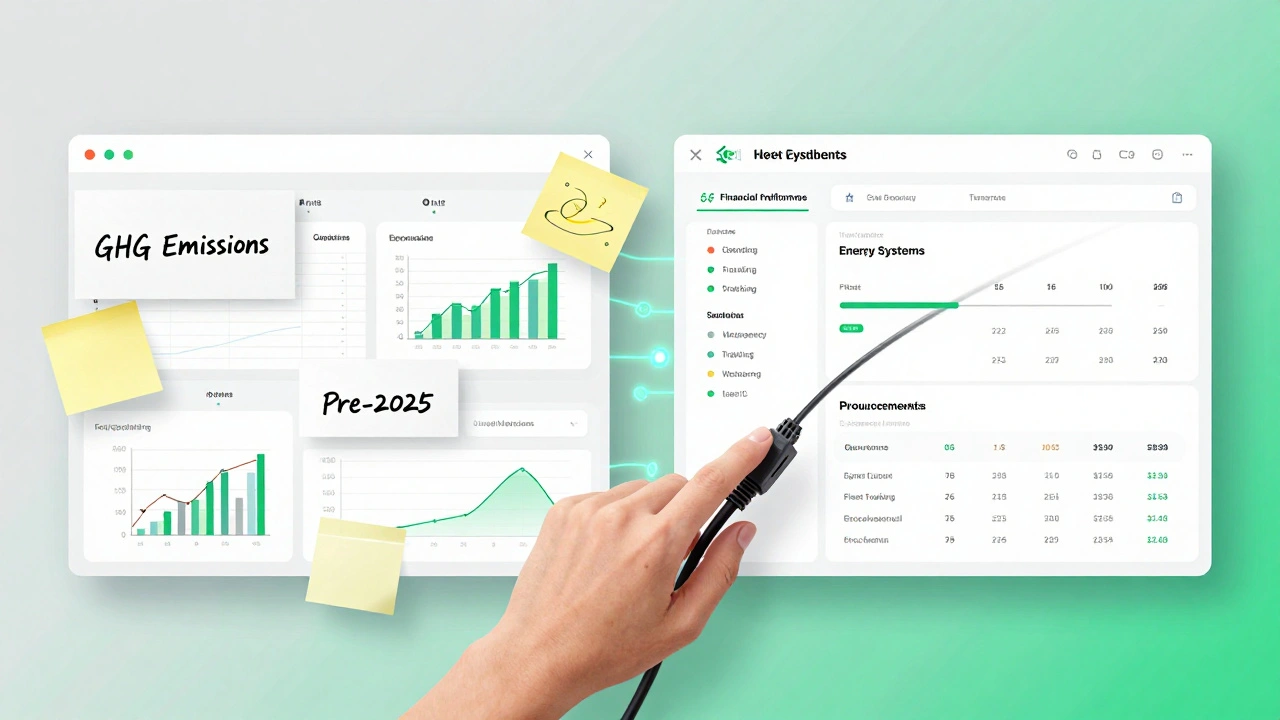
What does "limited assurance" mean? Your auditor reviews your data collection process and gives a "reasonable basis" opinion-not a full audit. But it still means your internal controls over emissions data must be solid. If your team is still using spreadsheets from 2020, you’re at risk. Start building systems now. Integrate emissions data into your financial close process. Train your finance team. This isn’t sustainability’s job anymore-it’s finance’s.
ISSB vs. SEC: Similar, But Not Interchangeable
Both ISSB and SEC rules are built on the same foundation: governance, strategy, risk management, and metrics and targets. That’s good news. If you’re already reporting under ISSB’s IFRS S2, you’re 70% there.
But here’s where they split:
| Requirement | ISSB (IFRS S2) | SEC Final Rule |
|---|---|---|
| Scope 3 Emissions | Required if material | Not required |
| Assurance | Required for all disclosures | Only for Scope 1 and 2 emissions (phased) |
| Financial Statement Impact | Disclosed in notes | Disclosed in notes with 1% threshold |
| Reporting Format | Standalone sustainability report | Integrated into 10-K or 20-F |
| Geographic Scope | Global (adopted in 36 jurisdictions) | U.S. registrants only |
ISSB pushes for broader coverage. SEC pulls back on Scope 3 and limits assurance. If you’re a multinational, you’ll need both. But if you’re a U.S.-only company, SEC is your only mandatory path. Don’t assume ISSB compliance covers you.

What About California and the EU?
California’s SB-261 law required companies to report climate financial risks by January 1, 2026. But a court injunction paused enforcement. Still, the state’s Air Resources Board (CARB) confirmed that companies can use IFRS S2 as a compliant framework. That’s a signal: even in mandatory states, global standards are becoming the default.
Meanwhile, the EU’s Corporate Sustainability Reporting Directive (CSRD) is far more demanding. Companies under CSRD must report on everything-from biodiversity to labor practices-and get full assurance on all disclosures. If you’re operating in Europe, you’re already ahead of the curve. But if you’re also listed in the U.S., you’re now juggling three systems: CSRD, ISSB, and SEC. The good news? The core structure is similar. Build a single data engine, and you can output different reports for each regulator.
Decision-Useful Data: The Real Goal
Neither the SEC nor ISSB wants a box-ticking exercise. They want data that helps investors decide where to put their money. That means:
- Be specific: "We’re reducing emissions" isn’t enough. "We cut Scope 2 emissions 32% from 2023 to 2025 by switching to 100% renewable electricity in all U.S. facilities" is.
- Be consistent: Use the same methodology year to year. If you change it, explain why.
- Be transparent: If your data has gaps, say so. Investors trust honesty more than polished numbers.
Companies that treat this as a compliance chore are setting themselves up for trouble. Those that treat it as a strategic tool-using the data to identify cost savings, new markets, or resilience opportunities-are gaining investor confidence and better access to capital.
What Should You Do in 2026?
Here’s a practical roadmap:
- Map your obligations: Are you a LAF, AF, SRC, or foreign issuer? Your deadlines vary. Know which ones apply.
- Integrate data systems: Connect your energy, fleet, and procurement data to your financial reporting platform. Stop manual spreadsheets.
- Train your finance team: They need to understand GHG protocols, materiality thresholds, and audit expectations.
- Start assurance prep: Even if you’re not required until 2028, begin internal controls now. Test your data flows.
- Don’t wait for perfect data: Report what you have. Improve next year. Investors expect progress, not perfection.
The clock is ticking. For calendar-year companies, 2025 filings are already being prepared. If you haven’t started, you’re behind. And if you’re still waiting for a "cleaner" rule? The SEC isn’t going to soften it. The world is moving toward transparency. The question isn’t whether you’ll report-it’s whether you’ll report well.
Do I have to report Scope 3 emissions under the SEC rule?
No. The SEC’s final rule does not require disclosure of Scope 3 emissions, even if they’re material. This was a major change from the proposed rule, made in response to industry concerns about data reliability and comparability. Companies may still choose to report Scope 3 voluntarily, but they are not obligated to do so under SEC rules.
What’s the difference between ISSB and SEC reporting formats?
ISSB standards require a standalone sustainability report, often published separately from financial filings. The SEC requires climate disclosures to be integrated directly into annual reports (Form 10-K for U.S. companies or Form 20-F for foreign issuers). This means SEC disclosures are legally part of financial filings and subject to audit, while ISSB reports are not.
Can I use the GHG Protocol for SEC reporting?
Yes. The SEC explicitly allows companies to use the GHG Protocol Corporate Standard for measuring Scope 1 and Scope 2 emissions. You can also use alternative methods if required by your jurisdiction, as long as you disclose which method you used and why.
Are small companies exempt from SEC climate disclosure rules?
Yes. Small reporting companies (SRCs), emerging growth companies (EGCs), and non-accelerated filers (NAFs) are exempt from disclosing Scope 1 and Scope 2 GHG emissions. However, they must still disclose all other climate-related information, including risks, governance, and targets. They are not exempt from the full rule-just the emissions data requirement.
How does the SEC rule treat carbon offsets and RECs?
The SEC requires companies to disclose the use of carbon offsets and renewable energy certificates (RECs) in their financial statements if they’re used to meet climate targets or reduce emissions. You must report the quantity purchased, cost, and how they relate to your emissions reduction goals. These cannot be used to claim emissions reductions unless they meet strict criteria, and they must be clearly separated from actual operational reductions.
What happens if I don’t comply with the SEC climate rule?
Non-compliance can lead to SEC enforcement actions, including fines, delisting from exchanges, or investor lawsuits. More importantly, missing disclosures erodes investor trust. Many institutional investors now screen for climate reporting quality. Companies that fall behind risk losing access to capital, facing higher borrowing costs, or being excluded from ESG-focused funds.