Climate Disease Risk Calculator
Input the current average temperature in your location and how much it has increased. This calculator shows how climate change affects disease transmission and mosquito activity.
Climate change isn’t just about hotter summers and stronger storms-it’s rewriting the map of disease risk.
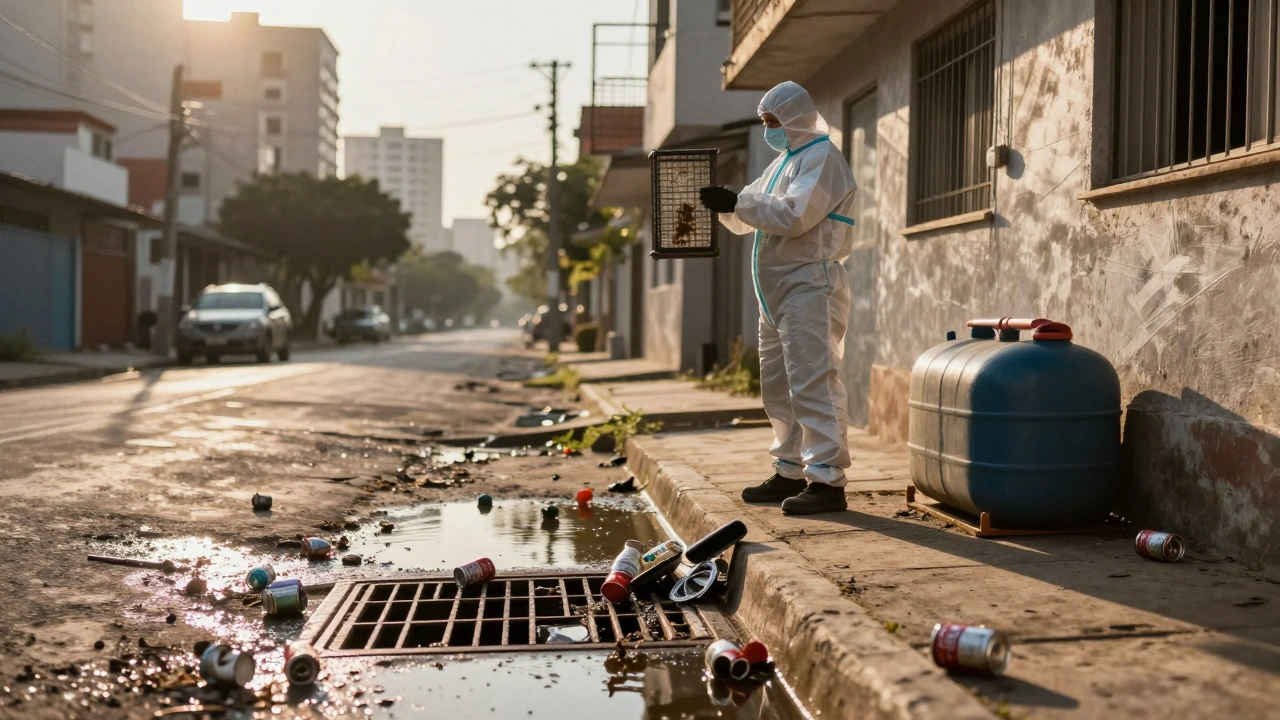
Five years ago, dengue fever was rare in Buenos Aires. Today, local health clinics are reporting cases that started right in the city’s suburbs. No one brought it in from abroad. The mosquitoes that carry the virus-Aedes aegypti-are now breeding year-round in urban water tanks, storm drains, and even discarded soda cans. This isn’t an anomaly. It’s a pattern repeating across Latin America, southern Europe, and parts of the U.S. Southwest. Climate change is making places that were once too cold for disease-carrying mosquitoes suddenly perfect breeding grounds.
It’s not just mosquitoes. Floods in Bangladesh are turning farmland into open sewers. In the Amazon, deforestation and erratic rains are creating stagnant pools where malaria-carrying mosquitoes thrive. Meanwhile, thawing permafrost in the Arctic is releasing ancient bacteria and toxins into water supplies, triggering outbreaks of illnesses never seen before in those regions. These aren’t distant threats. They’re happening now-and they’re spreading faster than health systems can keep up.
How rising temperatures turn mosquitoes into deadly machines
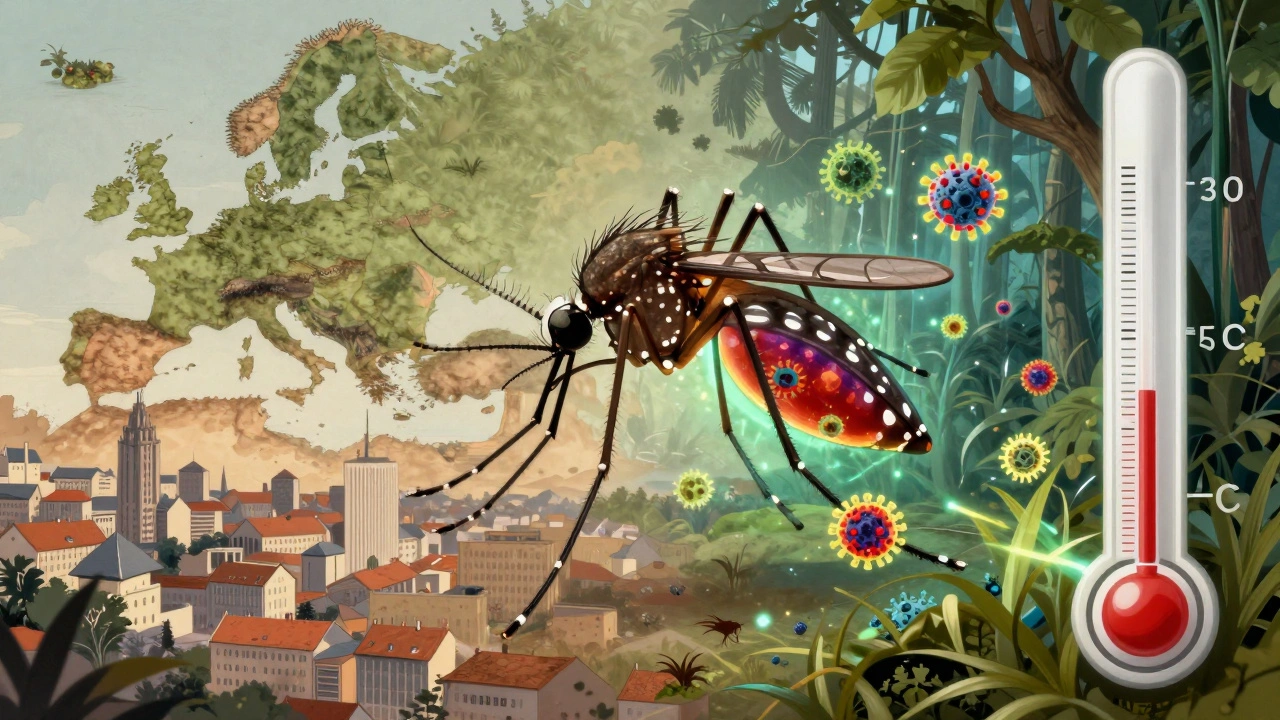
It takes more than just heat to make a mosquito dangerous. It takes the right temperature for the virus inside it to multiply. For the dengue virus, that threshold is 16°C. Once it hits that mark, the virus starts replicating inside the mosquito. Every extra degree speeds it up-by about 15% per 1°C rise. That means a mosquito that used to take 12 days to become infectious now does it in 10. And because warmer weather extends the mosquito season, they’re biting longer and more often.
In Europe, mosquito activity used to be limited to late summer. Now, in countries like Italy, Spain, and France, they’re active for six to seven months a year. The Asian tiger mosquito, Aedes albopictus, has spread to 17 European countries since 2000. Back then, it was in just three. The same trend is happening in the U.S. Southeast and Southwest. Albuquerque, where I live, hasn’t had a local dengue case yet-but neighboring states like Texas and Florida are seeing them every year. The climate is shifting under our feet.
And it’s not just dengue. Chikungunya and Zika are following the same path. Even malaria, once thought to be under control in temperate zones, is creeping back. Anopheles mosquitoes-the ones that carry malaria-are now surviving winters in the highlands of East Africa and southern parts of Europe. The World Health Organization warns that without action, we could see malaria return to places that haven’t had it in decades.
Water-borne diseases are rising with every flood and drought
Climate change doesn’t just bring more rain-it brings more chaos. Some places drown. Others dry up. Both scenarios make water-borne diseases worse.
Floods wash sewage into drinking water. After the 2024 monsoon floods in Bangladesh, waterborne illness rates jumped 68%. In the Amazon, communities saw a 45% spike in malaria cases between 2020 and 2024, tied directly to record deforestation and rainfall shifts. Floods don’t just carry bacteria-they carry despair. A 2024 study found that flood exposure led to 3.42 infant deaths per 1,000 births in Africa-more than double the rate from long-term exposure to unsafe water.
But droughts are just as dangerous. When water is scarce, people store it in open containers-tubs, barrels, buckets. These become perfect breeding sites for mosquitoes. In places like Kenya and India, droughts have led to more dengue outbreaks than floods. It’s a cruel paradox: too much water kills, and not enough water kills too.
And then there’s the Arctic. Permafrost is thawing at four times the global average rate. Ancient bacteria, trapped for thousands of years, are waking up. Antibiotic-resistant strains are emerging. Heavy metals and hormone-disrupting chemicals are leaching into rivers. People in northern Canada and Siberia are reporting strange new illnesses-rashes, neurological symptoms, kidney problems. No one knows exactly what’s in the water anymore. But they know it’s not safe.
The systems meant to protect us are falling behind
We have the science. We know where outbreaks are likely to happen. Climate-based models can predict dengue and cholera outbreaks with 78-85% accuracy by tracking temperature, rainfall, and past cases. But only 28 countries have integrated these tools into their health systems. Most of them are in Europe and East Asia.
In low-income countries, the gap is brutal. The Global Vector Hub, which tracks over 1,200 mosquito species, has just 45 staff members covering 180 countries. Outbreak data from places like Chad or Papua New Guinea can take six to eight weeks to reach global databases. By then, the outbreak is already spreading.
Health workers in Argentina told Reddit users they spent 37 days diagnosing their first local dengue case because no one had ever seen it before. In rural Bangladesh, 82% of people said they had no clean water or medical care during flood season. These aren’t failures of medicine-they’re failures of preparedness.
The European Centre for Disease Prevention and Control has a climate-health unit. The U.S. CDC has a climate and health program. But in 83% of African and Southeast Asian nations, there’s nothing even close. When the next flood hits, or the next heatwave spikes mosquito numbers, there’s no early warning. No surge capacity. No vaccines ready to deploy.
Money is flowing-but not nearly enough
The global market for climate-resilient health infrastructure grew from $8.7 billion in 2020 to $14.3 billion in 2025. That sounds like progress. But it’s a drop in the ocean compared to the $247 billion annual cost of vector-borne diseases alone. Dengue costs the Americas $2.1 billion a year in healthcare and lost productivity. Cholera outbreaks in refugee camps cost millions in emergency response.
Gavi, the Vaccine Alliance, has spent $860 million since 2021 on vaccines for malaria and other climate-sensitive diseases. That’s a good start. But it covers only 17% of the $5 billion annual need identified by the WHO. Most of that money goes to vaccines, not to fixing water systems, removing breeding sites, or training local health workers.
Meanwhile, the Climate Risk Index 2026 names St. Vincent and the Grenadines, Grenada, Chad, Papua New Guinea, and Niger as the five countries hit hardest by climate disasters-and all of them are seeing sharp increases in disease outbreaks. They’re not the biggest polluters. They’re the ones paying the highest price.
What’s next? The numbers don’t lie
By 2050, climate change could expose an extra 2.25 billion people to mosquito-borne diseases. That’s nearly a third of the world’s population. Sub-Saharan Africa will see an 87% increase in risk. South Asia will jump 73%. By 2040, the land area at high risk for disease outbreaks will grow from 9.3% to 14.7%-adding another 1.8 billion people to the danger zone.
Even if we limit warming to 2°C-something we’re not on track to do-these trends won’t reverse. They’ll keep climbing. The only question is how many people will get sick before we act.
It’s not too late-but time is running out
We can’t stop climate change overnight. But we can stop it from killing more people. That means investing in three things: early warning systems, clean water access, and community-based surveillance.
Every country needs real-time mosquito tracking. Every town needs storm drains cleaned and water storage covered. Every health clinic needs training to recognize diseases they’ve never seen before. And every government needs to treat climate-sensitive diseases like the emergencies they are-not as side effects of a bigger problem, but as the core threat they are.
The science is clear. The data is there. The tools exist. What’s missing is the will to use them before the next outbreak hits.
What are the most common climate-sensitive diseases?
The most common are mosquito-borne diseases like dengue, chikungunya, Zika, and malaria, and water-borne diseases like cholera, typhoid, and leptospirosis. These illnesses spread more easily when temperatures rise, rainfall patterns shift, or flooding occurs. Recent data shows dengue cases have expanded into southern Europe and parts of the U.S., while cholera outbreaks are increasing after extreme weather events in Africa and South Asia.
How is climate change making mosquitoes more dangerous?
Warmer temperatures speed up the life cycle of mosquitoes and the viruses they carry. For example, a 1°C rise in temperature can shorten the time it takes for the dengue virus to develop inside a mosquito by 15%. Warmer weather also extends the mosquito season-from 3-4 months to 6-7 months in places like southern Europe. This means more bites, more infections, and outbreaks in places that used to be too cold for mosquitoes to survive.
Can climate change bring back diseases that were eliminated?
Yes. Malaria was eliminated from many temperate regions in the 20th century. But now, Anopheles mosquitoes are surviving winters in southern Europe and East African highlands. The same is true for tick-borne diseases like Lyme disease, which has expanded its range by 35% in North America and Europe since 2010 due to warmer winters and longer active seasons for ticks.
Why aren’t we better prepared for these outbreaks?
Most health systems were built for stable climates. They lack real-time surveillance, trained staff, and funding for climate-specific responses. Only 28 countries use climate-based outbreak prediction models. In low-income regions, it can take 6-8 weeks to report an outbreak. By then, it’s often too late. Funding for prevention is also far below what’s needed-Gavi’s $860 million since 2021 covers only 17% of the WHO’s estimated annual need.
What can communities do to reduce risk?
Communities can eliminate standing water-empty containers, clean gutters, cover water tanks. Install window screens, use insect repellent, and wear long sleeves in high-risk areas. Local governments should prioritize clean water access and stormwater management. Training health workers to recognize new symptoms is critical. In Bangladesh, communities that cleaned water storage saw a 40% drop in cholera cases. Small actions, scaled up, save lives.
What comes next
If you live in a region where mosquitoes are now active year-round, check your home for standing water. Talk to your local health department about surveillance programs. Push for funding to improve water infrastructure. If you’re in a place that’s still safe-don’t assume it will stay that way. Climate change doesn’t respect borders. The next outbreak could start just over the next ridge, the next river, the next state line. The only way to stop it is to act before it hits.