Net-Zero Delay Calculator
Impact of Delayed Climate Action
The International Energy Agency states: "Delay by five years? The cost doubles. Delay by ten? It becomes unachievable." See how your delay affects the transition.
The IEA's Net Zero Pathway
According to the IEA's Net Zero by 2050 roadmap:
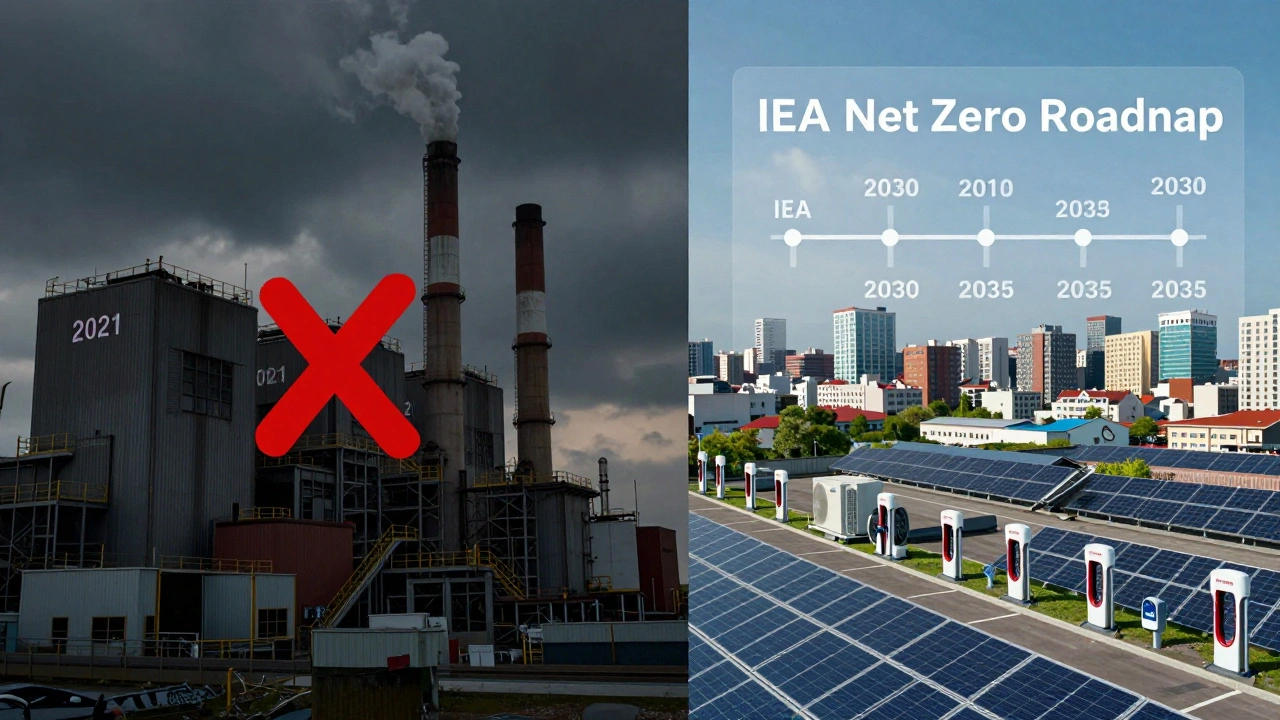
- 2030: Advanced economies must stop coal use
- 2035: All electricity from zero-emission sources
- 2040: Global coal phaseout
- 2050: Global net-zero
Without immediate action, we risk passing the 1.5°C threshold by 2027. The window for climate action closes in just 4 years.
The world is at a tipping point. Countries have pledged to reach net-zero emissions by mid-century, but no single nation can do it alone. The International Energy Agency (an autonomous intergovernmental organization established in 1974 as a specialized agency of the Organization for Economic Co-operation and Development (OECD)) has stepped into the role of global coordinator - not as a regulator, but as the trusted source of data, strategy, and shared accountability. Its mission today isn’t just about oil supplies anymore. It’s about making sure the entire global energy system transforms in time to keep warming below 1.5°C.
From Oil Crisis to Climate Crisis
The IEA was born in 1974 after the oil shock. Its original job? Keep the lights on during supply disruptions. Back then, the focus was on oil reserves, emergency sharing, and price stability. Fast forward to 2026, and the agency has completely reinvented itself. It now tracks everything from solar panel installations in rural India to hydrogen pipelines in Germany. Its annual World Energy Outlook reports are read by ministers, CEOs, and central bankers - not because they’re pretty, but because they’re the most accurate picture we have of where energy is headed.
Under Executive Director Fatih Birol, the IEA didn’t just tweak its mandate. It rebuilt it. The 2022 "IEA 3.0" update formally added three new pillars: accelerating clean energy transitions, strengthening energy security beyond oil, and tracking critical minerals like lithium, cobalt, and nickel. These aren’t afterthoughts. They’re the backbone of wind turbines, electric vehicles, and batteries. Without them, net zero is impossible.
The Net Zero Roadmap: A Global Blueprint
In May 2021, the IEA dropped its landmark report: Net Zero by 2050: A Roadmap for the Global Energy Sector. It wasn’t just another study. It was a call to action with deadlines. No vague promises. No "we’ll try." Just hard numbers.
- By 2030, advanced economies must stop using coal for power. The rest of the world has until 2040.
- No new oil, gas, or coal fields can be approved after 2021. Existing ones? They’re on a countdown.
- By 2035, every single unit of electricity must come from zero-emission sources - wind, solar, nuclear, hydro.
- Half of all heating in homes and buildings must come from heat pumps by 2030.
- 90% of heavy industry must have reached the end of its investment cycle - meaning old, polluting plants are retired.
This isn’t fantasy. It’s physics. The IEA didn’t invent these targets. It mapped them from real-world engineering, cost curves, and carbon budgets. The roadmap shows that net zero is possible - but only if we act now. Delay by five years? The cost doubles. Delay by ten? It becomes unachievable.
Three Scenarios, One Truth
The IEA doesn’t just give you one path. It gives you three - and the difference between them is stark.
- Stated Policies Scenario (STEPS): What happens if governments stick to what they’ve already passed into law. This path leads to 2.7°C of warming by 2100. Dangerous.
- Announced Pledges Scenario (APS): What if countries actually meet their public promises - even the ones not yet law. This gets us to 2.1°C. Still too high.
- Net Zero Scenario (NZE): The only path that keeps warming below 1.5°C. It requires immediate, massive, coordinated action. This is the one the IEA pushes.
These aren’t guesses. They’re built on real data from over 150 countries. Every wind farm, every coal plant closure, every EV sold - it’s all tracked. The IEA’s database is the most complete energy dataset on Earth. Governments use it to check if they’re on track. Investors use it to decide where to put money. Companies use it to plan their supply chains.
Who Gets More Time? Who Pays?
The roadmap doesn’t treat every country the same. It recognizes a basic truth: rich nations built the climate crisis. They have the money, the tech, and the infrastructure. So they have to move faster.
Advanced economies like the U.S., EU members, Japan, and Canada must hit net zero by 2050 - or earlier. Emerging economies like India, Indonesia, and Brazil get a little more breathing room. But here’s the catch: they can’t just copy-paste the Western model. They need tailored support.
This is where the Clean Energy Transitions Programme (CETP) comes in. The IEA doesn’t just hand out reports. It works directly with six key countries - Brazil, China, India, Indonesia, Mexico, and South Africa - and entire regions like Southeast Asia and Africa. It helps them design policies, train engineers, build grids, and avoid the mistakes made elsewhere. It’s not charity. It’s smart strategy. If these countries keep building coal plants, the whole world fails.
The Money Problem
The IEA can tell you what to do. But it can’t force banks to lend. And that’s the biggest gap.
The transition needs $4 trillion a year in clean energy investment. Right now, we’re at about $1.5 trillion. The rest? It’s stuck. Why? Because most financial institutions still fund fossil fuels.
Take Barclays and BlackRock. Both have announced "net-zero commitments." But internal documents show they still finance coal expansion. They don’t require companies to have credible transition plans. They don’t cut off loans when a utility keeps building gas plants. That’s not alignment. That’s contradiction.
The IEA’s position is clear: if you’re financing a coal plant that won’t close by 2040, you’re betting against the future. The agency says financial institutions must make net-zero alignment mandatory - not optional. No more "we’re working on it." Just stop funding what the science says must end.
Why does this matter? Because fossil fuel plants last 30-40 years. If you finance a new gas plant today, you’re locking in emissions for decades. That’s carbon lock-in. And it’s the reason the IEA says we can’t afford any new fossil fuel projects after 2021.
The Hidden Work: Data, Tracking, Accountability
Most people think the IEA just writes reports. But its real power is in tracking. Every month, it updates its data on:
- How many solar panels were installed in Brazil?
- How much coal did Poland retire?
- Did China’s EV sales meet its target?
- Are heat pumps replacing gas boilers in Germany?
This isn’t just for show. It’s used to hold governments accountable. When a country says it’s on track but the IEA data shows it’s falling behind, that’s a problem. It’s public. It’s undeniable. And it forces action.
The IEA also tracks critical minerals. Who’s mining lithium? Where are the bottlenecks? Which countries are dominating supply chains? This helps prevent new dependencies - like the ones we had with oil. The transition can’t be built on new monopolies.
What’s Next?
The 2023 update to the Net Zero Roadmap didn’t change the goals. It made them sharper. With updated climate science, the window for action got narrower. The IEA now says we need to peak global emissions by 2025 - just four years from now. That’s not a suggestion. It’s a requirement.
Member countries are starting to act. The EU has passed laws to ban new gas boilers. The U.S. is using tax credits to accelerate wind and solar. India is building the world’s largest solar park. But progress is uneven. Some countries are moving fast. Others are dragging their feet.
The IEA’s job isn’t to punish. It’s to equip. It gives governments the tools to make better decisions. It shows investors where the money should go. It tells companies what’s coming. And it reminds everyone: if we don’t act together, no one wins.
What is the IEA’s main role in the net-zero transition?
The IEA doesn’t enforce rules. Instead, it provides science-based roadmaps, tracks global progress, and gives member countries data-driven policy advice. It coordinates efforts by showing what’s working, what’s falling behind, and what needs to change - all based on real-world data from over 150 countries.
Do IEA member countries have to follow the Net Zero Roadmap?
No, they’re not legally bound. But the roadmap is the most credible global standard for net zero. Countries that ignore it risk falling behind on energy security, economic competitiveness, and climate goals. Many use it as the basis for their own national policies.
Why can’t we build new oil and gas fields after 2021?
Because every new field locks in emissions for 30-40 years. To stay below 1.5°C, we can’t add any new fossil fuel infrastructure. The IEA’s analysis shows that existing fields, if operated responsibly, can meet global demand until they’re phased out. Building new ones would make net zero impossible.
How does the IEA help developing countries?
Through the Clean Energy Transitions Programme (CETP), the IEA works directly with six key emerging economies - Brazil, China, India, Indonesia, Mexico, and South Africa - and regions like Africa and Southeast Asia. It provides technical analysis, policy design help, training, and access to global expertise so these countries can leapfrog fossil fuels instead of repeating past mistakes.
What’s the biggest obstacle to the net-zero transition?
The biggest obstacle isn’t technology or cost. It’s finance. Too many banks and investors still fund fossil fuel expansion, even while claiming to support net zero. Without forcing financial institutions to align their lending with science, the transition will stall - no matter how many solar panels are installed.
Final Thought
The IEA doesn’t have a police force. It doesn’t control budgets. It doesn’t sign treaties. But it has something more powerful: credibility. When the IEA says a path is impossible, countries listen. When it says a target is achievable, governments act. In a world full of empty promises, it’s the one institution that holds up a mirror - and shows us exactly where we stand.