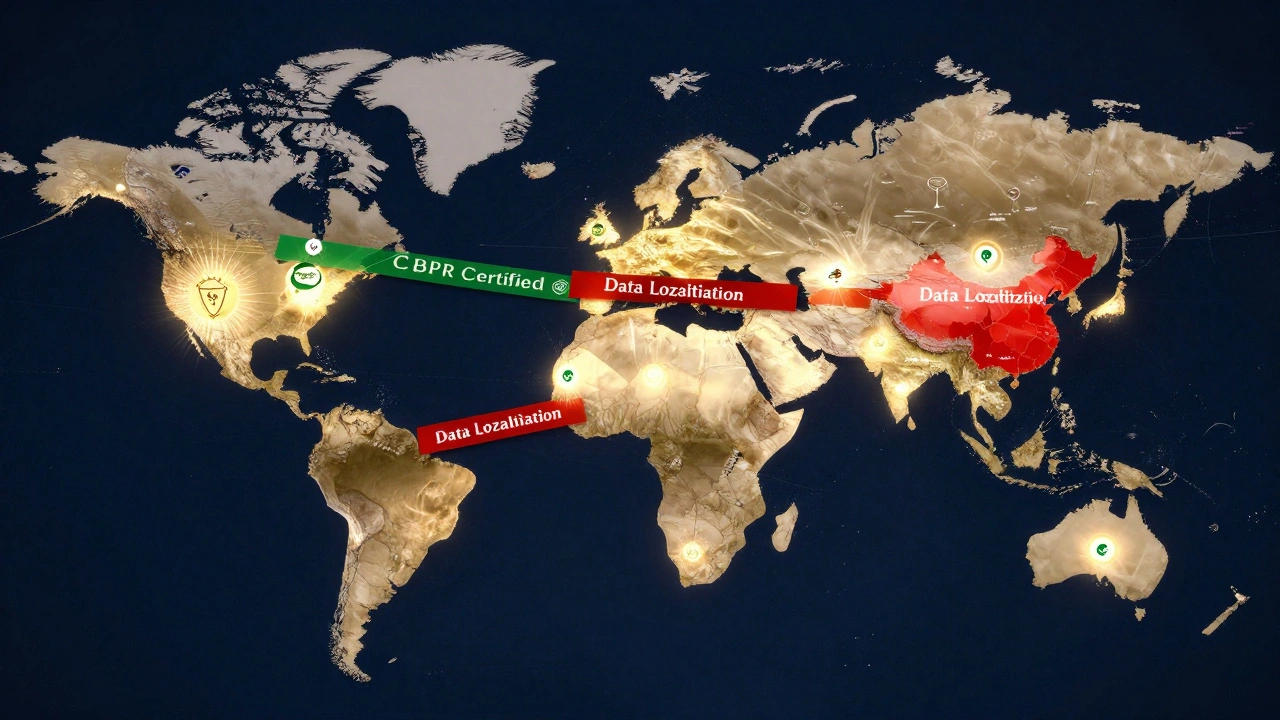
Data Localization Cost Calculator
Your Business Profile
CBPR Certification Status
Estimated Compliance Costs
CBPR Advantage
With CBPR certification, your costs could be reduced by 0% while maintaining compliance with data localization requirements in 0 APEC countries.
Legal Tangle Risk
Without CBPR certification, you face Low risk of legal conflicts when transferring data between 0 regions that have conflicting data rules.
By 2026, companies trying to move data across borders are caught in a legal maze. One country says they must store customer data locally. Another demands access to that same data under its own law. Meanwhile, a third insists the data can flow freely. This isn’t science fiction-it’s daily business for any company selling digital services overseas. The rules around where data can go, who can see it, and how it’s protected have turned into one of the biggest friction points in global trade today.
Why Data Localization Isn’t Just About Privacy
Many governments claim data localization laws are about protecting citizens’ privacy. But the real story is more complicated. Take China’s Personal Information Protection Law (PIPL), India’s Digital Personal Data Protection Act (DPDPA), or Russia’s Federal Law No. 242-FZ. These laws don’t just ask companies to store data locally. They give domestic authorities broad access to it. In some cases, foreign companies must hand over data to local regulators even if doing so breaks privacy rules in their home country. This isn’t about security. It’s about control. When a country forces data to stay within its borders, it also forces companies to build local data centers, hire local staff, and follow local audits. That costs money. For small startups, it’s often impossible. That means big players with deep pockets stay in the game, while new competitors get locked out. The result? Less innovation, fewer choices, and higher prices for consumers. And the numbers back this up. A study by ECIPE found that forced data localization in just one country-China-could reduce its GDP by 1.1%. Multiply that across dozens of countries with similar rules, and you’re looking at trillions in lost economic value. It’s not just about compliance. It’s about who gets to compete.The Legal Tangle: When One Law Breaks Another
Imagine you’re a U.S. tech company storing European customer data in a cloud server in Virginia. The EU’s GDPR says you can only transfer that data outside Europe if the receiving country offers "adequate" protection. But the U.S. Stored Communications Act says your company must hand over that data if a U.S. court orders it-even if that violates GDPR. This isn’t a hypothetical. It’s happened. In 2024, a German court fined a U.S. SaaS provider for failing to block U.S. law enforcement access to EU user data. At the same time, the U.S. Department of Justice sued the same company for not complying with a subpoena. The company was legally trapped. This kind of conflict is growing. Countries like Brazil and Nigeria have layered localization rules across finance, health, and telecom sectors. A bank operating in all three might need to store health records in São Paulo, financial logs in Abuja, and telecom metadata in Jakarta-all while trying to meet GDPR, CCPA, and other global standards. Each rule contradicts another. There’s no global rulebook. Just a patchwork of laws that don’t talk to each other.What’s Missing: A Common Framework
The World Trade Organization doesn’t ban data localization. But trade experts agree it’s a barrier. Without alignment, every new law adds another wall. The EU has its GDPR. The U.S. has no federal privacy law, but pushes its own standards through trade deals. Asia has a mix of strict rules and weak enforcement. Africa and Latin America are drafting their own versions. This fragmentation hurts everyone. Companies spend millions just tracking changes. A single update to India’s DPDPA in late 2025 forced 87 global firms to overhaul their data pipelines. That’s not innovation. That’s damage control. The answer isn’t more laws. It’s interoperability. The Cross-Border Privacy Rules (CBPR) is a voluntary framework developed by APEC that lets companies certify their data practices across participating economies. It’s not perfect, but it works. Companies certified under CBPR can transfer data between countries like the U.S., Japan, South Korea, Canada, and Singapore without fear of legal conflict. The U.S. Department of Commerce and the FTC have backed it for years. Now, the proposed U.S. Digital Trade Promotion Act formally endorses it as a model for future trade deals.
How Trade Deals Are Changing the Game
In February 2026, the U.S. and Indonesia signed a digital trade agreement that flipped the script. It didn’t just avoid data localization-it banned it for financial services. U.S. fintech firms can now process payments across borders without setting up local servers. The deal also removed local content rules for software and exempted digital products from import taxes. This isn’t an outlier. Similar agreements are being negotiated with Kenya, Vietnam, and Chile. They all share three things: they protect cross-border data flows, they reject forced localization, and they recognize trusted privacy frameworks like CBPR. These aren’t just trade deals. They’re blueprints for how the digital economy should work. Countries that sign these deals don’t give up sovereignty. They just choose to work within a system that keeps data moving. That’s how you stay competitive. That’s how you attract investment. That’s how you keep your startups from being crushed by compliance costs.The Real Cost: Innovation Stifled
Data localization doesn’t just hurt big companies. It kills innovation. Think about a health tech startup in Austin trying to partner with a research lab in Stockholm. If their patient data can’t flow freely, collaboration dies. A climate model built on global satellite data can’t run if each country locks its data behind local servers. AI training needs massive, diverse datasets. Localization fragments those datasets. It makes models less accurate, slower to train, and more expensive to build. Worse, localization often becomes a tool for economic nationalism. Countries use it to pressure foreign firms into building local factories, hiring local engineers, or giving up intellectual property. It’s not about privacy. It’s about control. And it’s working. In 2025, a U.S.-based AI firm pulled out of Brazil after being forced to hand over its algorithm source code to a state-owned data center. That’s not a one-off. It’s a trend.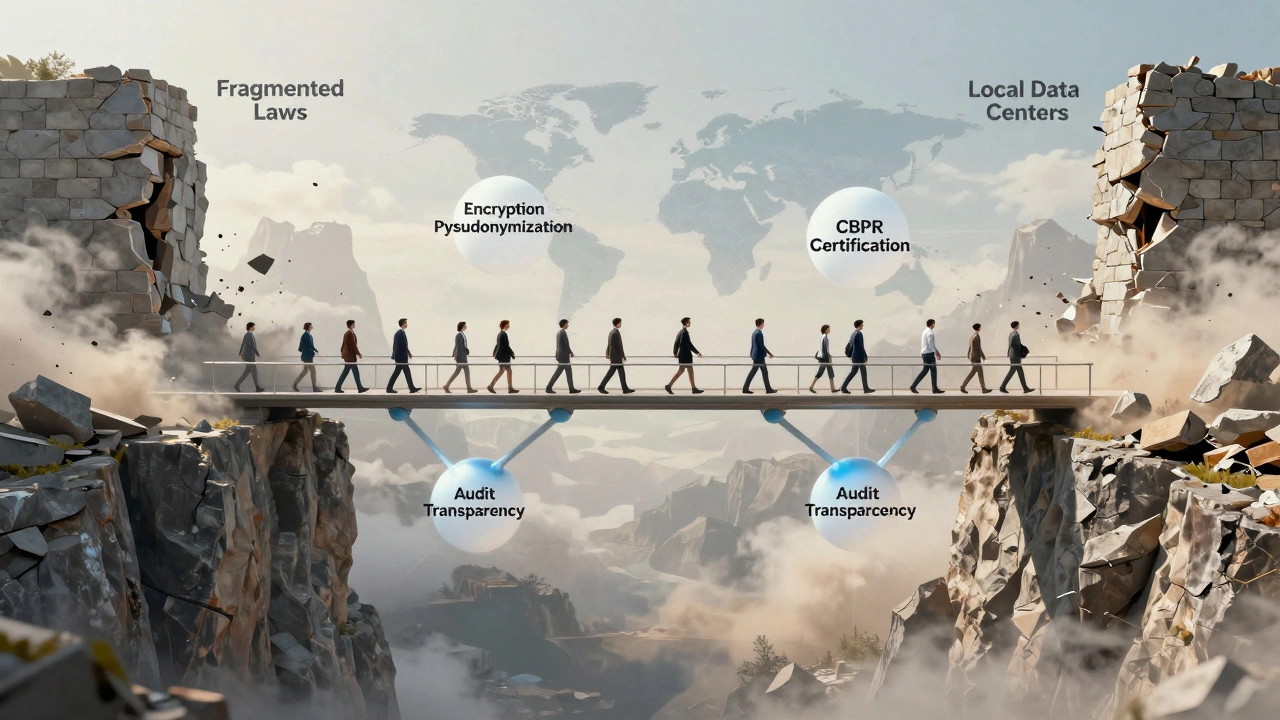
What Companies Need to Do Now
If you’re running a global business, here’s what you need to do:- Map your data flows. Know where every piece of personal data goes, who accesses it, and what laws apply.
- Classify your data. Health records, financial data, and government-related info are high-risk. Treat them differently.
- Adopt CBPR. Even if it’s voluntary, certification signals you’re serious about compliance and reduces legal risk.
- Build a regulatory intelligence system. Don’t rely on legal teams alone. Use tools that track law changes in real time across 50+ jurisdictions.
- Push back on localization. If a government demands data storage locally, ask for alternatives: encryption, pseudonymization, or certified data processors.
The Future Is Interoperable
The world won’t agree on one privacy law. But it doesn’t need to. What it needs is trust. CBPR, GDPR adequacy decisions, and bilateral trade agreements are the first steps toward a system where data flows where it’s needed-not where it’s forced to stay. The companies that win in 2026 won’t be the ones with the most local data centers. They’ll be the ones with the clearest, most transparent, and most interoperable data practices. The choice is simple: build walls and slow down, or build bridges and scale up. The global economy is already choosing.Are data localization laws actually improving privacy?
Not really. While they’re often sold as privacy protections, most localization laws give domestic authorities easier access to data. In countries with weak oversight, this often means more surveillance-not less. Real privacy comes from strong encryption, clear consent rules, and independent oversight-not from keeping data in one country.
Can I ignore data localization laws if I’m based in the U.S.?
No. If you serve customers in countries with localization laws, you’re subject to those laws-even if you’re headquartered in the U.S. Ignoring them can lead to fines, blocked services, or criminal liability for executives. The U.S. doesn’t protect you from foreign legal demands.
What’s the difference between GDPR and CBPR?
GDPR is a strict legal framework enforced by EU regulators. CBPR is a voluntary certification system that lets companies prove they follow privacy standards across multiple countries. CBPR doesn’t replace GDPR-it works alongside it. Many companies use both: GDPR for EU compliance, CBPR for global transfers.
Do data localization laws help national security?
They create the illusion of security. In reality, storing data locally doesn’t prevent hacking or spying. It just makes it easier for local governments to access it. The best security comes from strong encryption and secure systems-not geography.
Will the U.S. ever pass a federal privacy law?
It’s possible, but not soon. The focus right now is on trade policy-using CBPR and digital trade agreements to protect U.S. companies abroad. A federal law might come later, but for now, the U.S. is betting on international frameworks to manage privacy, not domestic regulation.