Back in 2022, emerging market debt (EMD) was seen as a risky bet. Strong dollar, high U.S. interest rates, and inflation fears pushed investors away. But by 2025, the story changed. EMD didn’t just recover-it became a strategic part of global portfolios. Why? Because the fundamentals shifted. Governments are spending less, inflation is falling, and yields are still attractive. For investors looking for income without taking on reckless risk, emerging market debt in 2025 is no longer a gamble. It’s a calculated move.
What’s Changed in Emerging Market Debt?
Emerging market debt isn’t one thing. It’s split into two main types: hard currency bonds (usually U.S. dollar-denominated) and local currency bonds (denominated in the country’s own money, like the Brazilian real or Indonesian rupiah). In 2024, hard currency bonds led the charge as credit spreads tightened. But in 2025, local currency bonds outperformed, returning 13.8% in USD terms through August-more than double the 8.7% from hard currency bonds.
That doesn’t mean local currency is always better. The big driver was the U.S. dollar weakening. When you strip out currency effects and look at returns in euros, local currency bonds barely moved. So the real win isn’t just the bond itself-it’s the combination of falling U.S. rates, a weaker dollar, and improving country fundamentals. That’s the sweet spot.
Fiscal Discipline Is No Longer Just a Buzzword
For years, emerging markets were criticized for running big deficits and piling up debt. In 2025, that’s changed. The average fiscal deficit across emerging markets is holding steady at 5.7% of GDP. That’s not perfect, but it’s far better than the 7-8% levels seen in the early 2020s. More importantly, government debt-to-GDP ratios are stable at around 60%. That’s not a red flag-it’s a sign of control.
What’s driving this? Countries are getting smarter. Brazil cut its primary deficit. Indonesia tightened its fuel subsidies. Ghana and Zambia restructured their debt under the G20 Common Framework, clearing the way for new investment. These aren’t one-off fixes. They’re structural changes. And investors noticed. Credit rating upgrades now outnumber downgrades for the third year in a row. That’s a trend, not a fluke.
Why Yields Are Still Attractive
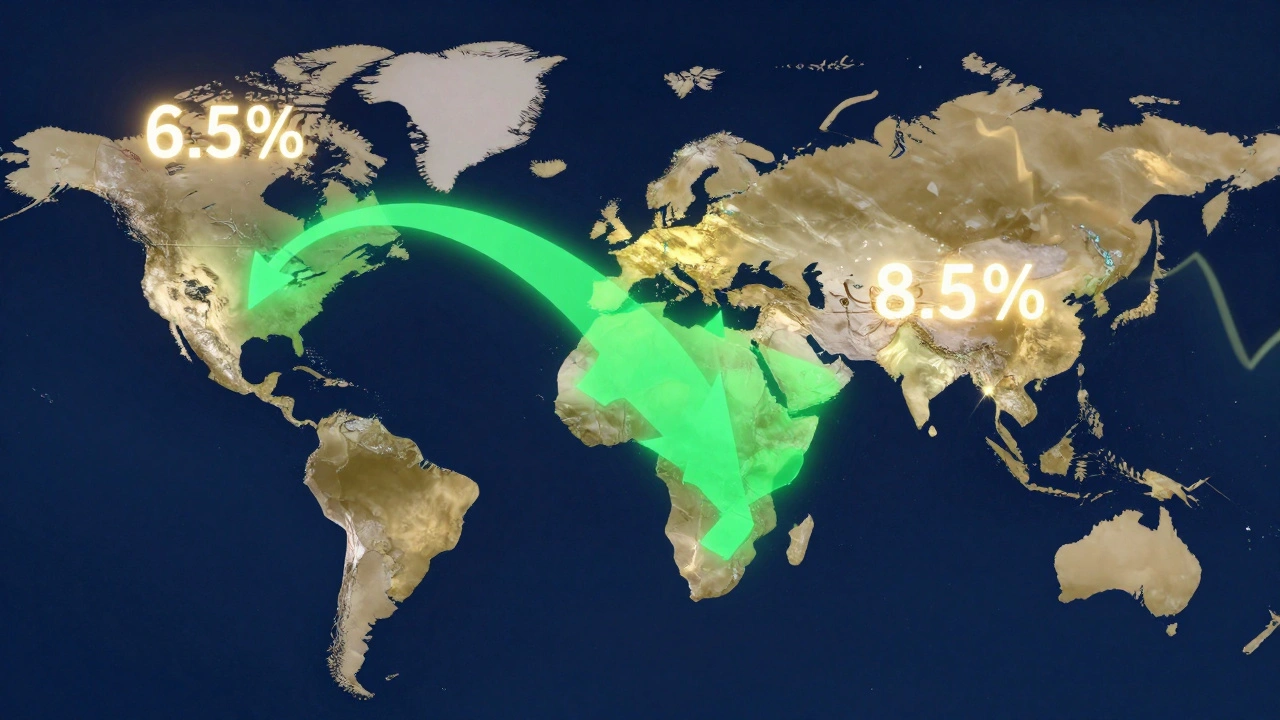
U.S. Treasury yields are falling. The Federal Reserve has started cutting rates. That’s good news for global markets-but especially for emerging markets. Why? Because when U.S. rates drop, money flows out of safe-haven assets and into higher-yielding ones. Emerging market bonds still pay more. Hard currency sovereign bonds are yielding around 6.5% on average. Local currency bonds? Often above 8%. That’s a big gap compared to U.S. 10-year Treasuries, which are hovering near 4%.
And here’s the kicker: you’re not just getting paid interest. You’re getting paid to take on less risk than before. Credit spreads-the extra yield investors demand for holding EM bonds instead of U.S. Treasuries-have compressed. That means markets believe these countries are less likely to default. In 2024, spreads tightened across the board, especially in higher-yielding sectors. In 2025, that trend continues, but now it’s backed by real fiscal discipline, not just optimism.

Local Currency vs. Hard Currency: Which One Wins?
By mid-2025, the consensus among major asset managers has shifted. J.P. Morgan gives high conviction to local currency debt and only medium conviction to hard currency credit. Why? Because local currency bonds benefit from three things at once: falling U.S. rates, a weaker dollar, and improving country fundamentals. That’s a rare combo.
But hard currency debt still has its place. It’s less volatile. It’s easier to access for investors without currency hedging tools. And in countries where local currency markets are shallow-like Nigeria or Pakistan-hard currency bonds are still the only viable option. Neuberger Berman says hard currency EM debt is back in focus because it offers “attractive yields and diversification” without the currency swings.
The smart move? Don’t pick one. Build a mix. Use hard currency for stability and local currency for higher returns. Keep your exposure balanced based on your risk tolerance and your view on the dollar.
The Bigger Picture: EMD Is Now a Core Holding
Five years ago, emerging market debt was a satellite allocation-something you tossed in if you had extra cash. Today, it’s a core holding. According to GAM’s October 2025 report, institutional investors are moving EMD from the sidelines to the center of their portfolios. The median allocation to EMD in fixed income portfolios rose from 4.2% in 2023 to 5.8% in 2025. Adoption rates jumped from 65% to 78% among institutional investors.
Why the shift? Because EMD now fits the new global reality. Developed markets are aging. Growth is slowing. The U.S. and Europe are stuck with low productivity. Meanwhile, emerging markets-especially outside China-are growing faster. The IMF projects the growth gap between emerging and developed economies will hit 2.6% in 2025. That’s not just a number. It means more tax revenue, more stable governments, and more reliable debt payments.
Even the rules are changing. Basel III reforms completed in 2024 reduced capital charges for banks holding EM sovereign debt. That means banks can hold more of it without tying up extra cash. More demand. Fewer barriers. That’s structural change.

Where the Risks Still Linger
Don’t get fooled. This isn’t a risk-free trade. The biggest threat? Higher tariffs. William Blair warns that rising trade barriers-especially from the U.S.-could hurt export-dependent economies like Mexico, Vietnam, and Turkey. A 10% tariff on Chinese goods might sound like a China problem. But it ripples through supply chains, hitting Southeast Asia and Latin America too.
Political noise is another wildcard. Franklin Templeton points out that “bombastic rhetoric” in countries like Argentina, Turkey, or South Africa can spark sudden volatility. Elections matter. Policy reversals matter. That’s why active management is key. You can’t just buy an EM bond index and call it a day. You need to pick countries with credible institutions, independent central banks, and reform momentum.
And inflation? It’s down-but not gone. If prices start creeping back up, central banks might have to pause rate cuts. That could slow the rally. The “Goldilocks” scenario-low inflation, falling rates, weak dollar-is working now. But it’s fragile.
What Should You Do in 2025?
Here’s the practical takeaway:
- Look for countries with improving fiscal discipline-Brazil, Indonesia, India, Chile. Avoid those still struggling with debt restructuring.
- Use local currency bonds for growth and yield, but hedge currency risk if you’re risk-averse.
- Keep hard currency bonds for stability and liquidity. They’re still a solid anchor.
- Don’t chase the highest yield. Focus on sustainability. A 10% yield in a country with a 7% deficit and no central bank independence is a trap.
- Consider timing. The biggest gains come when the Fed starts cutting and the dollar weakens. That’s happening now.
Emerging market debt in 2025 isn’t about hoping for a miracle. It’s about recognizing a shift. Countries are managing their money better. Inflation is under control. Yields are still high. And global investors are finally catching on. This isn’t a temporary bounce. It’s a new normal.
Is EMD Right for You?
If you’re an investor looking for yield beyond U.S. Treasuries and European bonds-without jumping into crypto or junk bonds-EMD fits. It’s not for everyone. You need patience. You need to understand that volatility is part of the game. But if you’re willing to look beyond headlines and focus on balance sheets, the returns are there.
It’s no longer about betting on emerging markets. It’s about investing in them. And in 2025, that’s a smart move.
Is emerging market debt still risky in 2025?
Yes, but less so than before. The overall risk has dropped because of improved fiscal discipline, lower inflation, and stronger growth in many countries. Credit rating upgrades now outnumber downgrades. That said, risks remain-especially from political instability, trade tariffs, and sudden currency swings. It’s not risk-free, but it’s far more predictable than it was five years ago.
Should I invest in local currency or hard currency EM debt?
It depends on your goals. Local currency bonds offered higher returns in 2025-13.8% through August-thanks to currency gains and strong bond performance. But those returns were boosted by a weaker U.S. dollar. If you expect the dollar to rebound, hard currency bonds may be safer. Hard currency bonds are also easier to access and less volatile. Most experts recommend a mix: use local currency for growth, hard currency for stability.
What’s the average yield on emerging market debt in 2025?
Hard currency sovereign bonds are yielding around 6.5% on average. Local currency bonds typically offer 8% or more. That’s significantly higher than U.S. 10-year Treasuries, which are near 4%. The yield spread reflects both the higher risk and the stronger growth potential in emerging markets.
Are emerging markets growing faster than developed countries?
Yes. The IMF projects the growth differential between emerging and developed markets will reach 2.6% in 2025, up from 2.5% in 2024. That means emerging markets are growing about 2.6 percentage points faster than the U.S. and Europe. This gap supports stronger tax revenues, lower deficits, and more stable debt markets.
What’s the biggest risk to emerging market debt in 2025?
The biggest risk is higher tariffs, especially from the U.S. Many emerging markets rely on exports. A trade war could hurt growth, weaken currencies, and increase debt stress. Political instability and a sudden return of inflation are also key risks. But the biggest danger isn’t the market-it’s ignoring country-level differences. Not all emerging markets are the same.
Can individual investors access emerging market debt?
Yes, but not directly through most brokers. Individual investors typically access EMD through mutual funds or ETFs that track benchmarks like the JPMorgan GBI-EM or EMBI Global indices. Minimum investments for direct bond purchases are usually $5 million or more, which is only for institutions. ETFs like EMB or IEMB offer exposure with as little as $100.