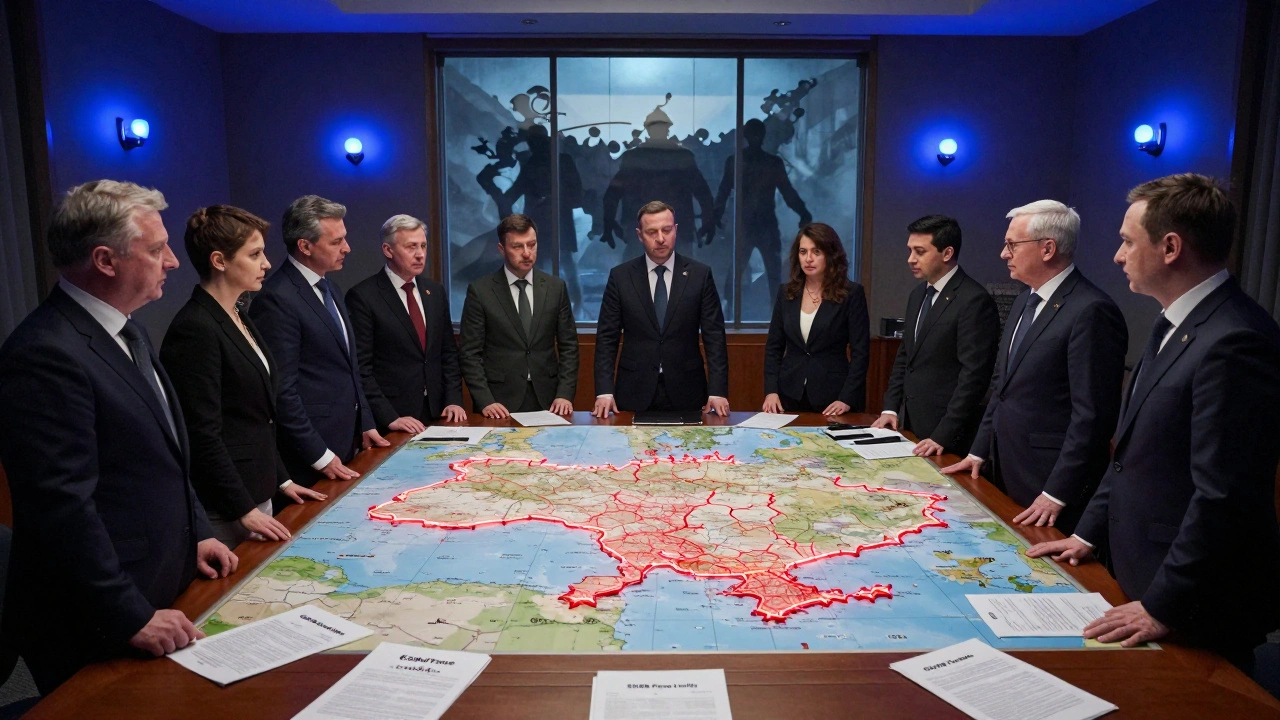
European Security Guarantees Comparison Tool
Compare the four security guarantee models for Ukraine with key metrics including costs, implementation timelines, political feasibility, and effectiveness.
Model 1: European Peace Facility
Model 2: NATO-EU Hybrid
Model 3: European Defense Union
Model 4: Frozen Russian Assets
Key Tradeoffs Summary
Cost
Model 1: €18B/year
Model 3: High treaty costs
Model 4: One-time €200B
Implementation
Model 1: Immediate
Model 3: Q3 2026
Model 2: Uncertain
Political Feasibility
Model 1: Moderate
Model 2: Low
Model 4: Low
When Russia invaded Ukraine in 2022, the world expected NATO to step in. But NATO didn’t extend membership. Instead, Europe had to build something new: European security guarantees for Ukraine. This isn’t a treaty signed in haste. It’s a complex, evolving framework shaped by money, politics, and hard choices - and it’s the only thing standing between Ukraine and another Russian attack.
What Exactly Are These Guarantees?
European security guarantees aren’t about promises. They’re binding commitments backed by real resources. After the 2023 Vilnius Summit, where NATO said Ukraine wouldn’t join anytime soon, EU leaders realized they couldn’t wait for the U.S. to act. So they built three core principles that now guide every decision:- Ukraine’s territory and sovereignty must be respected - no concessions, no trade-offs.
- Ukraine alone decides how to run its military - no outside limits on troop size or weapons.
- Ukraine chooses its own future - whether that’s the EU, NATO, or both.
The Four Models on the Table
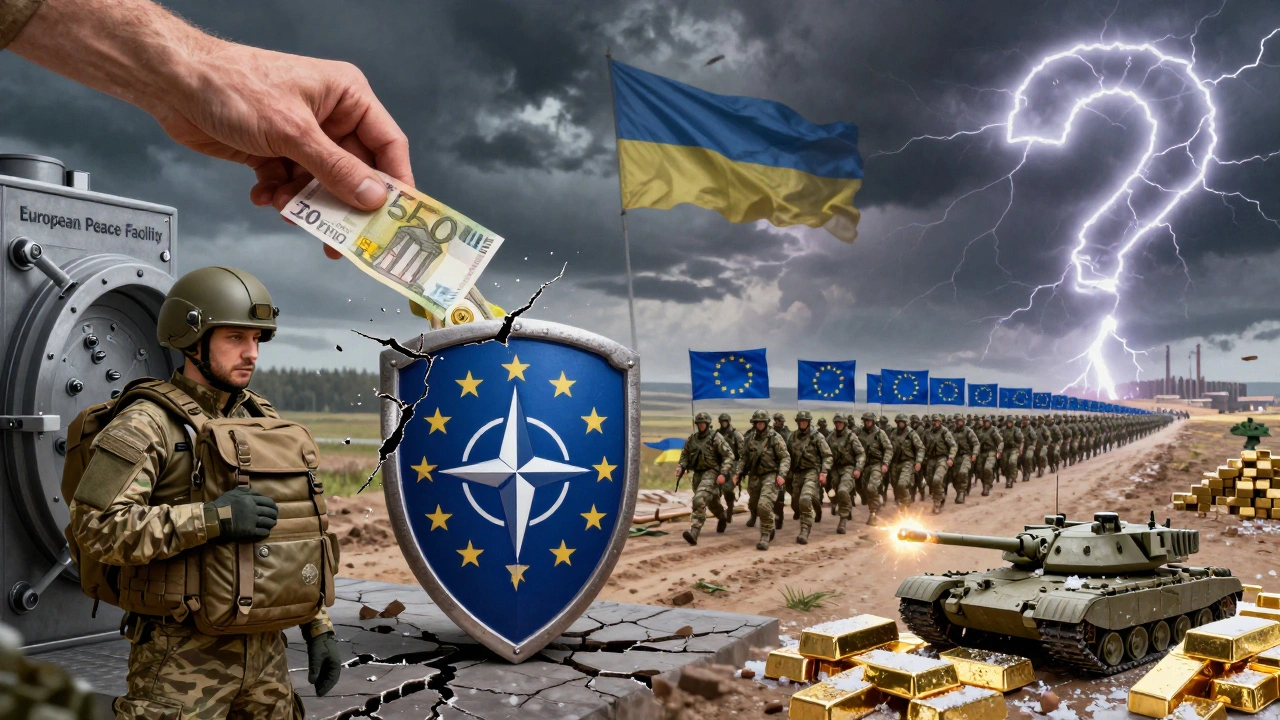
There’s no single plan. Four different models are being weighed, each with its own risks, costs, and political hurdles.Model 1: The European Peace Facility - This is the most immediate solution. The EU plans to pump €50 billion ($54.3 billion) into Ukraine’s defense by December 2025. That money buys weapons, training, and repair parts. It’s not a loan. It’s a grant. But it’s also temporary. Once the cash runs out, so does the support - unless new funding is approved.
Model 2: NATO-EU Hybrid - Imagine Article 5, NATO’s collective defense clause, applied to Ukraine. Sounds powerful. But it needs U.S. Senate approval. With a potential Trump administration in power, that’s unlikely. Even if passed, it creates legal chaos. Would Ukraine be treated like a member? What happens if it attacks a neighbor? No one has answers.
Model 3: European Defense Union - This is Europe’s most ambitious play. France and Germany want to create permanent battlegroups - 30,000 troops ready to deploy in 10 days. But this isn’t just adding soldiers. It means rewriting EU treaties. That takes time. The European Council on Foreign Relations says full implementation won’t happen until Q3 2026. Ukraine can’t wait that long.
Model 4: Frozen Russian Assets - Europe holds around €200 billion in Russian state assets seized since 2022. The idea? Use that money to fund Ukraine’s long-term defense industry - factories, missile plants, drone production. Sounds brilliant. But Russia is suing at The Hague. Legal battles could delay payouts until late 2026. And even if cleared, this money isn’t recurring. It’s a one-time boost.
Costs You Can’t Ignore
Money talks - and the bill is huge.Just keeping Ukraine’s military at 800,000 troops will cost €18 billion a year under the European Peace Facility model. The U.S. proposed $8 billion - but that was before the EU added new requirements. The gap isn’t just numbers. It’s philosophy. Europe is betting on long-term presence. The U.S. wants a quick exit.
Then there’s the hidden cost: modernization. Ukraine’s military still runs on Soviet-era tech. Integrating it with NATO systems? That’s €12 billion just for equipment upgrades. Add €7.2 billion to overhaul command and control systems - radar, communications, intelligence networks. Siemens and Thales are already working on it, with first phase delivery due by Q2 2026. But even then, there’s a 15- to 20-minute response gap compared to NATO’s 3-minute standard. That’s life or death on the front lines.
Training is another bottleneck. Germany says it can train 10,000 Ukrainian soldiers per month by 2026. Sounds good - until you do the math. To reach 800,000 troops, you need 80 months. That’s over six and a half years. Ukraine doesn’t have that time.
Why This Isn’t Like NATO
NATO works because it’s a club with teeth. Article 5 is automatic. Membership is clear. There are rules, penalties, and enforcement. European guarantees? Not so much.Chatham House found that only 37% of the drafted guarantee clauses include any penalty for violations. Compare that to NATO’s 92%. That means if Russia attacks again, Europe might have to negotiate - not retaliate. There’s no automatic response. No clear trigger. No binding obligation to defend.
And then there’s nuclear deterrence. The U.S. nuclear umbrella covers NATO members. Ukraine doesn’t have that. Russia knows it. That’s why the Kremlin says any security deal short of NATO membership is just a “gray zone” - an invitation for hybrid attacks: cyber, sabotage, energy cuts, disinformation.
Political Fault Lines
Not all EU countries are on board.Poland and the Baltics want to monetize frozen Russian assets now. Germany says wait for the International Court of Justice ruling. Hungary and Slovakia still trade energy with Russia at levels higher than before the war. That’s not just hypocrisy - it’s a vulnerability. If one member refuses to support a joint defense, the whole system cracks.
Even funding is messy. Eight EU countries need parliamentary approval for the €50 billion package. The Netherlands and Hungary are threatening to block it unless the cost-sharing formula changes. Right now, each country pays 0.12% of its GDP. That’s fine for Germany. For smaller countries, it’s a stretch. The political friction is real.
And then there’s the legal gray zone. Some experts at the Max Planck Institute warn that bypassing NATO membership could violate Article 10 of the Washington Treaty - the one that says only “European states” can join. If the EU grants Ukraine security guarantees without membership, could NATO be forced to expel members who act unilaterally? It’s a legal time bomb.
What Ukraine Wants
Polling from the European Council on Foreign Relations shows 68% of Ukrainians prefer EU security guarantees over NATO membership. Why? Because after 2014, when NATO promised “open door” but didn’t act, Ukraine learned: promises don’t stop tanks. The EU, though, has already offered membership. That’s a real path - not just a slogan.Ukraine’s EU accession process is now tied to security guarantees. Progress on Chapters 23 and 24 - judiciary and internal market reforms - depends on adopting a credible defense framework. That’s leverage. And Ukraine is using it.
The Big Picture
This isn’t just about Ukraine. It’s about Europe’s future.The November 24, 2025 summit was historic. For the first time, European leaders rejected a U.S.-led proposal outright. They said: we won’t sacrifice our principles for a quick deal. That unity - 18 countries standing together - is unprecedented.
The frozen assets, the battlegroups, the funding - none of it is perfect. But together, they’re building something new: a European security architecture that doesn’t rely on Washington. It’s slow. It’s expensive. It’s messy. But it’s real.
And if it works? It won’t just protect Ukraine. It will change the balance of power in Europe - permanently.
Are European security guarantees legally binding?
They are politically binding but lack automatic enforcement mechanisms. Unlike NATO’s Article 5, which triggers an automatic collective response, the EU’s guarantees rely on voluntary action by member states. Only 37% of drafted clauses include penalties for violations, making them weaker than formal treaties. Their strength comes from political consensus, not legal compulsion.
Can Ukraine join the EU before getting security guarantees?
Technically, yes - but in practice, no. The European Commission has made progress on Ukraine’s EU accession chapters conditional on adopting a credible security framework. Without it, negotiations on key areas like judiciary reform and internal market alignment will stall. The two processes are now interlocked.
Why not just give Ukraine NATO membership?
NATO membership requires unanimous approval from all 32 members. The U.S. and several European allies fear it would trigger direct conflict with Russia. After the 2023 Vilnius Summit, NATO agreed that membership was not feasible in the near term. European leaders then shifted focus to creating a parallel, non-NATO security framework that avoids immediate escalation.
How will frozen Russian assets be used?
The plan is to use the €200 billion in frozen Russian assets to fund Ukraine’s long-term defense industry - not to pay for weapons today, but to build factories, research labs, and production lines inside Ukraine. This would allow Ukraine to manufacture its own missiles, drones, and ammunition. Legal challenges from Russia’s Central Bank may delay disbursement until late 2026.
Is the 800,000-troop limit realistic?
It’s ambitious but achievable. Ukraine currently has around 700,000 active personnel. Reaching 800,000 requires rapid recruitment and training. Germany’s plan to train 10,000 soldiers per month by 2026 would take over three years to fill the gap. The real issue isn’t manpower - it’s equipment, logistics, and command integration. Without modernized systems, more troops don’t equal more combat power.