
FX Risk Calculator
FX Risk Impact Calculator
Calculate how exchange rate movements affect your international procurement costs and see how FX-linked contracts can protect your margins.
When you buy goods from overseas, you're not just paying for the product-you're paying for currency. One day, your supplier’s invoice is $100,000. The next month, because the dollar strengthened against their local currency, it’s only $92,000. Sounds great, right? But what if it goes the other way? What if next month, that same invoice jumps to $108,000? Suddenly, your profit margin vanishes. This isn’t speculation-it’s daily reality for companies sourcing from abroad. That’s where FX-linked supply contracts come in. They’re not fancy financial instruments reserved for big corporations. They’re practical tools any business that imports or exports can use to stop currency swings from eating into their bottom line.
Why Currency Risk Isn’t Just a Finance Problem
Most people think foreign exchange risk is something the treasury team handles. But it hits procurement, operations, and sales long before finance gets involved. Think about it: if your supplier in Vietnam suddenly raises prices because the Vietnamese dong strengthened against the dollar, you either absorb the cost or pass it to your customers. Either way, you lose. You might have locked in a great price last year. But if the exchange rate moves 15% in six months, that deal turns into a loss. According to Lumon’s research, FX volatility affects every layer of international procurement-from raw material shipping to warehouse storage to payroll for overseas staff. It’s not just about the invoice. It’s about your entire cost structure.How FX-Linked Contracts Actually Work
An FX-linked supply contract doesn’t mean you pay a fixed rate forever. It means you and your supplier agree upfront on how exchange rate changes will affect your pricing. There are three main ways this plays out.- Fixed-rate contracts: You lock in an exchange rate when the contract is signed. If the dollar weakens over the next six months, your supplier can’t raise prices just because their currency got stronger. You pay the agreed rate. Simple. Predictable. This works best when both sides trust each other and expect stable market conditions.
- Dynamic pricing: The price adjusts automatically based on real-time exchange rates. For example, if the euro drops 3% against the dollar, your invoice drops by 3%. This isn’t guesswork-it’s tied to publicly available financial data, like the ECB or Fed rate feeds. Suppliers who use this model need access to live FX platforms, not monthly bank statements.
- Shared risk models: Neither side takes full risk. Maybe you agree that if the exchange rate moves more than 5%, the extra cost is split 50/50. Or the supplier absorbs the first 2%, and you cover the rest. This builds trust. It says, “We’re in this together.”
These aren’t theoretical ideas. Companies like a mid-sized U.S. medical device maker use shared risk contracts with their Chinese component suppliers. When the yuan rose 8% in 2025, they didn’t scramble. They had a clause in place. The supplier took 3%, the buyer took 5%. No surprise hikes. No strained relationships. Just business continuing as planned.
Minimum Order Quantities (MOQs) and FX: A Hidden Trap
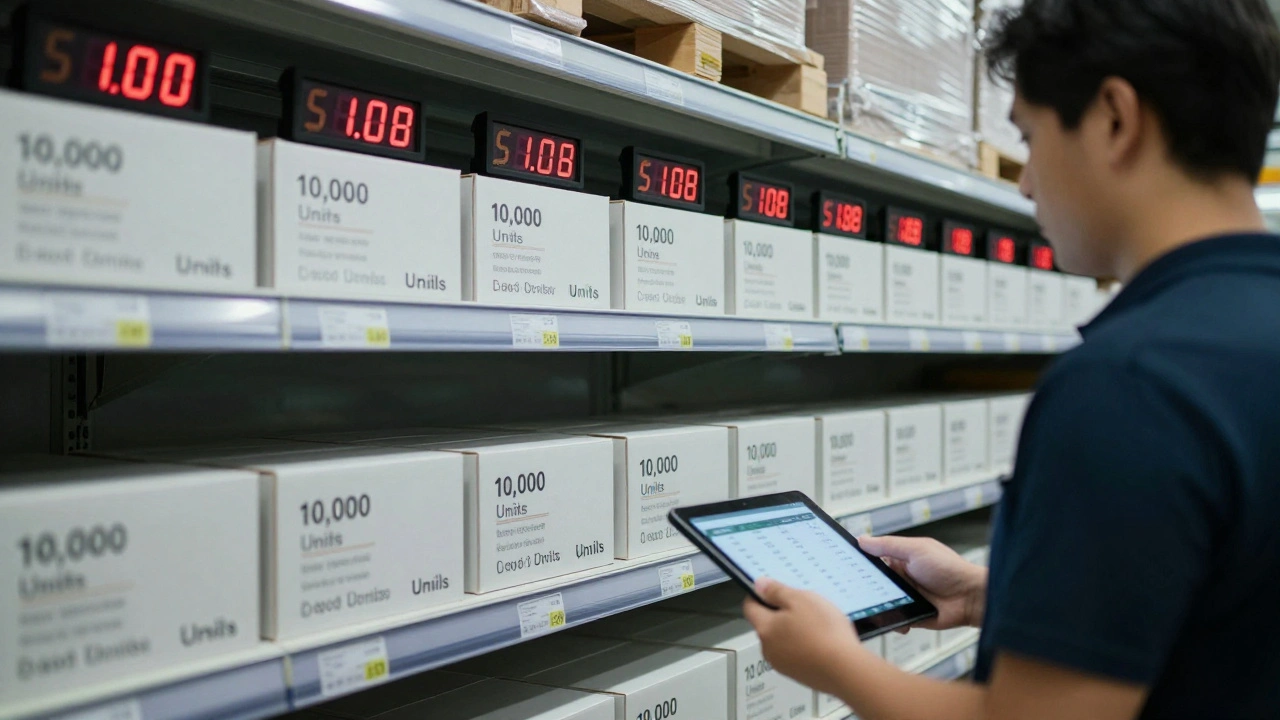
Many suppliers require you to buy a minimum number of units-say, 10,000 widgets per order. That’s normal. But here’s the catch: when the exchange rate moves, those MOQs become dangerous.If your local currency strengthens, those 10,000 widgets suddenly cost less. You might be tempted to order more. But if the rate reverses next month, you’re stuck with excess inventory you can’t sell. On the flip side, if your currency weakens, your supplier might raise the MOQ to protect themselves. Now you need to pay more upfront just to keep the line open. This isn’t about demand-it’s about currency volatility forcing you into bad inventory decisions.
FX-linked contracts fix this. By tying the unit price to a moving exchange rate, the supplier can keep the MOQ stable. You still buy 10,000 units. But if the dollar weakens, each unit costs more. If it strengthens, each unit costs less. The total outlay stays predictable. No guesswork. No overstock. No cash tied up in unsold goods.

Who Really Runs This Inside Your Company?
You can’t just hand this to your procurement manager and say, “Figure it out.” FX-linked contracts need coordination across teams.- Procurement leads the negotiation. They know the supplier’s cost structure, lead times, and flexibility.
- Treasury provides the real-time FX data. They monitor currency trends, access hedging tools, and track payment timing.
- Finance models the impact. They run scenarios: What happens if the peso drops 10%? How does that affect gross margin?
- Leadership sets the policy. Do we want to avoid all risk? Or are we okay with some exposure if it means better pricing?
At a manufacturing firm in Ohio, they used to treat FX as a “finance problem.” Then they lost $220,000 in one quarter because their supplier raised prices without warning. Now, every new international contract goes through a cross-functional review. Procurement brings the supplier terms. Treasury brings the FX forecast. Finance runs the margin model. And leadership approves the risk tolerance. It’s not perfect. But it’s controlled.
Technology Isn’t Optional Anymore
You can’t manage FX risk with spreadsheets and monthly bank statements. If your supplier adjusts prices based on a rate from last week, you’re already behind. Real-time FX-linked contracts need live data feeds-something that connects your ERP system to currency market APIs. Tools like Bloomberg, Reuters, or even cloud-based platforms like TransferMate give you live exchange rates, automated invoicing, and payment execution in local currency.One small electronics importer in Texas started using a platform that auto-adjusts invoices based on daily FX movements. They cut payment delays by 70% and reduced invoice disputes by 90%. Why? Because both sides saw the same number. No more “I thought we agreed on 1.25” arguments. Just facts. Transparency builds trust. And trust means better supplier priority, faster delivery, and even better pricing down the line.
Regulations and Standards You Can’t Ignore
FX-linked contracts don’t exist in a legal vacuum. If you’re dealing with government suppliers, the U.S. Federal Acquisition Regulation (FAR) Part 25 applies. It defines what counts as a foreign product and sets thresholds for reporting. For private companies, Incoterms (like FOB, CIF, DDP) still govern delivery responsibility-but they don’t touch currency risk. That’s where your contract comes in. The WTO Government Procurement Agreement (GPA) and U.S. free trade deals also set rules for how foreign suppliers are treated. But none of these solve FX risk. Only your contract does.So don’t assume your standard supplier agreement covers this. Most don’t. You need to add a clause: “All prices are subject to adjustment based on the daily average of [source] exchange rate.” Then define the source. Use the ECB, the Fed, or a major bank’s rate. Make it objective. No room for interpretation.
The Real Advantage: Trust, Not Just Savings
The biggest benefit of FX-linked contracts isn’t the numbers. It’s the relationship.Suppliers don’t like surprises. If you pay them $100,000 one month and $115,000 the next without warning, they assume you’re trying to squeeze them. But if you say, “Here’s how we’ll adjust prices based on the market,” they see you as fair. They trust you. And that trust translates into real advantages: earlier delivery slots, priority in production queues, even bulk discounts.
TransferMate’s research shows that suppliers who feel paid fairly are more likely to share cost-saving ideas, absorb minor delays, and even help you navigate local regulations. That’s not in any contract template. But it’s worth more than the savings from hedging.
When Not to Use FX-Linked Contracts
These aren’t magic bullets. They don’t work if:- Your supplier refuses to negotiate. Some small factories just want a fixed price. If they’re your only option, you might have to absorb the risk.
- You lack data. If you can’t access real-time exchange rates, you can’t make informed adjustments.
- Your orders are too small. If you’re buying $5,000 worth of parts per month, the cost of setting up a dynamic system may outweigh the benefit.
For those cases, simpler hedging-like forward contracts through your bank-might be better. But if you’re buying over $1 million annually from overseas, FX-linked contracts are the only way to truly control your margins.
Start Small. Think Big.
You don’t need to overhaul every contract tomorrow. Pick one high-volume, high-risk supplier. Draft a simple FX-linked clause. Test it for three months. Track the impact on your margin. Talk to the supplier. See how they respond. Then scale.Companies that wait until a crisis hits-like a 20% currency drop-are already behind. The winners are the ones who build these contracts into their standard procurement process. Not as a workaround. Not as a crisis tool. But as a core part of how they do business.
What’s the difference between an FX-linked contract and a forward contract?
A forward contract is a financial hedge where you lock in an exchange rate today for a future payment. It’s done through a bank and doesn’t involve your supplier. An FX-linked supply contract changes the pricing terms in your actual purchase agreement. The supplier agrees to adjust prices based on market rates. One protects your cash flow. The other protects your entire supply chain relationship.
Can small businesses use FX-linked contracts?
Yes, but they’re most useful if you’re spending over $250,000 annually on international purchases. For smaller volumes, a simple forward contract from your bank may be cheaper and easier. But if you’re buying from multiple countries or have long-term contracts, even small businesses can benefit from shared-risk models.
Do FX-linked contracts work for services, not just goods?
Absolutely. If you hire a software developer in India, pay a logistics provider in Poland, or outsource customer support in the Philippines, FX risk applies. Service contracts can include clauses like: “Payment will be based on the daily average of the USD/INR rate on the invoice date.”
What happens if the currency pair isn’t liquid?
If your supplier is in a country with a less-traded currency (like the Nigerian naira or the Vietnamese dong), use a proxy. Agree to use a major pair like USD/EUR or USD/GBP, then apply a fixed spread. For example: “Price adjusts based on USD/EUR rate, plus a 3% buffer for USD/VND conversion.” This avoids volatility in illiquid markets.
How often should FX-linked contract terms be reviewed?
Review every 12 to 18 months. Markets change. Suppliers change. Your volumes change. If the currency pair has moved more than 10% since the last review, renegotiate. Don’t wait for a crisis. Set a calendar reminder. Treat it like a contract renewal.