
AI Productivity Impact Calculator
How Generative AI Impacts Your Business
Calculate your potential productivity gains and economic value from generative AI adoption based on McKinsey's research.
Estimated Productivity Impact
This represents of your current revenue.
Industry-Specific Insights
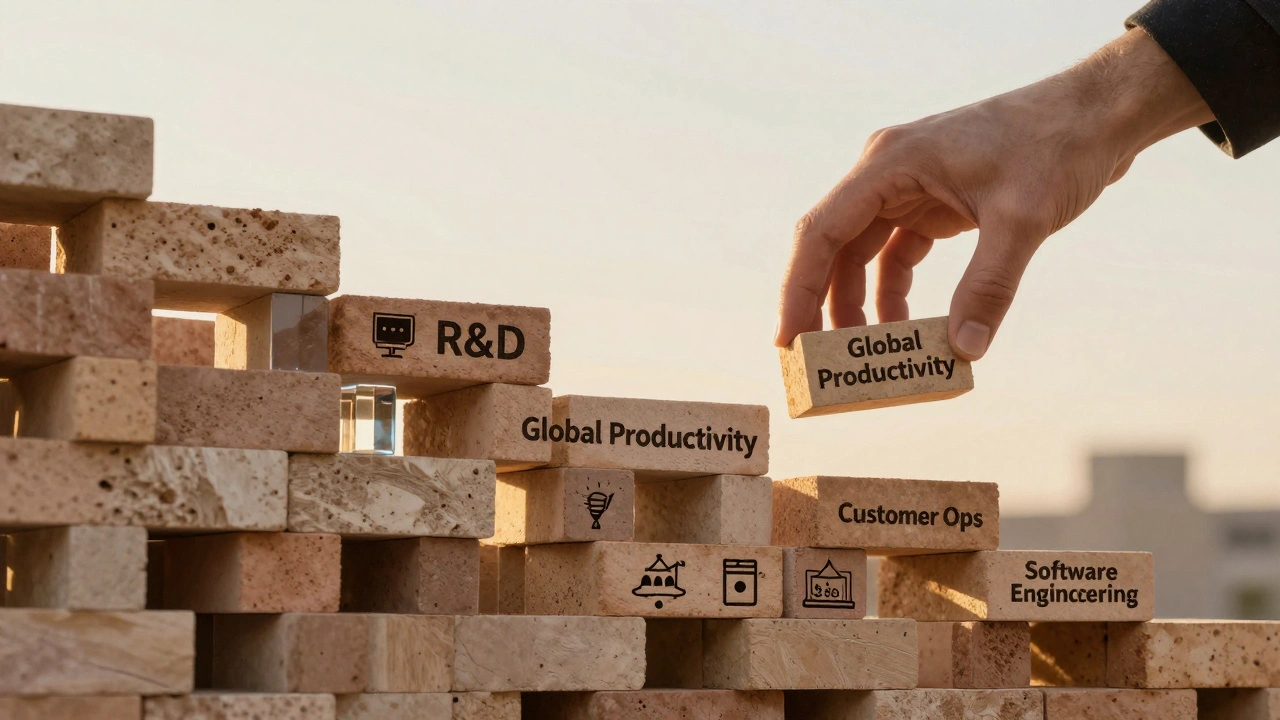
By 2040, generative AI could add $4.4 trillion to the global economy every year. That’s not a guess. It’s McKinsey’s upper-bound estimate, based on real data from 63 use cases across industries. But here’s the thing: most people think this money will appear out of nowhere, like magic. It won’t. It will be built-brick by brick-in customer service centers, software labs, marketing teams, and R&D departments. And it will come at a cost: jobs will change, skills will shift, and entire industries will be forced to adapt or fall behind.
Where the Money Is: The 75% Concentration
The $4.4 trillion doesn’t spread evenly. Almost three-quarters of it will flow into just four areas: customer operations, marketing and sales, software engineering, and research and development. Why these? Because they’re all built on language, creativity, and logic-the exact things generative AI excels at.
Think about customer service. Right now, reps spend hours repeating the same answers: "Where’s my order?" "How do I reset my password?" "Why was I charged twice?" Generative AI can handle 80% of those questions instantly through chatbots that don’t get tired, don’t hang up, and can even sound human. McKinsey says this alone could boost customer care productivity by up to 45%. That’s not just saving money. It’s freeing up human agents to handle the complex cases-the angry customers, the refund disputes, the one-in-a-million glitches-that no algorithm can fix.
Marketing and sales? AI doesn’t just write ads. It generates personalized email sequences, designs landing pages, and even creates video scripts based on customer data. A single marketer using generative tools can now produce the same volume of content that once took a team of five. That’s not replacing marketers. It’s turning them into strategists-focusing on what works, not how to make it.
Software engineering is where the real transformation is happening. Developers used to spend half their time writing boilerplate code, debugging syntax errors, or translating requirements into logic. Now, they type a prompt like: "Build a login flow with OAuth 2.0 and two-factor auth," and AI generates the code. Not perfect, but 70% there. That cuts development time by 30-50% in many cases. Companies like Microsoft and GitHub are already integrating this into their core tools. The result? Faster releases, fewer bugs, and engineers who can focus on architecture-not typing.
And then there’s R&D. Drug companies are using AI to simulate molecular interactions. Automotive firms are simulating crash tests in virtual environments. Semiconductor designers are optimizing chip layouts in hours instead of months. Generative AI isn’t just speeding things up-it’s letting researchers ask "what if?" a thousand times a day. That’s how breakthroughs happen.
The Productivity Engine: How AI Multiplies Output
Productivity isn’t about working harder. It’s about working smarter. And generative AI doesn’t just automate tasks-it amplifies human capability.
Take accountants. A typical mid-level accountant spends 40% of their time reconciling data, formatting reports, and chasing receipts. With AI, that drops to 10%. The extra 30%? They can now analyze trends, spot fraud patterns, or advise clients on tax strategy. That’s not automation. That’s elevation.
McKinsey estimates that generative AI could raise U.S. labor productivity by 0.7% annually through 2040. That sounds small. But productivity growth hasn’t broken 1.5% in the U.S. since the early 2000s. A 0.7% bump isn’t just an improvement-it’s a revival. Over 15 years, that adds up to nearly 11% more output. In dollar terms? That’s trillions.
Brookings Institution took this further. If cognitive workers (the ones doing analysis, writing, planning, designing) become 30% more productive, and cognitive work makes up 60% of economic value, then aggregate productivity jumps by 18%. That’s not a tweak. That’s a paradigm shift.
And here’s the kicker: this isn’t just a one-time gain. When AI helps workers innovate faster, it creates a feedback loop. Faster product cycles → more data → better AI models → even faster innovation. The economy doesn’t just get more efficient-it starts growing faster.
Who Gets Left Behind? The Hidden Cost of Efficiency
Every productivity boom has a downside. The steam engine didn’t just make factories faster-it made hand-weavers obsolete. The computer didn’t just speed up calculations-it replaced typists and data clerks.
Generative AI is different. It’s not replacing manual labor. It’s targeting the most educated workers: analysts, writers, coders, designers, researchers. Goldman Sachs found that two-thirds of U.S. jobs are exposed to AI automation. But it’s not the cashiers or truck drivers who are at risk. It’s the entry-level marketing associate, the junior accountant, the junior software developer.
Why? Because those are the roles built on predictable, repetitive cognitive tasks-the exact kind AI excels at. A recent study from the University of Pennsylvania and OpenAI found that AI threatens jobs in accounting, auditing, financial analysis, journalism, and even blockchain engineering. Not because AI can do everything better. But because it can do 70% of it faster, cheaper, and without a coffee break.
By 2040, entry-level positions may vanish. Companies won’t hire five juniors to do what one AI-augmented senior can do. That’s not evil. It’s economic logic. But it’s also a crisis waiting to happen. What happens to a 22-year-old with a business degree if their first job-data entry, report writing, customer outreach-is gone?
McKinsey warns: "A significant number of workers will need to substantially change the work they do." That’s not a slogan. It’s a mandate. And right now, very few companies are preparing for it.

The Adoption Race: Who’s Winning?
Investment in generative AI has surged. Venture capital funding jumped 74% between 2017 and 2022. That’s not a trend. That’s a stampede. Companies are racing to adopt because the cost of waiting is higher than the cost of failure.
Early adopters aren’t just saving money. They’re gaining competitive advantage. A retail chain using AI to personalize product recommendations saw a 22% increase in conversion rates. A law firm using AI to draft contracts cut review time by 60%. A biotech startup used generative AI to identify 12 new drug candidates in six weeks-work that would’ve taken two years.
But adoption isn’t universal. Small businesses still struggle with cost, complexity, and trust. Many leaders don’t know how to measure ROI. Others fear bias, errors, or legal liability. The technology is ready. The leadership isn’t.
Statista’s data from 47 countries shows that early adoption leads to 3x greater productivity gains than late adoption. That’s not a suggestion. It’s a warning. The gap between companies that use AI and those that don’t will widen-and fast.
The Long Game: Beyond 2040
The $4.4 trillion isn’t the finish line. It’s the starting line.
Wharton’s model shows AI’s biggest productivity boost happens in 2032, then fades. Why? Because once the low-hanging fruit is picked-chatbots, code generators, marketing copy-the gains slow. But here’s what no one talks about: the permanent shift.
When AI changes how people work, it changes how companies are structured. When engineers stop writing code and start guiding AI, they become product designers. When marketers stop creating ads and start interpreting data, they become customer psychologists. These aren’t just new roles. They’re new skill sets.
And that’s the real value of generative AI. It’s not about the money. It’s about rebuilding the economy around human creativity, not human repetition.
By 2055, AI could boost GDP by 3% annually. By 2075? 3.7%. That’s not science fiction. That’s the trajectory. But only if we prepare.
What Needs to Happen Next
If we want to capture the $4.4 trillion, three things must change:
- Education must shift. Schools need to teach AI collaboration, not just coding. Students need to learn how to prompt, edit, and validate AI outputs-not just memorize formulas.
- Companies must invest in reskilling. Every organization that uses AI must also train its workforce. This isn’t optional. It’s survival.
- Policymakers must act. Unemployment isn’t the problem. Underemployment is. We need wage insurance, transition grants, and portable benefits for workers shifting into new roles.
The money is there. The technology is here. The question isn’t whether we’ll get there. It’s whether we’ll be ready when we do.
How much of the $4.4 trillion will go to the U.S.?
The U.S. is expected to capture roughly 30-35% of the total value, or $1.3-$1.5 trillion annually, because it leads in software, finance, and tech innovation. But countries like Germany, Japan, and South Korea will also see large gains due to their strong manufacturing and engineering bases. China’s growth will be significant too, though its data restrictions may slow adoption in some sectors.
Will generative AI replace jobs or just change them?
It’s mostly changing them-not replacing them outright. Jobs that rely on repetitive cognitive tasks (like drafting reports, answering FAQs, or writing basic code) will shrink. But new roles will emerge: AI trainers, prompt engineers, ethics auditors, and hybrid roles where humans oversee AI output. The key difference? The next generation of workers won’t be hired for what they know-they’ll be hired for how they think with AI.
Is the $4.4 trillion estimate realistic?
Yes, but only if adoption is widespread and managed well. McKinsey’s number assumes AI is integrated into 70% of relevant workflows by 2040. If only 40% adopt it, the number drops to around $2 trillion. If we hit 80%, it could rise to $6 trillion. The range depends on three things: how fast companies implement AI, how well workers adapt, and whether regulations slow or speed up innovation.
Why does productivity growth peak in 2032?
Because that’s when the easiest gains are captured. Early adopters streamline customer service, automate code, and speed up design. After that, the gains slow because the low-hanging fruit is gone. The next phase-restructuring entire business models, retraining workforces, and building new AI-native companies-takes longer. That’s why the long-term impact is less about speed and more about structural change.
Can small businesses benefit from generative AI?
Absolutely-and maybe even more than big companies. A small marketing agency using AI can compete with a Fortune 500 firm by producing high-quality content at 1/10th the cost. A local restaurant can generate personalized loyalty emails, manage social media, and even design menus with AI tools that cost less than $20 a month. The barrier to entry is lower than ever. The challenge? Knowing how to use it wisely.
What Comes After
The $4.4 trillion isn’t the end goal. It’s a milestone. The real question isn’t how much value AI will create. It’s who will control it. Will it be a few tech giants? Will it be governments? Or will it be distributed-used by teachers, small business owners, artists, and researchers around the world?
The answer will determine not just economic outcomes, but social ones too. If we use AI to amplify human potential, we’ll build a more creative, productive, and equitable economy. If we use it to cut costs and reduce headcount, we’ll create a world of inequality and unrest.
The technology is here. The money is coming. The choice is ours.