Hong Kong R&D Impact Calculator
Understand Your Inputs
Based on Hong Kong's 2002-2006 transition where industry funding rose from 35% to 53% and collaboration rates increased to 11% (surpassing Germany, UK, and France), this calculator projects potential FDI impact.
Key Insight: Hong Kong's innovation edge comes from converting academic research into commercial products through strategic partnerships, not just funding levels.
Input Your Metrics
Target: 53% (Hong Kong's 2006 rate)
Target: 11% (Hong Kong's 2006 rate)
100 = World leading; Hong Kong currently ~85
Calculate Potential Impact
Current FDI
$2.8B
Projected FDI Impact
Potential FDI Increase
$0.0B
Innovation Score
0
Global Rank
--
Key Insight: For every 1% increase in university-industry collaboration, Hong Kong could attract $150M in additional FDI based on 2006 data.
Proven Model: Hong Kong's 2002-2006 transition (from 35% to 53% industry funding) saw collaboration rates rise to 11% and FDI growth by 38%.
When you think of Hong Kong, you probably picture skyscrapers, busy ports, and financial markets. But beneath that surface is something quieter, yet more powerful: a network of universities and companies working together to turn research into real-world tech. This isn’t just about patents or lab results. It’s about how Hong Kong is using its unique position to turn academic knowledge into economic advantage - especially when it comes to foreign direct investment (FDI).
Why Hong Kong’s Innovation Model Is Different
Most places try to boost innovation by pouring money into universities. Hong Kong did that too. But then it flipped the script. Instead of letting universities work in isolation, the government started pushing them to team up with businesses. The goal? Not just to publish papers, but to build products, create companies, and attract global investors. The numbers tell the story. In 2002, industry paid for only 35% of Hong Kong’s R&D. By 2006, that number jumped to 53%. Meanwhile, government funding dropped. This wasn’t a cut - it was a shift. The money moved from pure research to applied projects where companies could actually use the results. And it worked. By 2006, 11% of Hong Kong’s R&D firms were collaborating with universities. That’s higher than Germany (8.5%), France (10.1%), and even the UK (10%) at the time. For a city of just 7 million people, that’s impressive.The Changing Face of Industry-Funded R&D
You might expect manufacturing firms to be the main drivers of R&D. But in Hong Kong, that’s not the case anymore. In 2002, manufacturing companies funded 19% of industry-led research. By 2006, that fell to just 6%. Why? Because most of their factories moved to mainland China. But here’s the twist: Hong Kong-based companies still own and manage those factories. So even though the machines are in Shenzhen or Dongguan, the innovation - the design, the testing, the tech development - often happens in Hong Kong. Today, the biggest funders of R&D aren’t factories. They’re financial firms, logistics companies, and tech service providers. These businesses use university research to improve supply chains, automate trading systems, or build AI tools for risk analysis. It’s not about making widgets. It’s about making smarter systems that run the entire supply chain - from Hong Kong’s labs to the factories of the Pearl River Delta.The $19 Billion Push: Government Programs That Matter
Hong Kong didn’t leave this to chance. It launched major funding programs with real money behind them. The RAISe+ is a HK$10 billion (about $1.29 billion USD) initiative designed to help university teams turn research into market-ready products. That’s not a grant. That’s a commercialization engine. Then there’s InnoHK a program that brought together 28 research labs by inviting top global universities - from MIT to Imperial College - to partner with Hong Kong institutions. These aren’t just offices. They’re innovation hubs focused on health tech and artificial intelligence. The idea? Cluster talent. Share tools. Speed up breakthroughs. The Strategic Topic Grant allocates HK$150 million to tackle specific regional challenges - like aging populations or air quality - through university-industry teams. And the Young Collaborative Research Grant gives HK$50 million to early-career researchers who work directly with companies. These aren’t random funds. They’re targeted tools to build bridges between labs and boardrooms.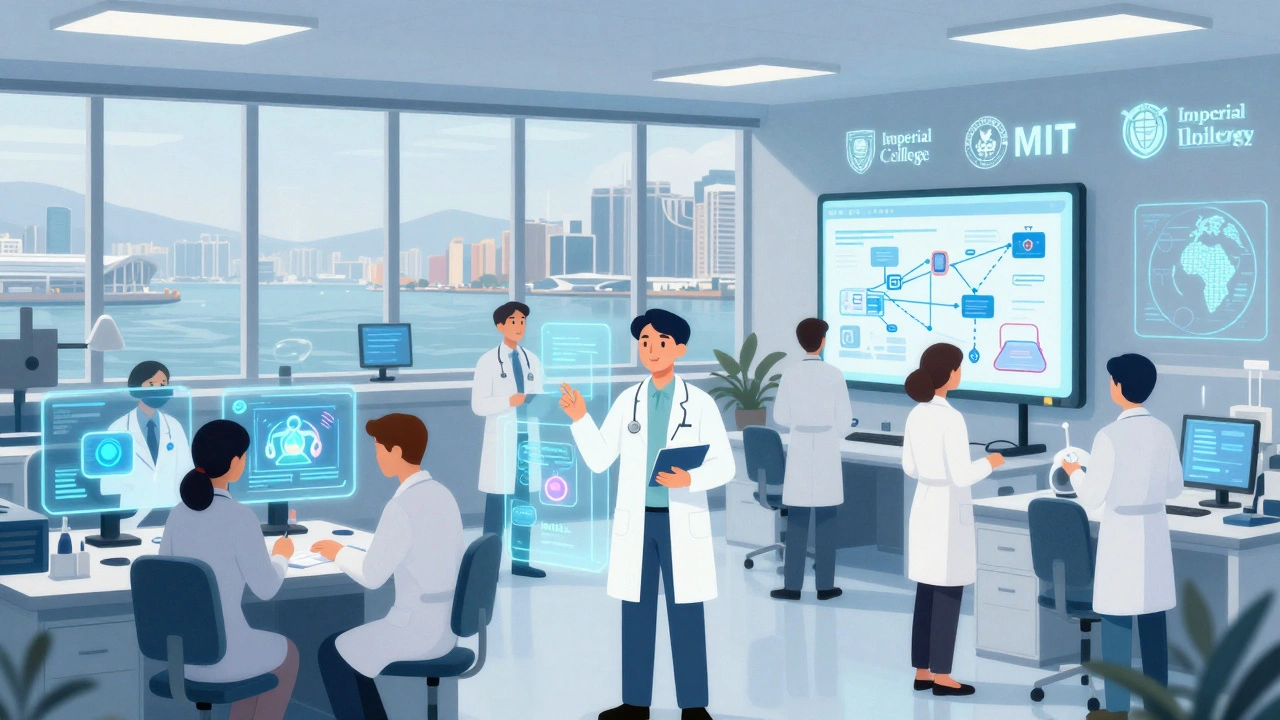
Global Research Powerhouse
Hong Kong’s universities aren’t just working locally. They’re connected globally. Between 2017 and 2021, researchers in Hong Kong co-authored 9,679 papers with colleagues in the UK alone. That’s a 64% increase over five years. The UK-Hong Kong research partnership is now one of the most productive in the world - even after political tensions. And the results show up in rankings. According to the World Intellectual Property Organization (WIPO), City University of Hong Kong ranks #1 globally for combining industry engagement and international collaboration. Collectively, Hong Kong’s university system leads all high-income economies in this metric. Even Switzerland, the Netherlands, and Singapore - countries known for deep industry ties - trail behind.The Hidden Problem: Low Private R&D Investment
But here’s the catch. For all this progress, Hong Kong’s companies still don’t invest enough in R&D. Many traditional firms see research as a cost, not an investment. That limits their ability to absorb new tech - what economists call "absorptive capacity." Faculty members report a frustrating pattern: their graduates with engineering degrees often leave for finance jobs because there aren’t enough tech roles in local firms. This gap is why universities started spinning off companies. Instead of waiting for existing businesses to adopt new tech, they created new ones. Startups like those born from HKUST or CUHK now commercialize AI tools, medical devices, and robotics systems. These startups hire the very graduates that big firms wouldn’t touch. It’s a workaround - and it’s working.