Predictive Maintenance ROI Calculator
Calculate Your Potential Savings
Estimate how much AI-powered predictive maintenance could save your manufacturing operation by inputting your current downtime costs and maintenance data.
Estimated Monthly Savings:
Your investment will pay for itself in approximately months
This calculator uses industry average data from the article where:
- • 50% reduction in unplanned downtime
- • 20-40% increase in machine life
- • 30-60% reduction in maintenance costs
Factories aren’t just louder anymore-they’re smarter. By 2026, artificial intelligence isn’t something manufacturers are testing in a lab. It’s running the lines. From the assembly robots at General Motors to the potato chip production lines at Frito-Lay, AI is quietly preventing breakdowns, catching defects before they leave the plant, and even simulating entire machines in real time. The result? Less downtime, fewer defective products, and more output without hiring extra workers. This isn’t science fiction. It’s happening now-and the numbers prove it.
Predictive Maintenance: Stop Fixing What’s Broken, Start Preventing What Will Break
For decades, factories ran on a simple rule: fix it when it breaks. Or, if you were fancy, change parts every 500 hours, no matter if the machine was running smooth or coughing. That’s reactive maintenance-and it’s expensive. Unplanned downtime costs manufacturers an average of $50,000 per hour in lost production. Some industries lose millions in a single day.
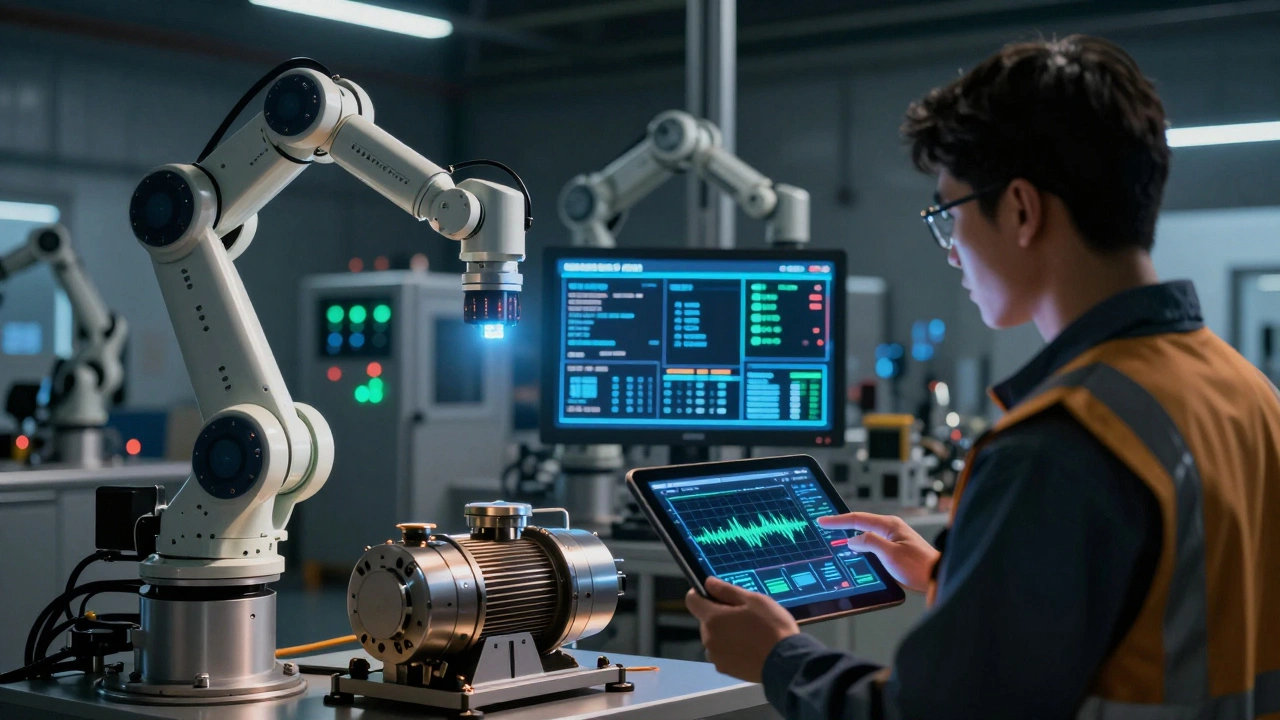
AI changes that. Instead of waiting for failure, sensors on motors, bearings, and hydraulic systems feed data-temperature, vibration, pressure, current draw-into machine learning models. These models learn what normal looks like. Then they spot the tiny shifts that humans miss: a bearing that’s starting to overheat, a valve that’s leaking slightly, a motor drawing 2% more power than usual. These aren’t alarms. They’re early warnings.
General Motors saw this firsthand. After installing IoT sensors on 1,200 robots across its plants, their AI system predicted over 70% of failures at least 24 hours ahead. Each alert came with a probability score, a root cause, and a recommended fix-like replacing coolant or checking motor bearings. The system auto-generated work orders in their maintenance software. Result? A 15% drop in unplanned downtime and $20 million saved in a year. They didn’t just fix machines. They stopped them from breaking in the first place.
It’s not just cars. A Canadian water utility used AI to monitor thousands of aging sensors that tracked water levels. Before, a faulty sensor could go unnoticed for weeks, risking environmental spills. With AI, anomalies showed up on a live map within minutes. Engineers fixed them before they failed. The system cut response time from days to hours.
According to McKinsey, companies using AI for predictive maintenance cut unplanned downtime by up to 50% and extended machine life by 20-40%. One power plant reduced turbine outages by 30%. A pump manufacturer cut maintenance costs by 40% and hit 90% prediction accuracy. The math is simple: fewer breakdowns = more production = more profit.
Quality Control: Seeing Defects Before the Human Eye Can
One missed defect can mean a recall, a lawsuit, or a lost customer. In food, pharmaceuticals, or electronics, even a tiny flaw matters. Traditional inspection relies on workers staring at screens or using basic vision systems that only catch obvious errors. But what about a hairline crack in a turbine blade? A slightly off-color paint job? A misaligned microchip?
AI-powered vision systems don’t get tired. They don’t blink. They see patterns humans can’t. Cameras mounted along production lines capture thousands of images per minute. AI models, trained on millions of labeled images of good and bad parts, instantly classify each product. They don’t just say “defective.” They tell you why: “Warpage detected at 12 o’clock,” “Contamination in corner weld,” “Dimensional deviation of 0.03mm.”
Siemens uses this in their factory in Amberg, Germany. Their AI system inspects over 1,000 products per minute with 99.998% accuracy. That’s one defect in every 50,000 units. And it learns. Every time a human overrides the system-say, marking a “false positive”-the AI updates its model. Over time, it gets better.
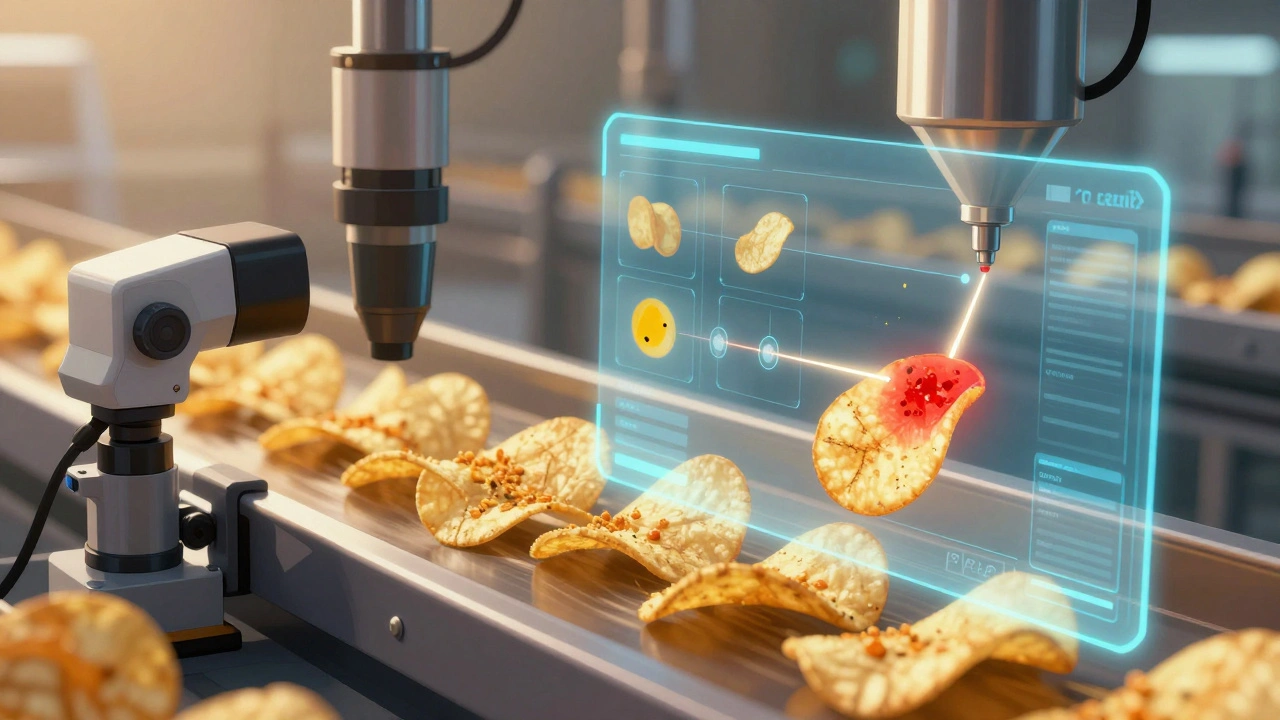
Frito-Lay uses similar tech to spot potato chips with too much oil or uneven seasoning. Their system doesn’t just catch bad batches-it flags the machine causing the issue. Was the seasoning hopper clogged? Was the conveyor speed off? The AI links the defect to the root cause, so maintenance adjusts settings before the next run.
The impact? One electronics manufacturer reduced customer returns by 67% after switching to AI vision. Another pharmaceutical company cut waste from mislabeled vials by 80%. Quality isn’t just about avoiding mistakes. It’s about knowing exactly where they come from-and fixing the system, not just the product.
Digital Twins: Running a Factory in a Simulation Before It Even Starts
What if you could test a new production line, a change in material, or a shift in schedule-without touching a single machine? That’s the digital twin.
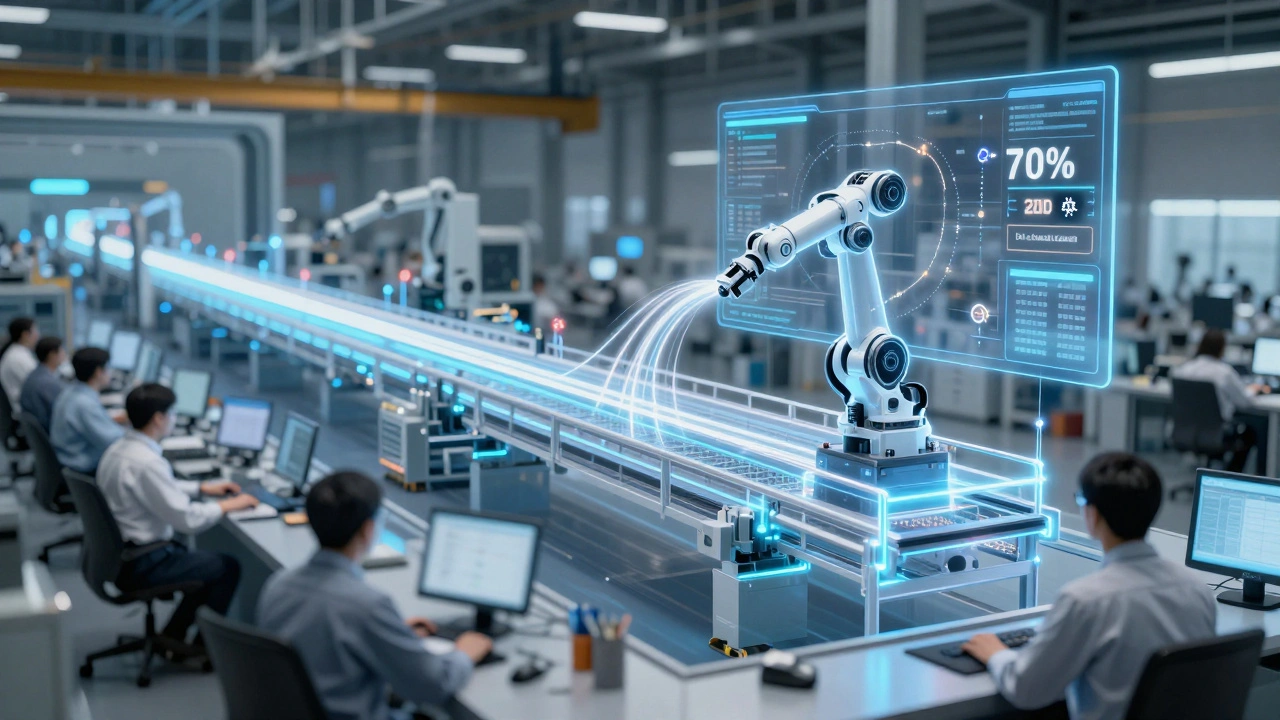
A digital twin is a living, real-time copy of a physical asset. It’s not just a 3D model. It’s a dynamic simulation fed by live data from sensors on the actual machine. If the real motor speeds up, the twin speeds up. If the real temperature rises, the twin shows the same spike. Engineers can then run experiments: What if we change the feed rate? What if we replace this bearing next week? What if we run 10% faster?
Rolls-Royce uses digital twins for jet engines. Each engine has its own twin, constantly updated by flight data. When an airline’s engine shows unusual vibration, engineers simulate the issue in the twin. They test solutions-adjusting fuel mix, changing airflow-before telling the pilot what to do. The result? Fewer groundings, fewer delays, and more reliable flights.
In manufacturing, digital twins help optimize everything. A company making heavy machinery used a twin to test a new assembly sequence. They simulated 12 different layouts, ran 500 virtual production cycles, and found one that cut cycle time by 18% and reduced worker movement by 30%. They implemented it in the real plant-and saw the same gains.
Siemens uses generative AI to create thousands of failure scenarios in the twin. What if a sensor fails? What if the cooling system slows? The AI simulates outcomes, then recommends the best maintenance schedule. This isn’t guesswork. It’s prediction powered by simulation.
Digital twins don’t just prevent breakdowns. They help you build better. One auto maker used a twin to redesign a robot’s path on the assembly line. The simulation showed the robot was hitting a guardrail 300 times per shift. They moved the guardrail 4 inches-and cut maintenance calls by 70%.
The Tech Stack Behind It All
You don’t need a billion-dollar budget to start. The core pieces are simple:
- IoT sensors: Cheap, wireless, and easy to install. They measure vibration, temperature, pressure, current, and more.
- Cloud platforms: AWS, Azure, or Google Cloud store and process data. No need for on-site servers.
- AI models: Supervised learning (trained on past failures) and unsupervised learning (finds anomalies without labels) work together.
- Dashboards: Real-time views show which machines are at risk. Alerts pop up on phones or tablets.
- CMMS integration: Your maintenance software (like SAP or IBM Maximo) auto-creates work orders when AI spots trouble.
Most manufacturers start with one line, one machine, or one process. Get one win. Then expand. The ROI is fast. One mid-sized manufacturer added sensors to five critical pumps. Within six months, they cut maintenance costs by 35% and reduced downtime by 60%. The sensors cost $8,000. The savings? Over $200,000.
Why This Isn’t Just a Trend-It’s a New Standard
AI in manufacturing isn’t about replacing workers. It’s about giving them superpowers. Maintenance teams aren’t walking around with clipboards anymore. They’re using AI to focus on what matters. Engineers aren’t guessing why a machine failed. They’re seeing the exact pattern that led to it.
Companies that wait for “perfect” AI systems will fall behind. The tech is mature. The data is available. The cost is low. The benefits are proven.
By 2026, the factories that win are the ones that use AI to predict, prevent, and optimize-not just react. Predictive maintenance cuts downtime. AI vision cuts defects. Digital twins cut waste. Together, they don’t just improve productivity. They redefine what’s possible.
Can small manufacturers afford AI for predictive maintenance?
Yes. Entry-level IoT sensor kits cost under $500 per machine. Cloud platforms charge by usage, not by size. Many vendors offer pay-as-you-go AI services. One mid-sized factory started with five pumps and saw a 60% drop in downtime within six months. The sensors paid for themselves in under three months.
Do I need data scientists to run AI in my factory?
No. Most modern AI platforms for manufacturing are built for engineers, not data scientists. You train the system with historical failure data, then it auto-updates. Dashboards show alerts in plain language: "Motor bearing at 87% risk. Replace in 7 days." No coding needed. Vendors handle the math.
How long does it take to see results from AI predictive maintenance?
Most companies see first results in 30-90 days. The first alerts come quickly. The big savings-reduced downtime, lower repair costs-show up in 3-6 months. One plant cut unplanned outages by 40% in just four months after installing sensors.
Is AI better than human inspectors for quality control?
For consistency and scale, yes. Humans get tired. AI doesn’t. A vision system can inspect 10,000 parts per hour with 99.9% accuracy. Humans max out at 500 with fatigue-induced errors. AI also spots patterns humans miss-like a 0.01mm shift in alignment that leads to failure after 100 cycles.
Can AI predict failures in old equipment?
Absolutely. AI doesn’t care how old a machine is. It learns from the data it receives. Even a 30-year-old pump can be retrofitted with sensors. The AI detects wear patterns based on real-time behavior, not age. One utility company extended the life of 15-year-old water sensors by 40% using AI-driven monitoring.
Next Steps: Where to Start
Don’t try to digitize your whole factory overnight. Pick one high-impact area:
- Find a machine that breaks down often and costs the most when it’s down.
- Install 3-5 basic sensors (vibration, temperature, current).
- Connect them to a cloud-based AI platform (many offer free trials).
- Set up alerts on your phone or tablet.
- Track downtime and maintenance costs for 60 days.
- Compare before and after. The difference will surprise you.
AI in manufacturing isn’t about the future. It’s about fixing what’s broken today-before it breaks again.