
PPP Performance Calculator
Calculate Your Partnership Impact
This tool helps you estimate the financial viability and expected impact of a public-private partnership in health security based on performance metrics. Input your key variables below to see how performance targets affect costs and outcomes.
Results
How This Works: The calculation uses performance-based payment principles from the WHO and CDC guidelines. At 80% performance, the government pays 80% of the expected cost, while the private partner receives the remaining portion. The tool shows the expected outcome improvement and cost efficiency.
When a pandemic hits, or a natural disaster disrupts supply chains, who shows up first? It’s not just the government. It’s not just hospitals. It’s the public-private partnership-a quiet but powerful alliance that keeps vaccines flowing, ambulances stocked, and clinics open when everything else is falling apart. These aren’t theoretical models. They’re real, working systems that saved lives during COVID-19, Ebola outbreaks, and regional health crises across the U.S. and beyond. But here’s the truth: most PPPs fail not because they’re too expensive, but because no one agreed on how to actually work together.
What Public-Private Partnerships Really Do in Health Security
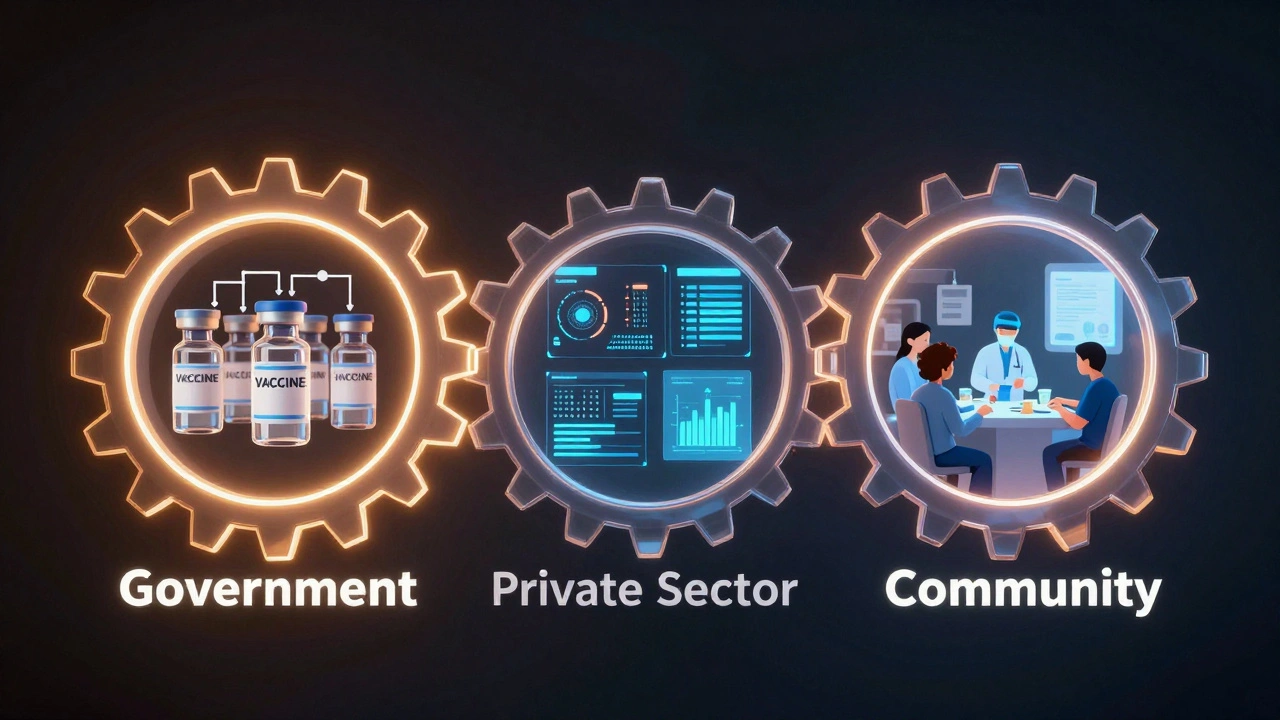
A public-private partnership (PPP) in health security isn’t just a contract. It’s a shared mission. The public side-government agencies like the CDC, state health departments, or WHO-brings authority, equity goals, and accountability. The private side-pharmaceutical companies, logistics firms, tech startups, insurance providers-brings speed, innovation, and capital. Together, they do what neither could do alone.
Think about vaccine distribution during the pandemic. The government didn’t build the factories. Private manufacturers did. But without government contracts guaranteeing purchases and coordinating distribution, those vaccines would’ve sat in warehouses. The CDC partnered with FedEx, UPS, and CVS to get shots into arms faster than any single agency could. That’s a PPP in action: shared risk, shared reward.
According to the World Bank, the most common PPPs in health involve three things: building or upgrading facilities, running clinical services, and managing supply chains. But the real magic happens when these pieces connect. A hospital built by a private contractor under a 20-year agreement? Fine. But if that hospital’s supply chain for insulin or antibiotics is managed by a private distributor with real-time data sharing and emergency protocols tied to public health alerts? That’s resilience.
The Three Pillars of a Working PPP
Not every partnership works. Some collapse under bureaucracy. Others get hijacked by profit motives. The ones that survive-and save lives-follow three non-negotiable rules.
- Shared methods, not just shared goals. Everyone agrees we need more vaccines. But do you agree on how to store them? Who pays for cold chain failures? Who gets fined if shipments are late? The HHS PPP Government Guide says it plainly: “It’s more important that partners agree on their methods.” A goal without a process is just a wish.
- Clear accountability with measurable outcomes. A PPP isn’t a black box. It needs KPIs: time to deliver critical supplies, percentage of rural clinics stocked, reduction in emergency room wait times. The WHO recommends starting small-piloting a PPP on diagnostic labs or maternal health clinics before scaling up. If you can’t measure it, you can’t fix it.
- Financial transparency and long-term affordability. Governments often sign long-term contracts without realizing the future cost. The WHO warns that “evidence has demonstrated a tendency to overcommit future revenues.” A hospital built with private capital might seem cheap upfront, but if the government must pay $10 million a year just to keep it running, it’s a trap. Payment structures must be tied to performance, not just construction.
Take the example of a PPP in New Mexico that partnered with a regional pharmacy chain to deliver chronic disease medications to rural communities. Instead of just handing over a grant, the state set up a dashboard: clinics reported inventory levels weekly, the pharmacy adjusted deliveries automatically, and the state paid only when delivery targets were met. Result? Medication gaps dropped by 68% in 18 months.
Where PPPs Shine: Real-World Applications
PPPs aren’t one-size-fits-all. Their power shows up in specific, high-stakes areas:
- Supply Chain Resilience - During the 2022 monkeypox outbreak, the U.S. government worked with private logistics firms to reroute vaccine shipments through regional hubs. Without those partnerships, delays would’ve cost lives. The Healthcare Distribution Alliance says PPPs are “essential for directing resources to areas in greatest need”-not after the crisis, but before.
- Vaccine Innovation - Moderna and Pfizer didn’t develop mRNA vaccines alone. They got billions in upfront funding from the U.S. government through Operation Warp Speed. In return, they agreed to prioritize U.S. supply and share manufacturing tech with other producers. That’s a PPP: public money de-risking innovation, private expertise scaling it.
- Emergency Response Coordination - In 2023, after wildfires in California overwhelmed local clinics, private health networks opened their facilities to public health teams. The state used a pre-established PPP framework to activate hospital beds, deploy mobile units, and share patient records across systems. No red tape. No waiting for approvals. Just speed.
- Primary Care Expansion - In Texas, a PPP between a nonprofit health system and local pharmacies allowed pharmacists to administer screenings for hypertension and diabetes. The state paid a fixed fee per screened patient. Result? Early detection rates jumped 40% in underserved counties.
The Hidden Costs and Common Pitfalls
PPPs aren’t magic. They’re complex-and easy to mess up.
One major risk? Overpromising future revenue. Governments sign contracts thinking, “We’ll pay later,” but later never comes. A study in Saudi Arabia found that poorly structured PPPs led to hospital losses because the private partner wasn’t held accountable for outcomes-only for construction. The WHO says governments must be able to “design, plan, and monitor complex, long-term contracts.” Most can’t. That’s why pilots matter.
Another pitfall? Loss of public accountability. When a private company runs a public clinic, who answers to the community? Who handles complaints? Without clear oversight, patients lose trust. The CDC’s best practice: embed public health officers inside private partner operations. Not as auditors-as collaborators.
And then there’s the data problem. Private firms own patient flow systems. Public agencies need that data to track outbreaks. But without clear data-sharing agreements, information stays siloed. The 2023 WHO guidelines stress that “health data must flow freely between partners” to enable real-time response. That means legal frameworks, not just goodwill.

How to Build a PPP That Lasts
Here’s how to do it right:
- Start small. Don’t try to overhaul the entire health system. Pick one service-like emergency dialysis transport or maternal health outreach-and build a PPP around it. Test it. Measure it. Fix it.
- Define roles before signing. Who handles procurement? Who manages staffing? Who pays for equipment breakdowns? Write it down. No assumptions.
- Use performance-based payments. Pay for results, not inputs. If a private partner delivers 95% of vaccines on time, pay the full amount. If they miss the target, reduce payment. No exceptions.
- Build in flexibility. Health emergencies change fast. Contracts must allow for rapid renegotiation. Include trigger points: “If cases surge 30% in 7 days, activate backup supply lanes.”
- Train public staff. Too many government teams don’t know how to negotiate or monitor PPPs. Invest in training. The WHO recommends building internal capacity before scaling partnerships.
There’s no silver bullet. But there is a proven path: collaboration with clarity, accountability with flexibility, and incentives tied to outcomes-not just contracts.
Why This Matters Now
Climate change, aging populations, and antibiotic resistance are making health security harder-not easier. Traditional public systems are stretched thin. Private innovation is moving faster than regulation. The gap? That’s where PPPs belong.
The World Bank says PPPs can help achieve Universal Health Coverage and meet SDG 3. But only if they’re designed with care. The CDC now uses PPPs to “better inform preparedness and response efforts.” That’s not a footnote-it’s the future.
If you’re a policymaker, your job isn’t to choose between public and private. It’s to design the bridge between them. And that bridge needs strong foundations. Not just funding. Not just contracts. But trust. Clarity. And shared purpose.
What’s the difference between a PPP and outsourcing?
Outsourcing is when the government hires a private company to do a job-like cleaning hospitals or managing IT systems. A PPP is deeper: both sides share risks, resources, and decision-making. In outsourcing, the public sector stays in control. In a PPP, they co-create the solution. For example, outsourcing might mean hiring a company to deliver vaccines. A PPP means that company helps design the delivery system, shares data with public health agencies, and shares financial risk if demand spikes.
Are PPPs only for wealthy countries?
No. Middle-income countries like Mexico, Brazil, and Thailand have used PPPs to build hospitals, improve diagnostics, and expand rural access. The WHO specifically highlights these countries as leaders in using PPPs to mobilize funds without overburdening public budgets. The key isn’t wealth-it’s capacity. Even low-resource settings can start small: a PPP for maternal health clinics, for example, can be built with local clinics, NGOs, and private suppliers.
Can PPPs reduce healthcare costs?
They can-but not always. A well-designed PPP reduces long-term costs by improving efficiency, cutting waste, and preventing emergencies. For example, a PPP that ensures consistent supply of insulin prevents costly hospitalizations. But if a contract locks the government into paying too much for maintenance or service, costs rise. The key is performance-based payments. Pay for outcomes, not inputs. And always compare PPP costs to traditional public delivery before signing.
What happens if a private partner fails?
Contracts must include clear exit clauses. If a partner misses targets for three consecutive months, the government can step in. Some PPPs include performance bonds-money the private partner puts up upfront that’s forfeited if they fail. Others have backup providers pre-qualified. The goal isn’t punishment-it’s continuity. Patients shouldn’t suffer because a company underperformed. That’s why monitoring and early intervention matter more than penalties.
Do PPPs replace public health funding?
They shouldn’t. PPPs are tools-not replacements. The WHO warns that governments must still invest in primary care, disease surveillance, and public health infrastructure. A PPP for a new hospital doesn’t fix broken community clinics. The best approach is to use PPPs for specific, high-impact areas where private expertise adds value, while keeping core public health functions fully funded and accountable.