Reskilling Investment Calculator
Calculate Economic Impact
Estimate the return on investment for public-private training partnerships versus unemployment benefits
When workers lose jobs to automation or shifting industries, who pays to retrain them? Governments can't do it alone. Companies won't foot the whole bill. Yet millions of people need new skills-fast. The answer isn't more classroom lectures. It's public-private training partnerships-structured collaborations where governments, employers, and schools share responsibility, funding, and control to build real, job-ready skills at national scale.
How These Partnerships Actually Work
These aren't vague agreements. They're funded, tracked, and measured systems. Think of them as shared infrastructure for workforce development. Public money builds the classrooms, certifies the programs, and ensures access. Private money funds the equipment, pays mentors, and hires the graduates. The key is alignment: what's taught must match what employers need right now.Take Germany's dual education system. It's not theoretical. Students spend three to four days a week at a company, learning directly from skilled workers. Two days a week, they're in a vocational school. The company pays a training allowance. The government covers the school costs and sets national standards. Employers help design the curriculum. Over 50% of German youth enter this path. The result? One of the lowest youth unemployment rates in Europe.
It's not just Europe. Malaysia's National Dual Training System gave companies tax breaks for every apprentice they hired. Between 2007 and 2008, over 3.3 million workers went through employer-led training. Companies didn't just write checks-they built training centers inside their factories. They chose the trainers. They set the performance standards. And they hired most of the graduates.
Funding Models That Actually Move the Needle
There are three proven ways these partnerships are funded:- Shared Infrastructure Funding - The government builds or upgrades training centers. Companies pay for equipment, software, and staff. In Malaysia, the government funded the facilities. Employers paid for the trainers and materials. This split kept costs manageable while ensuring quality.
- Employer Tax Incentives - Governments reduce corporate taxes for companies that train workers. Malaysia's tax deductions for setting up internal training centers led to a surge in participation. In Thailand, Siam City Cement partnered with the government to train construction workers. The state covered certification costs; the company paid wages during training.
- Direct Corporate Investment in Education - Companies like IBM don't just hire graduates-they create the pipeline. Their P-TECH model starts in high school. Students get free access to college courses, paid summer internships, and mentors from IBM and other tech firms. The public school system provides the space and basic instruction. IBM and partners provide tech, curriculum, and job pathways. By age 18, students graduate with an associate degree and a job offer.
Why Traditional Education Fails at Reskilling
Most colleges and vocational schools teach what they've always taught. They don't adjust quickly. A course on Excel 2010 won't help someone land a job in data analytics in 2026. Public-private partnerships fix this by making employers co-designers of training.Take Maricopa Community Colleges in Arizona. They didn't redesign their IT programs based on textbook updates. They sat down with Walmart, Intel, and local tech firms. What skills were missing? Cloud support. Cybersecurity basics. Data entry automation. Within six months, new courses were live. Students didn't just learn theory-they worked on real company projects. Internships turned into full-time jobs. The colleges didn't pay for it alone. The companies funded the curriculum development, donated equipment, and hired 70% of graduates.
Without employer input, training becomes irrelevant. With it, you get agility. You get relevance. You get outcomes.
The Role of Sector Councils and Unions
Successful partnerships don't rely on one company or one government agency. They involve entire industries. Sector councils-made up of employers, unions, and training providers-identify skill gaps across whole industries, not just single firms.In Malaysia's Third Outline Perspective Plan, sector councils brought together construction firms, electricians, and safety trainers. Together, they mapped out the skills needed for smart infrastructure projects. They created standardized certifications. They pooled funding for training centers. This meant a worker trained in Kuala Lumpur could get a job in Penang because the standards were the same.
Unions aren't just negotiators here. They're partners in design. They help ensure training is accessible, fair, and includes safety and rights education. When workers trust the system, they enroll. When employers trust the outcomes, they hire.
Digital Skills and Removing Access Barriers
Reskilling doesn't just mean learning Python or SQL. It means getting online in the first place. Many workers lack devices, internet access, or digital literacy. Public-private partnerships are solving this too.MTN, a telecom provider in Africa, partnered with governments to cover data costs for online learning platforms. Young people in remote areas could access coding courses without paying a cent for data. Job hubs linked them to local tech roles. Intel's global initiative aims to reach 30 million learners by 2030, partnering with 30,000 institutions to provide devices, software, and curriculum.
This isn't charity. It's talent pipeline building. Every person who learns digital skills becomes a potential employee, entrepreneur, or customer. The private sector invests because they need workers. The public sector invests because they need economic growth.
What Makes These Models Sustainable?
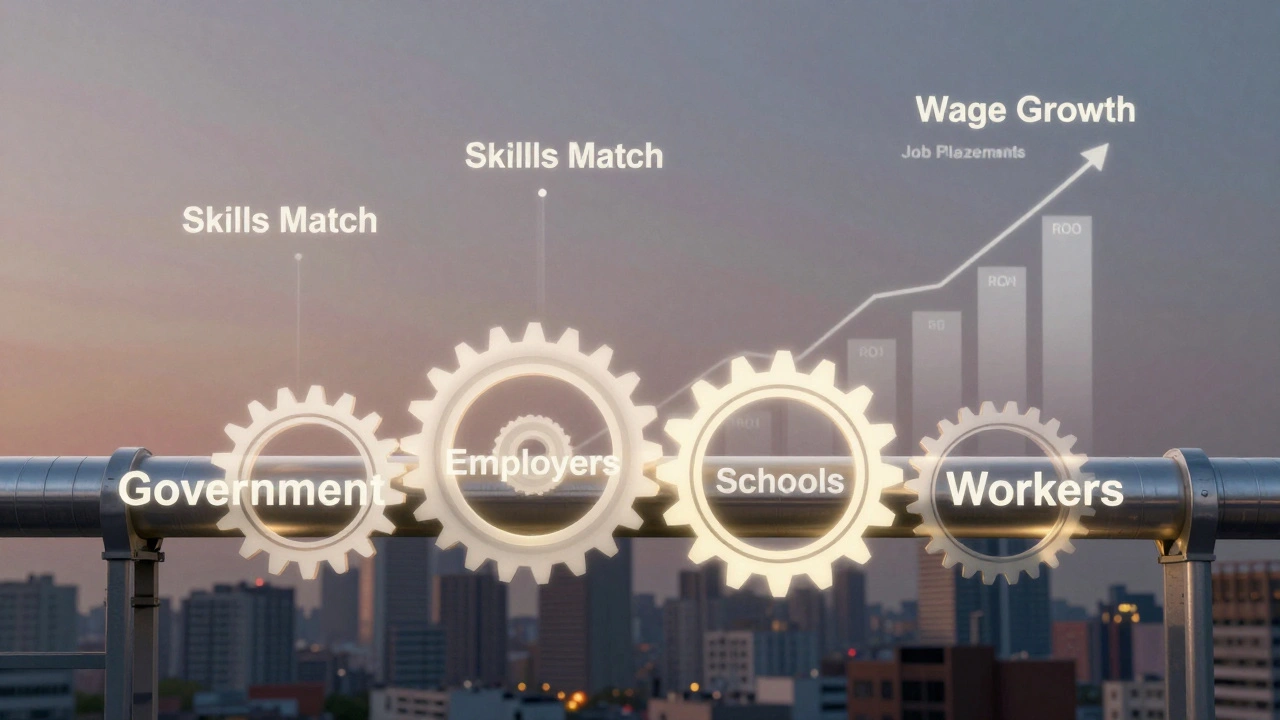
Not all partnerships last. The ones that do share five traits:- Shared ownership - No single party controls everything. Employers help design the curriculum. Educators help assess outcomes. Government ensures quality and access.
- Real-time feedback - Employers report skill gaps every six months. Training programs adjust. No more five-year curriculum cycles.
- Clear pathways - Students know what job comes next. A certificate isn't the end-it's a step toward a paid internship, then a full-time role.
- Financial commitment from both sides - If the government pays 100%, companies don't care. If companies pay 100%, access is limited. Balance is key.
- Measurable outcomes - How many got hired? What was their salary increase? How long did they stay in the job? Data drives improvement.
These models aren't perfect. They require political will, consistent funding, and trust between often-suspicious parties. But they work. They've trained millions. They've filled skilled jobs. They've turned unemployment into opportunity.
Why This Matters Now
By 2030, over 40% of current job skills will be outdated. Automation, AI, and green energy are reshaping work faster than ever. Countries that rely on old-school education systems will fall behind. Those that build responsive, employer-driven training networks will lead.The question isn't whether we can afford to invest. It's whether we can afford not to. Workers need a path. Companies need talent. Governments need economic resilience. Public-private training partnerships deliver all three-by design, not by accident.
Can public-private training partnerships work in developing countries?
Yes-and they often have higher impact. In countries with limited public funding, private sector involvement is critical. Malaysia and Thailand show how tax incentives and direct employer investment can scale training rapidly. The key is aligning incentives: companies get skilled workers, the government gets economic growth, and workers get jobs. Mobile technology and low-cost digital platforms make it easier than ever to reach rural and underserved populations.
Do these partnerships only help young people?
No. While many programs start in high school, the most urgent need is reskilling adults. Germany's dual system includes adult apprenticeships. IBM's P-TECH model has expanded to adult learners. Sector councils in Malaysia and the EU now focus on mid-career workers displaced by automation. Lifelong learning isn't a buzzword-it's the core of these models. Employers need experienced workers who can adapt. These partnerships make that possible.
How do you prevent companies from exploiting these partnerships?
Strong governance. Training programs must include worker protections: fair wages during apprenticeships, limits on work hours, certified qualifications, and union oversight. In Malaysia, the government required companies to meet national skill standards before receiving tax breaks. In Germany, unions negotiate training conditions. Without oversight, companies might use training as cheap labor. With oversight, it becomes a fair investment in human capital.
What's the biggest barrier to scaling these models?
Coordination. Getting employers, schools, unions, and government agencies to agree on standards, timelines, and funding is hard. It takes time, trust, and institutional buy-in. The most successful models have a neutral coordinator-a training authority, sector council, or public agency-that keeps all parties aligned. Without that, partnerships fall apart into isolated projects.
Are these partnerships expensive for governments?
They cost less than unemployment benefits and social assistance over time. Germany spends about €12,000 per apprentice over three years. The average unemployment benefit in Germany is €1,500 per month. After one year of unemployment, the cost exceeds training. Plus, trained workers pay taxes, start businesses, and contribute to the economy. The return on investment is clear: every dollar spent on reskilling yields $3-$7 in economic growth, according to OECD analysis.
Public-private training partnerships aren't a theory. They're a working system that's already lifting millions out of unemployment and into skilled careers. The question isn't whether they're possible. It's whether your country will choose to build them.