Photonics vs. Traditional Computing Calculator
Estimated Photonics Performance
Moore’s Law isn’t dead-it’s just running out of room. For decades, chipmakers kept squeezing more transistors onto silicon, making computers faster and cheaper every two years. But now, we’re hitting walls: heat, power, quantum tunneling, and cost. You can’t keep shrinking transistors forever. So what’s next? The answer isn’t one technology. It’s two: quantum computing and silicon photonics. Together, they’re not just extending Moore’s Law-they’re rewriting the rules of what computing can do.
Why Moore’s Law Stalled
The problem isn’t just that transistors are getting tiny. It’s that they’re getting messy. At 3 nanometers and below, electrons leak. Heat builds up. Power consumption spikes. And the cost of building each new chip factory? Over $20 billion. That’s not sustainable. Even the best chipmakers-TSMC, Intel, Samsung-are slowing down. What used to be a predictable rhythm is now a slog. This isn’t a temporary glitch. It’s a fundamental limit of silicon and electricity.And then there’s dark silicon. More than half the transistors on modern chips can’t be turned on at once without melting the chip. So manufacturers turn off parts of the chip to stay cool. That’s not progress. That’s compromise. We need a new way to move and process data. That’s where photonics and quantum come in.
Silicon Photonics: Light Instead of Electrons
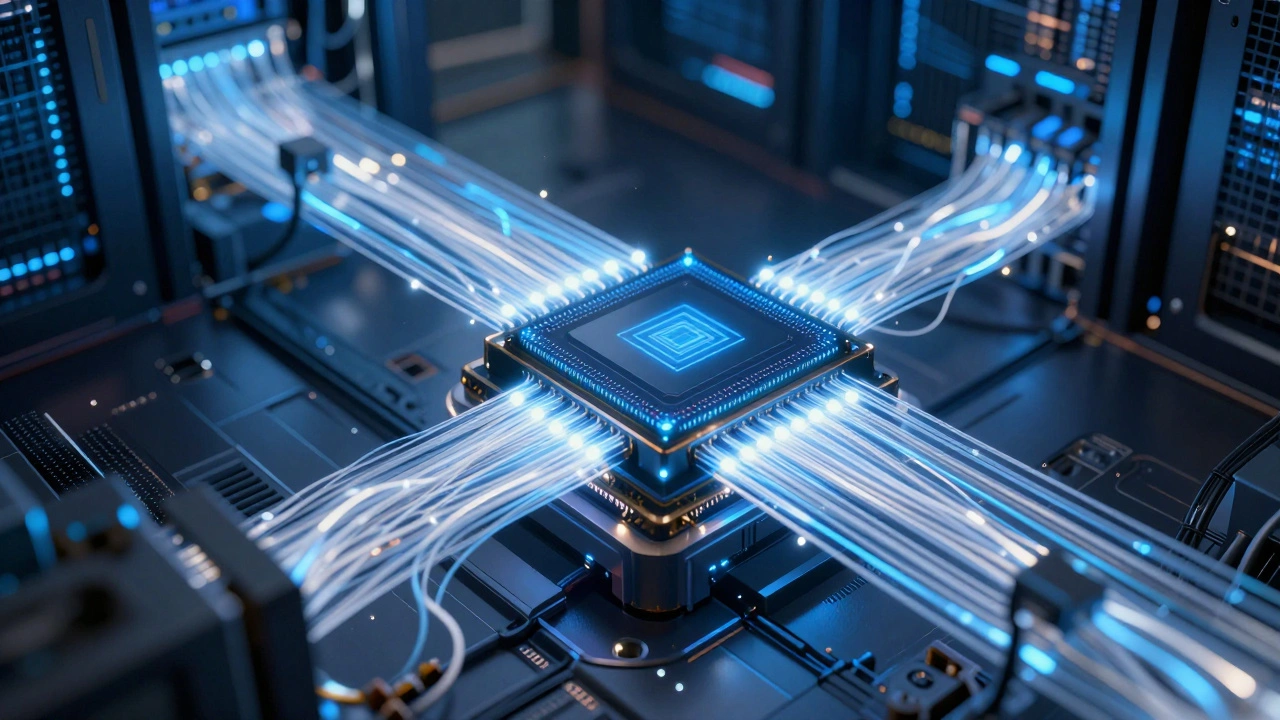
Forget copper wires. The future of data movement is light. Silicon photonics replaces electrons with photons-particles of light-to send data across chips and between them. Light doesn’t heat up like electricity. It doesn’t interfere with nearby signals. And it can carry way more data at once.That’s why companies like Nvidia, Broadcom, and Marvell are rushing into co-packaged optics (CPO). CPO doesn’t just put a fiber cable on a server. It builds optical circuits directly into the same package as the processor. Think of it like wiring a light bulb into your phone charger instead of using a separate cord. The result? Bandwidth jumps. Power drops by up to 3.5x. Heat shrinks. And data moves faster than ever.
Nvidia’s Quantum-X and Spectrum-X Photonics platforms are already in testing. They’re targeting AI data centers where every millisecond counts. By 2026, expect CPO to be in every major cloud and AI server. Broadcom is pushing 6.4 terabits per second. That’s 6,400 gigabits. A single chip. And it’s not just for networking-it’s for moving data between memory, AI accelerators, and CPUs without bottlenecks.
TSMC is taking this further. In 2026, they’ll launch a 3D stack: an electrical chip on top of a photonic chip. The gap between them? Less than 10 microns. That cuts signal delay by 10x and slashes power use by 75%. This isn’t a tweak. It’s a redesign of the entire chip architecture. Photonics is no longer an add-on. It’s core.
How Lithography Still Keeps Moore’s Law Alive-For Now
You can’t talk about chips without talking about photolithography. Yes, it’s old tech. But it’s still the engine. ASML’s EUV machines use lasers to vaporize tin, creating extreme ultraviolet light at 50,000 pulses per second. That light etches patterns smaller than a virus onto silicon.Current machines use a 0.33 numerical aperture (NA). That’s fine for 3nm chips. But the next wave-0.55 NA and beyond-will push us toward 1-trillion-transistor chips. That’s not science fiction. It’s happening in 2025. These machines are so complex, only ASML makes them. And they cost $350 million each. But if you’re building AI servers or quantum hardware, that’s the price of staying ahead.
It’s not just about making smaller features. It’s about packing more functionality into less space. And that’s where chiplets come in.
Chiplets and CMOS 2.0: The New Chip Architecture
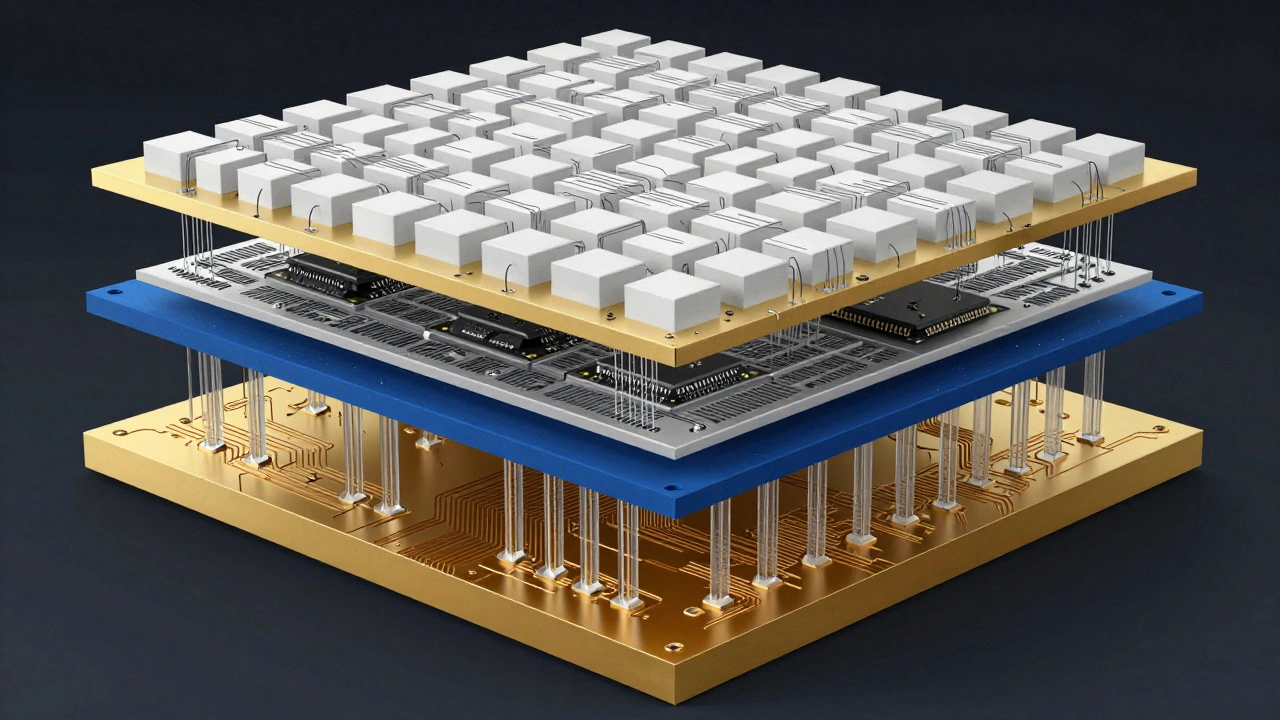
Forget one big chip. The future is many small ones. Chiplets let you build separate pieces-CPU, memory, AI engine, photonics-on different silicon slices. Then you stack them like LEGO bricks using advanced packaging. Each piece is optimized for its job. The CPU? Made with the latest transistor tech. The memory? Built with high-density DRAM. The photonics? Made with silicon light circuits.At imec, researchers are pushing this further with CMOS 2.0. Instead of building one thick chip, they stack 200-nanometer-thin layers. Each layer is made with the perfect process for its role. One layer handles logic. Another handles sensors. Another handles optical links. Then they’re bonded together electrically. The result? A single chip that acts like one unit-but is built like a team.
This isn’t just about performance. It’s about cost. You don’t need to build a $20 billion factory to make a new chip. You just need to make one new layer. That’s how innovation survives when Moore’s Law ends.
Quantum Computing: Not Faster, Just Different
Quantum computing doesn’t try to beat classical computers at their own game. It plays a different game entirely. Classical bits are 0 or 1. Quantum bits (qubits) can be 0, 1, or both at once. That’s called superposition. And when you link them? You get entanglement. Suddenly, you can solve problems that would take a supercomputer thousands of years-in seconds.But we’re not there yet. Today’s quantum machines are noisy. They’re called NISQ-Noisy Intermediate-Scale Quantum. They’re useful for experiments, but not production. The real breakthrough will come with early fault-tolerant quantum computers (eFTQC). These are systems with 100 to 1,000 logical qubits, error-corrected so they don’t collapse under their own noise.
And here’s the kicker: the first real applications aren’t in finance or AI. They’re in chemistry. Materials science. Drug discovery. At Los Alamos and NERSC, over 40% of supercomputer time is spent simulating molecules. That’s where quantum will make its first big dent. Why? Because quantum systems naturally mimic quantum behavior. You don’t need to approximate. You just simulate.
Cat Qubits: The Quiet Revolution
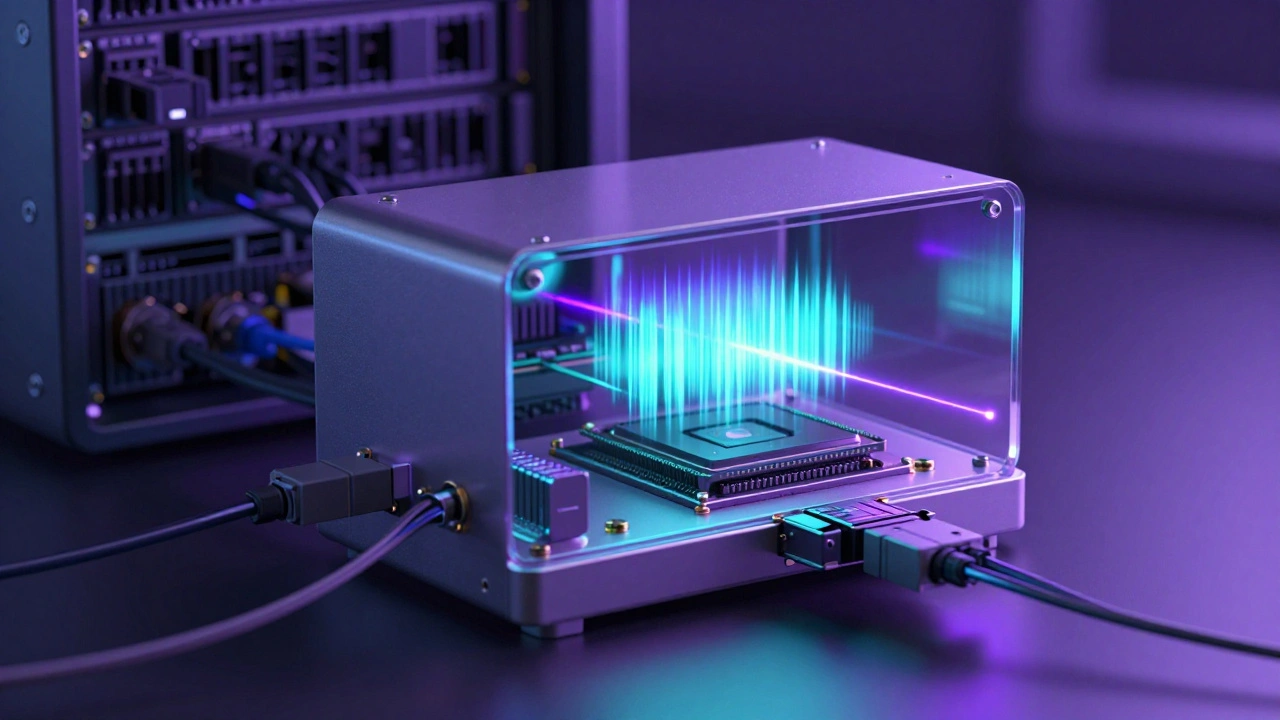
Most quantum systems use transmon qubits. They’re fragile. They need extreme cold. They’re slow. But a new type-cat qubits-changes everything.Cat qubits use the same hardware. Same cryogenic setup. Same control electronics. But they’re 90% more efficient. Why? Because they need fewer physical qubits to do the same job. Fewer qubits mean less wiring. Less cooling. Smaller footprint. Lower power. That’s huge.
Imagine a quantum accelerator sitting right next to a supercomputer in a data center. Not in a separate lab. Not needing a whole new power grid. Just plugged in. That’s what cat qubits make possible. And it’s not theory. Companies like Quantinuum and others are already testing them. By 2028, we’ll see the first eFTQC systems in HPC centers.
The Convergence: Light Meets Quantum
Here’s the real story. Photonics and quantum aren’t rivals. They’re partners.Quantum computers need precise control. That means lasers. That means optical fibers. That means photonics. And as quantum systems scale, they’ll need to talk to classical systems. That means optical links. High-bandwidth, low-latency, low-power. CPO.
The future isn’t quantum OR classical. It’s quantum AND classical-with photonics as the glue. AI chips will use CPO to move data. Quantum accelerators will use photonics to receive instructions and send results. And the whole system will be built on chiplets, stacked layers, and EUV lithography.
This isn’t a prediction. It’s already happening. Nvidia’s 2026 roadmap. TSMC’s 3D stacking. ASML’s 0.7 NA machines. Cat qubit prototypes. All of it is real. All of it is happening now.
What This Means for You
If you’re in tech, this isn’t about the future. It’s about next year. If your company still thinks Moore’s Law is just about more transistors, you’re already behind. The new metric isn’t transistor count. It’s:- How much data can you move per watt?
- Can your system integrate optical I/O?
- Are you preparing for quantum-classical hybrid workloads?
- Do you have the infrastructure to support chiplet-based designs?
Cloud providers, AI labs, semiconductor firms-they’re already building. If you’re not, you’re not just falling behind. You’re building on sand.
Is Moore’s Law really over?
Yes, in the traditional sense. You can’t keep shrinking silicon transistors forever. But Moore’s Law as a trend-faster, cheaper computing-isn’t dead. It’s being reinvented. Photonics and quantum computing are the new engines. They don’t double transistor count. They double performance per watt, reduce latency, and unlock entirely new types of computation.
What’s the difference between silicon photonics and quantum computing?
Silicon photonics improves classical computing by using light instead of electricity to move data. It’s faster, cooler, and more efficient. Quantum computing uses quantum mechanics to solve problems that are impossible for classical computers. One enhances what we already do. The other lets us do things we couldn’t before.
Why is CPO such a big deal?
CPO moves optical components from the edge of the server to right next to the processor. That cuts power use by up to 70%, boosts bandwidth, and reduces heat. For AI data centers, this isn’t a luxury-it’s survival. Without CPO, networks choke on data traffic. With it, you can scale AI models without needing a new power plant.
When will quantum computers be practical?
Early fault-tolerant quantum computers (eFTQC) with 100-1,000 logical qubits are expected between 2028 and 2030. But practical use starts earlier-with specialized applications like materials simulation in labs and HPC centers. You won’t run ChatGPT on one. But you might discover a new battery material using one.
Why are cat qubits better than transmons?
Cat qubits achieve the same performance as transmons but with 90% fewer physical qubits. That means less cryogenic cooling, smaller size, lower power, and simpler control electronics. It’s not a new material-it’s a smarter design. And it’s compatible with existing hardware. That’s why it’s the fastest path to scalable quantum.