
AI Impact Sector Calculator
Discover the projected economic value shift and job impact for your industry by 2030
Select Your Industry
Industry Impact Overview
Select an industry to see your results
By 2030, the way value is created across industries won’t just change-it will be rewritten. Artificial intelligence isn’t just another tool anymore. It’s the engine driving a trillion-dollar reallocation of economic power. Some sectors will explode in value. Others will lose ground fast. And the winners won’t be the ones with the biggest budgets-they’ll be the ones who understood where AI cuts deepest and moved first.
Banking: The Fastest Winner
Banking is already leading the AI race. In 2023, banks spent less than 5% of their tech budget on AI. By 2025, that number jumped to 12.3%. Why? Because AI doesn’t just help here-it replaces entire departments. Fraud detection systems now catch anomalies in milliseconds. Algorithmic trading adjusts portfolios in real time, reacting to global news before humans even read it. Personalized financial advice, once reserved for high-net-worth clients, is now available to millions through AI-powered chatbots that understand spending habits, risk tolerance, and life goals.McKinsey estimates banks could gain $200 billion to $340 billion annually by 2030 from AI. But here’s the catch: 60-70% of back-office tasks-loan processing, document verification, compliance checks-are automatable. That means fewer clerks, fewer analysts, fewer middle managers. The value doesn’t disappear-it shifts. Jobs in data science, AI ethics oversight, and customer experience design are growing faster than any other role in finance. A bank that still hires for manual reconciliation in 2028 will be outpaced by one that hires AI trainers and model auditors.
Retail and Consumer Goods: The $660 Billion Shift
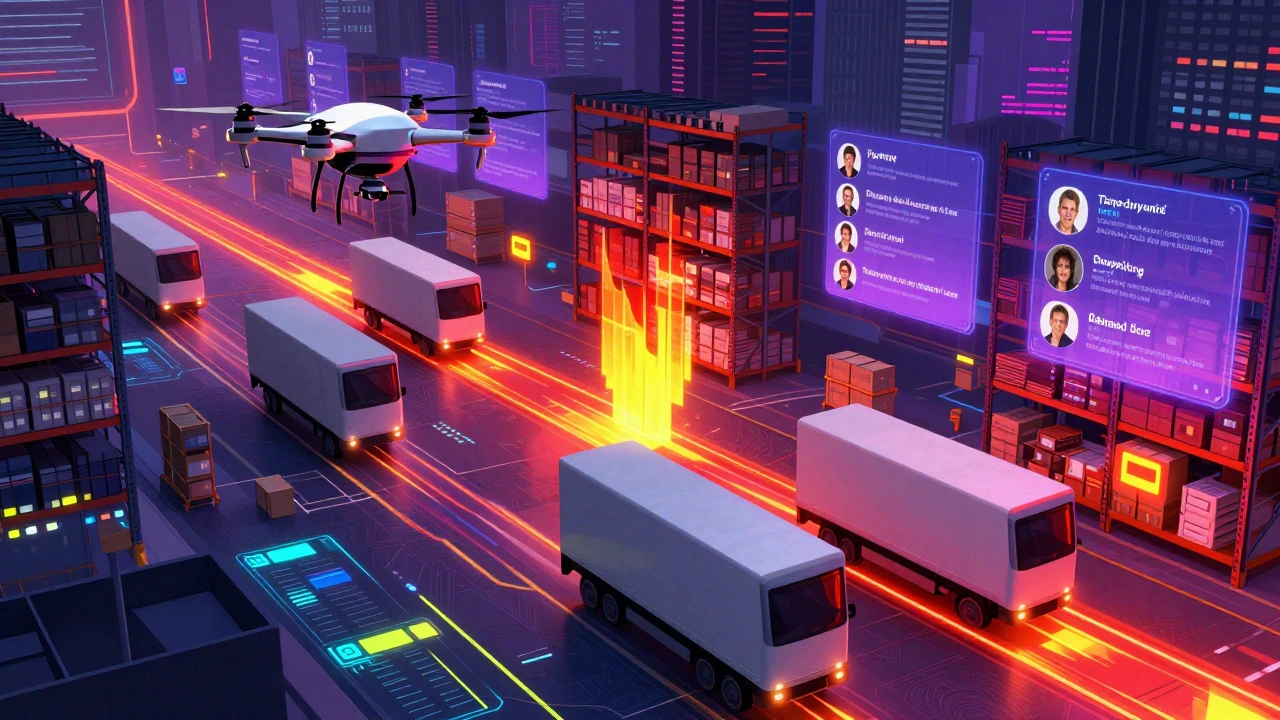
Retail is where AI makes the biggest dollar impact-up to $660 billion annually by 2030. That’s not just better recommendations on your phone. It’s a complete overhaul of how products move from warehouse to doorstep.AI predicts demand down to the store level. It knows that in Cleveland, a heatwave means 40% more bottled water and 20% fewer umbrellas. It adjusts inventory before shelves empty. It reroutes delivery trucks based on traffic, weather, and driver availability-all in real time. Personalization isn’t just "customers who bought this also bought…" anymore. It’s AI designing custom product bundles for individual shoppers based on their social media activity, past returns, and even local events.
But here’s the flip side: $220 billion of that $660 billion will shift away from traditional merchandising, logistics, and store operations. Warehouse workers? Fewer. Store clerks? Fewer. Data scientists? More. Retailers who cling to human-driven forecasting will see margins shrink. Those who invest in AI-driven supply chains will dominate.
Healthcare and Life Sciences: Slowing Discovery, Speeding Cures
Drug discovery used to take 10-15 years and cost over $2 billion per drug. Now, AI cuts that timeline in half. Insilico Medicine found a new drug candidate in just 18 months-75% faster than the industry average. That’s not a fluke. It’s the new baseline.AI scans millions of molecular structures, predicts which ones will bind to disease targets, and simulates side effects before a single lab test is run. This doesn’t replace scientists-it multiplies their output. A single team can now test what used to take five teams a decade. The value shift? From R&D labor to AI infrastructure and computational biology talent.
By 2027, 65% of radiology departments will use AI to flag tumors, fractures, and anomalies. Nurses and technicians won’t be replaced-they’ll be augmented. AI handles the initial scan review; humans focus on patient communication and complex cases. The result? Faster diagnoses, fewer errors, and a workforce that’s more skilled, not less. But hospitals still struggling with outdated imaging software or resistant staff will fall behind.
Manufacturing: Automation Meets Precision
Manufacturing doesn’t get the headlines, but it’s where AI quietly saves billions. Quality control used to mean inspectors walking the floor, checking parts by eye. Now, AI-powered cameras spot micro-cracks, misalignments, and material defects with 99.8% accuracy. That’s cutting defect rates by 45% by 2028.But the real value isn’t in spotting flaws-it’s in preventing them. AI analyzes sensor data from machines to predict when a bearing will fail, a conveyor belt will slip, or a weld will weaken. Predictive maintenance reduces downtime by 30-50%. That’s not just cost savings-it’s production continuity.
Engineering teams are using AI to simulate thousands of design variations overnight. What used to take weeks of prototyping now happens in hours. The result? Faster innovation cycles and products that perform better. But here’s the catch: 63% of manufacturers say integrating AI with legacy equipment is their biggest hurdle. Companies with modern factories will thrive. Those clinging to 20-year-old machines will see their margins erode.
Technology and Professional Services: The AI Amplifiers
Software developers, consultants, lawyers, and accountants aren’t being replaced-they’re being supercharged. AI writes 30% of routine code. It drafts contracts, summarizes legal briefs, and pulls financial insights from spreadsheets faster than any junior analyst.Wharton’s research shows AI boosts productivity in knowledge work by 25-40%. Accounting clerks are 35% faster. Teaching assistants can grade essays with AI help. Lawyers spend less time on discovery and more on strategy. The value isn’t in replacing these roles-it’s in letting experts focus on what only humans can do: judgment, empathy, negotiation.
But this creates a new divide. Workers who learn to use AI tools will earn more. Those who don’t will be sidelined. A 2025 survey found that 52% of data entry roles will become obsolete by 2030, while roles requiring AI collaboration will grow by 38%. The winners? People who can speak both human and machine.
Construction and Agriculture: The Laggards
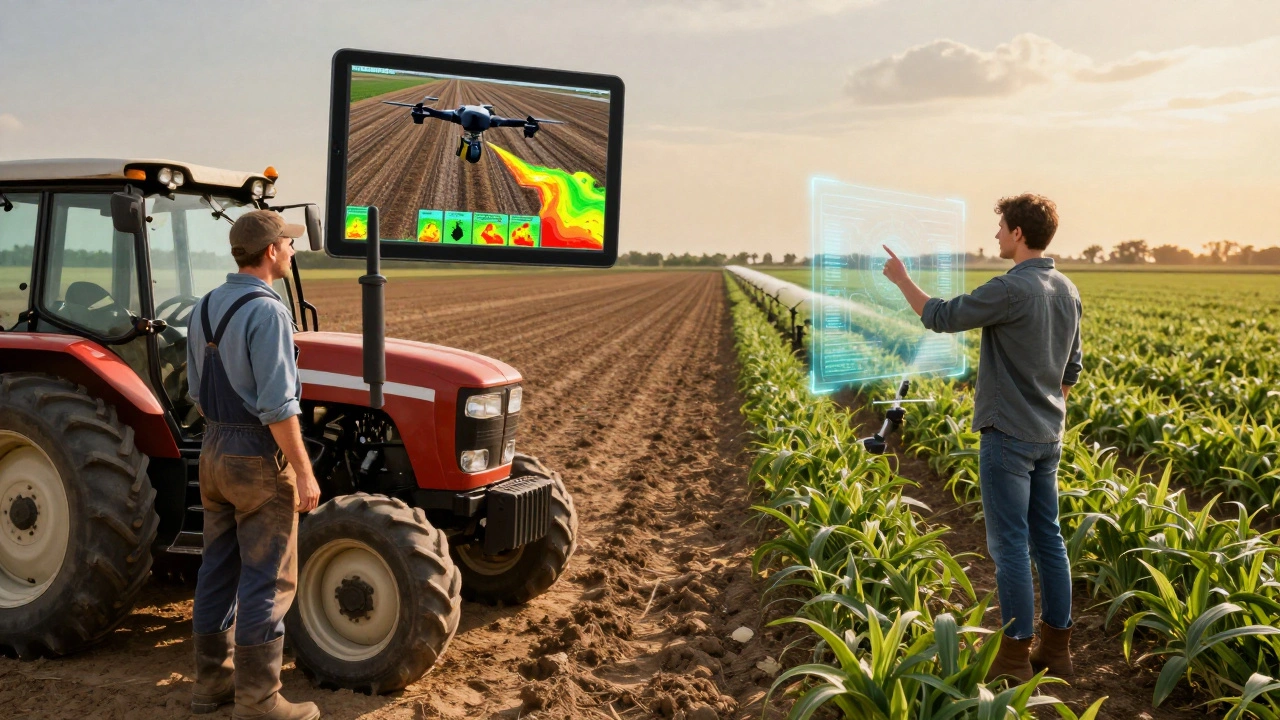
Not every sector is rushing in. Construction and agriculture are moving slowly. Only 42% of construction firms and 51% of farmers expect major AI changes by 2030. Why? High upfront costs, fragmented operations, and resistance to change.But that’s a mistake. AI can now analyze drone footage to track excavation progress, predict material shortages, and optimize crew schedules. In farming, AI monitors soil moisture, predicts pest outbreaks, and adjusts irrigation down to the square foot. These aren’t luxuries-they’re survival tools.
Companies that wait will lose to competitors who automate. A farm using AI to reduce water use by 20% and increase yield by 15% will outproduce one relying on decades-old methods. A construction firm using AI to cut project delays by 25% will win more bids. The gap between adopters and non-adopters will widen-and fast.
The Bigger Picture: Who Wins, Who Loses
By 2030, AI will have shifted $19.9 trillion in global economic value. That’s not a guess. It’s IDC’s projection. And it’s not spread evenly. Banking, retail, tech, and healthcare will capture the lion’s share. Manufacturing will follow closely. But sectors like education, public administration, and hospitality will see slower gains.Job losses? Yes. But not as many as feared. The World Economic Forum predicts 92 million jobs will be displaced by 2030-but 170 million new ones will be created. The difference? The new jobs require AI collaboration. Care workers, cybersecurity analysts, AI trainers, sustainability coordinators-they’re growing fastest.
The real risk isn’t automation. It’s stagnation. Companies that treat AI as a cost center instead of a growth engine will fall behind. Workers who refuse to learn new tools will be left out. Countries that don’t invest in AI-ready education will lose global competitiveness.
What You Need to Do Now
If you’re in business, don’t ask if you should adopt AI. Ask where it will hit hardest in your industry. Map out your most repetitive tasks. Which ones are rule-based? Which ones involve data? Those are your first targets.Train your team-not just on how to use AI tools, but on how to work with them. The best employees won’t be the ones who code the best algorithms. They’ll be the ones who know how to ask the right questions, interpret the results, and make decisions when the AI gives conflicting answers.
And if you’re in a slow-adopting sector-construction, agriculture, local government-don’t wait for someone else to lead. Start small. Pilot one AI tool. Measure the results. Scale what works. The window to catch up is closing fast.
By 2030, AI won’t be something you use. It’ll be something you’re defined by. The question isn’t whether you’ll be affected. It’s whether you’ll lead-or follow.
Which industries will gain the most from AI by 2030?
Banking, retail, life sciences, and high technology are projected to gain the most. Banking could see $200-340 billion in annual value from AI-driven fraud detection, trading, and customer service. Retail and consumer goods could gain up to $660 billion through hyper-personalization and supply chain optimization. Life sciences will accelerate drug discovery, cutting development time by 30-50%. Tech companies benefit from AI building AI-faster software development, automated testing, and intelligent infrastructure.
Will AI eliminate more jobs than it creates?
No. The World Economic Forum estimates 92 million jobs will be displaced by 2030, but 170 million new roles will emerge. The net gain is 78 million jobs. But the new jobs aren’t the same. They require skills in AI collaboration, data interpretation, and human-AI teamwork. Roles like AI trainers, cybersecurity analysts, care workers, and sustainability coordinators are growing fastest. Jobs that are purely repetitive-like data entry or manual bookkeeping-are the ones at highest risk.
Why are some sectors adopting AI slower than others?
Construction and agriculture lag because of legacy systems, fragmented operations, and high upfront costs. Many farms and construction sites still use paper records and analog tools. Integrating AI requires new sensors, software, and training-something small businesses struggle with. Regulatory hurdles also slow healthcare adoption, while creative industries worry about quality control. But the biggest barrier is mindset: waiting for someone else to prove it works instead of testing it themselves.
How will AI affect wages and income inequality?
AI will widen the gap between those who use it and those who don’t. Workers who learn to leverage AI tools will see wage growth-accounting clerks, nurses, and teachers using AI have seen productivity boosts of 28-42%. But workers in automatable roles-like clerks, drivers, and assembly line workers-face wage stagnation or job loss. Companies that invest in AI upskilling reduce this gap. Those that don’t will see a two-tier workforce: high-skill, high-pay roles and low-skill, low-pay ones.
Is AI’s economic impact sustainable after 2030?
Yes, but the fastest gains happen before 2030. Wharton’s model shows AI will boost global productivity by 1.5% by 2035 and nearly 4% by 2075. The biggest value shifts-automation of routine tasks, new product development, and service personalization-will peak by 2030. After that, growth slows as adoption saturates. But the economic structure won’t revert. Sectors that lead in AI will maintain their advantage. The real question isn’t whether AI’s impact lasts-it’s whether societies adapt fast enough to share its benefits.