
Sovereign Cloud Cost Calculator
Calculate Your Sovereign Cloud Costs
Estimate how much more expensive sovereign cloud services could be for your organization based on usage patterns, industry requirements, and workload types.
What Exactly Is a Sovereign Cloud?
A sovereign cloud isn’t just another cloud service. It’s a system built so that data never leaves a country’s borders - not even metadata. If you’re a government agency in France, a hospital in Germany, or a bank in Brazil, your data stays on servers physically located within your nation. Foreign governments, even those running the cloud provider, can’t access it. This isn’t about convenience. It’s about legal control. After GDPR hit in 2018, companies realized they couldn’t rely on global cloud giants like AWS or Azure to guarantee data stayed put. Sovereign clouds were born out of that fear: what if the U.S. government demanded access to data stored in Germany? Or China accessed financial records in Brazil? Sovereign cloud providers like Oracle, T-Systems, and Nutanix now offer infrastructure where the physical location, access rights, and even who manages the servers are locked to local laws.
Why Data Residency Isn’t Just a Box to Check
Most people think data residency means storing data in the right country. It’s deeper than that. Sovereign clouds require that every piece of data - logs, backups, temporary files, even system metadata - stays within jurisdictional lines. A single log file sent to a U.S.-based analytics tool can break compliance. That’s why providers like T-Systems and VMware enforce strict routing rules. Your data can’t be routed through a global backbone. It has to stay on local networks. For organizations in the EU, this isn’t optional. Nearly 92% of EU member states now require sovereign cloud use for public sector data, according to Dr. Elena Rodriguez of the European Commission. In healthcare, 63% of providers use sovereign clouds to meet GDPR and local patient privacy laws. In finance, it’s 57%. But here’s the catch: defining where “local” ends is messy. Is a data center in Poland enough for a company based in Poland? What if the parent company is in the U.S.? Sovereign clouds force you to answer those questions before you even start migrating.
Security: More Control, More Complexity
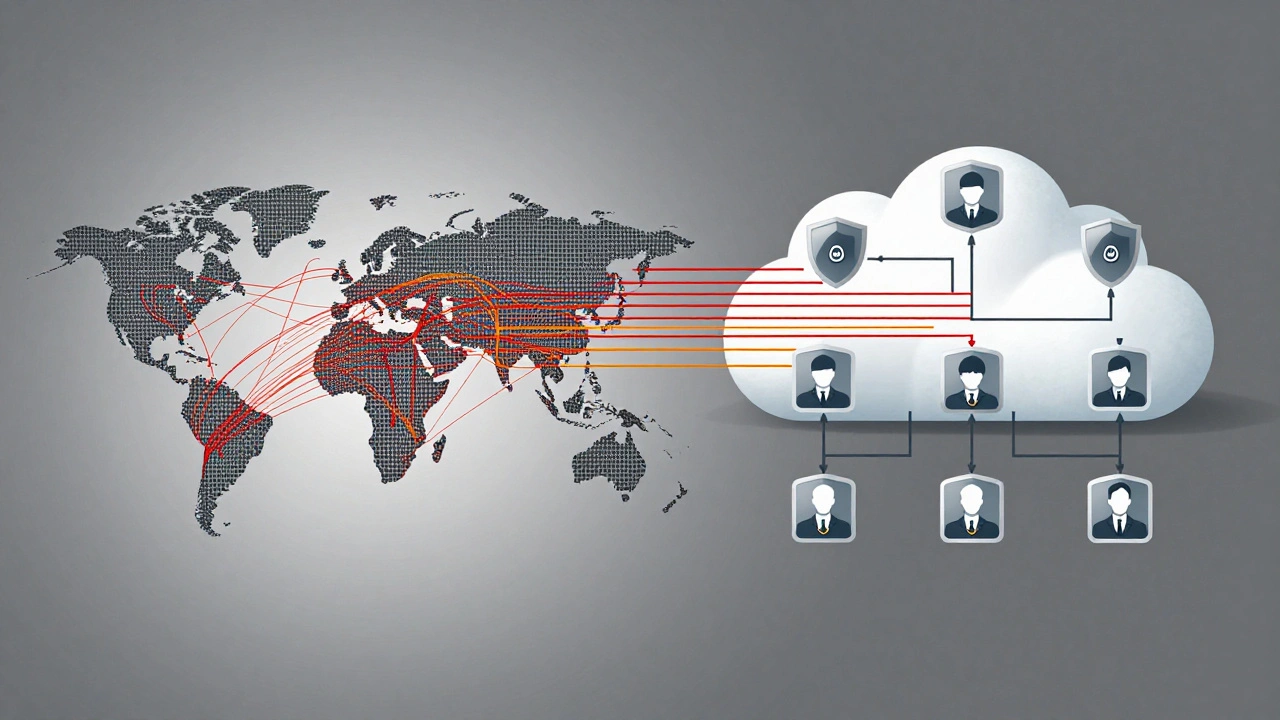
Sovereign clouds promise tighter security - and they deliver, but not without tradeoffs. The biggest win? Customer-managed encryption keys. Unlike public clouds where the provider holds the keys, sovereign clouds let you control them. Only your team, or approved local personnel, can decrypt data. Access is restricted by citizenship or security clearance. In France’s Ministry of Defense, only French nationals with top-level clearances can manage the VMware sovereign cloud. That’s a huge step up from standard cloud setups. But this control comes with a cost. Localized management interfaces become new targets. IEEE Security & Privacy found in 2024 that sovereign clouds introduce fresh attack surfaces because they rely on smaller, less-tested local systems. A breach in a small German data center isn’t just a local incident - it’s a national one. And patching? Slower. Updates need local approval. No quick global rollout. You trade speed for control. And that means your security team needs new skills: not just cloud security, but understanding local legal frameworks and how to audit them.
Performance: Slower, But Predictable
Let’s be honest: sovereign clouds aren’t fast. They’re 8-12% slower than global public clouds when handling international traffic. Why? Because they can’t use the most efficient global routes. If your server is in Spain and you’re sending data to a partner in Japan, your request can’t go through the fastest path - it has to stay within Europe first, then find a compliant exit point. That adds latency. But for workloads that stay local - like a hospital’s patient records accessed only by staff in the same city - performance is nearly identical to public clouds. VMware’s 2024 benchmarks show processing speeds are within 5% of standard clouds for localized tasks. The real performance win? Compliance audits. Because everything is contained and documented locally, audit turnaround drops by 30%. A German healthcare provider cut audit time from 12 weeks to 3. That’s not just efficiency - it’s risk reduction. If you’re in a regulated industry, faster audits mean fewer fines and less stress. But if your business relies on real-time global collaboration - say, a multinational supply chain - sovereign clouds can become a bottleneck.
Costs: You Pay for Control
Sovereign clouds cost 20-25% more than standard cloud services. Why? You’re paying for exclusivity. Dedicated data centers. Local staff. Custom compliance layers. Limited economies of scale. TrueFullstaq confirmed this in 2024: “There are challenges regarding costs and functionality.” A Scandinavian financial firm spent $2.3 million over nine months trying to migrate to a sovereign cloud - and abandoned it because their legacy systems didn’t play nice. That’s not rare. 38% of negative reviews on Gartner Peer Insights cite “higher than expected operational costs.” But here’s what those costs buy you: 100% compliance. Public clouds, even with added controls, only hit 65-75% compliance rates. For government agencies or banks, that gap isn’t a risk - it’s a dealbreaker. You’re not just paying for servers. You’re paying for legal certainty. And that’s worth it… if you need it. For startups or non-regulated businesses? It’s overkill.
Implementation: It’s Not Plug-and-Play
Don’t expect to flip a switch. Enterprise deployments take 6 to 12 months. The average is 8.2 months for companies with over 5,000 employees, according to Nutanix. Why so long? Three big hurdles: data classification, legacy integration, and jurisdictional boundaries. You have to figure out what data is sensitive enough to move. That’s 78% of all implementation challenges. Then you have to connect old systems - think 15-year-old mainframes - to a modern sovereign cloud. That’s 65% of projects hitting delays. Finally, you need to define exactly where your data can and can’t go. Is your cloud in Canada? What if your users are in the U.S.? That’s 52% of organizations struggling. Successful teams use phased approaches: start with non-critical apps, build governance policies, train staff, then move sensitive data. Training alone takes 120-160 hours per administrator. And 89% of successful projects bring in external consultants. This isn’t a DIY project. You need experts who know both cloud infrastructure and local regulations.

Who’s Using It - And Who Shouldn’t
Government agencies lead adoption. In Europe, 68% of public sector organizations use sovereign clouds. Financial services are next, at 52%. Healthcare follows at 63%. These are sectors where a data breach isn’t just a PR problem - it’s a legal disaster. But outside regulated industries? Adoption is low - just 12% of commercial applications. Why? Because most businesses don’t need it. A SaaS startup selling apps to global customers doesn’t benefit from being locked into one country. Their users are everywhere. Their data flows globally. For them, a sovereign cloud adds cost and complexity without value. The smartest organizations today use hybrid models: 83% of enterprises keep sensitive data in sovereign clouds and run everything else - marketing tools, HR systems, analytics - on standard public clouds. That’s the sweet spot: control where you need it, flexibility where you don’t.
The Bigger Picture: Fragmentation vs. Cooperation
There’s a quiet war brewing. On one side, sovereign clouds protect national interests. On the other, they risk breaking global cooperation. MIT’s Professor David Chen warns that strict data residency rules are slowing cross-border cyber threat sharing. In 2025, 43% of international cyber intelligence exchanges were delayed because data couldn’t legally cross borders. Imagine a pandemic outbreak. Health data needs to flow fast between countries. But if each nation has its own sovereign cloud, sharing becomes a legal minefield. Analysts from Computer Weekly say 76% fear “sovereign cloud silos” could hurt global responses to climate change, pandemics, or cyberattacks. The industry is starting to respond. T-Systems introduced “layered sovereignty” in 2026 - a model where you pick which rules matter most: data residency? Access control? Infrastructure ownership? You don’t have to lock everything down. It’s a step toward flexibility. But the tension remains. Sovereign clouds give you control. But control comes at the cost of connection.
What’s Next? The Road to 2028
The sovereign cloud market is exploding. It’s projected to hit $127.5 billion by 2028, growing at nearly 28% a year. Why? Because more countries are passing data localization laws - especially in Asia-Pacific and Latin America. Microsoft launched Azure Government Sovereign Regions in May 2025. Oracle expanded to 12 new countries in January 2026. VMware added tools to visualize data boundaries. The future isn’t about choosing between global and local. It’s about mixing them. Hybrid models will dominate. Modular sovereignty - letting you pick and choose your rules - will become standard. But the core truth won’t change: if your data is sensitive, regulated, or critical to national interests, you don’t get to outsource control anymore. Sovereign clouds aren’t a trend. They’re the new baseline for trust.
Is a sovereign cloud the same as a private cloud?
No. A private cloud is owned and operated by a single organization, but it can still run on global infrastructure - meaning data could cross borders. A sovereign cloud is defined by legal jurisdiction. It must keep data within national borders, restrict access to local personnel, and comply with local laws - even if it’s hosted by a third party like Oracle or VMware. Sovereignty is about legal control, not ownership.
Can I use a sovereign cloud for my startup?
Only if you’re in a regulated industry - healthcare, finance, government - or if your customers demand it. For most startups, the 20-25% higher cost and slower international performance aren’t worth it. Stick with public clouds unless you’re legally required to use a sovereign solution. If you plan to scale into Europe or Canada later, plan ahead. Migrating later is expensive and disruptive.
Do I need to retrain my IT team?
Yes. Your team needs to understand both cloud infrastructure and local data laws. Training averages 120-160 hours per administrator. Skills like AWS or Azure certification aren’t enough anymore. You need people who know GDPR, CLOUD Act, or your country’s equivalent. Many organizations hire external consultants for the first year. Don’t skip this step - misconfigurations can lead to massive fines.
What happens if my sovereign cloud provider gets hacked?
The breach is still contained within your country’s borders - that’s the point. But because the infrastructure is less common than global clouds, it may have fewer security patches and less scrutiny. Local providers often lack the resources of AWS or Azure. You need stronger internal monitoring, regular audits, and strict access controls. Customer-managed encryption keys help - even if the system is breached, the data stays encrypted. But you’re responsible for protecting those keys.
Can I move data out of a sovereign cloud later?
It’s complicated. Most sovereign cloud contracts require you to delete or return data in a way that meets local laws. You can’t just export it to a global cloud. Some providers offer data portability tools, but they’re slow and expensive. If you think you might need to move data later, design your architecture with exportability in mind from day one. Otherwise, you could get locked in.