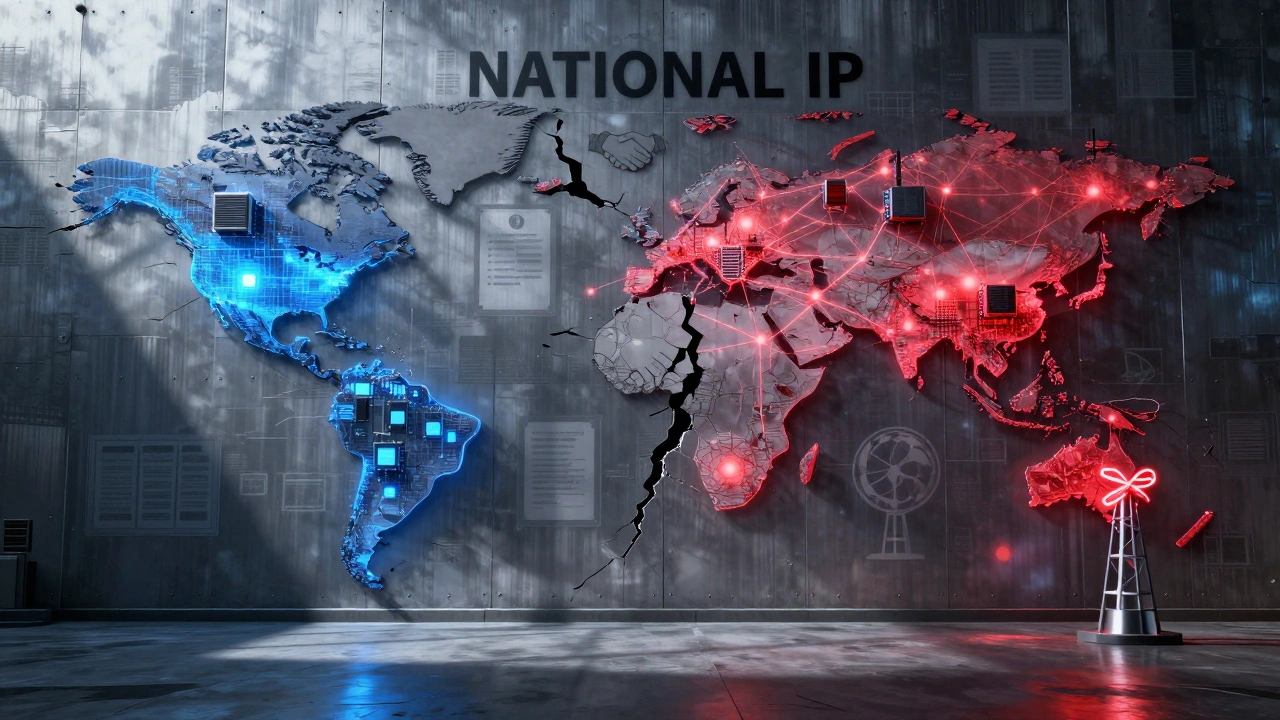
When a country starts treating patents like border checkpoints, you know the global tech game has changed. It’s no longer just about who invents the fastest chip or the smartest AI-it’s about who owns it, who controls it, and who gets to use it. This isn’t science fiction. It’s happening right now, and it’s reshaping how innovation moves-or doesn’t move-across borders.
Techno-nationalism isn’t just protectionism with a tech twist. It’s a full-blown state strategy where governments treat advanced technology as a core element of national security. Think of it this way: if a nation’s power used to be measured in tanks and aircraft carriers, now it’s measured in quantum processors, 5G networks, and semiconductor supply chains. And the tool they’re using to lock that power down? Intellectual property.
Why IP Is the New Weapon
For decades, international patent systems were built on the idea that sharing innovation drives global progress. The World Intellectual Property Organization (WIPO) helped standardize how patents are filed and enforced across countries. But that era is fading. Today, countries like China, the U.S., and the EU are using IP laws not just to protect inventions, but to control them.
China leads the world in patent filings-outpacing the U.S., Germany, and Japan combined in patents, utility models, trademarks, and industrial designs. That’s not an accident. It’s policy. The Chinese government funds R&D, directs state-backed firms to file aggressively, and uses IP as leverage in trade talks. Meanwhile, the U.S. has tightened export controls on semiconductor tech, blocked Chinese firms from buying critical components, and pushed allies to exclude Huawei from 5G networks-all under the banner of national security.
IP used to be a bridge between nations. Now, it’s becoming a wall.
The Mechanics of Techno-Nationalism
Techno-nationalism doesn’t just rely on tariffs or sanctions. It’s a toolkit:
- Targeted subsidies: Governments pour billions into domestic AI startups, quantum labs, and battery manufacturers-with strings attached. If you take federal money, you can’t license your tech to rivals abroad.
- Preferential procurement: Public agencies are required to buy from local firms, even if foreign options are cheaper or better. The U.S. government now mandates that federal agencies prioritize American-made semiconductors.
- Foreign investment filters: Countries screen foreign buyers of tech firms. Germany blocked a Chinese company from acquiring a robotics firm. India now requires approval for any foreign investment in AI or cybersecurity startups.
- Data sovereignty laws: If your data flows through a server in France, it must follow French rules. Same in Brazil, Russia, and Indonesia. These aren’t just privacy laws-they’re tech control mechanisms.
- Talent pipelines: Nations are racing to attract engineers. Canada’s global talent stream, Japan’s tech visa fast-track, and Australia’s innovation visas aren’t just immigration policies-they’re strategic investments in human IP.
These aren’t isolated moves. They’re parts of a coordinated system designed to build self-sufficient national tech ecosystems. The goal? Reduce dependence on foreign suppliers, prevent tech leakage, and turn innovation into a strategic asset.
The Fracturing of Global Innovation
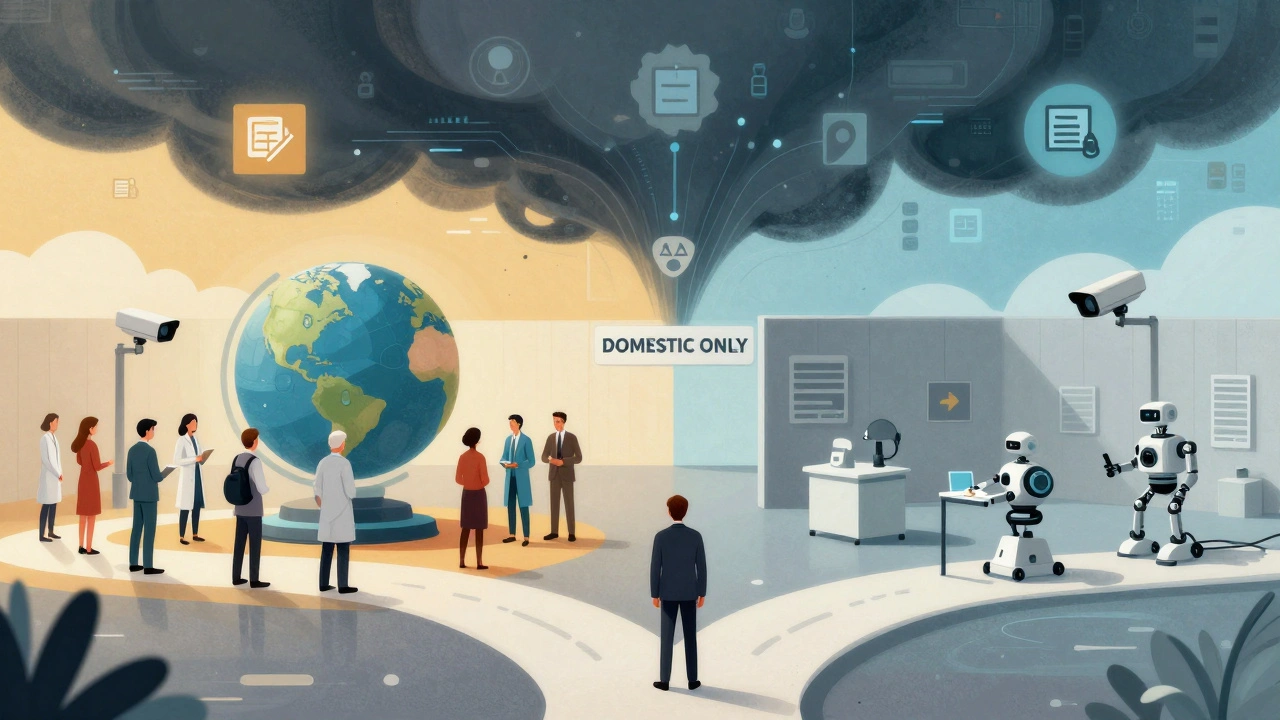
When countries start treating IP as national property, collaboration breaks down. Universities that once co-published research now avoid joint projects. Startups hesitate to license their tech abroad for fear of being cut off. Research labs in Europe and Asia are quietly shifting focus from global partnerships to domestic-only initiatives.
Take the example of green tech. Climate change doesn’t care about borders. But techno-nationalism does. Countries are hoarding patents for lithium-ion batteries, carbon capture systems, and hydrogen fuel cells. They’re restricting exports of rare earth minerals needed for wind turbines. The result? Global decarbonization slows down because innovation isn’t shared-it’s locked away.
And it’s not just clean energy. The same pattern is emerging in AI training data, medical diagnostics, and drone navigation systems. Each country is building its own version of the future, with incompatible standards, fragmented datasets, and isolated software stacks. What was once a single global internet is now becoming a patchwork of national intranets.
Who Pays the Price?
At first glance, techno-nationalism looks like a win for domestic industries. More jobs. More investment. More control. But the hidden costs are piling up.
- Slower innovation: When companies can’t access global talent or research, progress stalls. A 2025 study by the OECD found that tech firms operating under strict national IP rules developed new products 30% slower than those with cross-border access.
- Higher prices: Without global competition, prices rise. U.S. consumers are already paying 20-40% more for domestically produced semiconductors than for imported equivalents.
- Supply chain fragility: Relying on one country for critical tech is risky. When a flood hit a Taiwanese chip factory in 2024, global car production halted. Techno-nationalism didn’t prevent that-it made it worse by discouraging diversified sourcing.
- Legal chaos: A startup in Berlin might hold a patent approved in Germany, but if its algorithm uses data from Brazil and is sold in Canada, it’s caught in a web of conflicting laws. Compliance costs for multinational tech firms have doubled since 2020.
The irony? The biggest losers aren’t foreign firms. They’re the small innovators-the startups, researchers, and independent developers-who can’t afford to navigate 20 different regulatory systems.

Is There a Middle Ground?
Some argue we need to double down on national control. Others say we should return to open global systems. But the truth is more complicated.
There’s room for both national security and global cooperation-but only if we redefine what “protection” means. Instead of locking IP behind borders, countries could:
- Create security-clearance licensing: Allow trusted international partners to access sensitive tech under strict oversight, not blanket bans.
- Build multilateral IP pools: For critical technologies like climate tech or pandemic response tools, nations could pool patents and grant non-exclusive licenses globally.
- Adopt origin-based rules: Rather than blocking all foreign tech, require transparency on where components come from and how data flows. This lets nations protect their interests without cutting off innovation.
- Strengthen enforcement over exclusion: Instead of banning Chinese AI firms, enforce existing IP laws against theft. If a company steals a patent, punish the theft-not the nationality.
The old model of “global innovation for all” is gone. But the new model of “every nation for itself” is unsustainable. The future belongs to those who can protect their interests without isolating themselves.
What This Means for Businesses
If you’re running a tech company today, you can’t ignore this shift. Here’s what you need to do:
- Map your IP geography: Where are your patents registered? Where are your data centers? Which countries’ laws affect your operations? Document it.
- Build dual-track R&D: Have one team focused on global collaboration, another on domestic compliance. Don’t assume what works in one market will work everywhere.
- Monitor policy shifts: The U.S. CHIPS Act, the EU’s Digital Operational Resilience Act, and China’s new data security law aren’t static. They evolve monthly.
- Engage with policymakers: Don’t wait to be regulated. Get involved in industry groups, trade associations, and public consultations. Your voice matters.
The companies that survive won’t be the ones with the biggest budgets. They’ll be the ones that adapt fastest to a world where innovation is no longer free to roam.