Maritime Escalation Risk Calculator
Assess Regional Tension Risk
Input key parameters to calculate the risk of maritime escalation based on real-world Indo-Pacific conflict dynamics. This tool uses data from the article to model how specific actions push situations into higher risk zones.
The Indo-Pacific is no longer just a geographic term-it’s the center of gravity for global power. From the crowded shipping lanes of the South China Sea to the undersea cables that carry most of the world’s internet traffic, this region is where nations are testing limits, pushing boundaries, and risking conflict over control of the seas. As of 2025, the balance of power here is fraying. It’s not about who has the biggest navy anymore. It’s about who can bend the rules without firing a shot-and who’s left holding the bag when the game gets dangerous.
China’s Maritime Machine: Coercion Below the Threshold of War
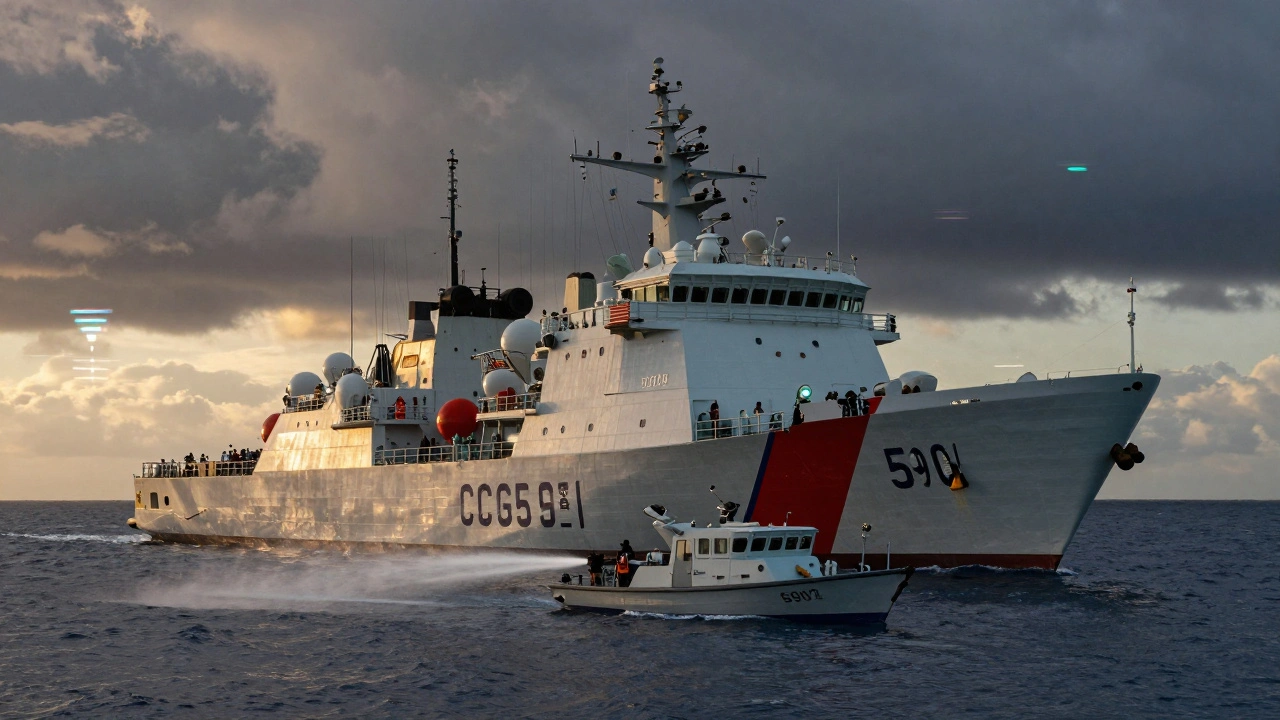
China doesn’t need to declare war to change the map. Its Coast Guard fleet, now 135 vessels strong, includes ships like the CCG 5901-an 8,200-ton behemoth that dwarfs the coast guard cutters of most regional nations. These aren’t just patrol boats. They’re mobile enforcement platforms, armed with water cannons, reinforced hulls, and surveillance gear that tracks every ship’s movement. Since 2020, China’s maritime enforcement actions have jumped by 200%. In the first nine months of 2025 alone, there were 147 documented incidents where Chinese vessels shadowed, blocked, or rammed ships from other countries.
The most alarming tactic? AIS spoofing. Automatic Identification Systems are supposed to tell ships where each other are. China now manipulates these signals to make vessels disappear or appear elsewhere-creating confusion, misleading patrols, and covering up illegal operations. Since 2022, AIS spoofing incidents have tripled. It’s digital camouflage on the open sea.
And then there’s the islands. Seven artificial islands in the Spratlys, built from scratch on reefs, now host 3,000-meter runways, radar domes, and missile-ready positions. These aren’t just outposts-they’re forward operating bases that let China project power 1,500 miles beyond its shores. The U.S. calls this militarization illegal under international law. China says it’s just building on its own territory. Neither side is backing down.
The Flashpoints: Where the Next War Could Start
There are three places on the map where things could explode tomorrow.
Second Thomas Shoal-a tiny reef in the South China Sea-is now a standoff that’s lasted over a decade. The Philippines keeps a small troop of marines on an old, rusting ship called the BRP Sierra Madre. China sends coast guard vessels to surround it, cutting off food, water, and fuel. In October 2025, a Chinese ship deliberately rammed a Philippine government vessel near Thitu Island. That wasn’t a mistake. It was the first time a nation’s maritime asset was physically destroyed in this dispute. General James Mattis called it a shift from "grey zone" to "amber zone"-meaning it’s no longer about pressure. It’s about damage.
The Taiwan Strait is the other big one. China conducts 14 military drills near Taiwan every few months. In 2025, those drills included live-fire exercises, long-range missile simulations, and naval blockades. The U.S. responds with freedom of navigation operations-8 in 2025 alone. But Taiwan isn’t just a military issue. It’s a chip issue. China needs advanced semiconductors to build its next-gen warships and drones. The U.S. cut off 45% of China’s access to these chips. That’s not just a trade sanction. It’s a strategic chokehold.
The Yellow Sea might seem quiet, but it’s a powder keg. South Korea and China have been fighting over fishing rights since 1998. In 2025, there were 28 violent clashes between their coast guards. One side fires water cannons. The other uses ramming. No one’s dying-yet. But the pattern is clear: when diplomacy fails, force fills the gap.
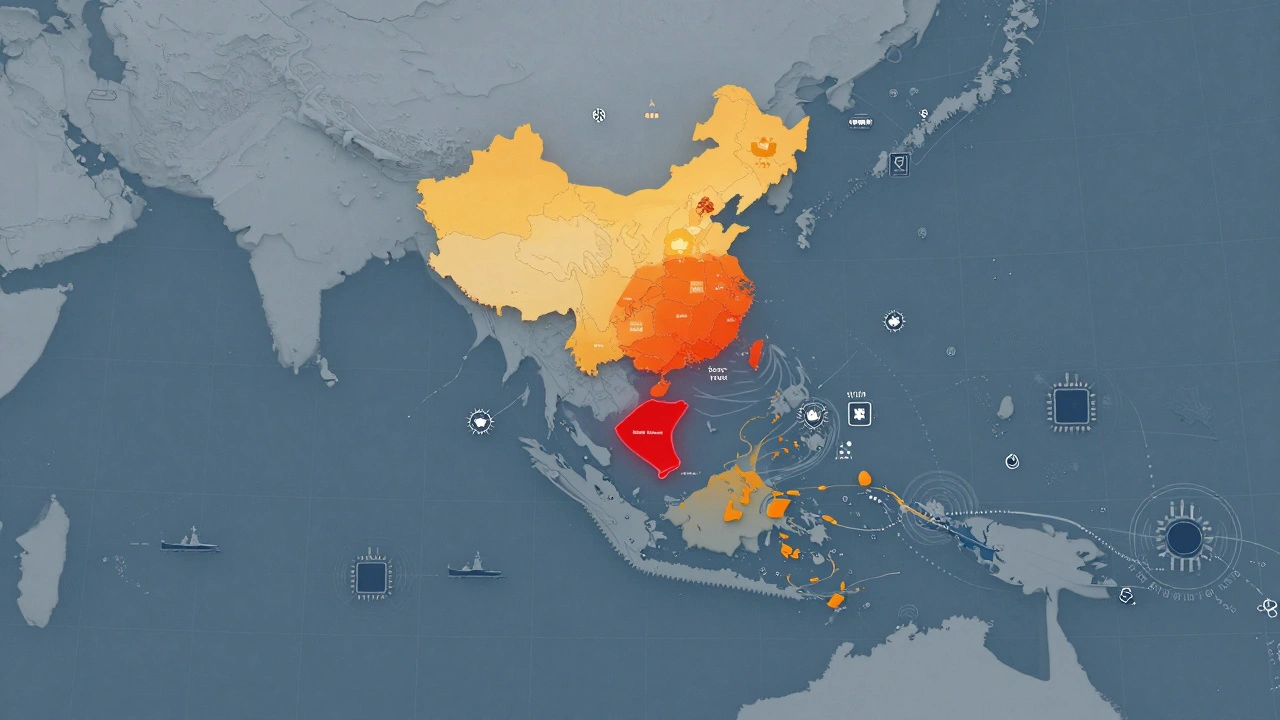
Who’s Standing Up? The Regional Response
Not every country in the region wants to pick a side. But most can’t afford to sit still.
Japan has gone from pacifist to powerhouse. Its JS Izumo, a 19,500-ton helicopter carrier, now carries F-35B fighter jets. That’s not a typo. Japan, which banned offensive military capabilities after WWII, now has a ship that can launch stealth fighters. It’s a quiet revolution.
Vietnam plays a smarter game. It doesn’t challenge China directly. Instead, it quietly strengthens ties with the U.S., Japan, and India. In May 2025, Vietnam hosted the USS Ronald Reagan-the first U.S. aircraft carrier visit in decades. Vietnam also bought six Russian Kilo-class submarines and added 12 new coast guard vessels since 2022. It’s hedging. Not choosing. Surviving.
India is doing the same. It’s holding border talks with China while also doing joint naval exercises with South Korea and Malaysia. India’s goal isn’t to fight China. It’s to make sure it’s not alone if China decides to act.
The Philippines is stuck in the middle. It’s been pushed into a U.S. alliance, but its leaders keep trying to negotiate with Beijing. In October 2025, Manila announced it was negotiating a "memorandum of understanding" with China to reduce tensions. Analysts called it meaningless-because it avoids the real issue: sovereignty. Without addressing who owns the islands, any agreement is just a pause button.
Trade, Sanctions, and the Invisible War
The real war isn’t fought with missiles. It’s fought with trade.
China controls 12 of the world’s 20 busiest ports. Chinese firms operate 86 terminals across 43 countries. That means they can delay shipments, block cargo, or even reroute supply chains-all without firing a shot. If a country opposes China, it risks having its goods stuck at a Chinese-run port for weeks.
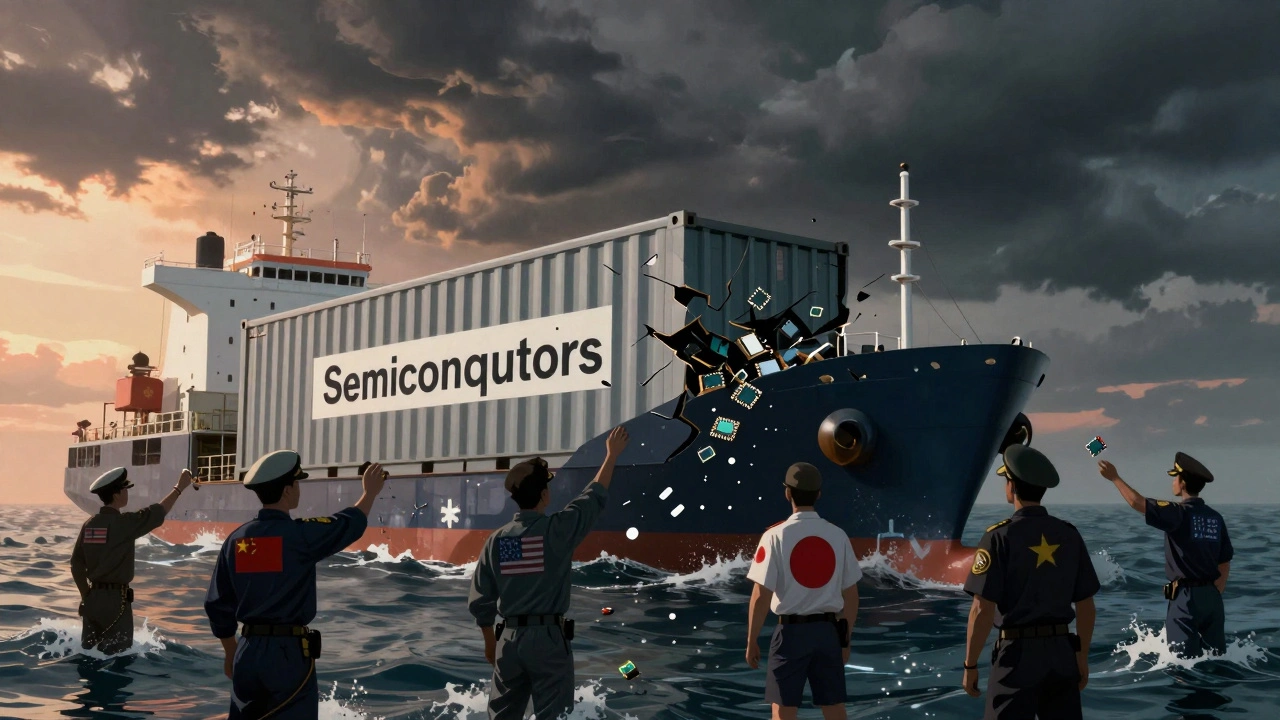
The U.S. response? Sanctions on semiconductor exports. China’s navy needs advanced chips for targeting systems, radar, and drone control. Cutting off 45% of China’s supply is like removing its eyes and ears. It’s slow. It’s quiet. But it’s effective.
And then there’s the Indian Ocean-a blind spot. China built its first overseas military base in Djibouti in 2017. Now it operates 17 commercial ports along the Maritime Silk Road, many with dual-use potential. If war breaks out in the Indo-Pacific, China could cut off oil shipments from the Middle East by controlling chokepoints like the Strait of Malacca, which carries 25% of global trade.
The Rules That Don’t Work
There’s a rulebook for this. It’s called the Code for Unplanned Encounters at Sea (CUES). Adopted by ASEAN in 2014, it was meant to prevent accidents-like ships bumping into each other or using water cannons. It cut accidental clashes by 45%. But China never signed it. The U.S. and allies follow it. China doesn’t. So when Chinese ships ram Philippine vessels, they’re not breaking a rule. They’re operating outside one.
The same goes for the 2001 Provisional Measure Zone between South Korea and China. It was supposed to prevent fishing fights. In 2025, there were 28 violent coast guard clashes anyway. Rules only work if everyone believes in them. And right now, China doesn’t.
What Comes Next?
The numbers don’t lie. Defense spending in the Indo-Pacific hit $615 billion in 2025-32% of the world’s total. China’s official budget is $230 billion. Independent estimates say it’s closer to $350 billion. The U.S. is pouring billions into AUKUS, building Virginia-class submarines for Australia. Japan is upgrading its fleet. India is expanding its navy. Vietnam is buying submarines. The Philippines is begging for help.
But here’s the problem: most of these nations don’t have the training. The Naval Postgraduate School found it takes 18 to 24 months just to learn how to use modern surveillance systems. Smaller nations like the Philippines lack the technicians, the data networks, the satellites. They’re outgunned-not just by weapons, but by knowledge.
And the experts? A September 2025 Lowy Institute survey found 78% believe a military clash between major powers is "more likely than not" before 2030. The most dangerous flashpoint? Not Taiwan. Not the Yellow Sea. Second Thomas Shoal. Because it’s small. It’s ignored. And it’s getting hotter every day.
There’s no easy fix. Diplomacy is broken. Rules are ignored. Sanctions hurt, but they don’t stop. Militarization is accelerating. And the world’s most important shipping lanes are becoming a battlefield.
What’s at stake isn’t just control of the sea. It’s control of the global economy. If the Indo-Pacific slips into chaos, the price of everything-from your phone to your gasoline-will rise. And no one will be able to say they didn’t see it coming.
Why is the South China Sea so important?
The South China Sea is critical because it carries $5.3 trillion in annual trade-nearly a third of global maritime commerce. It’s the main route for oil, gas, electronics, and raw materials moving between Asia, Europe, and the Americas. China claims nearly all of it under its nine-dash line, but international law, specifically UNCLOS, says no country can own the sea. That clash-between China’s claims and international norms-is the core of the dispute.
What’s the difference between grey zone and amber zone tactics?
Grey zone tactics are actions that fall between peace and war-like coast guard ships blocking another nation’s vessel, or AIS spoofing to hide movements. They’re designed to avoid triggering a military response. Amber zone means crossing the line into deliberate physical harm-like ramming a ship or damaging infrastructure. The October 2025 ramming of the Philippine vessel marked the shift from grey to amber, signaling a new level of aggression.
Why can’t ASEAN unite against China’s actions?
ASEAN is made up of 10 nations, many of which depend heavily on trade with China. Countries like Cambodia and Laos rely on Chinese investment. Vietnam and the Philippines want to push back, but they can’t act alone. Without a unified stance, China can pick off nations one by one. ASEAN’s principle of consensus means one country can block any action-so nothing gets done.
How do trade sanctions affect China’s military?
The U.S. and allies have cut off China’s access to advanced semiconductors, which are essential for modern naval systems-like targeting computers, radar, and drone control. According to CSBA, this affects 45% of China’s advanced naval electronics production. While China is trying to build its own chips, it’s years behind. This isn’t about punishing China-it’s about slowing its military modernization.
Is the U.S. military presence in the Indo-Pacific enough?
The U.S. conducts freedom of navigation operations (FONOPs) and has alliances with Japan, Australia, and the Philippines. But its forces are stretched thin. China’s Coast Guard has 135 vessels. The U.S. Coast Guard has only 45. The U.S. Navy is powerful, but it can’t be everywhere at once. The real strategy now is building regional partners-like training Filipino coast guard crews or supplying Vietnam with patrol boats-so the U.S. doesn’t have to carry the whole burden.
What role do undersea cables play in this conflict?
75% of global internet traffic flows through undersea cables in the Indo-Pacific. China owns or controls 12 of the world’s 20 busiest ports, giving it access to cable landing stations. If conflict breaks out, cutting or damaging these cables could shut down financial systems, military communications, and internet access across Asia. Protecting them is now a national security priority-not just a tech issue.
Why is the Second Thomas Shoal more dangerous than Taiwan?
Taiwan is a political flashpoint, but it’s also heavily monitored and understood. The Second Thomas Shoal is a tiny reef with a few Filipino marines on an old ship. It’s low-profile, poorly defended, and surrounded by Chinese vessels. There’s no clear red line. A single misstep-a collision, a water cannon blast, a mistaken order-could trigger a military response. Experts like Dr. Bonnie Glaser say it’s more likely to spark war because it’s unpredictable and lacks diplomatic safeguards.