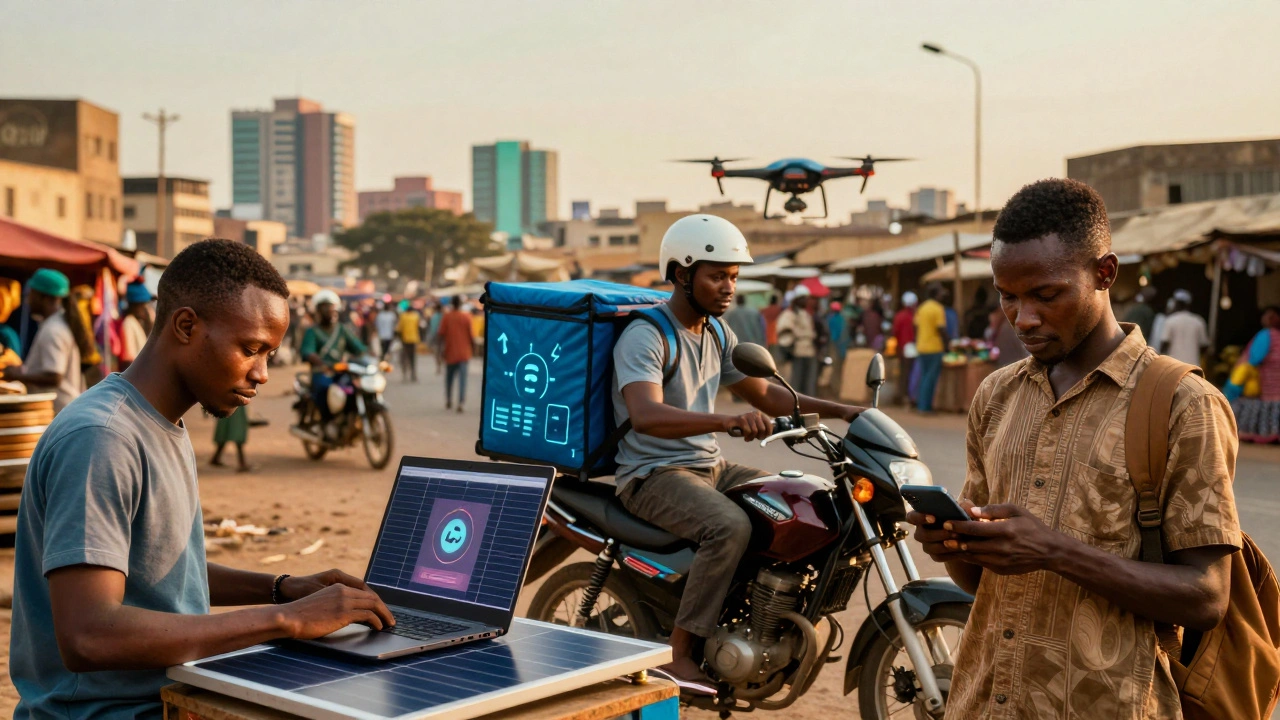
By 2026, more than 60% of Africa’s 1.5 billion people are under 25. That’s not just a number-it’s a tidal wave of energy, ambition, and potential. For the first time in history, a continent has more young people than ever before, and they’re not waiting around for permission to build the future. They’re hacking together businesses, coding apps, delivering medical supplies on motorbikes, and selling goods across borders using mobile money. But here’s the problem: the system isn’t built to handle them.
What Exactly Is the Youth Bulge?
The youth bulge isn’t accidental. It’s the result of decades of high birth rates and falling child mortality. In 1995, Africa had 750 million people. Today, it has 1.5 billion. By 2050, it could hit 2.5 billion. And the biggest chunk? Young people. About 830 million Africans are between 15 and 35. That’s more than the entire population of India. Meanwhile, Europe’s working-age population is shrinking. Japan’s is collapsing. Africa’s is exploding.This isn’t just about numbers. It’s about timing. The window to turn this into an economic advantage-called the demographic dividend-is narrow. If Africa can get these young people into productive jobs, education, and entrepreneurship by 2040, it could add $500 billion to its annual GDP. If it fails? It could lose $50 billion a year to unemployment, crime, and brain drain.
Why Jobs Are the Missing Piece
Every year, 10 to 12 million young Africans enter the job market. Only about 3 million formal jobs are created. That leaves 7 to 9 million without stable income. And here’s the kicker: most of those formal jobs aren’t even in Africa. They’re in Europe, the U.S., or Canada-taken by people who had access to better schools, networks, and visas.What’s left? Hustle culture. On Reddit’s r/Africa, 78% of young respondents say they juggle two or three income streams. One person might teach English online in the morning, deliver food via motorcycle at noon, and run a small e-commerce store selling secondhand clothes after dark. No employer. No health insurance. No safety net. Just survival.
And yet, these are the people who built LifeBank, a Nigerian startup that delivers blood and vaccines using drones and motorbikes. They secured $12 million in funding in late 2025. They now employ 1,200 people. But stories like that are rare. Most youth-led startups fail within three years. Why? According to the World Bank, 79% cite lack of access to finance. 63% say bureaucracy and red tape kill them. And 57% admit they just didn’t have the right skills.
The Digital Leap: Africa’s Hidden Advantage
Here’s the surprising truth: Africa doesn’t need to copy Silicon Valley. It’s building its own version.Mobile money is everywhere. In East Africa, 74% of adults use it. In Ghana, digital exports hit $6.2 billion in 2025-19% of the continent’s total. E-commerce is growing fast: from $22 billion in 2021 to $75 billion in 2026. And it’s not just tech hubs like Lagos or Nairobi. A young woman in rural Rwanda sells handmade jewelry via WhatsApp. A teenager in Senegal builds AI tools for local farmers using free online courses.
But here’s the catch: only 47% of Africans have reliable internet. Only 43% have steady electricity. That means innovation happens in spite of the system, not because of it. Many startups use solar panels to power their offices. Others rely on mobile hotspots because fixed broadband is too slow or expensive. The best digital businesses in Africa aren’t the ones with the most funding-they’re the ones that work around broken infrastructure.

Education Isn’t Keeping Up
You can’t build a digital economy with a 1980s classroom. Right now, only 34% of African graduates have skills that match the needs of the digital economy, according to the African Union’s 2025 Education Report. Most schools still teach memorization, not problem-solving. Coding? Optional. Financial literacy? Rare. Critical thinking? Almost never tested.Rwanda is trying something different. Since 2022, its “Smart Africa” program has trained over 127,000 young people in digital skills. Result? 78% got jobs within six months. That’s not magic. It’s targeted training: web development, data entry, digital marketing-all taught in local languages, with real clients and real projects. Other countries are starting to copy it. But the scale needed? Massive. The International Labour Organization says it takes 18 to 24 months of focused training to get someone job-ready in the digital economy. And Africa needs to train tens of millions.
The Infrastructure Gap
You can’t run a startup on a phone if the power goes out for 12 hours a day. You can’t ship goods if the roads are dirt tracks. You can’t grow a business if your bank account gets frozen because of a corrupt official.Afrobarometer’s 2025 survey found that 87% of young entrepreneurs blame unreliable electricity as their biggest hurdle. 76% say transportation is a nightmare. 68% say internet is too slow or too expensive. The African Development Bank says Africa needs $100 billion a year to fix this. Right now, it’s getting $45 billion.
But innovation is filling the gaps. In off-grid areas, 32% of youth-led businesses now use solar power. Mobile apps bypass banks-people pay each other via MTN Mobile Money or Airtel Money. Startups use WhatsApp and Telegram instead of CRM software. They’re not waiting for governments to fix things. They’re building around them.
Corruption and Governance: The Silent Killer
Let’s be honest: talent isn’t enough if the system is rigged. Transparency International says corruption costs Africa $148 billion a year. That’s more than the entire GDP of 25 African countries combined. It’s not just about bribes. It’s about contracts going to connected insiders. It’s about licenses that take six months to get because someone’s uncle works at the ministry. It’s about taxes that change overnight because a politician needs cash.Dr. Ibrahim Assane Mayaki, former head of NEPAD, calls this the “resource curse.” Countries with oil, minerals, or diamonds often see their wealth sucked up by elites while everyone else stays poor. The youth bulge won’t help if the money never reaches them.
But change is happening. Forty-two of Africa’s 54 countries now have data protection laws. That’s up from 28 in 2021. The AfCFTA launched its Digital Trade Protocol in January 2026 to make cross-border e-commerce easier. It could create 12.3 million jobs by 2030. These aren’t just policies-they’re signals. They say: “We’re trying.”

What Works: Real Examples
Not every story ends in failure. Here’s what’s working:- LifeBank (Nigeria): Uses tech to deliver blood and vaccines. Now operates in Ethiopia too. Created 1,200 jobs.
- Rwanda’s Smart Africa: Trained 127,000 youth. 78% placed in jobs.
- Flutterwave (Nigeria): A fintech company that processes payments across Africa. Valued at $3 billion. Started by two Nigerian engineers.
- Andela (Pan-African): Trains software developers and places them with global companies. Now operates in 10 countries.
What do these have in common? They didn’t wait for permission. They solved real problems. They used technology. They hired locally. And they scaled fast.
The Window Is Closing
Africa has a 15- to 20-year window to make this work. After 2040, the population will start aging. The dependency ratio-how many non-working people each worker supports-will rise. That’s what happened in Asia. That’s what’s happening in Europe. Africa can avoid it-but only if it acts now.The Brookings Institution says if Africa creates 25 million formal jobs a year, it could add $1.2 trillion to its GDP by 2035. That’s more than the entire economy of South Africa today. But if it doesn’t? The World Bank warns that climate change and AI automation could destroy 22% of African jobs by 2040. And without jobs, young people don’t just become unemployed. They become desperate.
The Path Forward
So what needs to happen?- Train millions for digital jobs. Focus on coding, data, digital marketing, and financial literacy-not theory, but practice.
- Fix infrastructure. Solar power, mobile networks, and roads aren’t luxuries. They’re the foundation.
- Cut red tape. If starting a business takes 60 days and 12 forms, no one will try.
- Invest in local entrepreneurs. Not just big foreign investors. Give young Africans access to capital, mentorship, and markets.
- Hold leaders accountable. No more corruption. No more stolen money. The youth aren’t asking for handouts-they’re asking for a fair shot.
This isn’t about charity. It’s about economics. Africa’s youth aren’t a burden. They’re the most valuable asset the continent has ever had. The question isn’t whether they can drive growth. It’s whether the system will let them.