Trade Finance Risk Assessment Tool
Business Profile
Risk Assessment
Based on current market conditions, we'll assess your exposure to three key risk factors:
Risk Assessment Results
Overall Trade Finance Risk Exposure
High RiskLiquidity Risk
75% exposure
Insurance Risk
68% exposure
Counterparty Risk
82% exposure
Recommended Actions
- ● Evaluate local development bank funding sources
- ● Review insurance policy exclusions for tariff changes
- ● Implement geopolitical risk checklist for counterparties
- ● Explore tokenized trade finance pilots
- ● Consider bilateral arrangements with buyers
Based on current market conditions as of 2026. Your business is exposed to increased counterparty risks due to fragmented markets and regulatory changes. The system is increasingly selective, favoring businesses with geopolitical expertise.
Trade finance isn’t broken-it’s being rebuilt. What used to be a predictable system of letters of credit, bank guarantees, and standardized insurance is now a patchwork of conflicting rules, rising tariffs, and shaky counterparties. In 2026, if you’re still treating global trade like it’s 2020, you’re already behind. The real question isn’t whether trade finance is under stress-it’s whether your business can survive the new rules.
Why Liquidity Is No Longer Guaranteed
Money market funds (MMFs) used to be the silent engines of global trade. They soaked up short-term cash from exporters and lent it to importers, keeping the wheels turning. In December 2025, U.S. MMFs held $7.65 trillion. That’s up $800 billion in just one year. Sounds solid, right? But here’s the catch: regulators are forcing them to hold more cash on hand. The SEC now requires higher liquidity buffers. The UK’s FCA and Hong Kong’s SFC are pushing weekly liquid assets up from 30% to 50%. That means less money gets lent out. Less lending means tighter credit for importers. And when importers can’t get financing, exporters don’t get paid.This isn’t theoretical. A textile manufacturer in Bangladesh reported last month that its usual U.S. buyer canceled a $4.2 million order-not because demand dropped, but because the buyer’s bank couldn’t secure the trade finance line anymore. The bank’s MMF partner had hit its liquidity cap. That’s the new reality: liquidity isn’t just scarce, it’s rationed.
And the cost? Central banks may still be cutting rates, but the floor is higher than before. By the end of 2026, U.S. and UK rates will settle around 3.25%. The EU at 2.19%. That’s not the near-zero world of 2021. Higher rates mean higher trade finance fees. Smaller businesses, especially in emerging markets, are getting squeezed out. UNCTAD found that commodity-dependent economies are seeing revenue losses not from lower prices, but from simply not being able to move goods at all.
Insurance Isn’t What It Used to Be
Trade credit insurance used to cover you if a buyer defaulted. Now, it’s becoming a minefield. Insurers are pulling out of high-risk corridors. One major insurer quietly stopped offering coverage for shipments from China to the EU if the goods carried any component subject to U.S. export controls. Why? Because the legal risk is too high. If the U.S. later decides those components violate sanctions, the insurer could be liable-even if the transaction was legal at the time.Meanwhile, tariffs are rewriting the rules. The U.S. slapped 145% tariffs on some Chinese goods. China responded with 125%. These weren’t just numbers on paper-they changed behavior. Companies started stockpiling. A German automaker told Bloomberg it doubled its inventory of Chinese-made wiring harnesses, even though demand hadn’t changed. That means more trade finance is now tied up in warehousing, not movement. And insurers don’t know how to price that.
Specialized trade insurance products are emerging, but they’re expensive and narrow. One new policy from a London-based firm covers only shipments between the U.S. and India if the goods are declared as “non-strategic components.” That’s not a safety net-it’s a loophole. And if you’re in Nigeria or Vietnam, you might not even qualify. The insurance layer that once protected small exporters is now a luxury for the few who can navigate the fine print.
Counterparty Risk Is No Longer About Credit Scores
Before 2023, counterparty risk meant checking a company’s balance sheet. Now, it’s about geopolitics. Is the buyer’s bank tied to a sanctioned entity? Does the seller use a port that might be blocked next month? Is the product made with rare earths from a region under export controls?Take cobalt. The Democratic Republic of Congo exports 70% of the world’s supply. But China now restricts exports of cobalt processed in third countries. So a battery maker in Mexico that buys cobalt from a Swiss refiner could suddenly find its shipment blocked-not because of anything it did, but because the Swiss refiner used Congolese ore that China now considers “tainted.”
Traditional credit scoring tools can’t map this. Banks are scrambling to build new risk models, but most still rely on legacy systems built for stable, globalized trade. A 2025 audit by J.P. Morgan found that 68% of trade finance approvals in emerging markets were based on outdated data. The result? A spike in defaults among firms that looked fine on paper but were caught in invisible supply chain traps.
And it’s not just private companies. Governments are becoming unpredictable counterparties. The U.S. is using the International Emergency Economic Powers Act (IEEPA) to impose tariffs without congressional approval. Those tariffs are now under Supreme Court review. So a business signs a contract today, only to find next week that the tariff rate changed retroactively. Who pays? The buyer? The seller? The bank that issued the letter of credit? No one knows. And no insurance policy covers that.
Tokenization Is the Wild Card
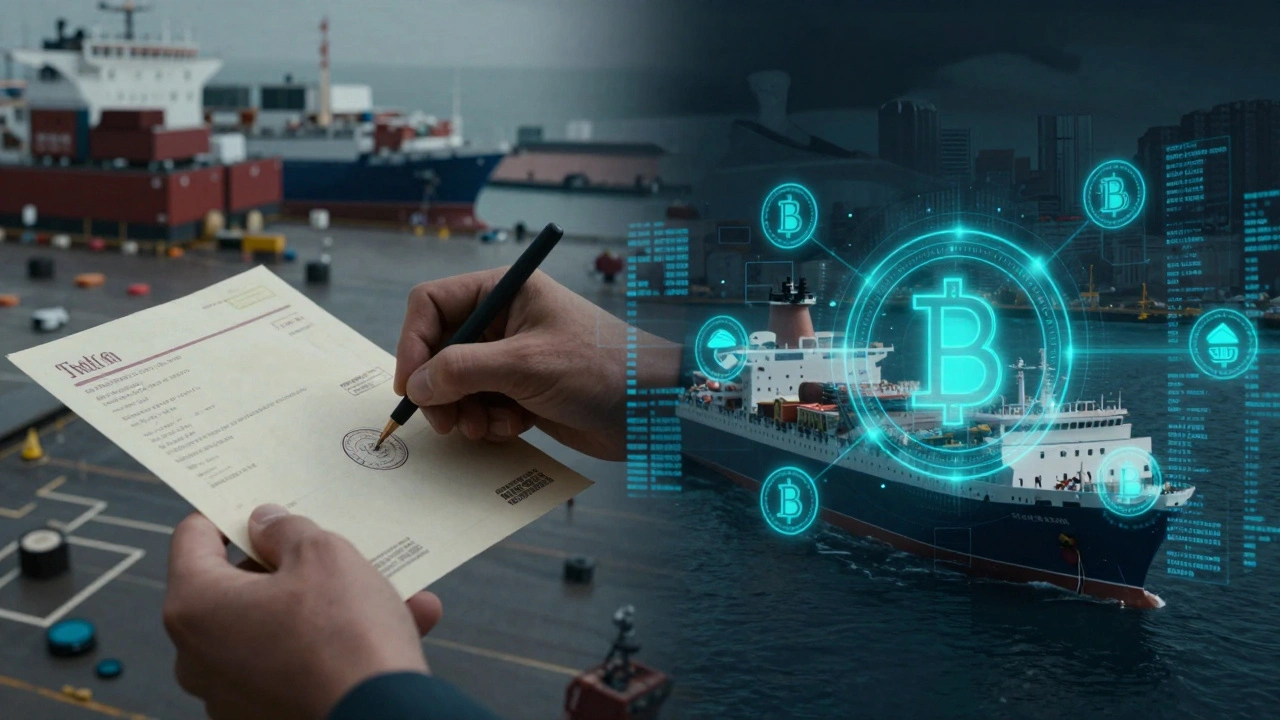
There’s one glimmer of hope: tokenization. It’s not magic, but it’s the closest thing we have to a fix. Tokenized assets-like digital bonds or blockchain-based letters of credit-can settle in minutes instead of days. They’re transparent, auditable, and programmable. If a payment is due only after customs clearance, the smart contract can trigger it automatically.Some banks are already testing it. HSBC and Standard Chartered ran a pilot last year moving $120 million in trade finance across Southeast Asia using tokenized instruments. Settlement time dropped from 7 days to 4 hours. Costs fell by 40%. The tech isn’t perfect yet-regulators are still figuring out how to tax it, and cybersecurity risks remain-but it’s growing fast.
And it’s not just about speed. Tokenization can help with insurance too. Imagine a digital policy that auto-adjusts based on real-time tariff data. If a new 25% tariff is announced, the policy recalculates coverage and notifies all parties. That’s not science fiction-it’s being built right now.
But here’s the catch: tokenization only works if both sides are on the same platform. And in fragmented markets, that’s rare. A Chinese exporter might use a blockchain system approved by the People’s Bank of China. The U.S. importer uses a different one cleared by the Fed. They can’t talk to each other. So tokenization might solve the problem for some, but deepen the divide for others.
Who’s Getting Left Behind?
The biggest winners in this new system are large multinationals with legal teams, in-house treasury departments, and access to private capital. They can hedge, stockpile, and lobby. They can afford to pay 20% more for insurance because they know they’ll get paid.The losers? Small and medium exporters in Africa, Latin America, and parts of Asia. A coffee cooperative in Colombia told UNCTAD they lost 30% of their buyers last year-not because their beans were worse, but because banks wouldn’t finance shipments to buyers in countries with volatile tariff regimes. They tried to switch markets, but their logistics partners didn’t have the capacity. Their insurance didn’t cover the new routes. Their bank didn’t understand the new rules.
And the cycle continues. Fewer buyers → less revenue → less access to credit → fewer exports → slower development. UNCTAD warns this isn’t a temporary dip. It’s a structural shift. Countries that relied on trade to grow are now stuck.
What Can You Do Now?
If you’re in trade finance, here’s what matters:- Know your counterparties’ exposure-not just to credit risk, but to tariff changes, export controls, and sanctions. Build a geopolitical risk checklist.
- Reevaluate your liquidity buffers-don’t assume MMFs will always be there. Diversify funding sources. Look at local development banks or regional trade pools.
- Ask your insurer what’s excluded-not just what’s covered. Many policies now have hidden carve-outs for “regulatory change” or “geopolitical event.”
- Test tokenized platforms-even if you’re not ready to go all-in, try a pilot. The tech is moving faster than regulation.
- Build bilateral relationships-if the multilateral system is broken, go direct. Barter deals, prepayments, and long-term contracts are making a comeback.
Trade finance isn’t dying. It’s becoming more selective. The rules are changing. The players are changing. The tools are changing. If you don’t adapt, you won’t just lose business-you’ll get locked out.
Why are money market funds reducing trade finance lending?
Regulators in the U.S., UK, and Hong Kong are requiring money market funds to hold more liquid assets-up to 50% weekly liquidity, up from 30%. This makes the funds safer but reduces the amount of cash available to lend for trade. As a result, banks have less capital to issue letters of credit or provide buyer financing, tightening credit for importers and exporters.
Can trade credit insurance protect me from tariff changes?
Most traditional trade credit policies do not cover tariff increases or regulatory changes. They only cover buyer insolvency or non-payment. Some newer, specialized policies now offer limited coverage for tariff-related disruptions, but they’re expensive, have strict conditions, and are often unavailable to small exporters. Always check the exclusions section.
What’s the biggest risk for small exporters today?
The biggest risk isn’t default-it’s exclusion. Small exporters are being locked out of financing because banks can’t assess their counterparty risk in fragmented markets. Their buyers may be in countries with volatile tariffs, or their goods may use components under export controls. Without clear data or access to new tools like tokenization, banks simply say no.
Is tokenization a real solution or just hype?
It’s a real solution, but not a universal one. Tokenized trade finance has cut settlement times by over 90% and reduced costs by 40% in pilot programs. But it only works if both parties use compatible platforms. In fragmented markets, where different countries use different systems, interoperability remains a major hurdle. It’s promising, but adoption is uneven.
How are emerging markets adapting to trade fragmentation?
Many are turning to bilateral deals and stockpiling. For example, cobalt buyers are bypassing global markets and negotiating direct deals with suppliers. Others are building regional trade alliances, like the African Continental Free Trade Area, to reduce reliance on volatile Western markets. But these shifts require new skills, new partnerships, and new financing models-things most small businesses don’t have access to.
Trade finance in 2026 isn’t about who has the best credit score. It’s about who understands the rules before they change. The system is no longer global. It’s fractured. And the winners aren’t the biggest-they’re the ones who see the cracks before everyone else.