Content Label Verification Tool
Check Your Content
Every time you scroll past a news headline, a video, or a social media post, you’re making a split-second decision: Is this real? Is this honest? Who made it? In a world where AI can write a news article in seconds, deepfakes look real, and sponsored posts are hidden behind smiley emojis, trustworthy information labels are no longer optional-they’re essential.
What Are Trustworthy Information Labels?
Think of them like nutrition facts on a food package. You don’t need to be a chemist to understand that a product has 12 grams of sugar or is made with organic ingredients. Similarly, a trustworthy information label tells you whether a piece of digital content was made by a human, generated by AI, paid for by a corporation, or pulled from another source-all in plain sight.
These labels aren’t just tiny text at the bottom of a page. They’re designed to be noticed, understood, and trusted. They answer three basic questions: Who made this? How was it made? Can I trust it? Without them, you’re left guessing-and that’s exactly what bad actors count on.
The Five Key Types of Labels You Should Know
Not all labels are the same. Different kinds serve different purposes. Here are the five most important ones you’ll start seeing everywhere:
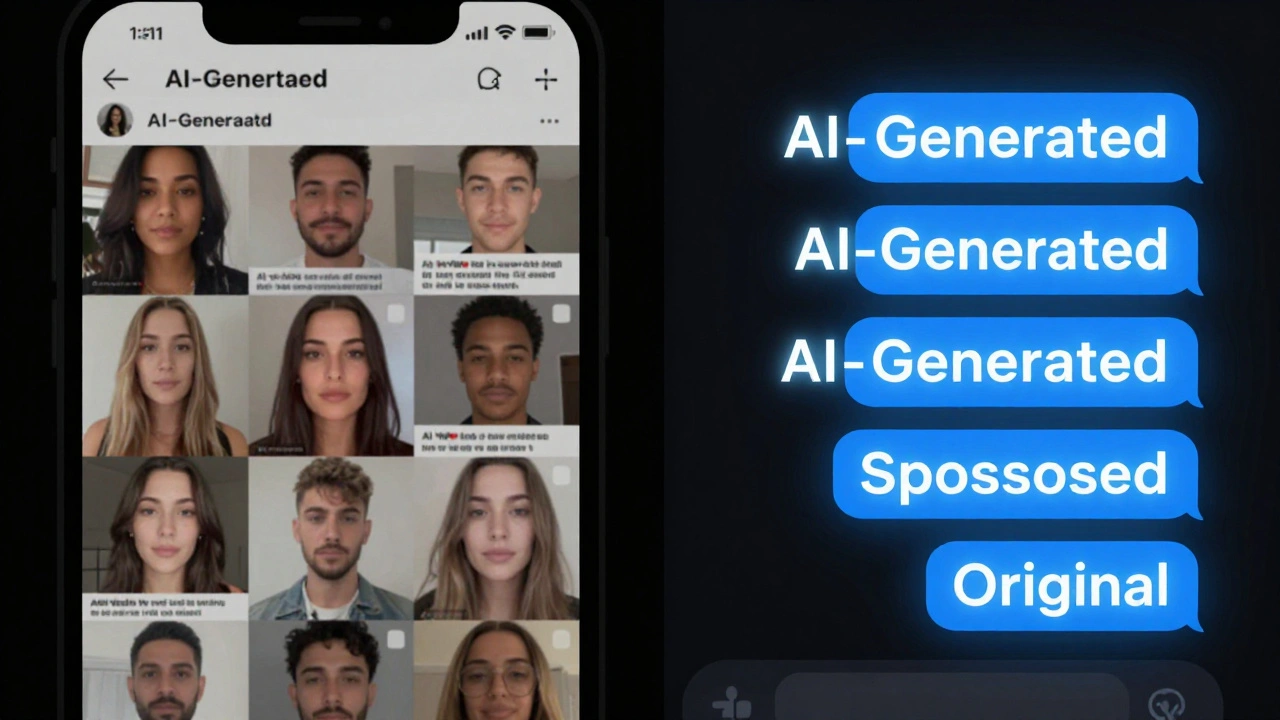
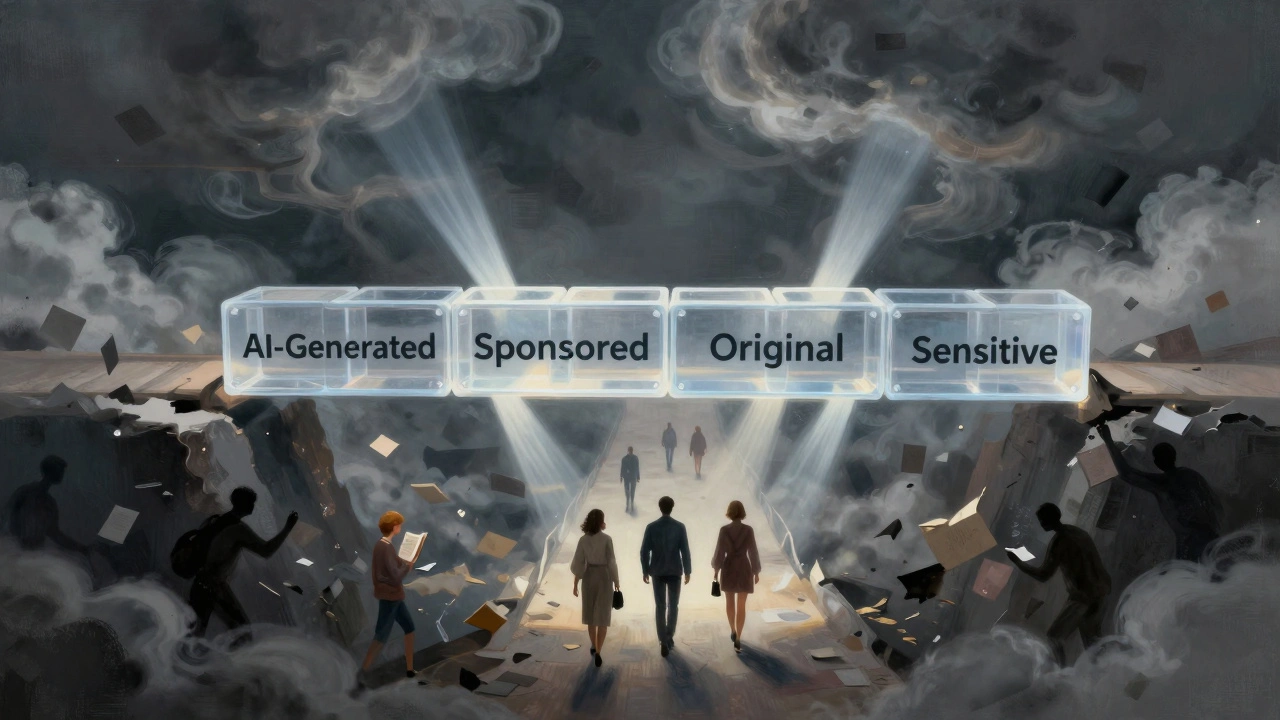
- AI-Generated Content: This label appears when text, images, audio, or video was created or heavily edited by artificial intelligence. It doesn’t mean the content is false-but it does mean you should ask: Was this fact-checked? Who trained the AI?
- Sponsored Content: If a brand paid for this post, this label says so. No more sneaky product placements disguised as personal reviews. This is the digital version of “ad” on TV.
- User-Generated Content (UGC): This tells you the content came from a regular person, not a professional outlet. It’s useful for social media, reviews, or community forums-but it also means you should check for bias or lack of expertise.
- Original Content: This one’s simple: the article, photo, or video was created here, not copied from somewhere else. In a world where reposted misinformation spreads faster than facts, this label matters.
- Sensitive Content: Warns you before you see graphic, disturbing, or emotionally triggering material. It’s not about censorship-it’s about consent.
These labels don’t just exist on websites. They’re built into the files themselves. That’s thanks to standards like Content Credentials and a tamper-proof digital signature system developed by the Content Authenticity Initiative that travels with the file no matter where it’s shared. Even if someone downloads a photo and posts it on a different platform, the label stays with it.
How Verification Works Behind the Scenes
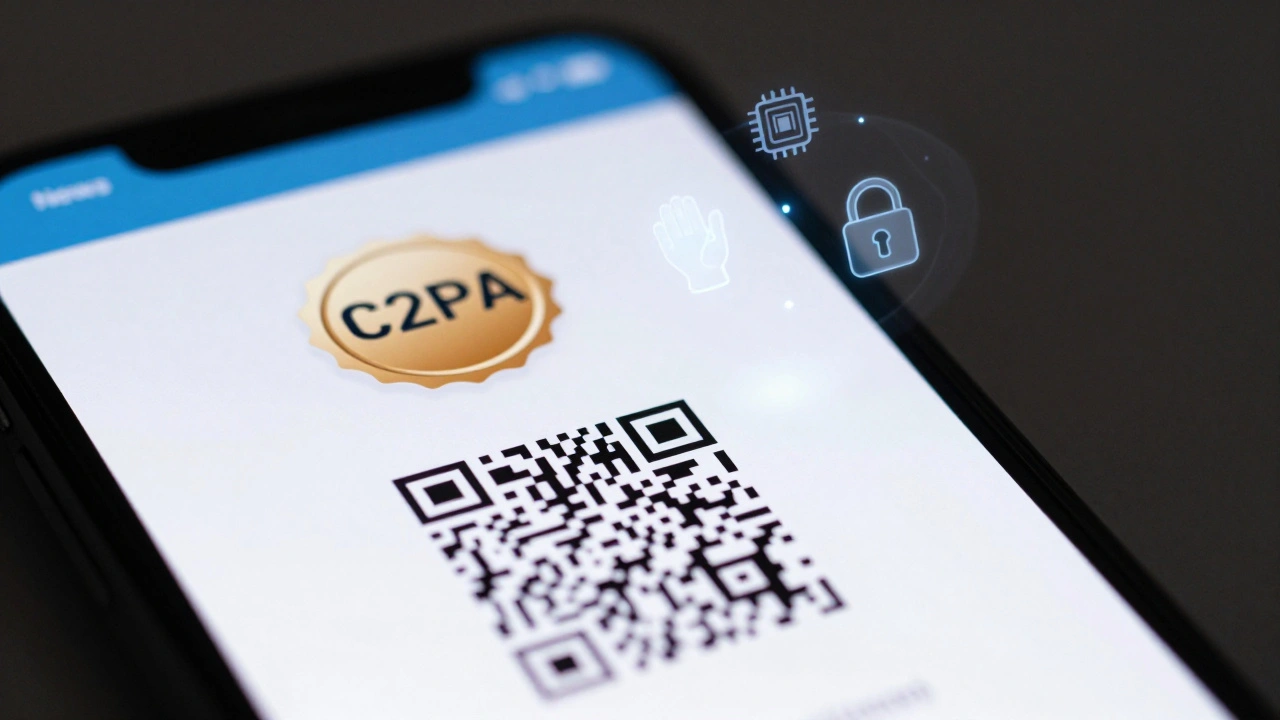
How do we know these labels aren’t just fake stickers slapped on anything? That’s where C2PA and the Coalition for Content Provenance and Authenticity, an open technical standard that embeds cryptographic proof directly into digital files come in.
Here’s how it works: When a journalist writes a story, their editing software automatically attaches a hidden digital signature. It records:
- Who created it
- When it was created
- What tools were used
- Any edits made along the way
This data is stored in a way that can’t be removed or changed without breaking the signature. If you scan a QR code on a news article (like the system tested by Swiss researchers), your phone checks that signature against a public ledger. If it matches, you know the article hasn’t been altered since it was published.
This isn’t science fiction. The Associated Press, Adobe, Microsoft, and Google are already using C2PA. Major platforms like X (formerly Twitter) and YouTube are testing integration. The technology is here. The question is: Will we use it?
Why This Matters More Than Ever
In 2024, researchers at Stanford found that over 60% of online content labeled as "breaking news" was either AI-generated or repurposed from old stories. Half of those didn’t have any disclosure.
People aren’t just confused-they’re exhausted. A 2025 survey from the Shorenstein Center showed that 73% of adults feel less confident in online information than they did five years ago. That’s not just about fake news. It’s about the erosion of trust in every source.
Trustworthy labels rebuild that trust by making the invisible visible. They shift the burden from the reader (“Is this real?”) to the creator (“I’ll tell you plainly what this is.”). It’s a cultural reset. Instead of asking, “Who can I believe?” we start asking, “Who is being transparent?”
Real-World Examples You Can See Today
You don’t have to wait for big platforms to adopt this. Some are already doing it right:
- WordPress plugins like Aithenticate let bloggers click a button to label AI-assisted posts. No coding needed.
- The Swiss Digital Initiative created a visual label system used by Swiss news sites. It shows a badge with four clear criteria: transparency, independence, accuracy, and user control. No jargon. Just facts.
- Newsrooms in Germany and Canada now embed QR codes on every article. Readers scan them to see the editor’s notes, sources, and correction history.
These aren’t gimmicks. They’re accountability tools. And they’re working. A 2025 study found that when news articles included clear origin labels, readers were 47% more likely to remember the facts and 31% less likely to share them without reading.
What’s Missing? Education and Consistency
Labels alone won’t fix misinformation. If people don’t understand what they mean, they’re useless.
Imagine a world where every school teaches kids to check for content labels the same way they learn to check a URL. Where every social media app shows a tooltip when you hover over a label. Where advertisers are fined for hiding sponsorship tags.
Right now, we’re in the Wild West. One site uses a tiny blue dot. Another uses bold red text. Some labels disappear when you copy the content. That’s chaos. Standardization is the next step. The Content Authenticity Initiative and the C2PA standard are pushing for global consistency, but adoption is uneven.
Here’s what needs to happen:
- Platforms must enforce label visibility-no hiding them behind “more info” menus.
- Labels must be uniform across services. One meaning. One look. Everywhere.
- Creators need simple tools. If labeling takes more than 3 seconds, most won’t do it.
- Users need education. Schools, libraries, and community centers should run workshops on reading digital labels.
The Bigger Picture: Trust as Infrastructure
Trust isn’t a feeling. It’s infrastructure. Just like electricity, water, and roads, we need systems that make trust possible at scale. Content labels are that system for the digital age.
They don’t eliminate bias. They don’t stop lies. But they make it harder to hide them. And that’s enough. Because once people know what to look for, they start demanding more. They start asking: Why wasn’t this labeled? Who’s hiding something?
When we stop treating digital content as a free-for-all and start treating it like a public good-something that needs oversight, standards, and accountability-we don’t just fix misinformation. We rebuild a culture of honesty.
Are content labels mandatory by law?
Not yet everywhere, but they’re becoming required in some places. The European Union’s Digital Services Act now requires clear labeling of AI-generated content and sponsored posts. California and Canada have similar rules in place. In the U.S., federal legislation is being debated, but adoption is mostly voluntary-for now. The trend, however, is clear: regulation is coming.
Can labels be faked or removed?
Basic text labels? Yes, easily. But C2PA and Content Credentials use cryptographic signatures embedded directly into the file. These can’t be removed without breaking the file’s integrity. If someone tries, the system detects it and shows a warning. That’s why the best labels aren’t just visible-they’re built into the file itself.
Do I need to label my personal blog posts?
If you use AI to help write or edit your content, yes. Even small blogs are part of the information ecosystem. Many platforms now auto-detect AI use and add labels automatically. But if you’re editing manually, you can still choose to label your work as "Original" or "Human-Crafted" to build trust with your readers. Transparency isn’t just for big media-it’s for everyone.
How do I know if a label is legitimate?
Look for standards-backed labels: C2PA, Content Credentials, or Swiss Digital Initiative. These use open, auditable systems. Avoid labels that are just images or text without a way to verify them. If you can scan a QR code or click a link that takes you to a public verification page, it’s likely real. If the label just says "AI-Generated" with no further info, be skeptical.
Will labels slow down content creation?
Not if the tools are designed well. Modern CMS plugins like Aithenticate let you label content with one click. AI detection tools can auto-apply labels during upload. The goal isn’t to add work-it’s to make trust automatic. The real slowdown happens when people don’t trust content and spend hours checking every post. Labels reduce that burden for everyone.
Trustworthy information labels are the quiet revolution we didn’t know we needed. They’re not flashy. They don’t go viral. But they’re the reason we’ll still believe what we read tomorrow.