
U.S. R&D Impact Calculator
Understanding R&D Impact
For every $1 cut in federal R&D funding, the economy loses $4-$9 in economic output. This calculator estimates the potential impact of budget cuts based on the article's analysis.
Estimated Economic Impact
These estimates are based on the article's finding that each $1 cut in R&D leads to $4-$9 in lost economic output.
China's R&D Growth Comparison
While the U.S. proposes a 20% cut, China increased its R&D spending by $173B between 2020-2023. This chart shows the widening gap.
China now files more patents in AI and semiconductors than the U.S. and EU combined.
For decades, the United States led the world in innovation-not because it had the cheapest labor or the largest factories, but because it invested relentlessly in research. From the birth of the internet to the development of mRNA vaccines, U.S. innovation didn’t happen by accident. It was funded. It was planned. It was fought for. But right now, that engine is at risk.
In 2022, American businesses spent $692 billion on research and development. That’s more than the entire GDP of Canada. Universities added another $108 billion. Together, they made the U.S. the world’s top R&D spender. But here’s the problem: while private companies kept spending, the federal government is planning to cut its R&D budget by over 20% in 2026. That’s not a tweak. It’s a wrecking ball.
Where the Money Really Comes From
Most people think government funds innovation. That’s partly true-but not anymore. Today, the private sector drives 78% of U.S. R&D spending. Companies like Google, Pfizer, Intel, and Tesla are the real engines. They spend billions each year on new drugs, chips, AI models, and electric vehicles. In fact, five industries account for nearly 80% of all business R&D: information technology, pharmaceuticals, semiconductors, professional services, and aerospace.
But here’s the catch: private companies don’t fund basic research. They don’t fund the kind of work that takes 10, 15, or 20 years to pay off. They fund development-the stuff you can turn into a product next quarter. That’s why federal funding matters so much. The National Science Foundation, NIH, and DOE don’t build apps. They fund the scientists who discover the next breakthrough that apps will be built on.
In 2023, universities alone spent over $117 billion on research. That’s up 8% in one year. Why? Because federal grants are still flowing-barely. Professors, postdocs, and grad students are working on cancer therapies, quantum computing, and fusion energy because someone, somewhere, wrote a check. If that check stops, the pipeline dries up.
The Coming Budget Crash
The Trump administration’s 2026 budget proposal isn’t just a cut. It’s a collapse. Federal R&D funding is slated to drop from $197.5 billion to $154 billion-a $43 billion slash. That’s a 22% reduction. But the real damage is deeper. The National Science Foundation? Cut from $8.6 billion to $2.9 billion. A 66% plunge. The Department of Health and Human Services? Cut in half.
These aren’t arbitrary numbers. They’re the life support for entire fields. The NSF funds 25% of all academic research in math and physical sciences. The NIH funds 80% of U.S. biomedical research. Without them, labs shut down. Grad students drop out. Postdocs leave for Canada, Germany, or Singapore.
And it’s not just about losing jobs. The ITIF estimates that if these cuts go through, the U.S. will lose $717 billion in GDP between 2026 and 2035. That’s $23 billion in lost economic output just in 2026. And that’s before accounting for the ripple effects: fewer patents, fewer startups, fewer spin-offs, fewer new industries.
China Is Watching-and It’s Not Waiting
While Washington debates cuts, Beijing is doubling down. China’s R&D spending grew by $173 billion between 2020 and 2023. The U.S. grew by $93 billion. That’s not a race. That’s a gap widening by the month.
China isn’t just spending more. It’s spending smarter. It’s building national labs focused on AI, quantum, and next-gen batteries. It’s offering tax breaks to companies that invest in R&D. It’s recruiting top U.S. scientists with better funding, better labs, and better housing. And it’s working. In 2024, China filed more patents in AI and semiconductors than the U.S. and EU combined.
What happens when China leads in battery tech? In AI chips? In gene editing? The U.S. won’t just lose market share. It’ll lose control over critical infrastructure. Imagine a world where every electric car battery comes from China because the U.S. stopped funding the research that made it possible.
The Startup Ecosystem Is Built on R&D
Venture capital doesn’t fund ideas. It funds technology. And technology doesn’t come from thin air. It comes from labs. From peer-reviewed papers. From decades of basic science.
Think about modern AI. ChatGPT didn’t emerge from a garage startup. It was built on decades of academic research funded by the NSF and DARPA. Same with GPS, touchscreens, voice recognition, and lithium-ion batteries. All of them started in government-funded labs.
Today’s startups-whether they’re building AI-powered drug discovery tools or fusion reactors-depend on publicly funded research. If the NIH stops funding cancer genomics, startups lose their data. If the NSF stops funding quantum algorithms, startups lose their foundation. Without federal R&D, venture capital has nothing to invest in.
And it’s not just Silicon Valley. Cities like Boston, Austin, Pittsburgh, and even Albuquerque are becoming innovation hubs because of university partnerships, federal grants, and research parks. Cut those, and you cut the roots of the next generation of companies.
The Hidden Cost of Saving Money
People say, "We can’t afford to spend $40 billion on research." But here’s the truth: we can’t afford not to.
The $40 billion cut sounds like savings. But over the next decade, it will cost the economy $717 billion in lost GDP. That’s nearly 18 times the amount saved. Tax revenues will drop by $179 billion to $366 billion. Millions of jobs will vanish-not just in labs, but in factories, tech firms, hospitals, and supply chains that depend on innovation.
It’s like cutting the fuel line to your car because you’re worried about the cost of gas. You save $50 a month. But then your car stops. And you have to buy a new one.

What’s Still Working
Not all hope is lost. University R&D spending hit $117 billion in 2024. That’s the highest it’s ever been. Why? Because state governments, private donors, and federal grants are still in play. Companies like Microsoft, Apple, and Meta are pouring billions into university partnerships. The private sector is stepping in where the government is stepping back.
But that’s not a solution. It’s a stopgap. Universities can’t replace federal funding. They don’t have the scale. They don’t have the mandate. And they can’t fund national priorities like climate resilience, pandemic preparedness, or defense tech.
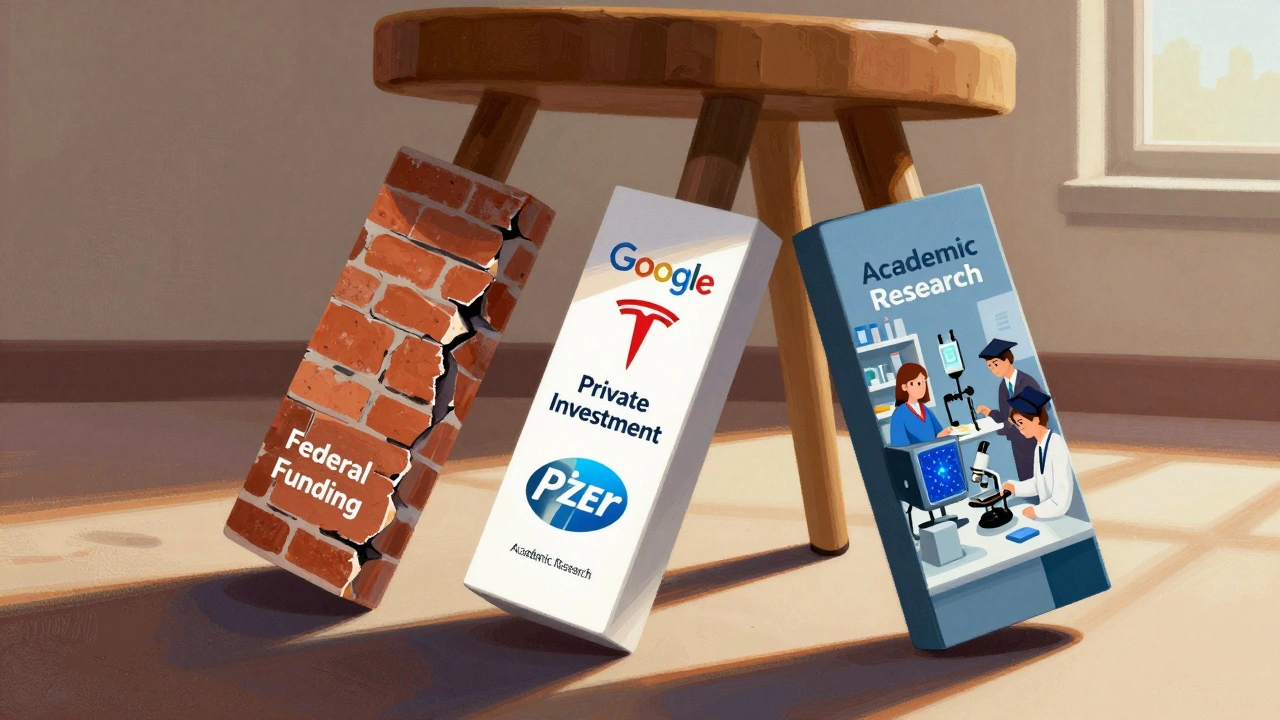
The truth? The U.S. innovation system is a three-legged stool: federal funding, private investment, and academic research. Remove one leg, and the whole thing falls over.
The Future Is Written Today
The U.S. doesn’t need to be the biggest spender. It just needs to be the smartest. It needs to fund the research that others won’t. The risky stuff. The long-term stuff. The stuff that changes everything.
If we cut R&D now, we’re not saving money. We’re selling our future. We’re handing leadership in AI, biotech, clean energy, and semiconductors to other nations. And once that happens, it’s nearly impossible to get back.
There’s still time to change course. But it won’t happen by accident. It will take political will. Public pressure. And a recognition that innovation isn’t an expense-it’s the foundation of everything we value.
Why does federal R&D funding matter if private companies spend more?
Private companies spend more, but they focus on short-term development-turning ideas into products. Federal funding pays for basic research: the foundational science that takes 10-20 years to pay off. Without it, there’s nothing for companies to build on. GPS, the internet, mRNA vaccines, and AI all started with government-funded research.
What happens to startups if federal R&D is cut?
Startups rely on publicly funded research for their core technology. If the NIH stops funding cancer genomics or the NSF stops funding quantum computing, startups lose their data, tools, and intellectual foundation. Many won’t survive. Others will move overseas where funding is stable.
Is China really outspending the U.S. in innovation?
Yes. Between 2020 and 2023, China increased its R&D spending by $173 billion. The U.S. added only $93 billion. China is now filing more patents in AI and semiconductors than the U.S. and EU combined. If U.S. funding keeps falling while China’s keeps rising, the U.S. could fall to second place in global R&D by 2030.
How much economic damage could these cuts cause?
The ITIF estimates that cutting R&D by 20% over the next decade would cost the U.S. economy $717 billion in lost GDP and $179-$366 billion in lost tax revenue. That’s 18 times more than the amount saved in cuts. Every $1 cut in R&D leads to $4-$9 in lost economic output.
Can universities replace federal R&D funding?
No. While university R&D hit $117 billion in 2024, it still depends heavily on federal grants. Universities can’t fund national priorities like defense tech, climate resilience, or pandemic preparedness at scale. They also can’t match the long-term, high-risk investments that only the federal government can make.