
Venture Funding Sector Calculator
Calculate 2025 Venture Funding Distribution
Based on article data: $425B total global funding, with AI at 50% and Climate/ Frontier Tech at 18%
Funding Breakdown
The venture capital landscape in 2025 didn’t just grow-it restructured. Global startup funding hit $425 billion, the third-highest year on record, after a three-year slump. But the real story wasn’t just the numbers. It was where the money went. While AI still swallowed half of all venture dollars-$211 billion, up 85% from 2024-the smart money started shifting toward technologies that don’t just make software faster, but make the planet work better. Robotics, clean energy, advanced semiconductors, and climate adaptation systems pulled in nearly $76 billion, up 35% from last year. This wasn’t a fluke. It was a deliberate pivot.
AI Still Leads, But It’s No Longer the Whole Story
OpenAI’s $40 billion funding round and SpaceX’s $800 billion valuation made headlines. AI was everywhere. But if you looked past the splashy deals, you saw something quieter-and more meaningful. Investors weren’t just pouring money into chatbots and image generators. They were backing companies that used AI to solve real problems: predicting crop failures with satellite imagery, optimizing wind farm output with machine learning, or automating carbon capture in industrial plants. The frontier wasn’t AI alone. It was AI + infrastructure.
That’s why late-stage funding in Q4 2025 went to companies in energy, semiconductors, and prediction markets-not just automated coding or generative AI. These weren’t flashy apps. They were hardware-heavy, regulation-heavy, and long-term plays. And yet, they got funded. Why? Because the exit potential changed. Wiz’s $32 billion acquisition by Google showed that deep tech startups could be bought for massive premiums. Investors realized: if you build something that moves the needle on climate, energy, or logistics, you don’t need to IPO. A tech giant will come knocking.
The Rise of Frontier Technologies
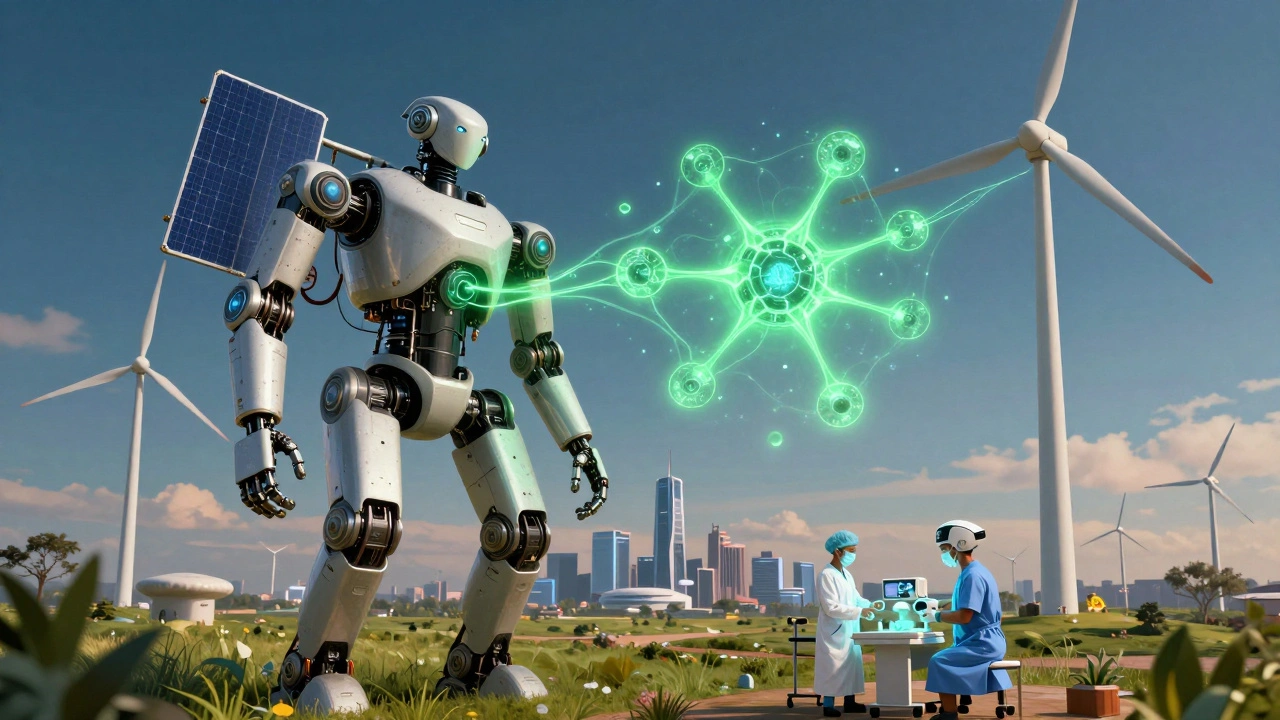
Robotics saw the biggest jump. In Q4 2025 alone, robotics startups raised $18.3 billion-up 42% from the same quarter in 2024. That’s not just warehouse bots. It’s autonomous farm equipment in Iowa, underwater drones inspecting offshore wind turbines in the North Sea, and surgical robots in rural clinics across India. These aren’t sci-fi dreams anymore. They’re operational. And they’re profitable.
Climate tech didn’t just grow-it diversified. Early-stage funding went to companies building next-gen batteries, green hydrogen electrolyzers, and AI-powered grid balancing tools. One startup in Texas raised $120 million to turn methane emissions from cattle farms into clean fuel. Another in Sweden got $85 million to build modular nuclear reactors small enough to fit on a truck. These weren’t fringe ideas. They were answers to supply chain breakdowns and energy shortages that hit hard in 2024 and 2025.
Even semiconductors got a boost. The chip shortage of 2022 didn’t disappear-it evolved. In 2025, venture capital flowed into companies making chips for climate sensors, edge AI for weather prediction, and radiation-hardened processors for space-based monitoring systems. It wasn’t about making faster smartphones. It was about making smarter systems that could survive extreme conditions.
Where the Money Came From
The U.S. took 64% of global venture funding in 2025-$274 billion-up from 56% in 2024. That dominance wasn’t random. It was policy-driven. The Inflation Reduction Act’s tax credits, the CHIPS Act’s manufacturing grants, and state-level climate innovation funds gave startups a clear path from lab to market. California, Texas, and Colorado became hotbeds for climate tech, not just AI.
Europe didn’t lag. In fact, European VCs allocated 22% of their capital to climate tech-higher than the U.S.’s 15%. Germany, the Netherlands, and Sweden led the charge, backing startups that could scale across the EU’s carbon border tax system. Meanwhile, China’s share dropped from 24% to 18%. Why? Regulatory tightening, slower IPO markets, and a focus on domestic tech over global climate solutions.
Corporate venture capital (CVC) changed too. Instead of throwing money at 50 startups, big companies like Siemens, Shell, and Lockheed Martin started making fewer, deeper bets. SVB’s 2025 report showed CVCs made 22% more secondary investments-buying shares from early investors to rebalance portfolios toward climate and robotics. This wasn’t speculation. It was strategy.
Why This Shift Matters
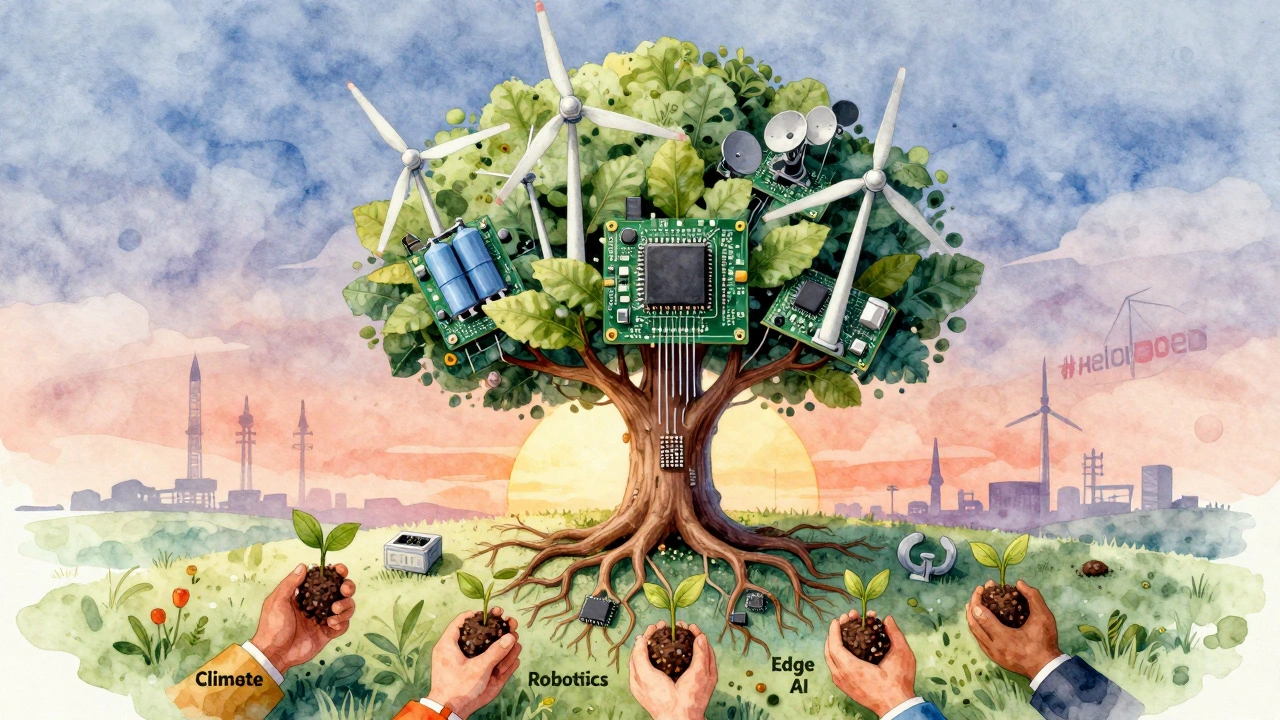
Frontier tech isn’t easier. It’s harder. Deloitte found climate startups need 25-40% more capital to reach profitability than software-only companies. They need regulatory approvals, physical infrastructure, supply chains, and safety certifications. A SaaS company can launch in six months. A fusion reactor takes five years.
But here’s the twist: they’re more resilient. During the 2024 recession, AI startups with weak monetization models got cut. Climate and robotics startups? They kept growing. Why? Because their customers weren’t consumers. They were utilities, governments, and manufacturers-entities with long-term budgets and urgent needs.
The IPO market reopened in 2025, and it wasn’t just for social media apps. Companies like Heliogen (solar thermal energy), Form Energy (long-duration batteries), and Relativity Space (3D-printed rockets) went public. Their market caps? Between $2 billion and $8 billion. Not Uber-level, but real. Sustainable. And repeatable.
What Comes Next
2026 will see this rotation deepen. Wellington Management predicts frontier and climate tech will hit 25% of global venture funding-up from 18% in 2025. AI won’t fade. It’ll become the engine inside every solution. Think of it this way: AI is the brain. Robotics is the body. Climate tech is the mission.
Expect more public-private partnerships. The U.S. Department of Energy, the EU’s Green Deal, and even Saudi Arabia’s NEOM project are now co-investing with VCs. These aren’t grants. They’re equity stakes. Governments are betting real money on private innovation.
And the exits? They’re getting bigger. Secondary markets hit 18% of all venture activity in 2025-up from 12%. That means early investors are cashing out, and new funds are stepping in. The cycle is tightening. The market is maturing.
One thing is clear: the venture capital game isn’t about chasing the next viral app anymore. It’s about building systems that last. The winners in 2026 won’t be the ones with the flashiest demos. They’ll be the ones who solved a problem no one else wanted to touch-and made money doing it.
Why did venture funding increase in 2025 after years of decline?
Venture funding rebounded in 2025 due to three key factors: AI’s maturation created new commercial applications, regulatory incentives like the U.S. Inflation Reduction Act unlocked public-private capital, and the IPO market reopened after a multi-year pause. Companies with clear revenue models-especially in climate tech and robotics-proved they could scale profitably, attracting both traditional VCs and corporate investors.
Is AI funding slowing down in 2025?
No-AI funding grew 85% year over year to $211 billion, the highest ever. But its share of total venture funding stayed at 50%, meaning other sectors grew just as fast. The shift wasn’t away from AI, but toward AI-powered infrastructure: robotics, energy systems, and climate tools that use AI as a layer, not the whole product.
Why is climate tech getting more funding now than before?
Three reasons: (1) Technology matured-batteries, hydrogen, and carbon capture are now viable at scale; (2) Regulation forced change-carbon taxes, emissions rules, and green subsidies created demand; (3) Exit paths opened-acquisitions like Wiz’s $32 billion sale proved climate tech could deliver massive returns. Investors realized these weren’t charities-they were businesses.
How did corporate venture capital change in 2025?
Corporate VCs shifted from broad, speculative investing to targeted, strategic bets. They made fewer deals but invested deeper, often using secondary transactions to buy into mature startups. Many focused on climate and robotics because these aligned with their long-term operational needs-like reducing emissions, automating supply chains, or cutting energy costs. Efficiency became more important than volume.
Which regions are leading in frontier tech funding?
The U.S. led with 64% of global funding, driven by policy support and tech hubs like Silicon Valley and Austin. Europe followed, with 22% of its venture capital going to climate tech-higher than the U.S.’s 15%. China’s share dropped to 18% due to regulatory shifts. Emerging markets like India and Brazil saw growth in fintech and agritech, but frontier tech funding remained concentrated in the U.S. and Europe.
Are frontier tech startups riskier than AI startups?
Yes, but not in the way you think. Frontier tech startups require more capital, take longer to scale, and face complex regulations. But once they hit product-market fit, they’re harder to disrupt. An AI app can be copied overnight. A fusion reactor or autonomous grid system? Not so much. The risk is upfront. The reward is long-term dominance.