
Wage Compression Calculator
Calculate Your Wage Compression Ratio
Determine if your organization has wage compression issues. Enter the new hire salary and the tenured employee's salary to see if you're at risk of losing top talent.
Compression Ratio Results
When your best engineer finds out a new hire with half her experience is making 95% of her salary, she doesn’t just feel underpaid-she feels betrayed. That’s not speculation. It’s what happened at a tech firm in Austin after they rolled out pay transparency in 2024. Within three weeks, three senior employees quit. The company didn’t break any laws. They posted salary ranges. But they never fixed the broken math underneath.
Why Pay Transparency Backfires Without Equity
Pay transparency isn’t just about sharing numbers. It’s about trust. When employees see what others make, they don’t just compare salaries-they compare fairness. And if the system looks rigged, trust evaporates. Since 2021, 24 U.S. states have passed laws requiring employers to disclose salary ranges in job postings. Colorado, New York City, and Connecticut led the way. The goal? Close the gender and racial pay gap. And it’s working: in states where these laws have been in place for three years, the gender pay gap shrank by 4.2 percentage points, according to the U.S. Department of Labor. But here’s the catch: transparency without equity is like turning on a light in a messy room. You see the mess. And now everyone else does too. That’s where wage compression comes in. It happens when new hires earn almost as much-or sometimes more-than people who’ve spent years climbing the ladder. beqom’s 2024 study found 57% of companies implementing pay transparency suffer from this. In 32% of cases, new hires earn 90% or more of what senior employees make. That’s not a market adjustment. That’s a system failure.The Hidden Cost: Losing Your Tenured Talent
The real damage isn’t in the headlines. It’s in the quiet resignations. Harvard Business Review tracked 200 mid-sized companies after they went public with pay data. Those that didn’t fix compression saw 37% higher turnover among employees with three or more years of tenure. That’s not a small number. That’s a brain drain. One senior software engineer on Reddit posted in March 2025: "After our company posted salary bands, I found out my new junior hire was making 95% of what I make after eight years. I handed in my resignation the next day." That’s not an outlier. It’s a pattern. ADP’s 2024 Workforce Vitality Report found companies that did regular pay equity audits saw 28% less turnover among long-term staff. The difference? They fixed the problem before they announced it.Three Levels of Transparency-and Which One Works
Not all transparency is created equal. There are three levels:- Basic compliance: Just posting salary ranges in job ads. 42% of companies do this. It’s legal. It’s minimal.
- Strategic transparency: Sharing salary bands internally by role and level. 38% do this. This is where real change starts.
- Full transparency: Everyone sees everyone’s salary. Only 5% go this far. And it’s risky.

How to Fix Wage Compression Before It Breaks You
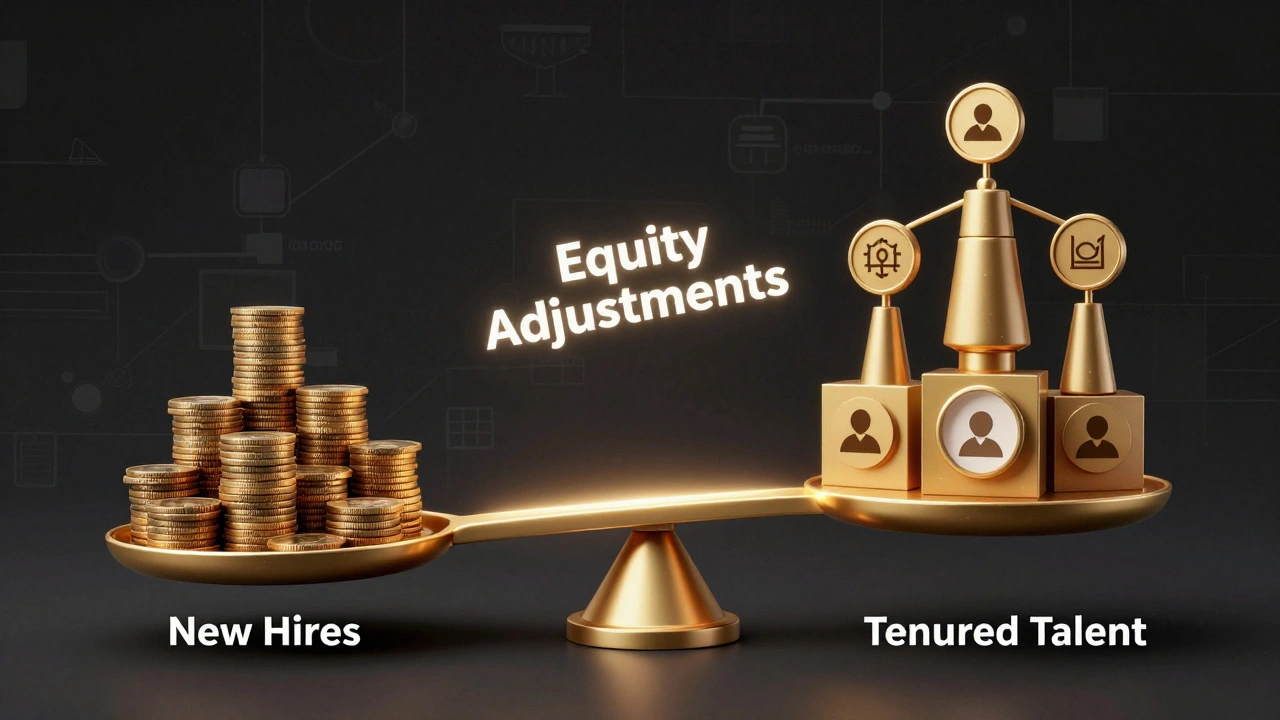
You can’t fix what you don’t measure. And most companies don’t measure it until it’s too late. Mercer’s 2024 survey identified four proven strategies:- Targeted equity adjustments: Give raises to tenured employees whose pay is below market or compressed. Used by 37% of companies. Simple. Effective.
- Expanded career lattices: Add more levels between junior and senior. Instead of just "Junior," "Mid," and "Senior," add "Mid-1," "Mid-2," "Senior-1," etc. Used by 42% of companies. Gives people room to grow without a promotion.
- Tenure-based bonuses: Add a retention bonus or longevity stipend. Not a raise-just extra. Used by 28%. Signals that experience matters.
- Accelerated promotions: Fast-track high performers. Used by 19%. Prevents top talent from feeling stuck.
The Audit That Saves Your Culture
Before you announce anything, run a compensation audit. Not a one-time check. A deep dive. Start with these steps:- Map every role to a clear level and salary band.
- Compare current pay against market data (using platforms like Salary.com or Paycom).
- Flag anyone whose pay is below their level’s median-especially those with three+ years.
- Calculate compression ratios: new hire pay ÷ tenured employee pay. Anything above 90% is a red flag.
- Run the numbers by gender, race, and tenure. Look for patterns.
How to Communicate Without Causing Panic
Announcing pay bands isn’t enough. You need to explain them. Willis Towers Watson’s research shows the most effective approach is "transparency with context." That means:- Sharing salary bands alongside clear progression paths
- Explaining how raises, promotions, and bonuses work
- Showing employees how to move to the next band
- Not hiding the fact that some people are being adjusted
The Future Is Dynamic
The next wave isn’t just about posting numbers. It’s about making them live. Adobe’s "compensation confidence score" gives employees a percentile ranking-"You’re in the 72nd percentile for your role and experience level"-without revealing names. Internal surveys showed 31% higher satisfaction with pay fairness. The European Union’s new Pay Transparency Directive, effective August 2026, will force companies with 100+ employees to publish pay gap data. The U.S. is following. The Department of Labor’s new rule, effective January 2027, will require federal contractors to report pay by race, gender, and job category. The companies that survive this shift won’t be the ones who posted the most data. They’ll be the ones who fixed their pay structures first.What Happens If You Do Nothing?
Deloitte’s 2026 report says it plainly: companies that implement transparency without fixing compression face 34% higher long-term compensation costs. Why? Because replacing talent is expensive. The average cost to replace a mid-level employee is 50-60% of their annual salary. And here’s the brutal truth: your best people aren’t waiting for you to catch up. They’re reading Glassdoor. They’re talking on LinkedIn. They’re comparing offers. If you wait until someone walks out the door to fix your pay system, you’re already behind.Start Now. Don’t Wait for the Law.
You don’t need to be in Colorado or New York to act. The laws are catching up. But the culture is already here. If you’re an HR leader, ask yourself:- Do we know what our compression ratios are?
- Have we audited pay by tenure, gender, and race?
- Do our top performers see a clear path to more money-or do they feel stuck?
- Are we ready to explain pay decisions, or just announce them?
What is wage compression?
Wage compression happens when new hires earn nearly the same-or sometimes more-than employees with significantly more experience or tenure. This often occurs when companies raise entry-level pay to match the market but don’t adjust pay for long-term staff, leading to unfair pay gaps within the same role.
Is pay transparency required by law?
As of January 2026, 24 U.S. states require employers to disclose salary ranges in job postings. States like Colorado, New York City, Connecticut, Nevada, and Rhode Island were early adopters. The EU’s Pay Transparency Directive will take effect in August 2026, affecting companies with 100+ employees across 27 countries.
Does pay transparency reduce pay gaps?
Yes. In states where pay transparency laws have been in place for three or more years, the gender pay gap has shrunk by 4.2 percentage points, according to the U.S. Department of Labor. Transparency exposes disparities, forcing companies to address them.
How can I prevent top talent from leaving after pay transparency?
Conduct a compensation audit first. Identify employees whose pay is compressed-especially those with three+ years of tenure. Adjust their salaries, expand career ladders, add tenure-based bonuses, or accelerate promotions for high performers. Communicate these changes clearly and frame them as investments in loyalty, not just corrections.
Should I share individual salaries with everyone?
Usually not. Full transparency-showing every employee’s exact salary-can hurt morale, especially in roles with high performance variability like sales or leadership. Instead, use strategic transparency: share salary bands, career progression paths, and how raises work. Companies like Salesforce and Adobe use this model successfully.
What tools help manage pay transparency and compression?
Platforms like Paycom, beqom, and Trusaic offer tools for salary band management, compression analysis, and equity audits. Pricing ranges from $8-$15 per employee/month for basic compliance to $22-$35 for advanced analytics. Trusaic’s PayParity is used by 14% of Fortune 500 companies to detect pay disparities.
What’s the biggest mistake companies make with pay transparency?
The biggest mistake is implementing transparency before fixing internal pay inequities. Companies that do this see 37% higher turnover among tenured employees. Transparency doesn’t cause distrust-it reveals it. Fix the system first, then communicate.