
Youth Employment Pathway Comparison Tool
Learn by Doing
- Earnings potential $42,000+ annually
- Time to job 3-12 months
- Success rate 82% hired full-time
- Key benefit Earn while you learn
Build Your Own Job
- Earnings potential $25,000-$500,000+
- Time to job 3-24 months
- Success rate 70% learn valuable skills
- Key benefit Build real-world problem-solving skills
The New Literacy
- Earnings potential $42,000+ annually
- Time to job 1-6 months
- Success rate 43% with no degree required
- Key benefit Industry-recognized micro-credentials
What's right for you?
Choose Apprenticeships if...
- You want immediate income while learning
- You prefer structured, hands-on training
- You want full-time employment after completion
Choose Entrepreneurship if...
- You have a business idea and want to build it
- You want to solve problems in your community
- You're comfortable with risk and uncertainty
Choose Digital Skills if...
- You want to enter tech or data fields quickly
- You prefer short-term, focused learning
- You want portable, industry-recognized credentials
Pro tip: The most successful young people combine these pathways. For example, an apprenticeship in healthcare plus digital skills training in health tech creates unique opportunities.
Every year, over 3 million young people in the U.S. graduate high school with no clear path to a job that pays a living wage. They’re not lazy. They’re not unambitious. They’re stuck in a system that still thinks a four-year degree is the only ticket to a good job-while employers are begging for workers who can code, fix a server, or run a small business. The gap isn’t about talent. It’s about structure.
Why the Pipeline is Broken
Youth unemployment in the U.S. has hovered around 8.7% in early 2026, nearly double the national average. But the real crisis isn’t just the number-it’s what happens after. In Houston, 80,000 to 90,000 students graduate each year. Only 27% earn any kind of credential within six years. And just 20% make over $42,000 annually by their late 20s. Meanwhile, local employers report 60,000 to 100,000 open jobs-many in healthcare, IT, and clean energy-that go unfilled because no one has the right skills.The problem isn’t that young people don’t want to work. It’s that they’re asked to jump through hoops no one else has to. Employers demand one year of experience for entry-level roles. But only 38% offer internships. So how do you get experience if you can’t get the job? It’s a loop that traps millions. One Reddit user summed it up with 2,845 upvotes: "I need experience to get experience."
And it’s worse for young women and youth of color. Women are 23% more likely to enroll in digital skills programs, but still face wage gaps. Youth of color wait 37% longer on average to find work than their white peers. Meanwhile, counselors and educators admit 58% of current resources don’t help students navigate this mess.
Three Paths Out: Apprenticeships, Entrepreneurship, Digital Skills
There are three proven ways to break this cycle-and they work best together.
Apprenticeships: Learn by Doing
Apprenticeships aren’t just for electricians anymore. In healthcare, IT, and clean energy, they’re the fastest way to turn a high school graduate into a skilled worker. Unlike college, you earn while you learn. You get paid. You get benefits. And you get a real job at the end.
Completion rates are high-87%, according to the U.S. Department of Labor in 2025. But here’s the catch: only 0.3% of U.S. workers are in apprenticeships. Compare that to Switzerland, where 15% of young people go through the same model. Why? Because we treat it like an afterthought. Companies don’t invest. Schools don’t partner. And government funding? Only 0.3% of federal workforce dollars go to youth programs, even though 13% of unemployed people are under 25.
The 2026 American Apprenticeship Act changed that. $3.2 billion is now flowing into sector-based programs in IT, healthcare, and renewable energy. Cities like Houston are already seeing results. One program paired 1,200 students with local hospitals. Within a year, 82% were hired full-time.
Entrepreneurship: Build Your Own Job
Not everyone wants to work for someone else. And that’s okay. Entrepreneurship programs give young people the tools to build their own businesses-whether it’s a mobile app, a tutoring service, or a sustainable packaging startup.
Yes, 90% of startups fail within five years, according to the Kauffman Foundation. But that’s not the point. The real value isn’t in the business. It’s in the skills. Young people learn how to pitch, manage money, solve problems, and handle failure. These aren’t just business skills-they’re life skills.
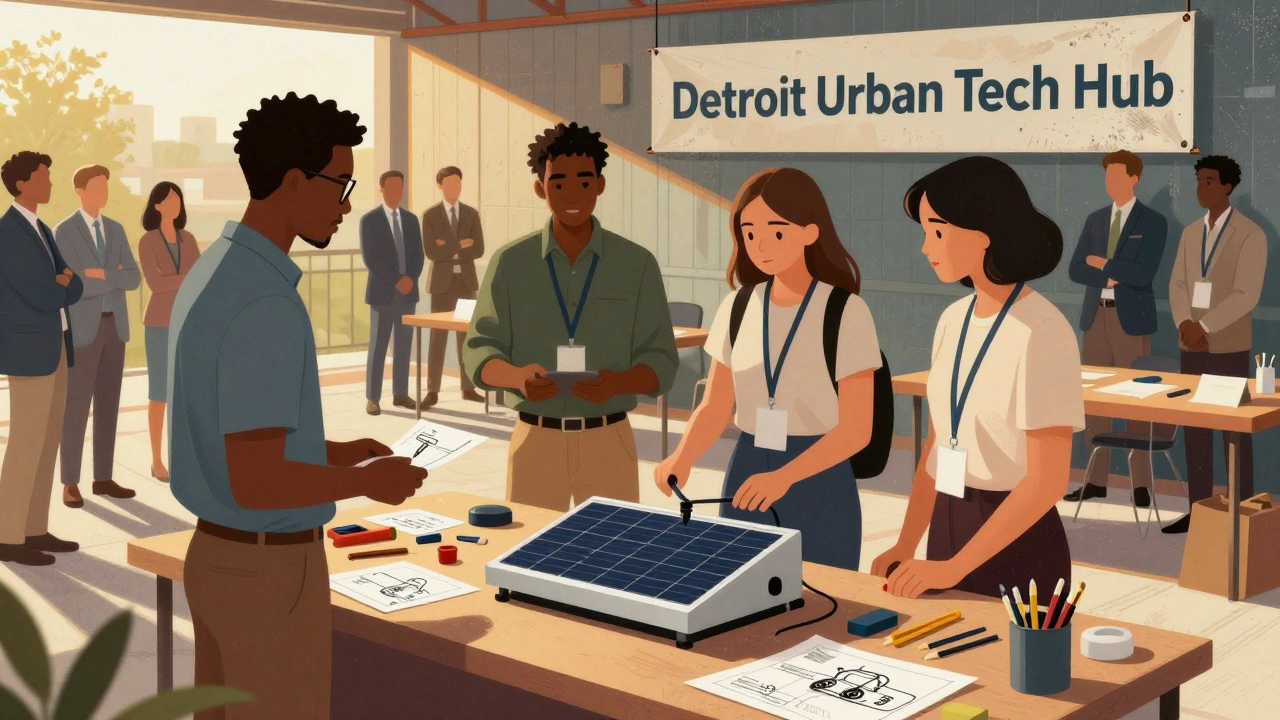
And when they succeed? The impact is huge. A single youth-led tech startup in Atlanta hired 12 people, all under 24. Another in Detroit turned a community garden into a $2 million urban farming enterprise. These aren’t outliers. They’re proof that when you give young people real resources-mentorship, seed funding, legal help-they don’t just survive. They lead.
Digital Skills: The New Literacy
If you can’t use AI tools, manage data, or secure a network, you’re already behind. Google Career Certificates show that 78% of participants land a job within six months. And 43% of those jobs didn’t even require a college degree.
But here’s the kicker: employers still ask for degrees they don’t need. A 2025 Schultz Family Foundation report found that 43% of companies require a four-year degree for roles where industry standards say it’s unnecessary. That’s not hiring. That’s gatekeeping.
That’s changing. Forty-four percent of Fortune 500 companies now have "experience-first" hiring policies. They care about what you can do, not where you went to school. Digital badges-micro-credentials you earn through short courses-are becoming the new resume. One program in Ohio lets students earn 12 industry-recognized badges in 10 weeks. Employers are starting to recognize them.
What Actually Works
Successful programs don’t just offer training. They fix the whole system.
- Career navigators in schools: One pilot in Michigan added advisors to every high school. Credential completion jumped 37%.
- Try-before-you-buy experiences: Instead of asking for a resume, companies let students do a real task for a day. Employers cut hiring risk by 63%.
- Digital badging systems: These replace vague transcripts with verifiable skills. A student who masters Python, data visualization, and cybersecurity can show employers exactly what they know.
Germany’s dual education system proves this works. Youth unemployment there is under 6%. Why? Because school and work are linked from day one. Students spend half their time in classrooms, half in companies. By 18, they’re not just qualified-they’re already employed.
And Singapore? Their TechSkills Accelerator program cut youth underemployment by 42% in three years. How? They didn’t wait for schools to change. They built the pipeline themselves-with employers, government, and tech firms all at the table.

The Roadblocks
It’s not all smooth sailing. Three big barriers stand in the way:
- Funding: Youth programs get a fraction of the money they need. Even successful initiatives struggle to serve more than 5% of local youth.
- Misaligned incentives: 72% of employers say they want to help, but they don’t know how. They’re not trained to mentor. They don’t have time.
- Scalability: One city, one company, one school can make it work. But what about the whole country? That takes coordination across 127 schools, 89 employers, and 34 community groups-all working in sync.
And then there’s AI. The World Economic Forum says 23% of entry-level jobs could vanish by 2028. That’s not a threat. It’s a wake-up call. If we keep training kids for jobs that don’t exist, we’re setting them up to fail.
The Way Forward
The best programs combine all three paths: apprenticeships for structure, entrepreneurship for creativity, and digital skills for the future.
Regions that do this see youth unemployment drop by 29% over five years. Single-focus efforts? Only 12% improvement. You can’t fix a broken system with one band-aid.
The data is clear. Young people are ready. Employers are desperate. The tools exist. What’s missing is the will to connect them.
It’s time to stop asking young people to fit into an old system. It’s time to build a new one-where learning leads directly to work, where skills matter more than diplomas, and where every young person has a real shot at a future that pays, grows, and lasts.
Why don’t more companies offer apprenticeships?
Many companies say they want to, but they don’t know how to set one up. There’s no clear guide, and they worry about costs. But programs like Houston’s PPC 2026 show it’s doable. With just $10,000 per apprentice and a 12-month ramp-up, companies get a trained worker who stays on after the program. The real cost is not doing it-losing out on skilled workers while competitors hire them.
Can someone without a degree get a good job with digital skills?
Absolutely. Google Career Certificates, IBM’s Digital Badge Program, and CompTIA certifications are now accepted by over 150 major employers-including Google, Microsoft, and Bank of America. These certs prove you can do the job. Employers who focus on skills instead of degrees fill roles 40% faster and see 30% higher retention.
Are entrepreneurship programs just for tech kids?
No. Programs in Detroit train youth to run urban farms. In New Orleans, students launch mobile food carts. In rural Iowa, teens build solar-powered irrigation systems. Entrepreneurship isn’t about starting a Silicon Valley startup. It’s about solving real problems with real resources. Any young person with an idea and a little support can build something that matters.
Why do digital skills programs have such high job placement rates?
Because they’re designed with employers. Google, IBM, and Microsoft help design the curriculum. They tell programs exactly what skills they need. Students learn how to use real tools, not just theory. And when they finish, they get direct referrals to hiring partners. It’s not magic-it’s alignment.
What’s the biggest mistake in youth employment programs?
Trying to fix it alone. Schools, businesses, nonprofits, and government all need to work together. One school can’t do it. One company can’t do it. But when 127 schools, 89 employers, and 34 organizations coordinate? That’s when you see real change. The most successful programs are ecosystems-not single programs.