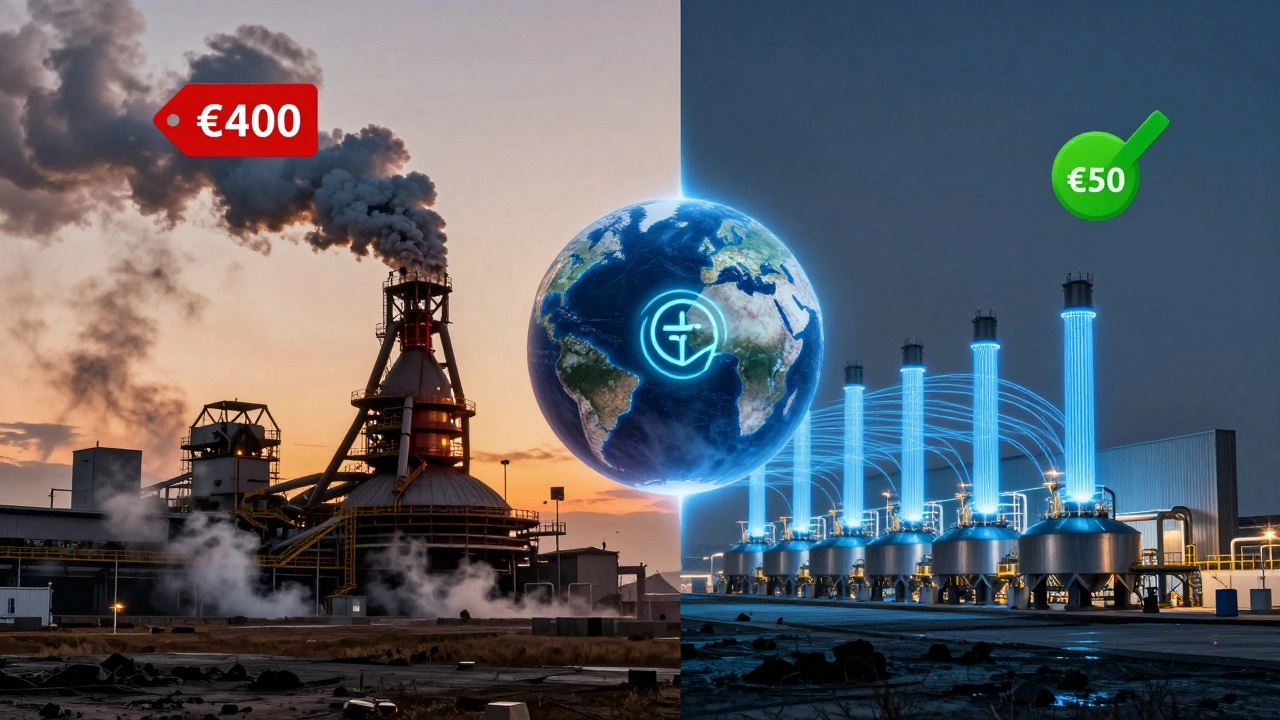
CBAM Cost Calculator
Calculate the estimated CBAM cost for imports based on the product type, quantity, and country of origin. The EU carbon price is currently €85 per ton of CO2.
Estimated CBAM Cost
Estimated CO2 emissions per ton of product
Calculating...
How This Works
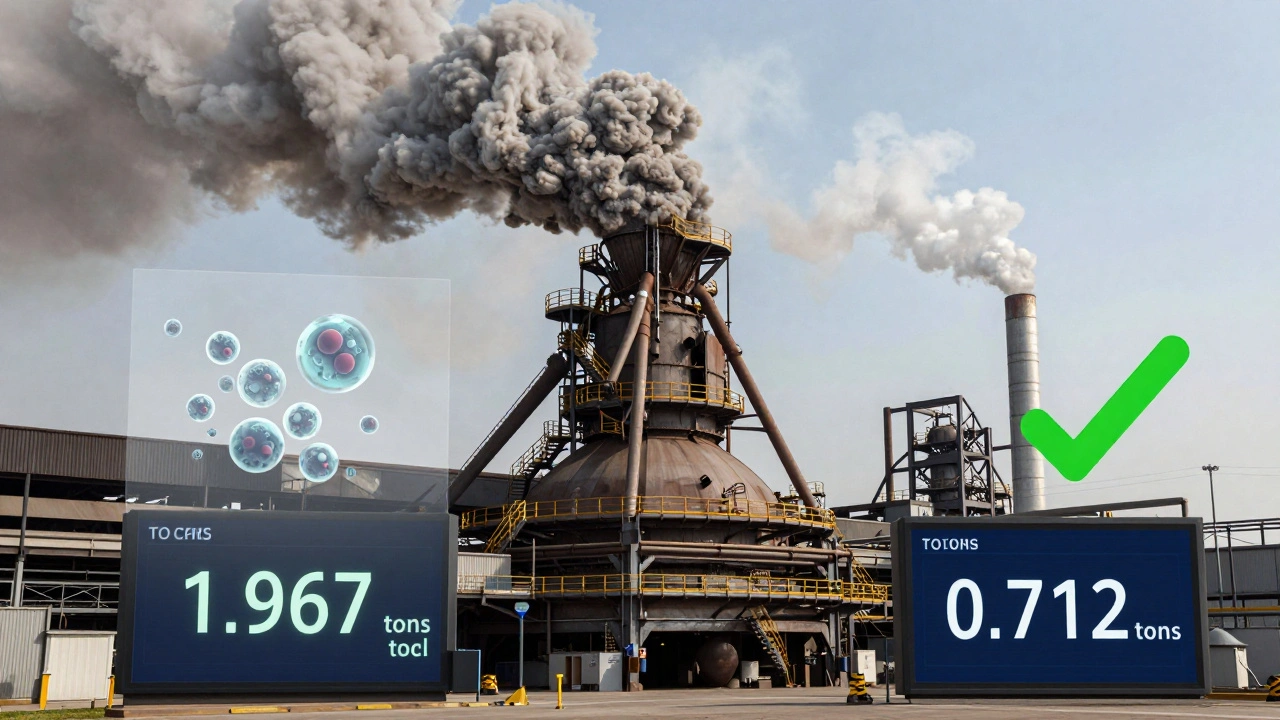
The EU carbon price is €85 per ton of CO2. CBAM charges the difference between the carbon price paid in the country of origin and the EU's carbon price. For example, if a product from Turkey emits 1.967 tons CO2 per ton of steel (compared to 0.712 tons for EU producers), the CBAM cost would be (1.967 - 0.712) * 85 = €106.63 per ton of steel.
Small businesses may incur additional compliance costs for data collection and reporting.
When you buy a steel beam from Turkey or fertilizer from India, you’re not just paying for the material-you’re also paying for the carbon emitted to make it. That’s the core idea behind carbon border adjustments. These aren’t just environmental policies. They’re trade policies dressed in climate language. And they’re already changing who wins and who loses in global markets.
What Exactly Is a Carbon Border Adjustment?
A carbon border adjustment, or CBAM, is a fee applied to imported goods based on how much carbon dioxide was emitted to produce them. It’s not a tax on the product itself-it’s a charge on the embedded emissions inside it. Think of it like this: if a U.S. steel plant has to pay $85 for every ton of CO2 it releases, a Turkish steel plant that emits twice as much per ton but pays nothing should, in theory, pay the difference when selling into the EU.
The European Union launched the first real CBAM in 2023. It’s not a full tax yet. Right now, importers just report emissions. But starting in 2026, they’ll have to buy certificates matching the EU’s carbon price-currently around €85 per ton. That’s not a guess. It’s based on the actual auction price of emissions permits under the EU Emissions Trading System.
Why This Matters for Trade
Before CBAM, companies in countries with weak climate rules had a hidden advantage. They could make steel, cement, or aluminum cheaply because they didn’t pay for pollution. The EU’s domestic industries, on the other hand, were stuck paying for carbon. That gap created what economists call carbon leakage: industries moving production overseas just to avoid climate costs.
The OECD estimates carbon leakage could cancel out 5% to 25% of emission cuts made by rich countries. CBAM tries to close that loophole. It doesn’t stop trade-it just makes sure the price of goods reflects their full environmental cost.
Right now, CBAM covers six sectors: steel, aluminum, cement, fertilizers, electricity, and hydrogen. Together, these account for 94% of industrial emissions covered by the EU’s carbon market. Steel alone makes up nearly half of the emissions targeted. That’s not random. These are the industries where emissions are high, hard to cut, and traded globally.
Who Pays the Most?
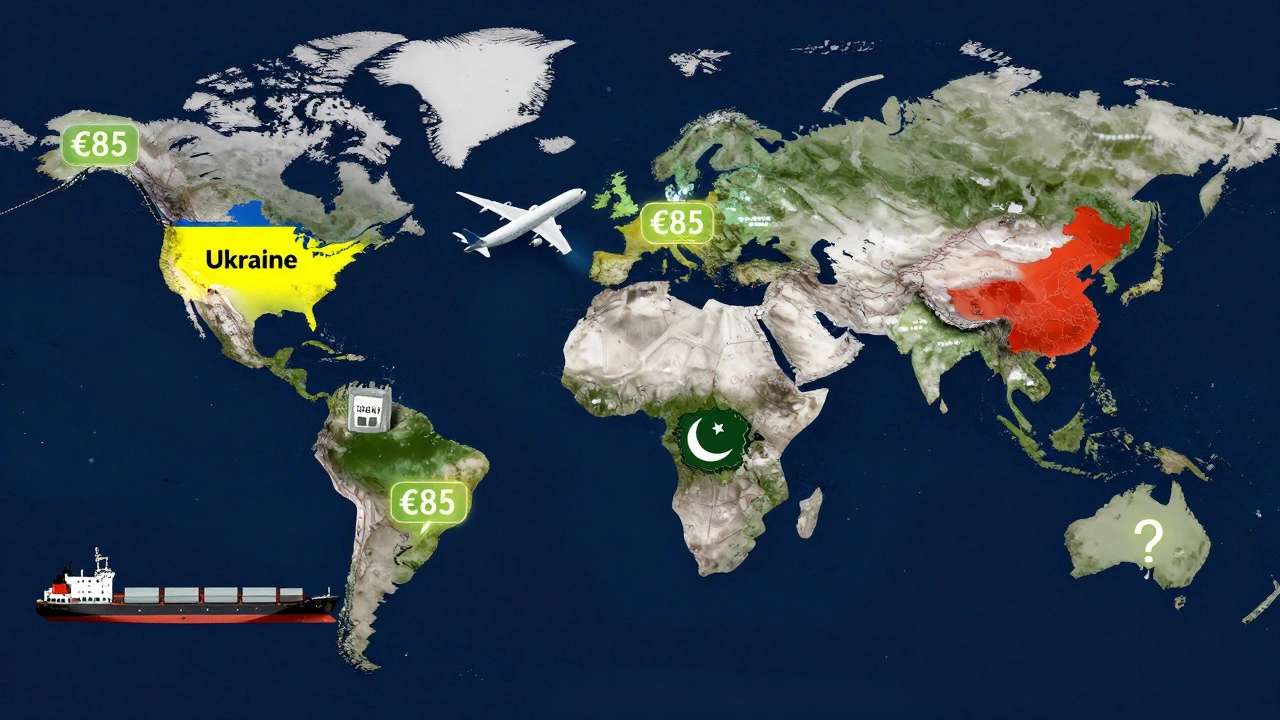
It’s not the U.S. or Germany. It’s Ukraine, Pakistan, and Turkey.
Ukraine exports about 3.7% of its total goods to the EU-mostly steel and aluminum. The World Economic Forum estimates CBAM could cut Ukraine’s GDP by 0.25% to 0.35%. That’s not a lot on paper, but for a country rebuilding after war, it’s a real blow.
Turkey saw its steel exports to the EU drop 12.3% in early 2024. Why? Because Turkish mills emit 1.967 tons of CO2 per ton of steel, while EU mills average just 0.712. That’s a 177% difference. Without upgrades, they’re priced out.
Even countries with their own carbon pricing aren’t safe. China has a national emissions trading system, but it’s worth only ¥58 per ton-about €7.50. That’s less than one-tenth of the EU price. So Chinese exporters still pay the difference. The EU doesn’t penalize them for having a system-it just charges them for not being as strict.
The Hidden Costs of Compliance
CBAM isn’t just about paying a fee. It’s about proving you paid it.
Importers must track emissions from every stage of production. That means gathering data from mines, smelters, power plants, and transporters-often across multiple countries. The Environmental Defense Fund says 73% of importers found data collection the hardest part of CBAM compliance.
For small businesses, the cost can be brutal. Setting up systems to verify emissions can run $50,000 to $200,000 per company. Annual reporting costs? Between €2,500 and €15,000. That’s a lot for a mid-sized importer of aluminum parts.
And if you can’t prove your emissions? The EU uses default values. For steel, that’s 1.967 tons per ton of product. If your real emissions are 1.2, you still pay for 1.967. That’s a 64% overcharge. It’s a blunt tool-and it hurts producers who are trying to clean up but lack the resources to prove it.
U.S. vs. EU: Two Different Paths
The U.S. is watching. And it’s debating whether to follow the EU model-or build its own.
The EU’s approach is clean: if you already paid a carbon price at home, you get credit. If your country has no system, you pay the full EU price. That’s designed to encourage global alignment, not punish.
Some U.S. lawmakers want something different. Proposals like the Clean Competition Act would slap a border fee on imports without requiring a domestic carbon price. That’s risky. The Council on Foreign Relations warns it could violate WTO rules. Why? Because it treats foreign goods worse than domestic ones. The EU avoids that by making the fee mirror what domestic producers pay.
There’s another difference: the U.S. Steelworkers Union says a CBAM could boost domestic steel sales by $8.5 billion a year. That sounds good-until you realize it means imported steel gets 15% to 25% more expensive. That could raise prices for cars, appliances, and construction projects. Consumers pay the difference.
Global Reactions: Anger, Adaptation, and Alarm
Not everyone sees CBAM as fair.
Pakistan called it “a new form of protectionism.” South Africa warned it could cost African economies $8.2 billion a year in lost exports. The Center for Global Development says low-income countries could see export declines of 3.5% to 5.5% in CBAM-covered sectors. That’s real money-money that pays for food, schools, and hospitals.
But there’s also adaptation. China is expanding its carbon market to cover steel and cement by 2026. India is considering a similar move. Even countries that oppose CBAM are realizing they need their own carbon pricing to stay competitive.
That’s the quiet win of CBAM: it’s forcing countries to act. Before, many could ignore climate rules. Now, if they want to sell to the EU, they have to clean up. The LSE Grantham Institute estimates CBAM could reduce global emissions by 0.5% to 1.2% by 2030-if paired with support for developing nations.
What’s Next? Expansion, Conflict, and Cooperation
The EU plans to add chemicals and plastics to CBAM by 2030. The UK is building its own version, set for 2027. Canada and Japan are watching closely. The U.S. has until 2025 to decide whether to act-or risk being left out of the rules that will define global trade.
But here’s the real question: can CBAM work without deepening global inequality? If only rich countries can afford the tech to cut emissions, then CBAM doesn’t level the playing field-it builds a wall.
That’s why experts warn: CBAM alone won’t solve climate change. It needs support. Technical help for data systems. Funding for clean steel plants in Vietnam or Indonesia. Training for inspectors in Nigeria or Bangladesh.
Without that, CBAM might reduce emissions-but at the cost of trust. And trust is what keeps global trade alive.
What This Means for Businesses
If you import steel, cement, or fertilizer into the EU, here’s what you need to do now:
- Start tracking emissions from your suppliers. Don’t wait for 2026.
- Ask for verified emission data-not estimates.
- Map your supply chain. Who produces what? Where? How much CO2?
- Consider switching suppliers if your current ones can’t prove low emissions.
- Factor CBAM costs into your pricing. It’s no longer a future risk-it’s a current cost.
For manufacturers outside the EU: if you want to keep selling to Europe, start investing in cleaner tech. The EU isn’t just taxing emissions-it’s buying them out. The market is shifting. The question is whether you’re ready to move with it.
Is CBAM a tax or a tariff?
CBAM is neither a traditional tax nor a tariff. It’s a fee based on the carbon content of imported goods. Unlike a tariff, which targets country of origin, CBAM targets the emissions embedded in the product. Unlike a tax, it doesn’t go to general government revenue-it’s designed to mirror the cost domestic producers pay under the EU ETS. The revenue goes to the EU budget, but the goal is not to raise money-it’s to prevent unfair competition.
Does CBAM violate WTO rules?
The EU says no. It claims CBAM follows the WTO’s National Treatment rule: imports are treated no less favorably than domestic goods. But India and China disagree. They argue it’s a technical barrier to trade under Article 2.2 of the TBT Agreement. The WTO hasn’t ruled yet. Legal experts warn that if the U.S. or UK design a CBAM without matching domestic carbon pricing, it’s far more likely to be challenged successfully.
Can countries with carbon pricing avoid CBAM?
Yes. The EU’s CBAM includes a credit system. If a country has a carbon price that’s equal to or higher than the EU’s, importers from that country get full credit. Switzerland, for example, has a carbon price close to the EU’s, so its exports face little to no CBAM cost. But if a country’s price is lower-like China’s or Russia’s-importers pay only the difference. This design encourages global alignment, not isolation.
What happens if a country doesn’t report emissions?
If a country or company can’t prove its emissions, the EU applies default values. These are based on the highest reported emissions in each sector. For steel, that’s 1.967 tons of CO2 per ton of product. This means companies that are actually cleaner still pay as if they’re the dirtiest. The EU says this prevents fraud. Critics say it punishes honest producers who lack the resources to measure accurately.
Will CBAM really cut global emissions?
The OECD estimates CBAM could reduce global emissions by 0.8 to 1.5 gigatons of CO2 annually by 2035. That’s roughly equal to taking 300 million cars off the road. But that assumes producers respond by decarbonizing. If they just shift exports to non-EU markets, emissions won’t drop-they’ll just move. CBAM only works if paired with global support for clean technology and capacity building.
Final Thoughts
Carbon border adjustments aren’t about punishment. They’re about pressure. They force producers to ask: Do we want to keep selling, or do we want to clean up? The answer isn’t always easy. But for the first time, the cost of pollution is being written into the price tag of everything we import. That’s not just policy. It’s a market signal-and markets respond faster than laws ever could.