
Debt Refinancing Calculator
Calculate your potential savings from refinancing high-interest credit card debt into a mortgage before rates rise again. The window is closing—act now before inflation reaccelerates.
Potential Savings
Important Deadline
Rates may rise by Q2 2026. Your window closes March 31, 2026. Current savings: $2,821.44/year. Waiting could cost you thousands.
Interest rates are falling. Again. But this time, it’s not a long-term trend-it’s a narrow opening, and it might slam shut before you even finish your paperwork. If you’re carrying high-interest debt, especially credit card balances or variable-rate loans, the next 90 days could save you tens of thousands of dollars. Or you could miss it entirely-and pay the price for years.
Why Now? The Rate Cut Window Is Real, But Short
The Federal Reserve cut rates twice in 2025: first in September, then again in December. By December 10, the benchmark rate dropped to 3.5%-3.75%. That’s down from 4.25% just three months earlier. It sounds small, but it’s enough to trigger a ripple effect across debt markets. Mortgage rates followed, slipping to 6.19% for a 30-year fixed loan in November, according to Freddie Mac. That’s nearly a full percentage point lower than a year ago. But here’s the catch: mortgage rates don’t move with the Fed. They track the 10-year Treasury yield. And that yield has already priced in the December cut. That means if you wait for another drop, you’re likely waiting for nothing. The market’s already ahead of you. Analysts at Rocket Mortgage say mortgage pricing is based on what traders expect rates to be in 60 days. Right now, the market expects just one more 0.25% cut in early 2026-then a pause. If inflation starts ticking up again in Q2 2026, as most economists predict, the Fed could reverse course fast. Rates could jump back up 75 to 100 basis points in under six months. That’s not a theory. That’s the consensus among six major institutions surveyed by Bloomberg.The Real Savings: Debt You Can Actually Eliminate
The biggest opportunity isn’t in lowering your mortgage payment. It’s in wiping out credit card debt. The median credit card interest rate in October 2025 was 25%. That’s not a typo. Twenty-five percent. Meanwhile, the average 30-year mortgage rate is 6.19%. That’s a 19-percentage-point gap. If you have $15,000 in credit card debt at 25%, you’re paying $3,750 a year in interest alone. Refinance that into your home equity and you’re paying under $930 a year at 6.19%. Cash-out refinancing is the most effective tool for this. In early 2025, the average borrower pulled out $94,000 in equity. That’s more than 16 times the average American’s $5,595 in credit card debt. People on Reddit’s r/personalfinance are posting real results: one user refinanced $75,000 in credit card debt and saved $8,400 a year. Another paid off $22,000 in medical bills and car loans with a single refinance. It’s not magic. It’s math. And it’s available right now.Commercial Real Estate and Leveraged Loans: Who Benefits?
It’s not just homeowners. Commercial real estate owners are jumping on this too. Multifamily property owners with floating-rate loans are locking in fixed rates below 6%. One investor on BiggerPockets refinanced a $2.3 million apartment building loan from 7.2% variable to 5.85% fixed. That’s a $30,000 annual savings on interest alone. The leveraged loan market tells a different story. High-yield bonds are outperforming loans in 2025, but loans still offer higher yields. The problem? Only the best borrowers are getting the deals. Guggenheim Investments found that 40% of the loan index still trades above par, meaning lenders are still competing for quality borrowers. But 7% of the market-CCC-rated borrowers-is responsible for 68% of recent defaults. If you’re in that group, refinancing isn’t an option. You’re already in distress. The takeaway: if your credit is solid and your cash flow is stable, you’re in the sweet spot. If you’re barely making payments, this window won’t help you. It’s not a rescue. It’s a reward for preparation.
What You Need to Qualify
This isn’t a free-for-all. Lenders are still cautious. You need:- At least 20% equity in your home for a conventional cash-out refinance (10% for HELOCs)
- A FICO score of 680 or higher for the best rates (some portfolio lenders accept 640+ at a premium)
- Two years of tax returns and recent pay stubs
- A debt-to-income ratio under 43%
The Hidden Risks: When Refinancing Backfires
Refinancing isn’t risk-free. Some people use the cash to pay off credit cards, then rack up new debt. That’s not financial freedom. That’s financial roulette. Others refinance to get a lower payment, but extend their loan term from 15 to 30 years. That lowers the monthly bill-but doubles the interest paid over time. You need a plan. Pay off the debt. Don’t just move it around. Commercial borrowers face another trap: increased documentation. One investor said his refinance took 15 extra days because the lender demanded three years of financial statements instead of two. That pushed his rate lock past expiration. He lost the deal.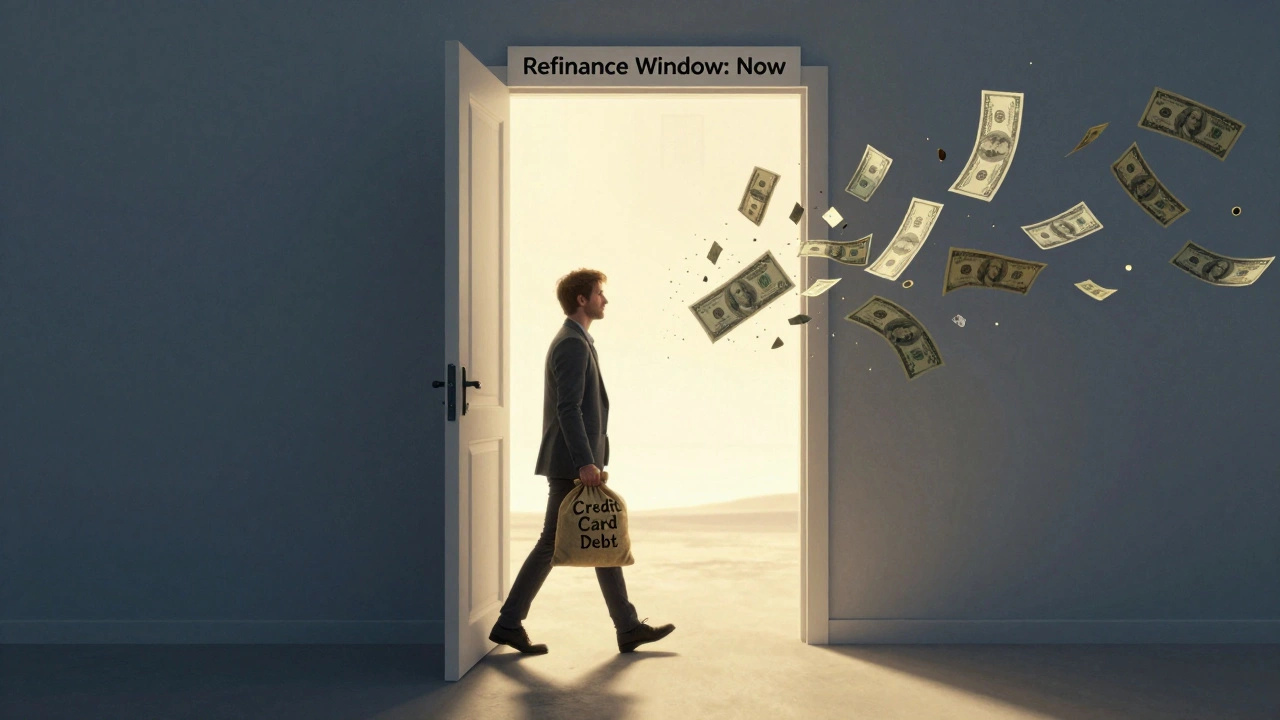
What to Do Now: A Simple Action Plan
If you’re considering refinancing, here’s your checklist:- Check your credit score. If it’s below 680, focus on improving it now. Even a 20-point jump can save you thousands.
- Calculate your debt. Add up all high-interest debt (credit cards, personal loans, auto loans). If it’s over $10,000, you’re a candidate.
- Estimate your equity. If your home is worth $400,000 and you owe $280,000, you have 30% equity. That’s enough.
- Get pre-approved. Don’t wait for the perfect rate. Get quotes from three lenders this week. Lock in a rate if it’s below 6.3%.
- Plan your cash-out. Use the money to pay off high-interest debt. Don’t spend it on vacations or new cars.
- Set a deadline. Mark March 31, 2026, on your calendar. That’s when the window is expected to close.
What Happens If You Wait?
If you wait until inflation reaccelerates in Q2 2026, you’ll see rates climb again. Mortgage rates could jump back to 7% or higher. Credit card rates? They’ll stay near 25%. The gap will vanish. The savings will disappear. The Fed isn’t going to cut rates again in 2026 unless inflation collapses. And most economists don’t think that’s happening. The economy is still growing. Wages are rising. Consumer spending is holding strong. Inflation isn’t dead-it’s just resting. This isn’t a once-in-a-decade opportunity. It’s a once-in-a-year one. And it’s shrinking by the day.Bottom Line: Act Before the Door Slams
The debt markets are offering a rare chance to rewrite your financial story. Lower your interest burden. Eliminate high-cost debt. Lock in stability before the next rate hike hits. You don’t need to be rich. You don’t need to be an expert. You just need to act before March. The numbers don’t lie. The window is open. But it won’t stay that way.Is now a good time to refinance my mortgage?
Yes-if you have high-interest debt like credit cards or personal loans. With mortgage rates near 6.19% and credit card rates at 25%, refinancing can cut your interest costs by over 70%. But don’t wait for rates to drop further. The market has already priced in the next cut. Act now, or risk missing the window.
Can I refinance if I have bad credit?
It’s difficult. Most lenders require a FICO score of at least 680 for the best rates. Some portfolio lenders accept scores as low as 640, but you’ll pay significantly more in interest. If your score is below 640, focus on improving it first-pay down debt, fix errors on your credit report, and avoid new credit applications. Refinancing with poor credit often costs more than it saves.
How much equity do I need to refinance?
For a cash-out refinance, you typically need at least 20% equity in your home. That means if your home is worth $300,000, you can’t owe more than $240,000. If you have less equity, a HELOC might be an option-it often requires only 10% equity. But HELOCs have variable rates, so they don’t offer the same long-term stability as a fixed-rate refinance.
Will refinancing hurt my credit score?
It might cause a small, temporary dip-usually 5 to 10 points-due to the hard inquiry and new account. But if you use the refinance to pay off credit card debt, your credit utilization ratio will drop, which usually leads to a net gain over time. The key is to avoid opening new credit accounts while refinancing.
What’s the biggest mistake people make when refinancing?
They treat it like free money. Refinancing isn’t a windfall-it’s a tool. The biggest mistake is using the cash to pay off debt, then running up new balances. That traps you in a cycle of borrowing. The only way to win is to pay off the debt and stop using credit cards or loans for everyday spending.
How long does the refinancing process take?
On average, it takes 30 to 45 days from application to closing. But delays are common-appraisals, document requests, and underwriting backlogs can push it to 60 days. If you’re trying to lock in a rate before March 2026, start now. Waiting until February means you’re gambling with your savings.
Are rate cuts good for commercial real estate?
Yes-for owners with floating-rate loans or loans maturing soon. Many multifamily property owners refinanced in late 2025 from 7%+ variable rates to 5.5%-6% fixed rates. That’s a 20%+ drop in interest costs. But lenders are demanding more documentation, and only borrowers with strong cash flow and high occupancy rates are getting approved. If your property is struggling, refinancing won’t fix it.
What happens if inflation comes back?
If inflation reaccelerates in Q2 2026 as expected, the Fed will likely raise rates again-possibly by 75 to 100 basis points within six months. Mortgage rates could jump back to 7% or higher. The window for refinancing will close. Those who waited will see their interest costs rise again. Those who acted will be locked in at today’s lower rates.