
NATO Defense Production Gap Calculator
Calculate how much additional production capacity is needed to meet NATO's defense requirements. Based on current data: Europe produces 1.1 million artillery shells annually but needs 3.5 million.
Input Production Metrics
Production Gap Analysis
Remaining Gap: 0.0 million units
Required Production Increase: 0.0 million units/year
Time to Close Gap: 0.0 years
Production Scenarios:
- Increase production by 0.5M units/year: years
- Increase production by 1.0M units/year: years
- Increase production by 1.5M units/year: years
The war in Ukraine didn’t just change the map of Eastern Europe-it shattered the old assumptions about how the West prepares for war. For decades, NATO countries treated defense spending like a seasonal expense: enough to keep the lights on, but never enough to build real capacity. That’s over. Today, the defense industrial base is no longer a backroom budget line. It’s the central nervous system of Western security. And it’s being rebuilt from the ground up-fast.
From Budget Line to Industrial Strategy
In 2014, only three NATO members met the 2% of GDP defense spending target. By 2025, that number jumped to 23 out of 32. Why? Because the war forced everyone to face a brutal truth: their stockpiles were empty. By mid-2025, NATO had sent over 1.2 million artillery rounds to Ukraine. In the process, many European nations dropped below 10% of their own required munitions reserves. That’s not a supply issue. That’s a survival risk.
The 2025 NATO Summit in The Hague didn’t just tweak the numbers. It rewrote the rules. Member states agreed to spend 5% of GDP on defense and security-related needs by 2035. That’s more than double the old target. This isn’t about raising taxes. It’s about rebuilding factories, hiring workers, and securing raw materials. It’s about turning a political promise into production lines.
The Numbers Don’t Lie
Global defense procurement is set to hit $2.9 trillion by 2027, up from $2.1 trillion in 2024. That’s an 11.3% annual growth rate-the fastest in decades. The U.S. is committing $1.02 trillion in its 2025 budget, with $385 billion going straight to R&D. Europe isn’t far behind. The European Commission launched the ReArm Europe Plan: a €150 billion loan facility to unlock up to €800 billion in defense spending by 2029. Sixteen EU countries are already using emergency budget clauses to bypass spending limits.
But money alone doesn’t make bullets. Or missiles. Or radar systems. The real bottleneck isn’t funding-it’s capacity. Europe currently produces 1.1 million 155mm artillery shells a year. The collective demand? 3.5 million. That’s a gap of 2.4 million rounds. The U.S. can’t fill it alone. And even if it could, relying on American suppliers for every shell, every battery, every drone undermines the whole point of the initiative: strategic autonomy.
Where the Bottlenecks Are
It’s not just artillery. It’s the tiny parts that make big systems work. Gallium arsenide semiconductors-critical for next-gen radar and electronic warfare systems-are in short supply. Current production can only meet 37% of projected demand through 2027. Drone procurement has tripled since 2022, jumping from $11.2 billion to $28.7 billion in just three years. Air defense systems are set to hit $98.4 billion by 2027. Naval programs? Six new submarine projects are underway, each worth an average of $14.3 billion.
And yet, the average defense contract still takes 28 months to award. Only 12% of NATO members hit the Alliance’s own target of 12 months. That’s not just slow. It’s dangerous. Companies won’t invest in new factories if they don’t know when-or if-they’ll get paid. That’s why multiyear contracts are now 63% of new awards, up from 22% in 2022. Long-term certainty is the only thing that can trigger private investment at this scale.

Who’s Doing It Right
Poland is the standout example. After Russia’s invasion, Warsaw didn’t wait for Brussels. It created the Ogólnopolski Program Modernizacji-a single, unified framework to coordinate 78 separate procurement projects. Contract timelines dropped from 24 months to 8.2 months. Defense spending jumped to 4.1% of GDP. It’s not just spending more. It’s spending smarter.
Other nations are following. The U.S. is accelerating drone and missile production through the Defense Production Act. Germany is expanding its Rheinmetall ammunition plants. France is investing in next-gen fighter jets and naval drones. But coordination is still patchy. Only 34% of European defense equipment meets NATO’s STANAG interoperability standards. That means a French tank might not talk to a Polish radio. A German missile might not fit an Italian launcher. That’s not just inefficient-it’s lethal in combat.
The Risk of Wasting Trillions
There’s a real danger here: spending trillions without fixing the system. European defense contracts cost 27% more on average than U.S. ones. Why? Fragmented procurement. Bureaucratic delays. Overpriced deals. The €9 billion Eurofighter scandal wasn’t an outlier-it was a symptom. Without reform, Goldman Sachs warns, 25-30% of this new spending could vanish into inefficiency.
Experts like Dr. Ian Brzezinski of the Atlantic Council say the key is speed: cut contract timelines to under 12 months. Dr. Elisabeth Braw of the American Enterprise Institute warns that without joint production targets, this spending will just enrich Lockheed Martin and Raytheon-not Europe’s own industry. The European Union Institute for Security Studies adds another layer: oversight failures. When contracts are opaque and audits are rare, waste follows.
The Road Ahead: Three Initiatives That Matter
NATO isn’t waiting for perfect solutions. It’s launching three concrete efforts to close the gap.
First, Project Arrow is building shared ammunition production facilities across six NATO countries. Goal: add 500,000 artillery shells a year by 2027. That’s not enough to close the full deficit, but it’s a start. It’s also a test: can nations share factories, supply chains, and even workers across borders?
Second, the European Defence Industrial Strategy, launching in early 2026, will force joint procurement. By 2030, 30% of air defense systems and 45% of armored vehicles must be bought together. No more 27 different nations ordering 27 different tanks. That’s the only way to reach economies of scale.
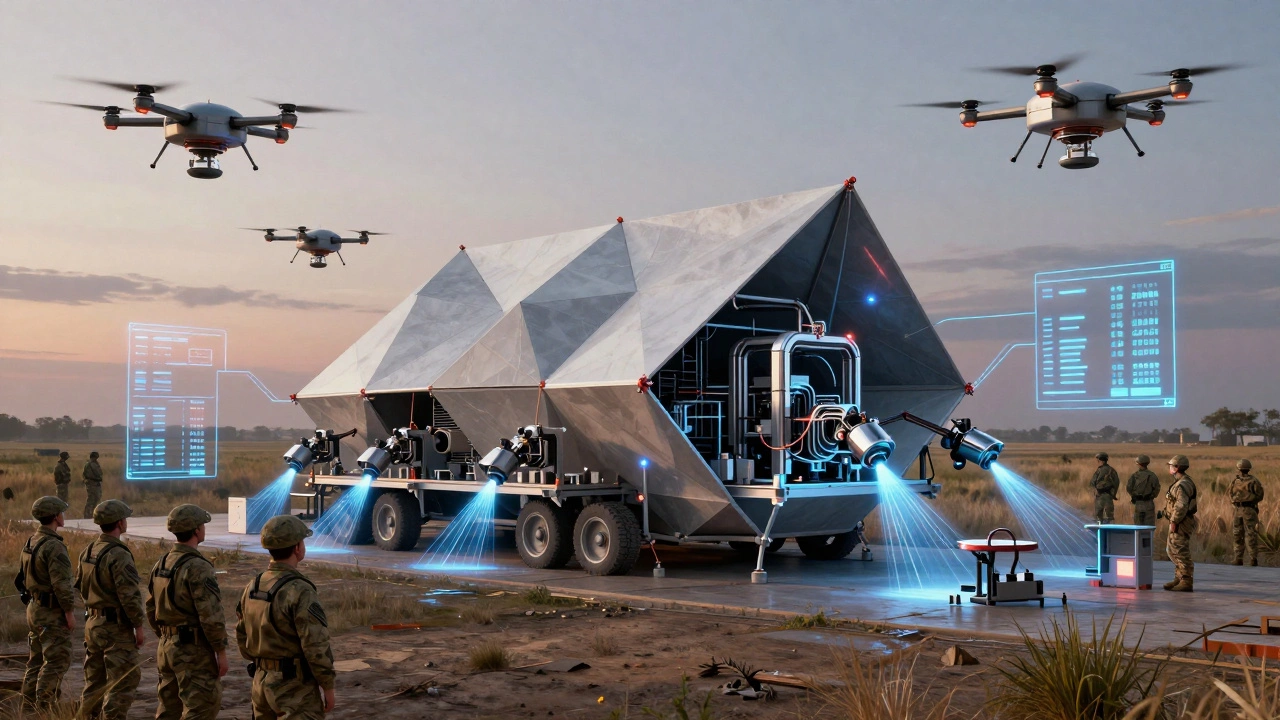
Third, NATO’s Innovation Fund is growing from €1 billion to €3.5 billion by 2027. This isn’t just for flashy tech. It’s for surge manufacturing: modular factories that can ramp up production in weeks, not years. Think 3D-printed drone parts. Automated shell assembly lines. AI-driven logistics that predict shortages before they happen.
What Success Looks Like
Success isn’t measured by how much money is spent. It’s measured by how many shells are fired, how many drones are flying, how many soldiers are protected. By 2030, NATO aims to cut reliance on non-NATO suppliers for critical equipment by 40%. That means fewer U.S. missiles, fewer Israeli sensors, fewer Russian-made components in legacy systems.
The real win? A defense industry that doesn’t need a war to justify its existence. One that can scale up when needed-and scale down without collapsing. That’s the difference between a military that’s ready for war… and one that’s scrambling through it.
The transformation isn’t just happening. It’s accelerating. And the next five years will determine whether NATO builds a durable, self-sufficient defense base-or spends its way into another crisis, just with bigger budgets and deeper debt.
Why is NATO shifting from 2% to 5% of GDP for defense spending?
The shift from 2% to 5% of GDP reflects a recognition that the old target was never enough to sustain modern warfare. The war in Ukraine exposed how quickly stockpiles of artillery, missiles, and drones can be exhausted. With Russia producing over 3 million artillery rounds annually and NATO members collectively running below 15% reserves in some cases, the Alliance realized it needed to rebuild industrial capacity-not just fund operations. The 5% goal is designed to fund not just equipment, but factories, supply chains, and workforce training for sustained, high-intensity conflict.
What’s the biggest bottleneck in NATO’s defense production right now?
The biggest bottleneck isn’t money-it’s manufacturing capacity and speed. Europe can currently produce only 1.1 million 155mm artillery shells per year, but needs 3.5 million. Factories are running at 89% capacity, leaving no room for wartime surge. Supply chains for critical components like gallium arsenide semiconductors can’t keep up. And procurement cycles still average 28 months, discouraging private investment. Without faster contracts and more factories, even the largest budgets won’t translate into more weapons on the ground.
Why can’t the U.S. just supply all of NATO’s needs?
The U.S. can’t be the world’s arsenal because it’s also under strain. American stockpiles are being drawn down to support Ukraine. U.S. factories are already operating near capacity. Relying on one country for critical supplies creates strategic vulnerability-if U.S. production slows, or if political priorities shift, NATO allies are left exposed. The goal of the revitalization is to build a self-sustaining European industrial base so that no single nation bears the burden alone.
How is Poland managing to produce weapons faster than other NATO countries?
Poland cut its average defense contract award time from 24 months to 8.2 months by creating a single, unified procurement program called the Ogólnopolski Program Modernizacji. Instead of 78 separate, competing bids, all military modernization efforts are coordinated under one strategic plan. It streamlined approvals, removed bureaucratic layers, and gave industry clear, long-term demand signals. Other countries are now trying to copy this model, but few have matched its speed or clarity.
What’s the risk of not fixing NATO’s procurement system?
If procurement stays slow and fragmented, NATO risks wasting up to 30% of its new defense spending on inefficiencies-overpriced contracts, duplicated efforts, and delayed deliveries. More critically, it could find itself unprepared for the next major conflict. Even with massive funding, if a tank can’t be ordered in under a year or a missile can’t be produced at scale, the Alliance’s deterrence value collapses. The money is there. The question is whether the system can keep up.
Will this defense buildup lead to a new arms race?
It’s already happening-but not in the way most people think. This isn’t about nuclear weapons or space weapons. It’s about conventional arms: artillery, drones, air defense, and ammunition. Russia has been ramping up production since 2022, and NATO is responding in kind. The difference is that NATO’s buildup is focused on replenishing what was lost, not expanding beyond existing needs. The goal isn’t to out-produce Russia indefinitely-it’s to reach a level of self-sufficiency that prevents future depletion.