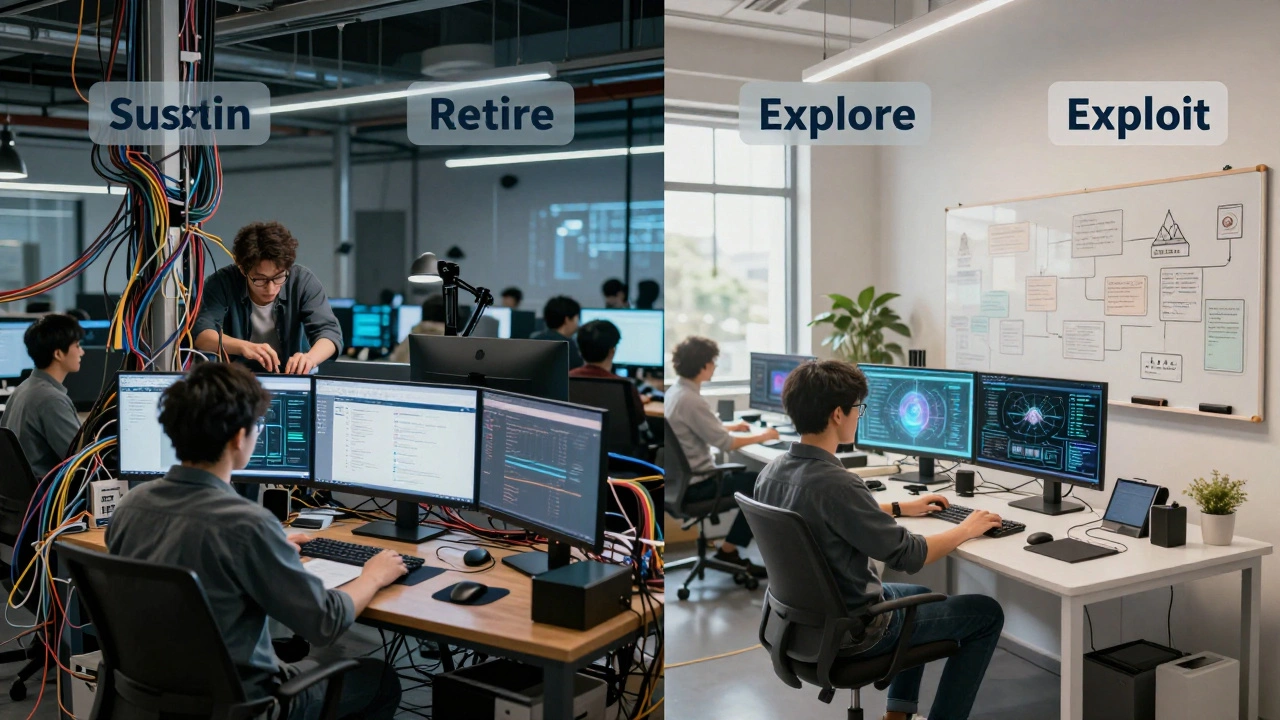
Portfolio Allocation Calculator
Allocate Your Tech Portfolio
Use the dual trajectory framework to allocate resources across your portfolio. The article recommends these target ranges:
Explore Zone (10-15%)
Innovation10%
Exploit Zone (25-35%)
Growth30%
Sustain Zone (40-50%)
Maintenance45%
Retire Zone (5-10%)
Wind-down15%
Allocate resources according to the dual trajectory framework. Total must equal 100%.
Most tech teams face the same impossible choice: grow fast or stay innovative. You can’t do both-so the thinking goes. But what if that’s a lie? What if scaling and specializing aren’t opposites, but two sides of the same coin? The companies winning right now aren’t choosing one over the other. They’re building portfolios that do both at the same time.
Why Your Tech Portfolio Is Broken
Think about your last tech initiative. Was it a new AI tool you built from scratch? A legacy system you kept running because it still made money? A customer portal you upgraded last year? Now ask yourself: were all of these treated the same way? Same budget process? Same team structure? Same performance reviews?
If yes, you’re not alone. Most companies treat their entire tech portfolio like it’s one big machine-tweak the knobs, crank up the speed, and hope it doesn’t break. But that’s like driving a truck and a sports car on the same track, expecting both to perform. The truck needs torque. The sports car needs precision. You can’t optimize both with the same settings.
Here’s what happens when you ignore this: engineers burn out. Innovation stalls. Revenue growth flattens. IQTalent’s 2023 study of 47 private equity-backed tech firms found that companies pushing hard for scale without protecting specialized work saw 40% higher engineer attrition. Why? Because the people who built the cool stuff got buried under process, meetings, and scaling demands. They left. And with them went the very innovation that could’ve kept the company ahead.
The Dual Trajectory Framework: How to Do Both
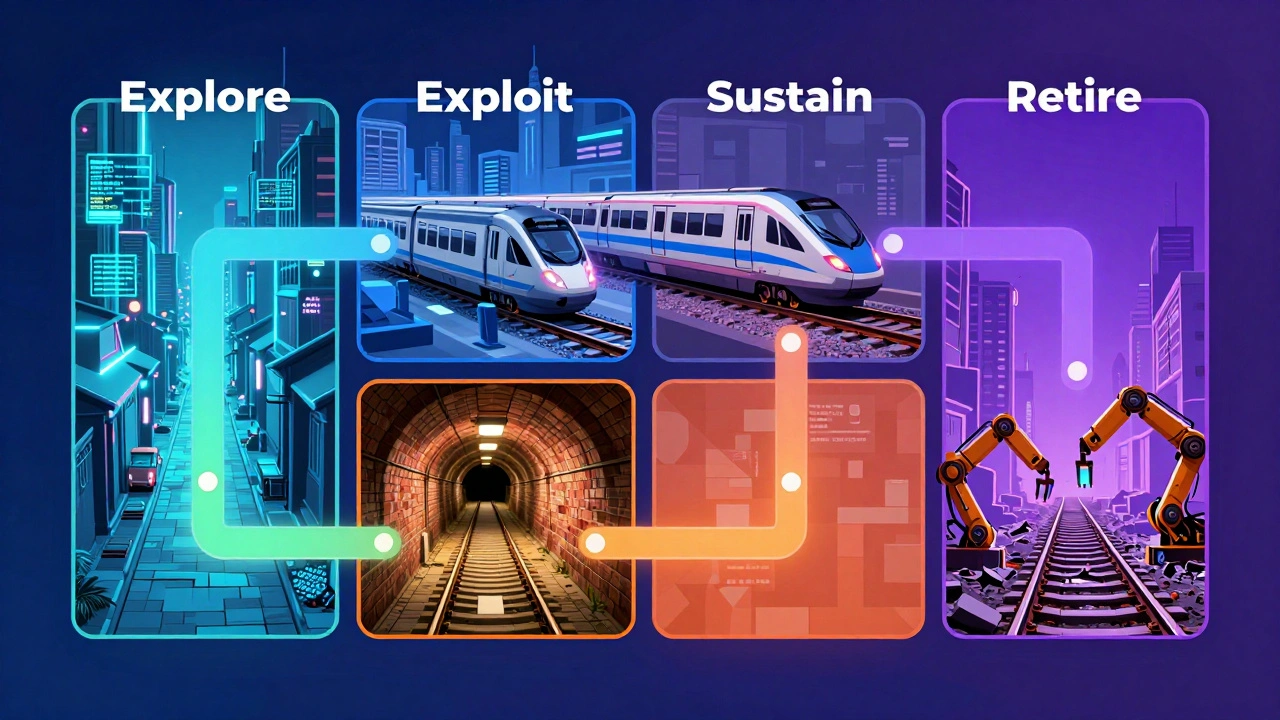
The solution isn’t more hours or better tools. It’s a new way to organize your tech work. Enter the dual trajectory framework: a system that splits your portfolio into four distinct zones, each with its own rules, resources, and rhythms.
- Explore (10-15% of portfolio): These are your wild ideas. The AI model you’re testing. The new interface prototype. The blockchain experiment. High uncertainty. Low revenue. High talent needs. This is where your best engineers spend 10-20% of their time-not as a side project, but as core work.
- Exploit (25-35%): These are ideas that showed promise. They’ve got users. They’re generating some revenue. Now you scale them. More servers. Better automation. More QA. This is where you hire process-oriented engineers and implement CI/CD pipelines.
- Sustain (40-50%): These are your cash cows. The billing system. The customer database. The inventory tracker. Reliable. Repeatable. Low innovation. High operational load. You don’t reinvent these. You optimize them. Fix bugs. Reduce costs. Automate maintenance.
- Retire (5-10%): These are the zombies. The app no one uses. The legacy API no one remembers. The tool that costs more to maintain than it’s worth. You don’t fix them. You shut them down. Cleanly. Systematically.
This isn’t theory. Guidehouse tracked companies using this model and saw a 22.7% improvement in application portfolio efficiency. IQTalent found they scaled 30% faster with 65% less disruption to development cycles. The magic? Each zone has its own goals, metrics, and team structure. You don’t measure the AI prototype the same way you measure the payroll system.
How to Allocate Resources Right
Money isn’t the only thing you need to allocate. Time. Talent. Attention. All of it.
Here’s how top firms do it:
- High importance + high capability: Build it yourself. Allocate 35-45% of your R&D budget here. These are your core strengths-things you’re good at and that matter to your business. Think proprietary algorithms, unique data pipelines, or customer-facing AI tools.
- High importance + low capability: Buy or license. Don’t waste time building what others already do well. If you need a cloud billing system, use Stripe or AWS. Save your engineers for what only you can do.
- Low importance + low capability: Partner. Use SaaS tools. Outsource. If it’s not core and you’re bad at it, don’t touch it.
- Low importance + high capability: Optimize. You’re good at this, but it doesn’t move the needle. Automate it. Reduce cost. Don’t grow it.
This matrix isn’t optional. EY found that 68% of companies fail because they misallocate. They pour money into a legacy system they’re good at but no one cares about. Or they try to build an AI platform from scratch when they could’ve licensed it. Both are expensive mistakes.
Real-World Impact: What This Looks Like in Practice
One manufacturing client of EY had a problem: they were losing market share. Their competitors were using AI to predict pricing in real time. Their internal team had built a basic model-but it was buried under maintenance work on old ERP systems.
They restructured. They set aside 15% of engineering time for Explore. They pulled two senior engineers off the ERP team and gave them a dedicated sprint cycle to improve the pricing model. They licensed the data pipeline from a third party instead of building it. They automated the ERP’s routine tasks with low-code tools.
In 10 months, they launched a real-time pricing engine. Revenue jumped 22%. The ERP system? Still running. But now it needed 40% less engineering time. The engineers who built the pricing engine? They stayed. Because they weren’t drowning in legacy code.
Another company-a SaaS startup-had 120 engineers. Half were working on 3 core products. The other half were stuck maintaining 17 legacy tools. They didn’t know which ones to kill. They did a portfolio audit. They retired 8 tools. They automated 5 more. They freed up 30 engineers. Half of them joined the Explore team. Within a year, they launched two new products that accounted for 18% of new revenue.
What Goes Wrong-And How to Fix It
People love this framework. Until they try to implement it.
The biggest mistake? Treating it like a one-time project. It’s not. It’s a muscle. You have to train it.
Here are the top three failures-and how to avoid them:
- “We don’t have time for portfolio audits.” You think you don’t have time. But you’re already wasting time-on dead projects, duplicated tools, confused teams. Start small. Pick one product line. Map its four zones. Do it in two weeks. You’ll see patterns you never noticed.
- “Our leadership wants growth now.” Yes. But growth without innovation is a dead end. Use the metrics. Show them: Explore initiatives have a 30% higher chance of becoming Exploit projects when given space. Show them the retention numbers. Engineers who work on Explore stay 2.3x longer.
- “We don’t have the right tools.” You don’t need fancy software. Start with a spreadsheet. List every tech initiative. Assign it to a zone. Track time spent. Budget used. Revenue generated. That’s enough to start. Apptio and Itonics help later-but they’re not the start.
And here’s the secret: the best teams don’t wait for permission. They start in their own corner. One engineer sets aside Friday afternoons for Explore. A manager pushes back on a meeting to protect sprint time. That’s how change happens-not from the top, but from the ground up.

Where This Is Headed: AI and the Future of Portfolio Management
The next leap isn’t in process. It’s in prediction.
Apptio’s 2025 update uses AI to forecast which Explore projects are most likely to become Exploit hits-based on data from 1,200+ companies. Itonics now pulls in real-time market signals: competitor moves, funding trends, regulatory shifts-and adjusts portfolio allocations automatically.
By 2026, Forrester predicts 75% of top PE firms will use integrated dashboards that show both financial performance and innovation output on one screen. That’s the future. Not just knowing how much you spent. But knowing what you learned.
And that’s the real win. This isn’t about doing more. It’s about doing the right things. The things that matter. The things that last.
Start Here: Your First 3 Steps
You don’t need a consultant. You don’t need a budget. You need to start.
- List every tech project you’re working on. Don’t skip the small ones. Even the “weird” ones.
- Assign each one to Explore, Exploit, Sustain, or Retire. Be honest. If it’s not moving the needle, it’s Retire.
- Find one Retire project. Kill it. Delete the code. Cancel the subscription. Tell the team. Free up even 10 hours a week. That’s your first win.
Then repeat. In three months, you’ll have a portfolio that actually works. Not because you did everything right. But because you stopped doing the things that didn’t.