Cross-Border Data Transfer Compliance Checker
Compliance Result:
By 2025, moving data across borders isn’t just a tech issue-it’s a legal minefield. If your company handles personal data from the U.S. or EU, you’re not just managing servers anymore. You’re navigating a web of laws that treat data like a national security asset. The old idea that privacy is about consent and transparency? It’s still there, but now it’s layered over something much bigger: control. Countries aren’t just protecting citizens’ data anymore-they’re protecting their own power.
The U.S. Shift: From Privacy to National Security
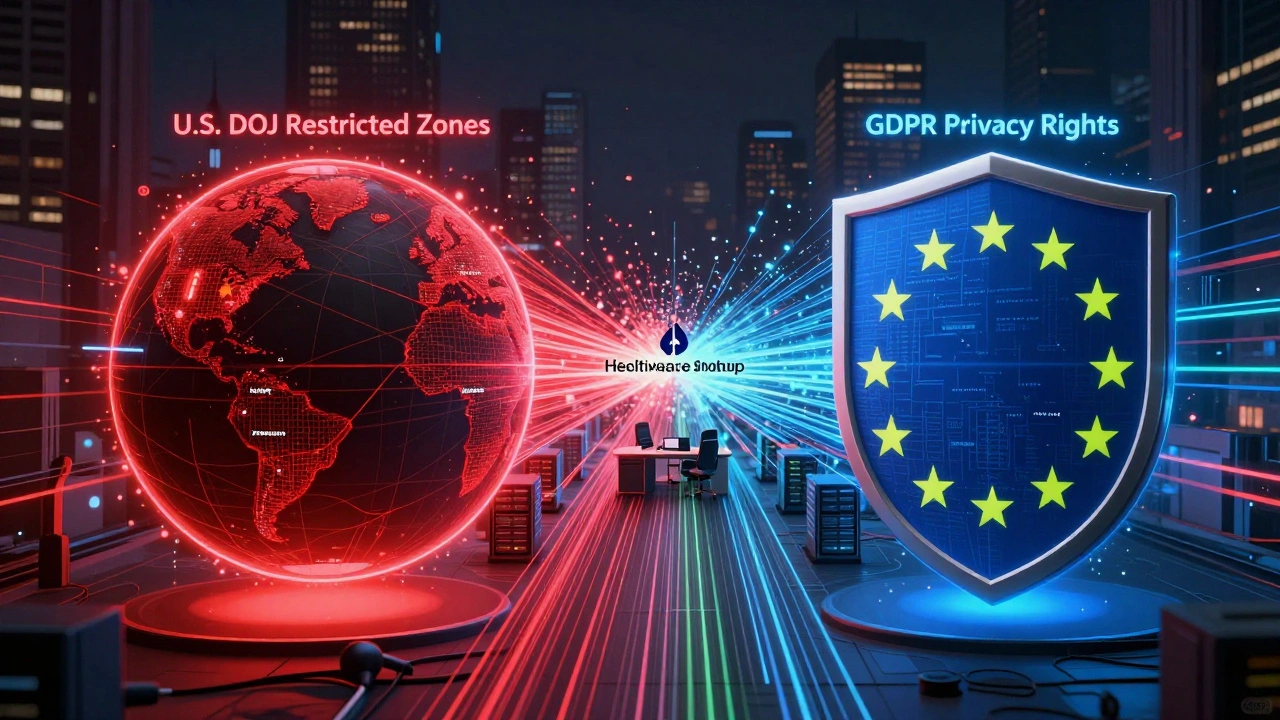
The biggest change in 2025 came from the U.S. Department of Justice. On April 8, 2025, the DOJ Data Security Rule went into full effect. This wasn’t a tweak to existing privacy laws. It was a complete pivot. Instead of asking, “Did you get permission?” the rule now asks, “Who are you giving this data to?” The rule blocks data transfers to six countries: China, Russia, Iran, North Korea, Cuba, and Venezuela. It doesn’t care if the transfer is for marketing, research, or cloud storage. If it’s sensitive data, and it’s going to one of those countries, it’s either banned or tightly restricted. What counts as sensitive? The DOJ defined it with cold precision:- Genomic data for 1,000 or more people
- Biometric data (like facial scans or fingerprints) for 1,000 or more people
- Precise location data for 1,000 or more devices
- Health or financial records for 10,000 or more people
- Social Security numbers linked to other identifiers for 100,000 or more people
The EU’s Countermove: Privacy as a Right, Not a Risk
While the U.S. drew red lines around countries, the EU doubled down on its core principle: data belongs to the individual. In November 2025, the European Council adopted new rules to streamline GDPR enforcement across borders. It didn’t change the law-it made it faster and harder to ignore. Now, when a data breach crosses multiple EU countries, regulators have binding deadlines to act. No more waiting years for one country to catch up. The European Data Protection Board (EDPB) also confirmed in 2025 that GDPR applies to AI training. If you’re using EU citizens’ data to train a chatbot in Singapore, you’re still bound by GDPR. Location doesn’t matter. Data does. The EU also moved to strengthen its data transfer tools. New standard contractual clauses for cloud services were published in November 2025. These aren’t just templates-they’re legal contracts that force vendors to prove they can protect data, even if they’re based in a country with weak privacy laws. And the EU is expanding its circle of trust. Brazil’s data protection law is now on track for an adequacy decision-meaning data can flow freely between the EU and Brazil without extra paperwork. The UK’s adequacy status was extended through 2031. These aren’t just legal moves. They’re geopolitical signals: the EU is building alliances around shared privacy values.The Collision: When U.S. Rules Clash with EU Rules
Here’s where things get messy. A U.S. company trying to follow both rules faces impossible choices. Say you’re a healthcare startup in Boston. You use a cloud provider in Germany to store patient records. That’s fine under GDPR. But if that provider’s servers are accessed by engineers in China (even just for maintenance), the DOJ rule says you’ve violated U.S. law. You can’t use the same vendor for both. Or take AI development. You train a model on EU patient data in Ireland. GDPR says you need lawful basis and transparency. But if you then deploy that model using servers in India, and the model accidentally stores a user’s location near a U.S. military base? Now you’ve triggered the DOJ rule. The fines tell the story. Uber paid €290 million under GDPR for unlawful data transfers. Clearview AI got fined €30.5 million for scraping biometric data from social media and selling it globally. These aren’t outliers. They’re warnings. The EU is punishing companies for treating data like a commodity. The U.S. is punishing them for letting it fall into the wrong hands.
Who’s Feeling the Pain?
It’s not just legal teams. Real people are dealing with the fallout. A senior privacy officer at a multinational tech firm told Reddit users in June 2025 they spent $2.3 million in just three months to rebuild their vendor management system. Why? Because the DOJ rule forced them to track not just where data went, but who had access to it-and from where. In healthcare, clinical trials now require 10+ compliance checks before data can leave the country. One compliance officer described it as “nightmare scenarios.” Every transfer needs new documentation, audits, certifications. Time delays are growing. Research is slowing down. But it’s not all chaos. Companies that had already mapped their data flows before 2025 had a huge advantage. One financial services CISO told TechTarget their existing system cut compliance costs by 65%. The lesson? If you didn’t know where your data was going, you’re now paying for it.What You Need to Do Right Now
If you’re managing data in 2025, here’s what you can’t ignore:- Map every data flow. Not just the big ones. Every API, every cloud sync, every third-party tool. If it touches U.S. or EU data, document it.
- Classify your data. Know what’s sensitive. Use the DOJ’s thresholds. If you have biometric data for 1,000+ people, you’re in the restricted zone.
- Know your vendors. Where are their servers? Who has access? Do they have offices in countries of concern? Ask for proof, not promises.
- Prepare for audits. The DOJ requires 10-year record retention. Annual audits are mandatory for restricted transfers. Start saving logs now.
- Train your teams. Engineers, HR, marketing-they all move data. They need to know what’s allowed and what’s not. A single Slack message sending a file to a contractor in China could trigger a violation.
The Bigger Picture: Fragmentation or Future?
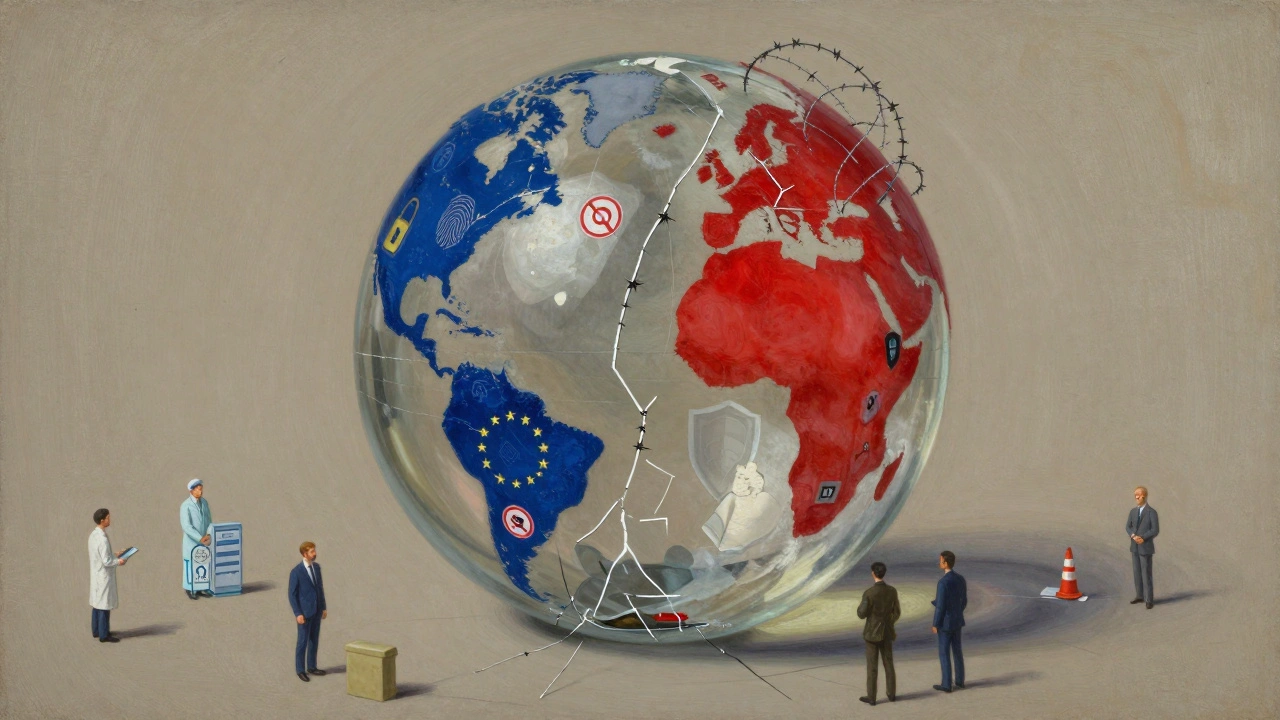
By 2027, Gartner predicts over 40% of AI-related privacy violations will come from accidental cross-border exposure. That’s not because people are careless. It’s because the systems we’ve built don’t understand borders anymore. Data flows where it’s easy, not where it’s legal. The global data governance market hit $18.7 billion in Q1 2025. Nearly $7 billion of that was spent on cross-border compliance tools. Companies like OneTrust and TrustArc are racing to build platforms that can track both U.S. and EU rules at once. But software can’t fix bad policy. The World Economic Forum warns that if countries keep building walls around their data, the global economy could lose $1.2 trillion a year by 2030. Innovation slows. Supply chains break. Startups can’t scale. The real question isn’t whether we can control data flows. It’s whether we should. The U.S. says yes-national security demands it. The EU says yes-but only if privacy rights are preserved. The rest of the world is watching, and 14 countries adopted GDPR-style laws in 2025 alone. We’re not moving toward one global standard. We’re moving toward a patchwork. The challenge isn’t just compliance. It’s survival. The companies that win will be the ones who treat data governance not as a cost center, but as a core part of their strategy.What’s Next?
The DOJ’s non-enforcement window ends July 8, 2025. After that, enforcement kicks into high gear. Assistant Attorney General Matthew Olsen made it clear: “Significant enforcement actions will commence in Q3 2025.” The EU is also working on changes to GDPR-updating definitions of personal data and clarifying rules for AI. Brazil’s adequacy decision could be finalized by year-end. India is drafting its own data localization law. The pace isn’t slowing. The only certainty? If you’re handling data across borders in 2025, you’re not just in tech. You’re in international law.Does the DOJ Data Security Rule apply to small businesses?
Yes. The rule applies to all U.S. persons-including individuals, small businesses, nonprofits, and startups-if they handle the defined categories of sensitive data. Size doesn’t matter. If you collect biometric data for 1,000 people or health records for 10,000, you’re covered. Many small firms assume they’re too small to be targeted, but enforcement doesn’t discriminate by revenue.
Can I still use cloud services like AWS or Azure if they have servers in China?
You can, but only if you ensure no U.S. sensitive data is stored, processed, or accessed from servers in China, Russia, or other countries of concern. Many cloud providers offer region-specific data centers. You must configure your services to route data only through approved regions (like U.S. East, EU Central, or Japan). Audit your settings quarterly. A misconfigured bucket or API endpoint could trigger a violation without your knowledge.
What counts as “access” to data under the DOJ rule?
The DOJ defines “access” as any scenario where a person or entity in a country of concern can view, download, modify, or otherwise interact with covered data-even remotely. This includes IT staff in China troubleshooting a server, a contractor in Russia viewing a database, or an AI model trained in India that retains U.S. data. The key is control, not physical location. If someone in a prohibited country can interact with the data, it’s access.
Does GDPR still apply if my company is based outside the EU?
Yes. GDPR applies to any organization that processes personal data of individuals in the EU, regardless of where the company is located. If you have customers, employees, or users in the EU, you must comply. This includes using AI tools trained on EU data-even if the training happens in Canada or Singapore. Location of the company doesn’t matter. Location of the data subjects does.
How long do I need to keep records of data transfers?
Under the DOJ rule, you must retain records of all covered data transactions for 10 years. This includes contracts, audit reports, data mapping documents, and vendor certifications. GDPR doesn’t specify a retention period for transfer records, but regulators expect documentation to be available for audits for at least 5 years. To stay compliant with both, keep everything for 10 years.
Are there any exemptions for humanitarian or research data?
There are no explicit exemptions in the DOJ rule for humanitarian, academic, or medical research. Even data used for global health studies or climate research is subject to the same restrictions if it meets the thresholds. Some organizations are seeking case-by-case exceptions through the Department of Commerce, but approvals are rare and slow. Assume no exemption exists unless you have written confirmation.
What happens if I accidentally transfer data to a country of concern?
Accidental transfers are still violations. The DOJ doesn’t require intent to enforce. If you discover a breach, you must report it internally, stop the transfer immediately, and initiate a remediation plan. You may also need to notify affected individuals and regulators under GDPR or state laws. Proactive disclosure can reduce penalties, but it won’t eliminate them. Prevention is the only safe strategy.
Can I use AI tools like ChatGPT if I’m processing U.S. or EU data?
Proceed with extreme caution. Most public AI tools, including ChatGPT, are trained on data from global sources and may retain inputs. If you paste U.S. sensitive data or EU personal data into these tools, you’re likely violating both the DOJ rule and GDPR. Use enterprise-grade, private AI models with data residency controls. Never feed identifiable information into public AI interfaces.