Dual-Use Technology Classifier
Product Specifications
Classification Results
When you buy a high-end computer chip, it might seem like just another part of your server or smartphone. But if that chip can be used to run weapons systems, crack encryption, or monitor protests, it’s no longer just a product-it’s a dual-use technology. These are items designed for civilian use but with clear military or security applications. And right now, controlling them is one of the biggest headaches in global trade.
What Exactly Counts as Dual-Use?
Dual-use technology isn’t some vague category. It’s defined by precise technical specs. Take analog-to-digital converters. If they process signals at 500 gigasamples per second or faster with 8-bit resolution or better, they’re controlled under U.S. export rules. The same goes for quantum computers, high-temperature coatings, and certain AI chips. The EU’s 2025 update added a new classification series-4A506-for quantum computing hardware, showing how quickly these rules are evolving. It’s not just hardware. Software, source code, and even technical documentation can be controlled. Upload a CAD file with encrypted military-grade design specs to a U.S. cloud server, and if someone in China accesses it remotely, that’s an export. No physical shipment needed. The UK government says that’s an export. The EU says that’s an export. China’s 2020 Export Control Law says that’s an export. But how you prove it? That’s where things get messy.The Patchwork of Rules
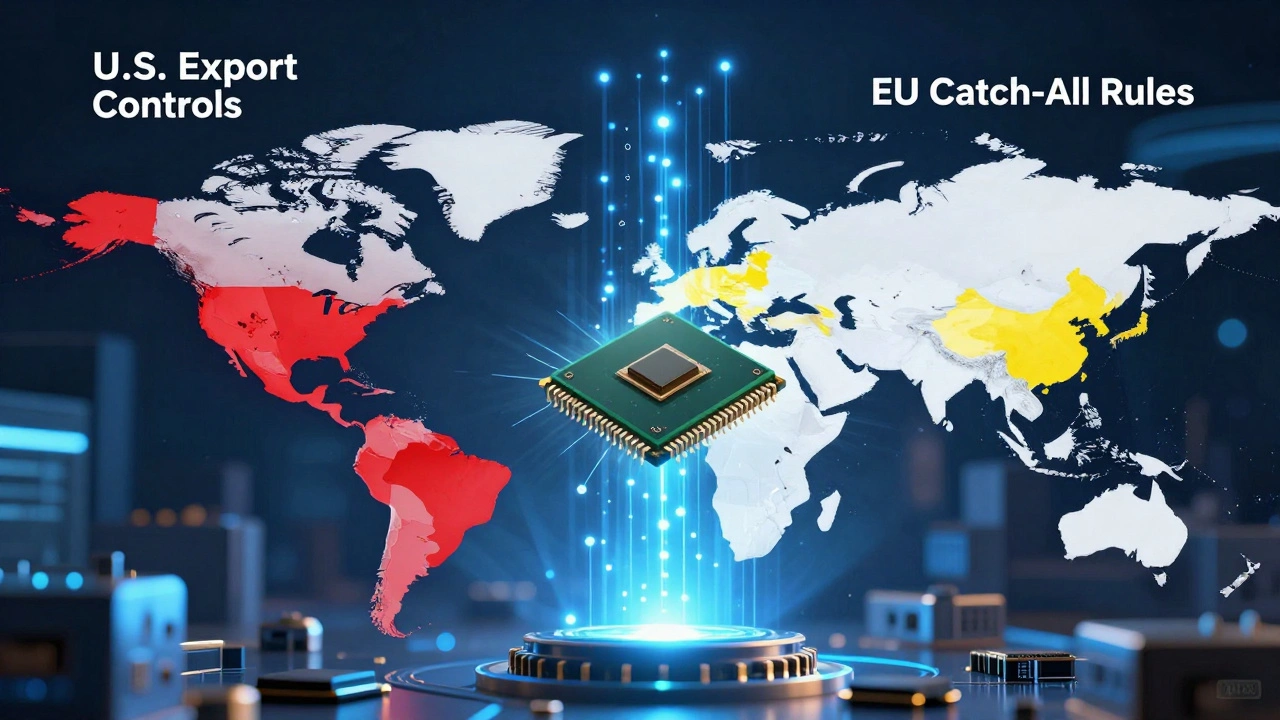
There’s no single global system. Instead, you’ve got overlapping regimes that often contradict each other. The U.S. uses the Export Administration Regulations (EAR) and the Commerce Control List (CCL). It’s detailed, technical, and focused on national security. If a part meets a specific threshold-like processing speed, temperature range, or resolution-it’s controlled. Everything else? Probably fine. The EU’s Regulation (EU) 2021/821 takes a different approach. It’s broader. It doesn’t just look at specs-it looks at intent. If your cybersecurity tool could be used to spy on journalists or suppress protests, you need a license-even if it’s not on the official list. That’s called a “catch-all” rule. And it’s stricter than anything in the U.S. system. Then there’s China. Its rules are less transparent but just as powerful. The 2020 law applies extraterritorially. If you’re a German company exporting to China, and your product has even a small link to nuclear, biological, or chemical weapons, China can block it. According to the European Chamber of Commerce, 87% of EU dual-use exports to China now face some kind of restriction. And the Wassenaar Arrangement? It’s supposed to be the glue holding it all together. A multilateral group of 42 countries that agree on what tech to control. But in practice, only 28 fully implemented the 2021 controls on intrusion software. The rest? Patchy. That’s why the EU started adding its own controls-like the 4A506 for quantum tech-because the group couldn’t move fast enough.Who’s Paying the Price?
This isn’t just a compliance headache. It’s costing businesses billions. Siemens spends €48.7 million a year just on export controls across 147 countries. ASML, the Dutch chipmaker, used to wait 120 days for a license. Now, thanks to AI-powered classification tools, they’ve cut that to 45 days. But most companies don’t have that kind of budget. Small and medium enterprises? 27% have given up on exporting altogether because the paperwork is too complex. The semiconductor industry alone spent $1.8 billion on compliance in 2024. TSMC’s Arizona plant needed 217 separate licenses just to move tech between its U.S. and Taiwan facilities. A single manufacturing tool received seven different classification codes across EU countries. One company got a license for a repair manual for an Airbus jet-but had to submit two versions: one for civilian use, one for military. The text was identical. Only the cover page changed. Cloud computing has made it worse. The UK recorded 2,847 cloud-related export license applications in 2024-up 63% from 2023. Nearly half involved U.S. providers like AWS or Microsoft Azure. If your engineer in Germany accesses controlled software hosted in the U.S., that’s an export. If they’re troubleshooting a system in Brazil? Another export. Each one takes weeks. Each one costs money.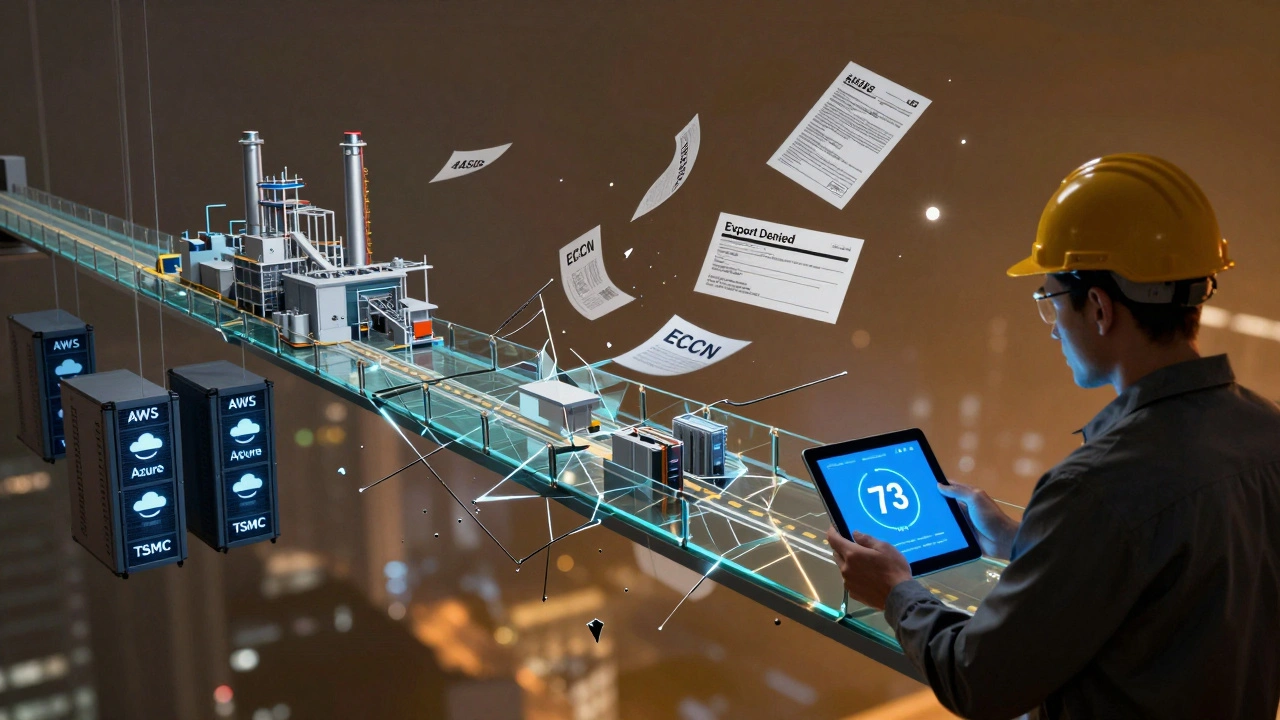
The Human Cost
Behind every license delay is a stalled project. A missed deadline. A lost contract. A 2024 survey by the European Association of Automotive Suppliers found 83% of members faced delays in semiconductor shipments-averaging 42 days per shipment. That’s not just a logistics issue. It’s a production line shutdown. For small suppliers, that’s often fatal. And then there’s the innovation drain. The European Council on Foreign Relations found that the EU’s early controls on quantum tech-while well-intentioned-dropped startup funding by 32%. Investors don’t like uncertainty. If you can’t predict whether your product will be blocked next month, you don’t invest. The same is happening in AI. The U.S. just added new controls on chips with over 100 petaflops of power to China, Russia, and 27 other countries. That’s a lot of R&D projects on hold.Why This Is Getting Worse
The system was built for the Cold War. Now it’s trying to keep up with quantum computing, AI, and cyber surveillance tools that didn’t exist 15 years ago. The U.S. review cycle for updating its control list is 18 months. By the time they add a new tech, it’s already outdated. Dr. Amy Woolf of the Congressional Research Service says dual-use controls blocked 17 known attempts by Iran to get missile tech between 2018 and 2022. That’s good. But the lag means new threats slip through. Meanwhile, the EU is moving faster-but alone. Their 2025 update on quantum tech came 14 months ahead of the U.S. That’s a strategic advantage. But it also means European companies are isolated. They can’t sell to the same customers as U.S. firms. Their supply chains are fractured. The OECD found a 63% variance in licensing decisions for the same item across EU member states. One country says yes. Another says no. That’s not regulation. That’s chaos.
What Can Companies Do?
You can’t ignore this. But you don’t have to drown in it. Start with classification. Know exactly what you’re selling. Use the U.S. ECCN codes or the EU’s Annex I list. Don’t guess. Hire someone who’s certified-like a Certified Export Specialist. The average learning curve for compliance officers is 18 to 24 months. You can’t train someone on the job and expect to stay compliant. Build internal systems. ASML didn’t just hire more staff. They built AI tools to auto-classify products. That cut processing time in half. Smaller companies can use cloud-based compliance platforms like ExportControl.com or TradeLens. They cost less than hiring a full-time expert. Map your supply chain. Know where your components come from. Know where your software is hosted. If you’re using AWS or Google Cloud, understand how your data flows across borders. Don’t assume “it’s just in the cloud” means it’s safe. And prepare for change. The Wassenaar Arrangement is meeting in 2026 to discuss quantum sensing. The EU is planning controls on commercial spyware by Q3 2026. The U.S. will likely follow. If you’re in cybersecurity, AI, or semiconductors, assume your product will be controlled next year. Plan ahead.The Bigger Picture
Dual-use controls aren’t going away. They’re growing. The global market for controlled goods hit $2.87 trillion in 2024-nearly 30% of all global trade. Compliance costs have jumped 210% since 2018. By 2028, they could hit $185 billion a year. The real danger isn’t that these controls are too strict. It’s that they’re inconsistent. Fragmented. Unpredictable. When one country controls a tech and another doesn’t, companies get caught in the middle. Supply chains break. Innovation slows. Trade shrinks. The Carnegie Endowment warns this could reduce global high-tech trade by 18% by 2030. That’s not a prediction. It’s a warning. The question isn’t whether we need dual-use controls. We do. But we need them to be clear, consistent, and fast. Right now, they’re none of those things. And the cost isn’t just financial. It’s the loss of trust, collaboration, and progress.What exactly is a dual-use technology?
A dual-use technology is any item-hardware, software, or technical data-that has both civilian and military applications. For example, a high-speed computer chip can power a smartphone or run missile guidance systems. Export control laws define these items based on precise technical specifications, like processing speed, resolution, or temperature tolerance. The U.S. EAR and EU Regulation 2021/821 both maintain detailed lists of controlled dual-use items.
Why do dual-use controls vary between countries?
Different countries prioritize different goals. The U.S. focuses on national security and weapons proliferation. The EU adds human rights concerns, controlling tools that could be used for surveillance or repression. China applies extraterritorial rules based on potential links to WMD programs. The Wassenaar Arrangement tries to harmonize rules, but implementation is inconsistent-only 28 of 42 members fully adopted the 2021 controls on intrusion software.
How do cloud services affect dual-use compliance?
Uploading controlled technology to a cloud server and allowing access from another country counts as an export. If your engineer in Germany accesses encrypted design files stored on AWS in the U.S., that’s an export to Germany. If someone in China accesses those same files, that’s an export to China. The UK and EU both require licenses for such transfers. The UK Export Control Joint Unit recorded 2,847 cloud-related applications in 2024-a 63% jump from 2023.
What are the biggest compliance challenges for small businesses?
Small businesses often lack dedicated compliance staff-67% have none. They struggle with classification, licensing delays, and inconsistent rules across borders. A 2024 survey found 27% of SMEs abandoned export opportunities because compliance was too complex. The average license takes 73 days to approve and costs $8,750. For a small firm, that’s not just a cost-it’s a deal killer.
Are there any tools or systems that help with compliance?
Yes. Companies like ASML use AI-powered classification tools to auto-assign export control codes, cutting license processing time from 120 to 45 days. Cloud-based platforms like ExportControl.com and TradeLens offer automated classification, license tracking, and audit trails. Training staff through certified programs like the Certified Export Specialist (CES) also reduces errors. The key is investing in systems, not just people.
What’s next for dual-use controls in 2026?
The U.S. introduced new controls on AI chips with over 100 petaflops of power in January 2026. The Wassenaar Arrangement will discuss quantum sensing tech, possibly controlling magnetometers with sensitivity below 1 femtotesla. The EU plans to expand cyber surveillance controls to include commercial spyware capable of intercepting encrypted communications. These changes will likely affect 89% of cybersecurity software exports. Expect more unilateral controls as multilateral agreements lag behind technology.