Emergency Procurement Fraud Risk Calculator
Emergency Procurement Risk Assessment
This calculator identifies potential fraud risks in emergency procurement by comparing your purchase against established benchmarks from the article. It checks for price anomalies, vendor verification status, and emergency classification compliance.
When a wildfire sweeps through a town, a pandemic hits, or a power grid fails, the government doesn’t have time to wait 90 days for a bid process. But rushing to buy masks, generators, or water purifiers opens the door to fraud, inflated prices, and wasted taxpayer money. Emergency procurement reform isn’t about slowing things down-it’s about making speed work without sacrificing accountability. The old way of doing things failed during the pandemic. Now, new systems are being built to fix that.
Why Emergency Procurement Needs to Change
In 2020 and 2021, federal agencies spent over $237 billion on emergency purchases. That’s more than the entire annual budget of many U.S. states. The Government Accountability Office found that 62% of those contracts lacked proper documentation. That’s not a typo. Six out of every ten emergency buys had no clear record of why a vendor was chosen, what price was paid, or whether it was the best option. And without that paper trail, fraud thrives. One vendor in Texas sold N95 masks for $4.50 each during the pandemic-three times the pre-crisis price. Another in Ohio won a $1.2 million contract for ventilators without ever having delivered one before. These weren’t isolated cases. The GAO found 15.5% of emergency contracts showed signs of bid-rigging, where vendors secretly coordinated to drive up prices. That’s not efficiency. That’s exploitation. The problem isn’t speed itself. It’s the lack of guardrails. You can’t stop a hospital from needing oxygen tanks because the procurement office is waiting for three bids. But you can make sure the vendor has been vetted, the price is fair, and the deal is public.The Three Pillars of Modern Emergency Procurement
Today’s best systems are built around three non-negotiable goals: speed, transparency, and fraud prevention. They don’t trade one for the other. They build all three into the same process. Speed comes from pre-approved vendor lists. Instead of scrambling to find suppliers during a crisis, agencies use lists of vendors who’ve already passed background checks, cybersecurity reviews, and price benchmarks. The Department of Defense’s Emergency Acquisition Rapid Response System (EARRS) cuts contract time from weeks to under 48 hours by using only vendors with CMMC Level 3 cybersecurity certification. That’s not just faster-it’s safer. Transparency means every emergency contract is published within 24 hours. Since 2023, 44 states have passed laws requiring public dashboards where anyone can see who got a contract, for how much, and why. New York City’s system shows every emergency purchase in real time. You can look up the vendor, the item, the price, and the justification. No hidden deals. No backroom calls. That’s how trust is built. Fraud prevention uses technology, not just paperwork. AI tools now scan emergency bids in real time. The OMB’s 2023 Directive M-23-10 requires all federal contracts over $100,000 to be checked by AI that compares prices to historical data. If a vendor suddenly charges $12,000 for a generator that normally costs $7,000, the system flags it. In DHS testing, these tools caught 89% of suspicious bids before payment was made. That’s a game-changer.How the System Works in Practice
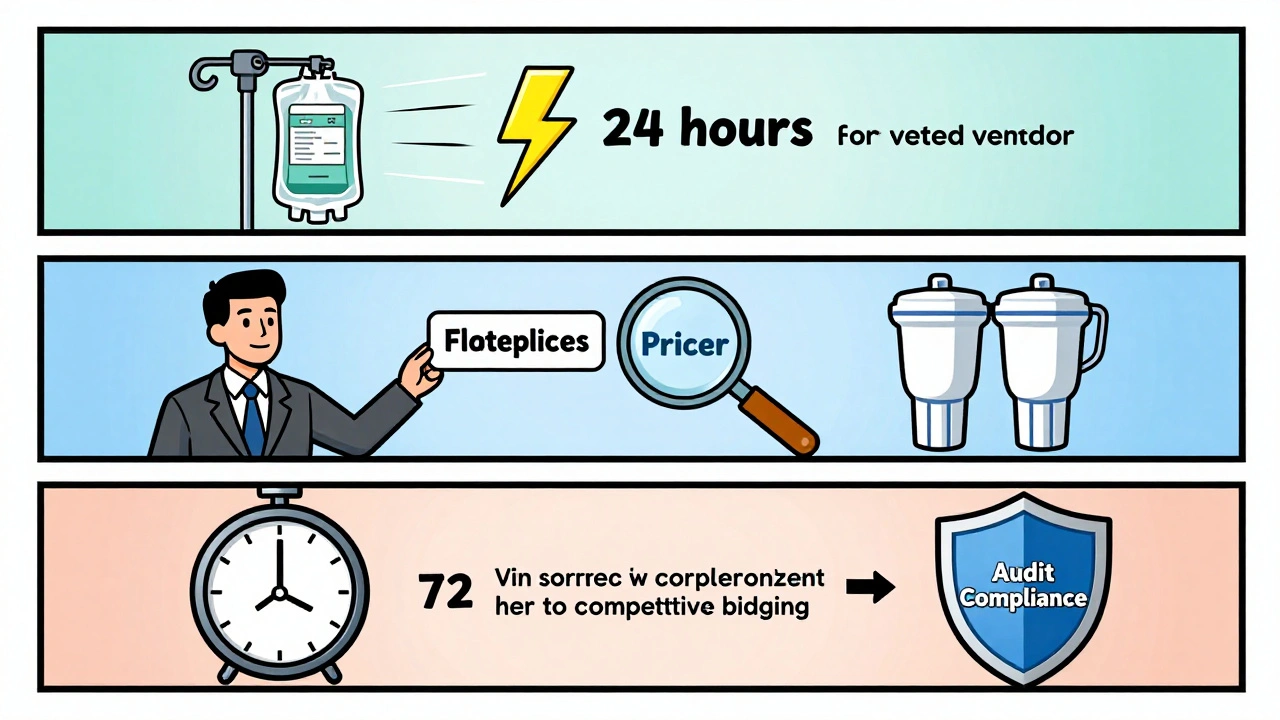
Think of emergency procurement as a three-tiered funnel:- Immediate Action (0-24 hours): Used when lives are at risk right now. A hospital needs IV bags. A fire department needs thermal cameras. No time for paperwork. But the vendor must be on the pre-approved list, and the purchase must be under $25,000. Justification is filed after the fact.
- Expedited Action (24-72 hours): For urgent but not life-or-death needs. A city needs portable water filters after a flood. Two pre-approved vendors are contacted. The lowest qualified bid wins. A written justification is required before payment.
- Transitional Action (72+ hours): If the emergency lasts longer than three days, the system shifts back to normal rules. Competitive bidding resumes. This stops agencies from keeping a contract in “emergency” status for months just to avoid oversight.
Technology Is the Real Game Changer
You can’t fix emergency procurement with more staff or more forms. You need tech. Blockchain audit trails are now standard in 87% of state systems. Every purchase is recorded on a tamper-proof ledger. If someone tries to alter a contract, it shows up. California mandated this in 2021. Now, every emergency buy has a digital fingerprint. Real-time dashboards are another must. The Biden administration’s Executive Order 14107 requires all federal agencies to have live procurement dashboards by the end of 2024. Nineteen agencies already do. You can see how much has been spent, which vendors are active, and where delays are happening. That’s not just for the public. It’s for internal auditors, too. And AI isn’t just for fraud detection. It’s used for vendor risk scoring. If a vendor has a history of late deliveries, lawsuits, or tax liens, the system automatically lowers their priority-even if they’re on the pre-approved list. One pilot in Ohio reduced fraud by 58% just by adding this layer.What Goes Wrong-and How to Fix It
Even the best systems stumble. The biggest problem? Inconsistent emergency declarations. One agency says a flood is an emergency. Another says it’s not. Procurement officers spend 25-40% of their time filling out redundant paperwork just to prove the emergency was real. That’s wasted energy. Another issue is vendor qualification for services. It’s easy to vet a company selling masks. But what about a consulting firm offering “emergency logistics planning”? How do you check their credentials in 24 hours? That’s where the system breaks down. Many agencies still rely on resumes and websites. The fix? Require professional service vendors to pre-register with certifications-like PMP or CPM-and pass a quick background check before the crisis hits. And then there’s the cost. Upfront investment is high. New York City spent $4.7 million on its reform system. But it saved $13.2 million in the first year by cutting fraud and getting better prices. The return isn’t just financial-it’s public trust.
What’s Next? The Road to 2025
The next big leap is FEMA’s National Emergency Contracting System 2.0, launching in September 2024. It will tie together all federal emergency buys into one platform. Every contract will auto-transition to competitive bidding after 30 days. Prices will be benchmarked against historical data. Blockchain will verify every step. And if an agency tries to extend an emergency contract beyond 180 days without approval? The system blocks it. The European Union is already doing something similar. Their 2023 directive says emergency purchases must be proportional and temporary. If you buy 10,000 ventilators during a surge, you can’t keep buying them for two years. You must rebid competitively within 90 days. The goal isn’t perfection. It’s resilience. Emergency procurement will always be messy. But it doesn’t have to be corrupt. With the right rules, the right tech, and the right training, agencies can move fast without falling apart.What You Can Do
If you’re a government worker, push for pre-approved vendor lists. Demand real-time dashboards. Push for AI tools to flag price spikes. Don’t wait for a crisis to start building systems. If you’re a vendor, get on those pre-approved lists now. Pass the cybersecurity checks. Submit your pricing data. You’ll be first in line when the next emergency hits-and you’ll avoid being labeled a profiteer. And if you’re a citizen? Demand transparency. Look up your state’s emergency procurement dashboard. Ask: Who got the money? Why? Was it fair? Public pressure is what forced these reforms in the first place. It’s what will keep them alive. Emergency procurement isn’t about bypassing rules. It’s about having better rules for when the world falls apart. The old system failed. The new one is here. Now we just have to make sure it works for everyone.What qualifies as an emergency for procurement purposes?
An emergency procurement is triggered when an unforeseen event creates an immediate threat to life, public health, or essential services-and there’s no time for normal bidding. Examples include natural disasters like wildfires or floods, pandemics, power grid failures, or chemical spills. Agencies must prove the situation requires action within 72 hours. The EPA and NYC Comptroller’s Office both define it as a situation where delay would cause serious harm. It’s not for budget shortfalls, routine shortages, or convenience.
How do pre-approved vendor lists reduce fraud?
Pre-approved lists cut down on last-minute vendor hunting, which is where fraud thrives. Vendors on these lists have already been vetted for financial stability, past performance, cybersecurity compliance, and legal history. The Department of Defense requires CMMC Level 3 certification for its list, which means vendors have proven they can protect sensitive data. This reduces the chance of shell companies winning contracts. Agencies using pre-approved lists report 63% fewer fraud incidents than those that don’t.
Can AI really prevent fraud in emergency buying?
Yes. AI tools analyze thousands of past purchases to spot anomalies. If a vendor suddenly charges $15,000 for a generator that usually costs $6,500, the system flags it. DHS testing showed these tools catch 89% of suspicious bids before payment. They also compare vendor history-like if the same company won 12 emergency contracts in three months. That’s a red flag. AI doesn’t replace human oversight, but it makes it 10 times more efficient.
Why do some emergency contracts last longer than 180 days?
That’s a systemic flaw. The Center for Strategic and International Studies found 28% of contracts labeled as emergencies in 2022-2023 were still active after 180 days. Often, agencies don’t re-evaluate because they’re busy, or they fear delays if they rebid. But keeping emergency status too long avoids competition and invites waste. New systems like FEMA 2.0 automatically terminate emergency contracts after 30 days and force a competitive process. That’s the new standard.
What’s the biggest mistake agencies make in emergency procurement?
The biggest mistake is treating emergency procurement as a one-off. It’s not a workaround-it’s a core function. Agencies that wait until a crisis to build vendor lists, train staff, or set price caps are already behind. The most successful systems spend 9-14 months preparing before any emergency hits. They train staff, test tech, and run drills. Emergency procurement should be as routine as payroll.
How can citizens hold their government accountable?
Check your state or city’s public emergency procurement dashboard. Look for contracts over $10,000. Ask: Is the vendor on the pre-approved list? Is the price consistent with past purchases? Was a justification filed? If you can’t find the info, request it under public records laws. Public pressure led to transparency laws in 44 states. It can keep them enforced.