Pandemic Preparedness Budget Gap Calculator
Calculate Your Country's Preparedness Gap
What the Results Mean
The World Health Organization recommends allocating 0.1-0.2% of GDP for pandemic preparedness to meet minimum International Health Regulations (IHR) standards.
This calculator shows the gap between your country's current spending and what's needed to avoid the next pandemic.
Your Results
Enter your country's GDP and current spending to see your preparedness gap.
Why national epidemic plans are broke-and what it costs
Every country has a plan for the next pandemic. Most of them are on paper. The real problem isn’t the plan-it’s the money. In 2025, the world spent just $3.7 billion on pandemic preparedness and response, according to the World Bank. That’s less than pandemic funding as a percentage of global GDP than what most households spend on pet food. Meanwhile, biological threats are growing faster than ever. New viruses, engineered pathogens, and antimicrobial resistance are no longer science fiction. Yet, the money to stop them hasn’t kept up.
The High Level Independent Panel (HLIP) on Financing the Global Commons warned in June 2025 that we’re standing at a precipice. Countries are cutting foreign aid even as outbreaks become more frequent and complex. The U.S., once a leader in global health security, contributed $667 million to the Pandemic Fund through 2026-only one-third of its own $2 billion pledge. Meanwhile, low- and middle-income countries (LMICs) are expected to cover their own preparedness with budgets that barely fund basic clinics, let alone surge capacity for a full-blown outbreak.
The $124 billion gap no one talks about
The Global Burden of Disease 2021 study found that to meet even the minimum standards under the International Health Regulations (IHR), the world needs $124 billion over the next five years. That’s not a luxury. It’s the cost of avoiding another 2020. The HLIP broke it down further: at least $10-15 billion per year just to get LMICs to baseline readiness. Then another $50-100 billion for emergency surge capacity when a real outbreak hits. That’s not a guess. It’s based on real data from 75 countries that have already applied for funding through the Pandemic Fund.
Right now, domestic spending on preparedness in most countries is between $1.2 billion and $3.7 billion a year. That’s less than 10% of what’s needed. And it’s not evenly distributed. Africa, which has the largest gaps in surveillance, labs, and health workers, received 43% of all Pandemic Fund grants-but that’s still only a fraction of what’s required. Meanwhile, high-income countries are spending more on pet insurance than on biosecurity.
What the Pandemic Fund actually does-and where it falls short
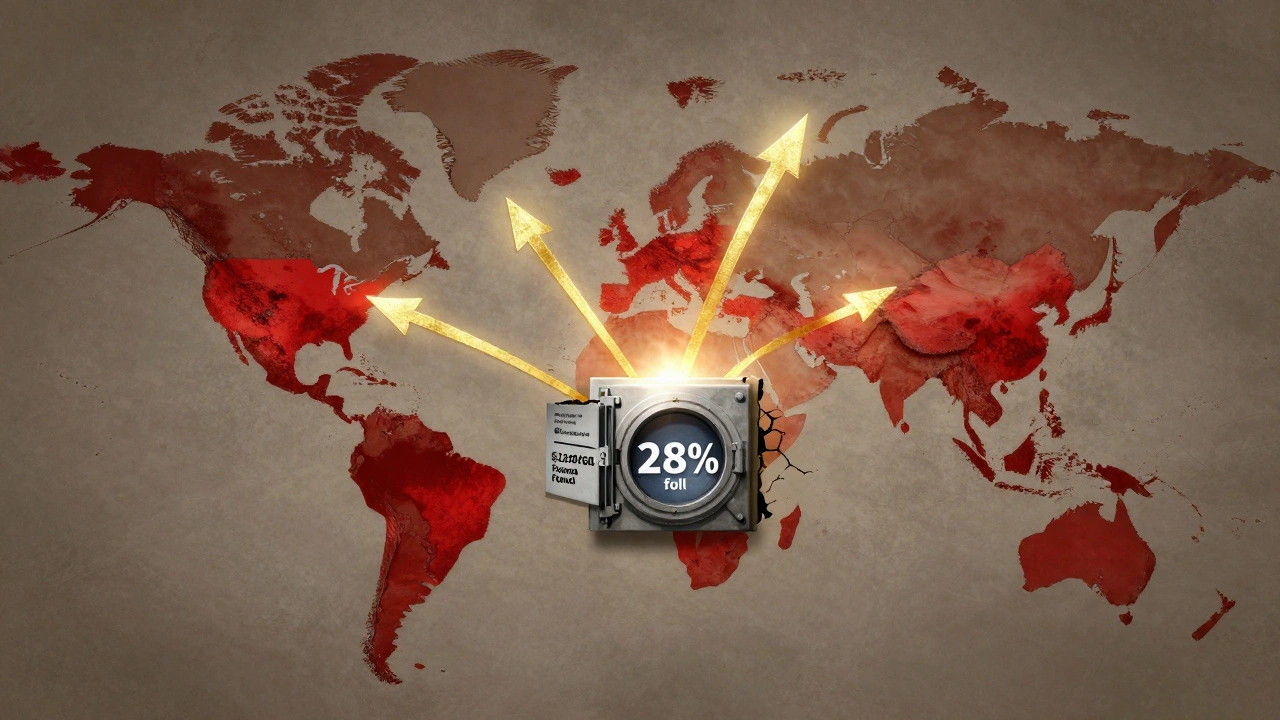
Launched in September 2022 and hosted by the World Bank, the Pandemic Fund is the first global mechanism designed to fix this. By December 2025, it had raised $2.98 billion from 28 donors and funded 47 projects across 75 countries. Every dollar it gives pulls in $7 more from local governments and other international sources. That’s a multiplier most development programs would kill for.
But here’s the catch: $2.98 billion is just 28.5% of the $10.5 billion annual shortfall identified by the World Bank. The Fund can’t cover everything. It focuses on surveillance, lab systems, and workforce training-the areas most broken. But it doesn’t pay for manufacturing vaccines on the ground in Africa or Southeast Asia. It doesn’t fund the stockpiles of antivirals or personal protective equipment. It doesn’t cover the cost of training 10,000 new epidemiologists in countries where the last one retired five years ago.
And while the Fund moves quickly-two funding rounds completed in three years-traditional lenders like the IMF and regional development banks still don’t have clear rules for rapid financing during a crisis. They wait for governments to request help. By then, it’s too late.
The five hidden budget gaps no one’s fixing
The HLIP’s 2025 report didn’t just point out the problem. It named the five gaps that keep countries from being ready:
- Domestic budget integration - Few countries treat pandemic readiness like fire drills or military readiness. It’s not in the national budget. It’s an afterthought.
- Medical countermeasure access - 90% of vaccine and drug manufacturing is in just five countries. When a new virus emerges, LMICs wait months for doses.
- Development bank incentives - Banks won’t lend money for things that might never happen. They need risk guarantees. None exist.
- Private sector financing - Companies won’t invest in preparedness unless they see a return. Right now, they see only cost.
- Fragile settings - Conflict zones, refugee camps, and failed states have no budgets at all. Yet they’re where outbreaks start.
Each gap needs a different fix. For domestic budgets, countries need to set aside 0.1-0.2% of GDP for preparedness. For manufacturing, we need regional hubs in Africa and Southeast Asia. For private sector buy-in, we need tax credits and liability protections. None of these are happening at scale.
Why biosecurity spending is the missing piece
Most people think of pandemics as natural disasters. But they’re not. Advances in synthetic biology and AI have made it easier than ever to engineer pathogens. A grad student in a garage can now create a virus that could spread faster than COVID-19. Yet, no country treats this like a national security threat.
The HLIP recommends that G20 and upper-middle-income countries spend 0.5-1.0% of their defense or security budgets on biosecurity. That’s about $5.3 billion a year globally. Right now, almost none of that money exists. The U.S. spends billions on cyber defense but less than $200 million on lab biosecurity. The EU spends more on protecting its borders from migrants than from engineered pathogens.
This isn’t paranoia. It’s strategy. If you’re not preparing for deliberate biological threats, you’re not preparing for the next pandemic-you’re just waiting for it.
What success looks like-and who’s doing it right
There are bright spots. Rwanda built a national surveillance network using mobile tech and trained 500 community health workers to report fever cases in real time. Senegal now manufactures its own rapid diagnostic tests. Thailand has a national stockpile of antivirals and a law requiring 0.15% of GDP to go to preparedness every year.
These countries didn’t wait for donors. They changed their budgets. They made preparedness a line item. They didn’t ask for permission. They just did it.
The World Bank has sent technical teams to 32 LMICs to help them build costed national action plans aligned with IHR standards. That’s the key: no more vague promises. Every country needs a budget with numbers: how many labs, how many tests, how many workers, how much storage. And they need to report it the same way every year.
What you can expect by 2027
The HLIP has set a hard deadline: September 2026. That’s when world leaders meet at the UN for the High-Level Meeting on Pandemic Prevention, Preparedness, and Response. By then, every country must show a plan to meet the 0.1-0.2% GDP benchmark. The Pandemic Fund plans to scale to $1 billion in annual funding by 2027. Regional manufacturing hubs in Africa and Southeast Asia will start producing 30% of their own vaccines and diagnostics.
But none of this happens without political will. The money is there. The tools are there. The data is there. What’s missing is the decision to treat preparedness like a national priority-not a charity case.
By 2030, without action, the funding gap will grow to $15.2 billion a year. That’s not a forecast. It’s a guarantee. The next pandemic won’t wait. Neither should we.
How countries can start today
- Set aside 0.1-0.2% of GDP annually for pandemic preparedness in the national budget.
- Create a dedicated unit inside the finance ministry to track all PPR spending.
- Require all public health agencies to report funding using standardized IHR indicators.
- Partner with regional manufacturers to build local capacity for vaccines and tests.
- Include biosecurity in defense budgets-treat engineered pathogens like cyberwarfare.
- Use the Pandemic Fund as a catalyst, not a crutch. Every dollar from the Fund should trigger matching domestic investment.
It’s not about spending more. It’s about spending smarter. And it’s not too late-if we start now.