Railway Sabotage Impact Calculator
Railway sabotage is a key component of hybrid warfare. According to the article, when Poland closed its border with Belarus in 2025, rail freight losses hit €1.2 billion in just 17 days. This calculator estimates the potential economic impact of railway disruptions on critical supply chains.
Adjust for supply chain ripple effects (0.5-3.0)
1.2Estimated Impact
Daily freight value: €70.6M (based on Poland-Belarus border closure data)
Total impact: €0.00M
Impact level: Low
Understanding the Impact
This calculator is based on real data from the article: when Poland closed its border with Belarus in 2025, rail freight losses hit €1.2 billion in 17 days (€70.6M per day). The multiplier accounts for ripple effects throughout supply chains.
A 7-day disruption could cost:
- €494 million for Poland
- €1.4 billion for EU supply chains
- 3,750+ jobs potentially impacted
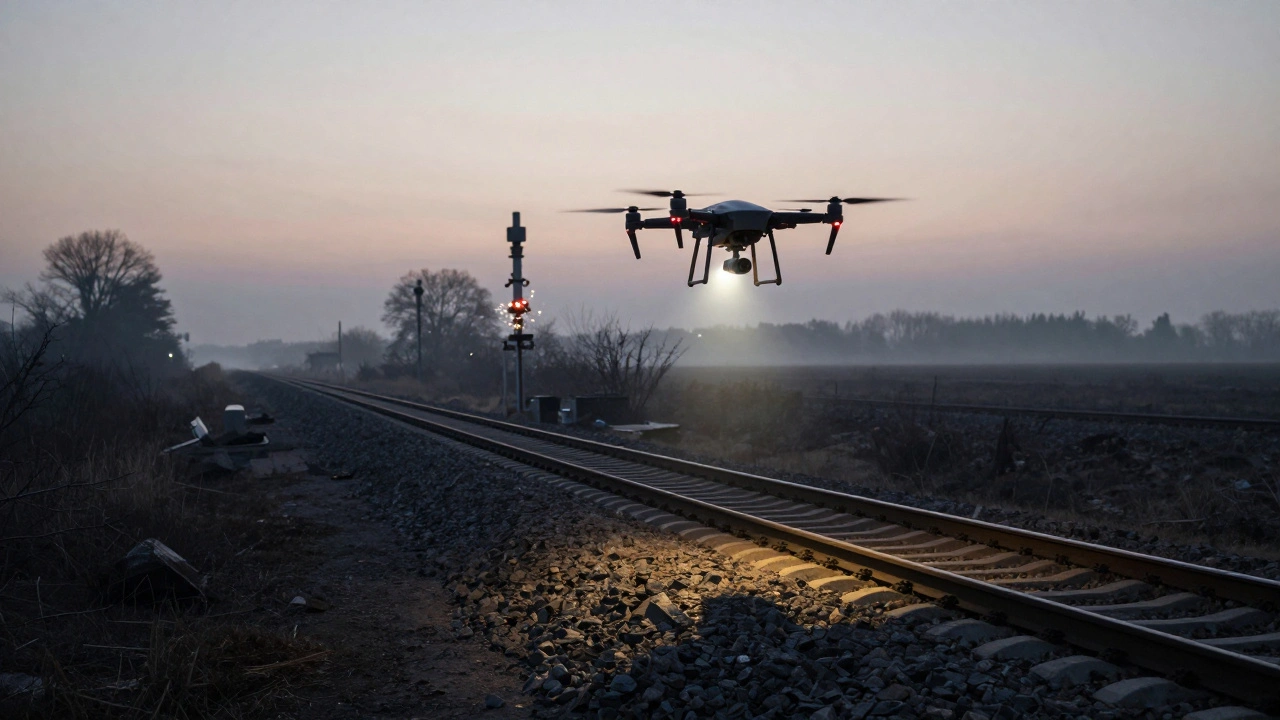
On a quiet morning in October 2025, a drone silently flew over a stretch of railway near the Polish-Belarusian border. It didn’t drop a bomb. It didn’t even carry explosives. Instead, it hovered just long enough to trigger a hidden magnetic pulse that fried the signaling system controlling train traffic. Three hours later, a freight train carrying critical EU supplies derailed. No one was hurt. No country claimed responsibility. But the message was clear: hybrid warfare is no longer theoretical-it’s operational, daily, and targeting the very arteries of Europe’s economy.
What Exactly Is Hybrid Warfare?
Hybrid warfare isn’t tanks rolling across borders or airstrikes on cities. It’s the quiet war you don’t see until it’s too late. It’s hackers shutting down power grids, drones disabling train signals, bots flooding social media with lies, and cargo ships mysteriously delaying shipments-all while Russia insists it’s not involved. This isn’t new. The idea dates back to Soviet-era "active measures," but since 2008, Russian military strategists have refined it into a precise formula: use ambiguity to paralyze, not to conquer. The turning point came in 2013, when General Valery Gerasimov wrote that modern conflicts are won not on battlefields, but in the spaces between peace and war. His "Gerasimov Doctrine" became the playbook. By 2022, when Russia invaded Ukraine, hybrid operations had already been running for years-against Georgia, Moldova, the Baltics, and now across all of Eastern Europe. Unlike traditional war, hybrid attacks don’t ask for surrender. They ask for confusion. They want you to question: Was that an accident? A glitch? Or something worse?Railway Sabotage: The Hidden Frontline
Railways are the silent backbone of Europe’s supply chains. They move coal, grain, military equipment, medicine, and parts for wind turbines. In 2025 alone, Eastern Europe recorded 147 attempted cyber intrusions targeting railway signaling systems-up from 89 the year before. And physical sabotage? That’s rising too. In March 2025, a section of track near Riga was damaged by a small explosive device disguised as a piece of construction debris. In July, a drone dropped a magnetic charge on a switch in western Ukraine, causing a freight derailment that delayed NATO resupply routes for 11 days. These aren’t random acts. They’re coordinated. The same GRU unit-Unit 74455, also known as Sandworm-that hacked Ukraine’s power grid in 2015 is now targeting rail infrastructure across Poland, Lithuania, and Slovakia. Poland’s "Railway Shield" program, launched in 2024, installed 12,000 sensors along 1,200 kilometers of track. AI algorithms now monitor for unusual vibrations, electromagnetic spikes, and drone activity. The result? A 58% drop in sabotage incidents. But it cost €83 million. And it’s not scalable for every country. The problem isn’t just the attacks. It’s the delay in response. On average, it takes 47 days to attribute a sabotage event to a specific actor. By then, the attackers are gone, the damage is done, and the political window for retaliation has closed.Cyber Operations: The Invisible War
While railways get the headlines, cyber operations are the real engine of hybrid warfare. According to ENISA, Russia’s GRU was behind 87% of major cyber incidents in Eastern Europe between 2022 and 2025. These aren’t just hacking attempts. They’re surgical strikes. In February 2025, a phishing campaign targeted Lithuanian energy operators. The goal? Not to steal data-but to create chaos during a scheduled grid maintenance window. When the system went offline, Russian disinformation bots flooded local news sites with claims that the EU had "deliberately blacked out" the country to punish its support for Ukraine. Panic spread. People hoarded candles. Hospitals switched to backup generators. The grid came back online in 90 minutes. But the damage to public trust? That took months to repair. These attacks follow a pattern: cyber intrusion → physical disruption → disinformation explosion. The sequence is designed to stretch response times thin. You’re busy fixing the power. Then you’re busy calming the public. Meanwhile, the next attack is already in motion. Estonia’s defense system, called X-Road, breaks this cycle. It’s a decentralized data exchange network that lets government agencies, utilities, and hospitals share threat intelligence in real time. In 2025, Estonia repelled 98% of cyber and hybrid attacks targeting its energy grid. Why? Because they didn’t wait for an attack to happen. They built a system that sees threats before they land.
Why Eastern Europe Is the Battleground
Russia doesn’t attack Western Europe the same way. Why? Because Eastern Europe is vulnerable-and it’s connected. Countries like Poland, Lithuania, and Ukraine sit at the intersection of Russian supply lines, NATO transit routes, and EU economic corridors. They’re the weak link in a chain. If you can disrupt rail traffic between Poland and Germany, you delay German-made parts from reaching Ukrainian factories. If you can make Latvians distrust their own government, you weaken NATO’s eastern flank. Russia also exploits internal divisions. In 2021, it flooded Lithuania with migrants from the Middle East, knowing the country had no capacity to handle them. The resulting political crisis strained relations between Lithuania and the EU. The same tactic was used in Latvia and Poland. It didn’t require soldiers. Just cash, fake documents, and a few social media accounts. And then there’s Belarus. Russia uses it as a launchpad for 70% of its hybrid operations in the Baltics. When Poland closed its border with Belarus in 2025, rail freight losses hit €1.2 billion in just 17 days. But the message worked: Russia lost its safe corridor.China’s Role: The Enabler
Russia doesn’t fight alone. China is quietly propping up its hybrid war machine. Since 2022, China has supplied Russia with dual-use technology-semiconductors, encryption tools, drone components-that are essential for cyber and drone operations. In September 2025, European rail operators reported delays in critical signaling components because China held up shipments for "logistical reasons." It wasn’t an embargo. It was a delay. But it crippled maintenance schedules across Poland and Ukraine. Chatham House calls this "hybrid warfare by proxy." China avoids direct blame while extending Russia’s ability to operate. Russian cyber teams can’t build advanced malware without Chinese chips. Russian drones can’t navigate without Chinese GPS modules. And Russian disinformation campaigns rely on Chinese cloud servers to host fake social media accounts. NATO’s 2025 summit called this out directly: "China cannot enable the largest war in Europe in recent century without consequences." But so far, consequences have been limited to diplomatic statements.
How Countries Are Fighting Back
Defense isn’t just about spending more money. It’s about changing how you think. Estonia’s Küberneetika program merged cyber defense with physical security. Guards now patrol data centers. Engineers check server rooms for tampering. Analysts monitor both firewalls and train tracks. The result? A 63% reduction in successful attacks. The EU’s Hybrid Toolbox, launched in 2023, gave countries a checklist: secure your grid, train your staff, share intelligence, debunk lies. It’s not perfect-railway-specific protocols are still missing-but it’s helped reduce successful Russian operations by 27% since 2023. NATO’s new NorthSeal platform, rolled out in December 2025, uses satellites and underwater sensors to monitor undersea cables and pipelines. It’s a direct response to the Nord Stream sabotage and the Scanlark vessel incident near Finland’s nuclear plant. And then there’s the Ukrainian IT Army. Started as a volunteer group in 2022, it now includes thousands of civilian hackers who actively disrupt Russian cyber operations. In 2025 alone, they launched 12 major counter-attacks that crippled Russian command networks. One hacker from Lviv told Reddit: "We use consumer drones to track Russian drone signals. We intercepted 37 last month. They think they’re invisible. We proved they’re not."The Future: AI, Drones, and Escalation
The next phase of hybrid warfare is smarter, faster, and more autonomous. Russia has already deployed "smart drones"-small, silent, and capable of identifying railway switches without human input. In November 2025, three of these drones bypassed Polish defenses and damaged signaling equipment near Białystok. No one saw them coming. By 2027, CEPA predicts that 65% of Russian disinformation will be AI-generated-deepfake videos of politicians admitting to corruption, fake audio of military commanders ordering retreats. These won’t just mislead. They’ll erode trust in democracy itself. The Baltic states are preparing for this. In 2026, Estonia, Latvia, and Lithuania will launch the "Railway Cyber Corridor," a unified defense system with shared threat data, synchronized AI monitoring, and joint response teams. It will cost €220 million-but it’s the only way to survive. The big question isn’t whether hybrid warfare will continue. It’s whether Europe can respond fast enough. RAND Corporation estimates a 78% chance Russia will rely on hybrid tactics through 2030. But the International Institute for Strategic Studies warns: as defenses improve, so does the risk of escalation. What if a drone attack kills civilians? What if a cyber strike shuts down a hospital? What happens when the gray zone turns red?What You Can Do
This isn’t just a government problem. It’s a societal one. If you live in Eastern Europe: report strange drones, unmarked vehicles near rail lines, or unusual website crashes. Don’t assume it’s a glitch. It might be a signal. If you’re a business: audit your supply chain. Are your parts coming from China? Are your digital systems protected against phishing? Are your employees trained to spot fake news? If you’re a citizen: question what you read. If a post makes you angry, it’s probably designed to. Check the source. Look for the EUvsDisinfo database-they’ve debunked over 32,000 Russian lies since 2022. Hybrid warfare thrives on apathy. It needs you to think it’s not your problem. It needs you to believe it’s too complex to understand. But it’s not. The attacks are simple. The response just needs to be smarter.Is hybrid warfare the same as cyberwar?
No. Cyberwar is just one tool in hybrid warfare. Hybrid warfare combines cyber attacks, physical sabotage, disinformation, economic pressure, and covert operations-all at once. A cyberattack on a power grid is cyberwar. A cyberattack on a power grid followed by fake news blaming the EU, then a drone blowing up a train carrying replacement parts-that’s hybrid warfare.
Why don’t NATO countries retaliate more forcefully?
Because retaliation risks escalation. If a country strikes back militarily, Russia could respond with full-scale war. Hybrid warfare is designed to stay just below the threshold that triggers Article 5. NATO’s response is to strengthen defenses, share intelligence, and impose sanctions-not to start a war they can’t control.
Can Russia win this kind of war?
Russia doesn’t need to "win" in the traditional sense. Its goal is to weaken NATO and the EU from within-to make them slow, divided, and exhausted. Even if Ukraine wins the battlefield, Russia can still win the long game by keeping Europe distracted, distrustful, and drained. That’s why hybrid warfare is permanent.
Are private companies at risk?
Absolutely. Rail operators, energy providers, telecoms, and even logistics firms are targeted because they’re critical infrastructure. A single successful attack on a rail signaling company can disrupt supply chains across 10 countries. Many small firms don’t have cybersecurity teams-and that’s exactly why they’re targeted.
How can I tell if a news story is fake?
Look for three things: 1) Is it only on one obscure website? 2) Does it make you extremely angry or afraid? 3) Is there no verification from major outlets like Reuters or AP? Check the EUvsDisinfo database or use the InVID tool to reverse-search videos. Most Russian disinformation is copied and reused across dozens of fake sites.