Innovation Portfolio Calculator
Balance Your Innovation Investments
Ensure your company is investing appropriately across short-term improvements and long-term bets. The right balance helps you thrive today while securing tomorrow's success.
Your Current Allocation
Recommended Allocation
Recommended Allocation
These percentages are tailored to your industry and risk tolerance
Portfolio Analysis
Select your current allocation to see analysis...
Risk Assessment
Your portfolio's risk level...
Most companies are stuck in a trap: they’re great at squeezing out small improvements today, but terrible at building anything meaningful for tomorrow. You see it everywhere - teams optimizing delivery speeds, cutting costs on existing products, and hitting quarterly targets with precision. Meanwhile, the big, risky ideas that could redefine the business? They’re gathering dust because no one’s willing to protect them from the daily grind. This isn’t a leadership problem. It’s a portfolio problem.
Why Your Innovation Efforts Keep Failing
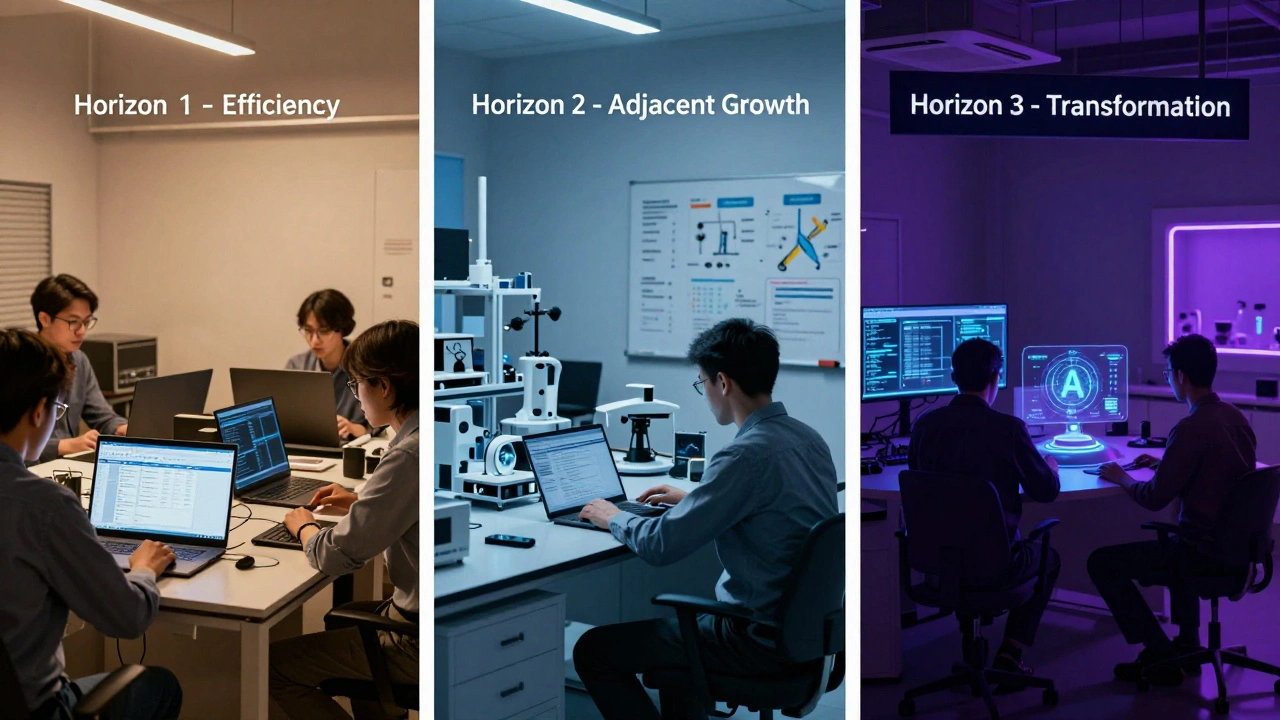
Organizations don’t fail because they lack good ideas. They fail because they treat every innovation like it’s the same. A software update that fixes a bug? A new feature that boosts customer retention? A radical shift into AI-powered services? All of these get thrown into the same bucket, evaluated with the same metrics, and funded from the same budget. That’s like trying to run a marathon, a sprint, and a rock-climbing competition all at once - using the same training plan. The answer isn’t more ideas. It’s better structure. Enter the Innovation Portfolio is a strategic framework that organizes innovation initiatives across three distinct timeframes: Horizon 1 (optimization), Horizon 2 (adjacent growth), and Horizon 3 (transformation). This model doesn’t just categorize projects - it forces leaders to make conscious trade-offs.Horizon 1: The Engine That Keeps the Lights On
Horizon 1 is where most of your money and talent already live. It’s about making today’s business better, faster, cheaper. Think: streamlining supply chains, improving customer service response times, reducing production defects, or launching minor product upgrades. These projects typically run 0-12 months, have low uncertainty, and deliver predictable returns. You need Horizon 1. Without it, your company doesn’t survive. But if it takes 90% of your resources, you’re not managing innovation - you’re just managing maintenance. A common mistake? Assuming Horizon 1 is "safe" because it’s predictable. It’s not. Over-investing here creates invisible decay. Your competitors are quietly building new models while you’re optimizing a model that’s already losing market share. Companies like Kodak and Blockbuster didn’t go broke because they were lazy. They went broke because they optimized their dying business to death.Horizon 3: The Wildcard That Changes Everything
Horizon 3 is where the future is forged. These are bets on entirely new markets, technologies, or business models - things that might take 5-10 years to pay off. Think: Tesla’s early investment in battery tech before EVs were mainstream. Amazon’s early experiments with AWS when most thought it was just an internal tool. Google’s AI research long before it became a product. These projects are messy. They often fail. They don’t fit into quarterly reports. They need autonomy, tolerance for failure, and funding that doesn’t come from the main budget. Here’s the hard truth: if you’re not spending at least 10% of your innovation budget on Horizon 3, you’re not preparing for the next decade. Gartner found that one-third of transformational projects are underfunded - not because they’re bad ideas, but because they’re evaluated using Horizon 1 rules. You can’t measure a 7-year moonshot with a 3-month ROI calculator.The 70-20-10 Rule (And Why It’s Not a Law)
You’ve probably heard the 70-20-10 rule: 70% on Horizon 1, 20% on Horizon 2, 10% on Horizon 3. It sounds neat. But it’s not a formula - it’s a starting point. A SaaS startup might need 50-30-20 because their market moves fast. A utility company might need 85-10-5 because regulation and infrastructure lock them into long cycles. The right mix depends on your industry, competitive pressure, and how much runway you have before disruption hits. What matters isn’t the percentage. It’s intentionality. Are you consciously choosing where to put your money? Or are you just letting the loudest project win?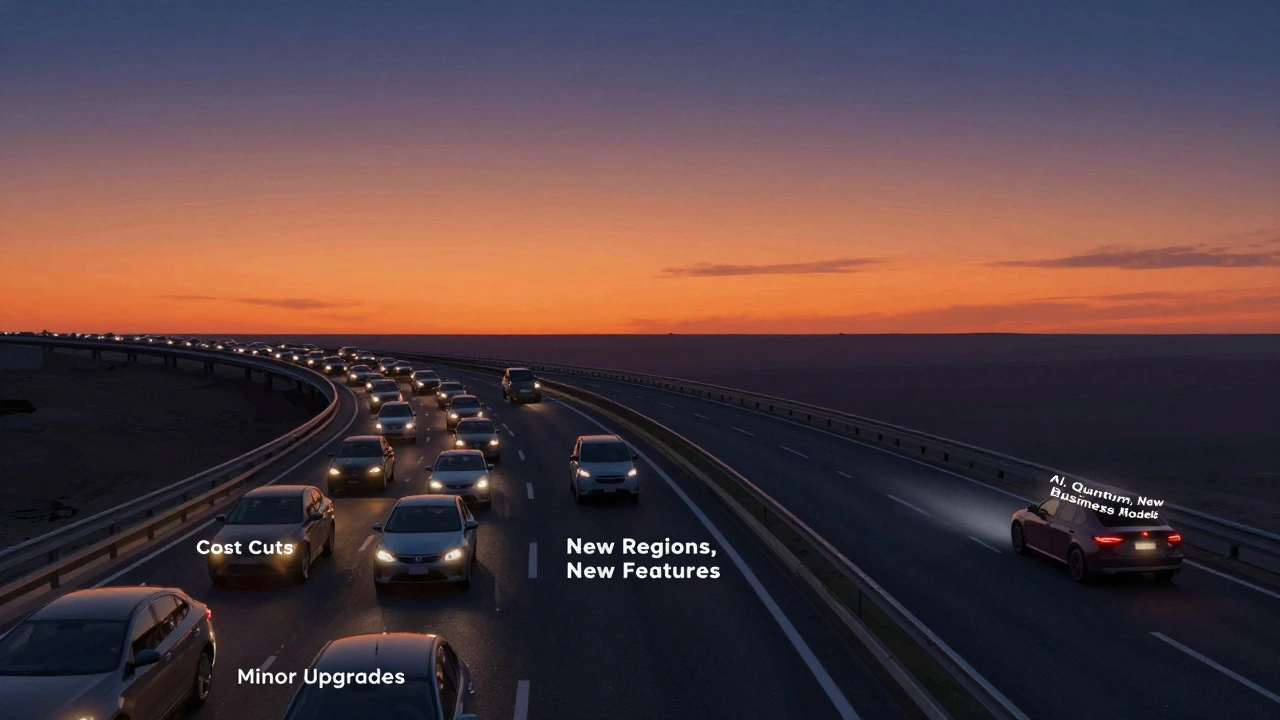
How to Build a Real Innovation Portfolio
Building a portfolio isn’t about creating a fancy slide deck. It’s about changing how you think, fund, and measure work.- Define clear strategic goals - What does growth mean for your company? Is it market share? New customer segments? Reducing operational risk? Your portfolio must tie directly to this.
- Separate governance - Horizon 1 projects should follow standard project management. Horizon 3 projects need venture-style oversight: smaller teams, longer timelines, milestone-based funding, and tolerance for pivots.
- Protect Horizon 3 funding - Create a separate budget. Don’t let it compete with quarterly cost cuts. Treat it like a startup within your company.
- Use different metrics - Horizon 1: efficiency, cost savings, cycle time. Horizon 3: number of experiments run, learning velocity, prototype success rate, strategic option value.
- Measure portfolio balance - Every quarter, ask: Are we still investing in Horizon 3? Are we over-indexing on Horizon 1? Are we stuck in a "maturity trap" where all our products are aging?
The Risk-Reward Matrix That Actually Works
Forget SWOT analysis. Use a simple 2x2 grid: Low Risk / Low Reward vs. High Risk / High Reward.- Horizon 1 lives in the bottom-right: low risk, moderate reward. Think process tweaks, minor feature adds.
- Horizon 2 sits in the middle: medium risk, medium-high reward. Think entering a new region with an existing product.
- Horizon 3 is top-left: high risk, high reward. Think AI-driven healthcare diagnostics for a company that sells insurance.
Why Your Talent Is Always Missing From Horizon 3
The best engineers, product managers, and strategists? They’re usually assigned to Horizon 1. Why? Because it’s visible. Because it has deadlines. Because it delivers results. Horizon 3 needs different talent - people who are comfortable with ambiguity, who can build prototypes in 30 days, who aren’t afraid to kill an idea that’s not working. These people are rare. And if you don’t actively recruit, protect, and reward them, they’ll leave. Companies that solve this create internal innovation labs or venture arms. They give Horizon 3 teams autonomy, separate reporting lines, and performance reviews based on learning - not revenue.
The Real Test: What Happens When the CEO Leaves?
The biggest sign your innovation portfolio is real? It survives leadership changes. If your Horizon 3 projects depend on one person’s passion, they’ll die when that person moves on. True portfolio management means the system outlives the leader. It’s baked into budgets, governance, and performance metrics. Ask yourself: If tomorrow, the CFO says "cut all non-essential spending," would Horizon 3 survive? If the answer is no, then you don’t have a portfolio. You have a wish list.What Happens When You Get It Right
Companies that balance horizons don’t just survive disruption - they cause it. Adobe shifted from selling boxed software to a subscription model. Netflix moved from DVD rentals to streaming. Apple moved from computers to phones to services. Each transition didn’t happen overnight. It happened because they kept funding Horizon 3 while optimizing Horizon 1. The result? They didn’t just grow. They redefined their industries. The alternative? You keep making the same product better - until someone else builds a completely different one. And then, you’re not just behind. You’re irrelevant.Final Thought: Innovation Isn’t a Project - It’s a System
You can’t innovate your way out of a bad system. You have to build a system that lets innovation happen - naturally, consistently, and at every level. Start by asking: Where is your money going? Who’s managing it? How are you measuring success? If your answers all point to today, you’re not preparing for tomorrow. The future doesn’t arrive because you want it to. It arrives because you built the conditions for it - one deliberate portfolio decision at a time.What’s the difference between Horizon 1 and Horizon 3 innovation?
Horizon 1 focuses on improving existing products, services, or processes to maximize current performance - things like reducing costs, fixing bugs, or adding small features. These projects are short-term (0-1 year), low-risk, and have predictable returns. Horizon 3 is about creating entirely new business models, markets, or technologies that could redefine the company. These are long-term (3-10+ years), high-risk, and often fail before succeeding. Horizon 1 defends your business. Horizon 3 redefines it.
Why do most companies underfund Horizon 3 projects?
Because financial systems, performance metrics, and leadership incentives are built for short-term results. Horizon 3 projects rarely show returns within a year - sometimes not even in five. Executives under pressure to hit quarterly targets naturally favor projects that deliver immediate wins. Without deliberate safeguards - like separate budgets or venture-style governance - Horizon 3 gets starved.
Is the 70-20-10 rule a hard rule for resource allocation?
No. It’s a useful starting point, not a formula. A fast-moving tech startup might need 50-30-20. A regulated industry like utilities might need 85-10-5. The key isn’t the numbers - it’s whether you’re making a conscious, strategic decision about where to invest. If your allocation happens by accident, you’re not managing innovation - you’re leaving it to chance.
How do you measure success for Horizon 3 projects?
Forget ROI. For Horizon 3, success means learning. Track how many experiments you run, how quickly you pivot, how many assumptions you test, and whether you’re building strategic optionality. A successful Horizon 3 project might never launch - but if it taught you something valuable about a new market or technology, it’s still a win. Metrics should focus on velocity, insight, and adaptability - not revenue.
Can a company survive without investing in Horizon 3?
Short-term? Yes. Long-term? No. Companies that focus only on Horizon 1 become efficient at running dying businesses. They optimize their way into obsolescence. Think of Blockbuster, Nokia, or Sears. They were great at their core business - until someone built something entirely new. Without Horizon 3, you’re not just falling behind - you’re building a business that has no future.