
Multilateral KPI Effectiveness Calculator
How Effective Are Your KPIs?
This calculator evaluates your KPI system against the four core dimensions of multilateral effectiveness (based on Brookings Institution's MIQ framework).
Why Measuring Multilateral Effectiveness Matters More Than Ever
In 2025, international organizations are under more pressure than ever to prove they’re making a difference. From climate crises to pandemics and trade wars, the world expects these institutions to act fast, coordinate well, and deliver real results. But how do you measure something as complex as global cooperation? It’s not enough to count meetings or sign agreements. What matters is whether people’s lives improve because of what these organizations do.
Back in 2015, only 42% of major international bodies used formal KPIs to track performance. By 2023, that number jumped to 78%, according to UNOPS. Why? Because donors, member states, and the public are demanding accountability. Funding is now tied to results-37% of multilateral aid in 2024 was conditional on meeting performance targets, up from just 12% a decade ago. If you can’t show impact, you risk losing support.
The EITI Model: A Blueprint for Real Results
The Extractive Industries Transparency Initiative (EITI), launched in 2002, didn’t just set a standard-it created a working system that others now copy. EITI’s KPI framework has three layers: how well its secretariat runs, how countries implement reforms, and how much influence it has globally.
One standout metric: the ‘Board decision implementation rate.’ EITI requires member countries to carry out decisions within 90 days, aiming for 95%+ compliance. That’s not a suggestion-it’s a hard target. Another key measure is ‘Validation Step 4 completion,’ which tracks whether countries actually change laws and publish data on mining revenues. As of Q3 2024, 57 countries were in the system, and those using EITI’s model showed 28% higher compliance than those relying on voluntary reporting.
What makes EITI different? Independence. Each country’s progress is reviewed by an external validator, not self-reported. That costs about $150,000 per assessment, but it builds trust. Compare that to the UN’s self-assessment model, where transparency is weaker and credibility often questioned.
AI, Hybrid Work, and the New KPIs of 2025
International organizations aren’t just dealing with global challenges-they’re adapting to how work gets done. Sixty-eight percent of international civil servants now work in hybrid setups, according to the OECD’s 2024 survey. That means KPIs have to account for time zones, async communication, and digital tools.
New metrics are emerging. ‘Cross-timezone meeting efficiency’ tracks whether teams maintain 75%+ productivity despite being spread across 10+ time zones. ‘Asynchronous collaboration success rate’ measures how often tasks finish without live meetings-targeting 85%+ completion. These aren’t fluff metrics. They’re survival tools.
AI is also reshaping performance tracking. The IMF’s 2024 pilot found that organizations tracking ‘AI implementation velocity’-calculated as (number of new AI tools adopted / total AI initiatives) × adoption speed-cut decision cycles by 37%. The World Bank’s 2025 roadmap goes further: AI now predicts implementation risks with 83% accuracy by analyzing past data patterns. That means teams can fix problems before they blow up.

Who’s Doing It Right? Comparing the Big Players
Not all international organizations measure performance the same way. The UN Development Programme (UNDP) tracks 147 KPIs across 176 countries. It’s thorough-but overwhelming. Meanwhile, the World Trade Organization (WTO) uses just 38, all focused on one thing: how quickly disputes are resolved and trade policies monitored.
The International Renewable Energy Agency (IRENA) leads in forward-looking metrics. Its ‘Strategic Goal KPI’ tracks renewable energy growth directly tied to its interventions. In 2023, IRENA’s efforts were linked to a 12.7% global increase in renewable capacity-a rare case of clear attribution.
But here’s the problem: only 43% of outcomes claimed by multilateral organizations can be directly tied to their actions, according to the World Bank. Why? Because so many actors are involved-governments, NGOs, private firms-that isolating one organization’s impact is nearly impossible.
That’s why the Brookings Institution’s ‘Multilateral Impact Quotient’ (MIQ) is gaining traction. It scores organizations on four weighted dimensions: Problem-Solving Effectiveness (40%), Inclusivity (25%), Institutional Adaptability (20%), and Resource Efficiency (15%). The World Bank scored 82/100. The UN Security Council? Just 53/100. The gap tells you everything.
The Dark Side of KPIs: When Metrics Lie
Too often, KPIs create illusions. A 2024 Transparency International report found that 54% of international organizations still report ‘Number of meetings held’ as a primary effectiveness indicator-even though staff admit it has little to do with real outcomes.
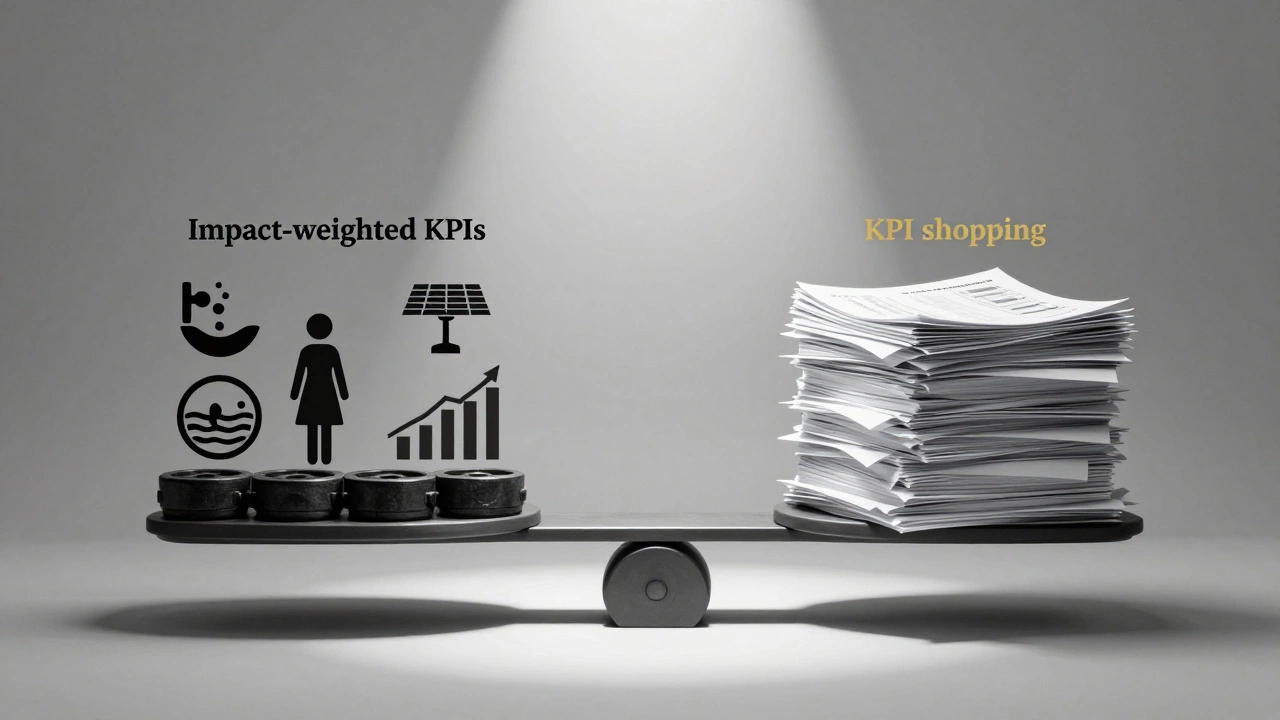
This is called ‘KPI shopping’: choosing easy-to-measure, flashy metrics instead of hard, meaningful ones. One UN staffer on Reddit (u/GlobalDevOfficer, 12 years in the field) said KPI reporting eats up 35-40% of staff time. That’s more than a third of their workweek spent filling out forms instead of fixing problems.
Another blind spot: trust. Seventy-one percent of international organizations don’t measure stakeholder trust-even though research shows trust correlates at 0.82 with long-term effectiveness. How can you lead if no one believes in you?
The WHO’s response to the 2023 mpox outbreak exposed this painfully. It took an average of 17 days to coordinate a multilateral response. The 2021 International Health Regulations set a 72-hour target. They missed it by over two weeks. No KPI tracked that delay.
What Works: Real Fixes from the Field
The best-performing organizations aren’t collecting more KPIs-they’re cutting them down. The OECD’s 2024 pilot showed that reducing KPI counts from an average of 142 to just 27 improved data quality by 58% and kept strategic focus sharp.
Successful systems share three traits:
- KPI ownership: Every metric has a named person responsible. This is in 89% of high-performing systems.
- KPI hygiene: Annual reviews retire outdated metrics. Only 47% of multilateral bodies do this.
- Sunset clauses: KPIs auto-expire after 24 months unless renewed. This prevents clutter.
Technology helps too. The Green Climate Fund’s real-time dashboards cut reporting time by 63% and boosted data accuracy by 41%. That’s not magic-it’s automation paired with human oversight.
Training matters. Organizations that invest 40+ hours of KPI literacy training per manager see 28% higher implementation success. People need to understand why metrics matter, not just how to fill out the forms.
The Future: Impact-Weighted KPIs and Global Equity
The UN Secretary-General’s January 2024 directive is a turning point: all UN funds and programs must shift to ‘Impact-weighted KPIs’ by December 2025. That means moving from counting activities-like workshops held or reports published-to measuring actual change: fewer people in poverty, cleaner water, more women in leadership.
Meanwhile, the BRICS nations launched the Alternative Multilateral Effectiveness Metrics Working Group in 2023. They created 12 new indicators focused on what matters to the Global South: local ownership, cultural relevance, and development priorities-not Western benchmarks.
The 2024 Global Multilateral Trust Index shows a 15-point gap between how the Global North and Global South rate effectiveness. That’s not just a data point-it’s a warning. If KPIs only reflect Northern priorities, they’ll keep failing the majority of the world.
The Multilateral KPI Exchange Platform (MKEP), launched in July 2024, is a game-changer. It’s a free, open library of 2,147 vetted KPIs across 47 themes. The ILO and FAO are already using it. This isn’t about control-it’s about sharing what works.
Final Thought: Count What Matters, Not What’s Easy
Measuring multilateral effectiveness isn’t about perfect numbers. It’s about asking the right questions: Are people better off? Did we listen to those most affected? Did we adapt when things changed? Did we use resources wisely?
As Dr. Nassef Manabilang Adiong said at the 2024 Doha Forum: ‘The true measure of multilateral effectiveness isn’t in the metrics we count, but in whether those metrics help us count what truly matters for human dignity across all cultures and contexts.’
In 2025, the organizations that survive won’t be the ones with the most KPIs. They’ll be the ones that measure what actually changes lives.