Climate Finance Gap Calculator
Climate Finance Calculator
This tool helps you visualize the climate finance gap between current contributions and the $300B/year target by 2035. Based on data from COP30, the Green Climate Fund, and UNCTAD reports.
Current Climate Finance
Results
Key Insight from Article: The Loss and Damage Fund currently receives only about $10B/year from voluntary pledges (vs. $300B target). Unlike other sources, it lacks a permanent funding stream and relies on unpredictable donor commitments.
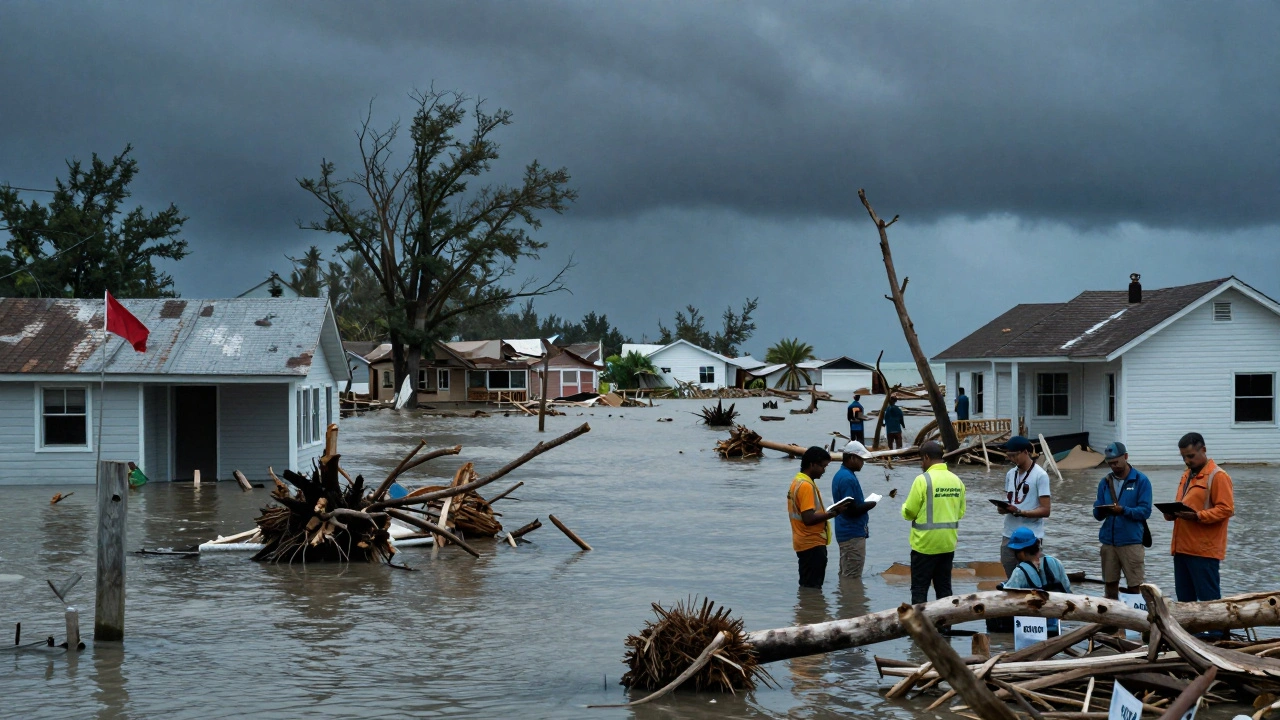
When hurricanes flatten coastal villages, droughts turn farmland to dust, or rising seas swallow entire island nations, the human cost is immediate. But the financial response? It’s slow, tangled, and often invisible. That’s where multilateral climate finance comes in-not as a quick fix, but as the backbone of how the world tries to pay for climate disasters and the shift away from fossil fuels. And right now, its governance is being rewritten.
Two Funds, One Problem: Who Pays for What?
There are two major funds driving the conversation today: the Loss and Damage Fund and the Transition Fund. They’re not the same, but they’re deeply connected. The Loss and Damage Fund, born at COP27 in 2022 and made operational at COP28 in 2023, is meant to cover costs that climate adaptation can’t prevent. Think: rebuilding homes after a superstorm, relocating communities buried by landslides, or compensating farmers who lost decades of crops to unseasonal heat. It’s not insurance. It’s reparations in practice. The Transition Fund, while not yet a formal entity, refers to the collective financial efforts to help developing nations move from coal and oil to renewables. This includes funding for grid upgrades, training workers in solar installation, or phasing out fossil fuel subsidies. It’s about building a new economy, not just surviving the old one. Both funds are meant for countries that did the least to cause climate change but suffer the most. Yet their governance structures are still being built-without clear rules, without enough money, and without enough trust.The Green Climate Fund: The Old Workhorse, Now Reformed
For over a decade, the Green Climate Fund (GCF) was the biggest player. It was created under the UNFCCC to be the main channel for climate finance from rich to poor nations. But it was slow. Bureaucratic. Hard for small countries to access. That changed in 2025. At COP30 in Belém, Brazil, the GCF wrapped up its final phase with a record $2.2 billion committed in a single year. How? By overhauling its entire system. It simplified accreditation for local banks and NGOs to deliver funds directly. It opened regional offices in Africa, Southeast Asia, and Latin America so countries didn’t have to fly to Seoul for approvals. It cut paperwork by 60% and sped up disbursements from 18 months to under 6. But the GCF is closing its doors as a standalone entity. Its role is being absorbed into a broader, coordinated system. It’s not disappearing-it’s evolving into a hub.The Four Giants Are Now Working Together
For the first time ever, the world’s four largest multilateral climate funds-GCF, Adaptation Fund, Climate Investment Funds (CIF), and Global Environment Facility (GEF)-released a Joint Results Report in November 2025. They didn’t merge. They didn’t compete. They aligned. Each fund still has its own mandate. The CIF focuses on transformational change in energy systems. The GEF handles biodiversity and land use. The Adaptation Fund supports community-level resilience. The GCF was the big financier. Now, they track the same outcomes: mitigation, adaptation, energy access, and nature protection. They use the same metrics. They share data. They hold joint reviews. This is huge. Before, a country might apply to three different funds for three different projects. Now, they can apply once-and get coordinated support. This model is becoming the blueprint for how the Loss and Damage Fund should operate. No more silos. No more confusion. One door, one process, one accountability system.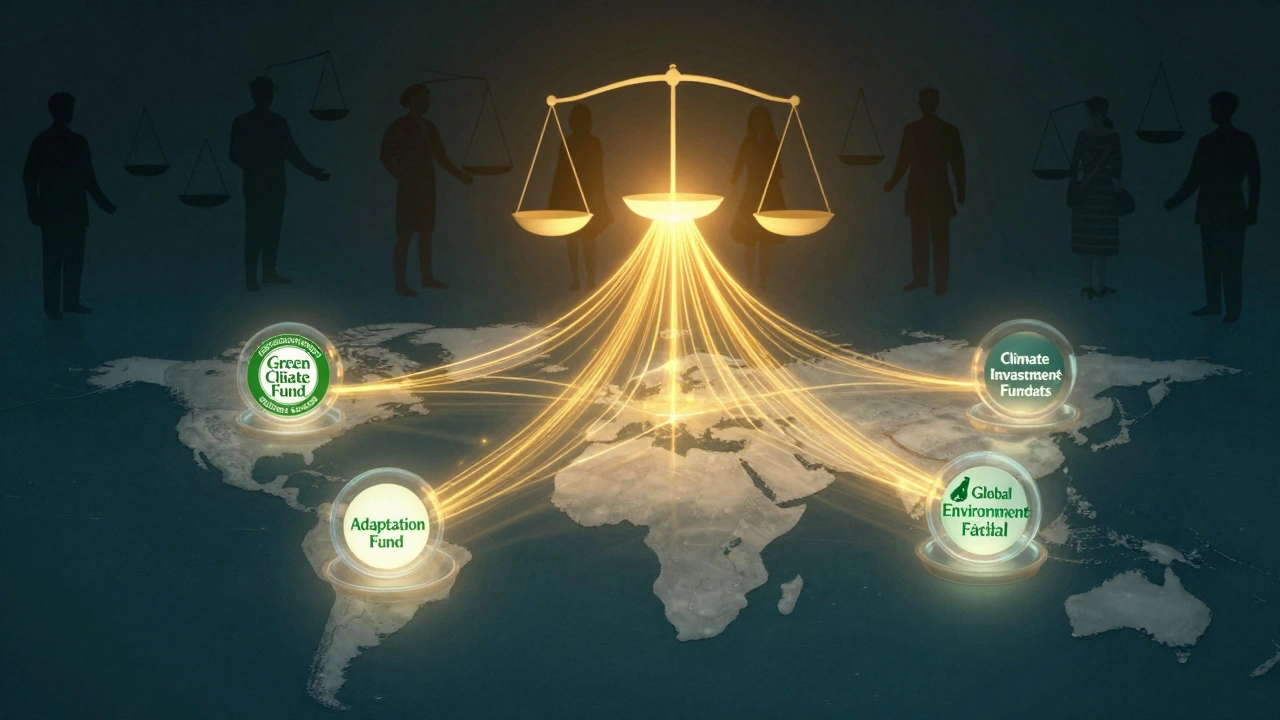
The Money Gap: 0 Billion by 2035, But Where’s It Coming From?
At COP30, nations agreed on a new target: $300 billion per year for climate finance in developing countries by 2035. That’s triple the old $100 billion goal. But here’s the catch: only $10 billion of that is expected to come from multilateral climate funds like GCF and GEF. Multilateral Development Banks (MDBs) like the World Bank are supposed to cover $240 billion. Private investors are meant to add $65 billion. That leaves $105 billion unaccounted for. Who fills that gap? Bilateral donors-countries like the U.S., Germany, Japan. But their contributions are inconsistent. The U.S. International Climate Finance Report for FY2025 shows funding fluctuates with political cycles. One year, it’s $11 billion. The next, it’s $7 billion. The Loss and Damage Fund is especially vulnerable. It doesn’t have a permanent funding stream. It relies on voluntary pledges. So far, only a handful of countries-like Scotland, Belgium, and New Zealand-have contributed. The U.S. and China haven’t pledged anything. Without predictable, long-term money, the fund can’t plan. Without planning, communities can’t prepare. And without preparation, the next disaster hits harder.Governance Isn’t Just About Money-It’s About Power
The real challenge isn’t the number of zeros on a balance sheet. It’s who gets to decide. Most multilateral funds are governed by boards made up of representatives from donor and recipient countries. But donor nations hold the majority of votes. That means decisions often reflect what wealthy countries want-not what vulnerable communities need. The Loss and Damage Fund tried to fix this. Its governing board includes equal representation from developed and developing countries. That’s a first. But it’s not enough. Real power lies in who controls the secretariat, who sets the criteria for funding, and who audits the results. The UNCTAD 2025 report says it plainly: “Fixing the foundations of the global financial system is essential.” That means giving developing nations real authority-not just a seat at the table, but the ability to write the rules. It also means trusting local organizations to lead. The International Institute for Environment and Development found that projects run by community groups have 40% higher success rates than those handed to international consultants. Yet most funds still require proposals to come through national governments-often slow, corrupt, or disconnected.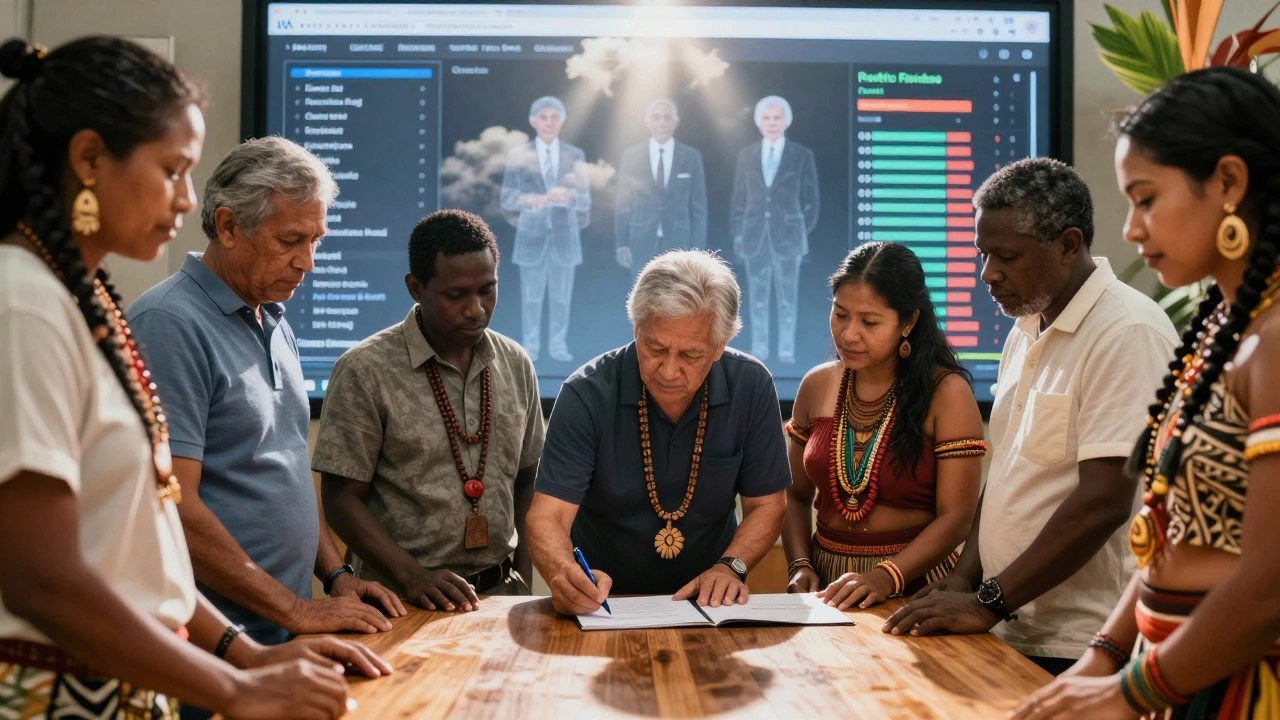
Private Money Is Coming In-But With Strings Attached
Governments are pushing private investors to step up. The GCF calls itself “a global hub where public trust meets private innovation.” But private money doesn’t care about justice. It cares about returns. A solar farm in Kenya? Great. A flood barrier for a fishing village? Not so much. Private investors need predictable profits. That’s why most climate finance still flows to projects that can generate revenue-renewable energy, electric vehicles, green bonds. Loss and damage? No revenue stream. No ROI. So private money avoids it. The solution? Blended finance. Public money takes the first loss. That reduces risk for private investors. But that requires transparency. And right now, we don’t know how much public money is being used to subsidize private gains. The EU Taxonomy and OECD’s Creditor Reporting System are trying to standardize how we track this. But without global agreement, companies can label anything as “climate-friendly.”What’s Next? The Roadmap No One’s Talking About
COP30 promised a roadmap to close the climate finance gap. But no one has published it yet. What should it include?- A binding mechanism to ensure the Loss and Damage Fund gets at least $10 billion a year from developed nations.
- Direct access for local NGOs and indigenous groups to funding-no government middlemen.
- A global registry of all climate finance flows, so we know where every dollar goes.
- Debt relief for vulnerable countries so they can spend on climate, not loan repayments.
- Independent oversight with real power-not just reviews, but sanctions for non-compliance.