Climate Project Risk Allocation Calculator
Calculate Your Project's Bankability
Estimate how different risk allocation strategies affect project returns and investor confidence. Input key variables from the article to see which structures create bankable projects.
Climate change isn’t coming - it’s here. And the infrastructure we rely on - power grids, water systems, transportation networks - is already cracking under the strain. But here’s the truth: governments alone can’t fix this. Too little money. Too slow. Too many rules. The real breakthrough? Public-private climate partnerships. Not just cooperation. Not just talk. Real, structured, bankable projects that deliver clean energy, resilient infrastructure, and returns for investors - all at once.
Think about it: who builds highways? Private contractors. Who owns wind farms? Private investors. Who sets the rules and secures land? Governments. When these two sides work together with clear contracts, they don’t just build projects. They build systems that last decades and survive storms, heatwaves, and supply shocks.
What Makes a Climate Project "Bankable"?
A bankable project isn’t just green. It’s predictable. Investors won’t put billions into something that could collapse under a single policy shift or extreme weather event. So what turns a climate idea into something banks will lend to?
- Long-term revenue streams - not one-time grants. Think power purchase agreements (PPAs) where utilities agree to buy electricity from a solar farm for 20 years. Or contracts for difference (CfDs) that guarantee a minimum price for clean energy, even if market prices drop.
- Risk allocation - the private partner handles construction delays, tech failures, and maintenance. The public partner handles policy changes, land access, and regulatory shifts. No one gets stuck with risks they can’t control.
- Clear performance metrics - not just "build a wind farm," but "deliver 500 GWh/year with 98% uptime, even during heatwaves." These aren’t suggestions. They’re contract terms.
The Melbourne Metro Tunnel in Australia didn’t just build a subway. It baked climate resilience into every contract. Requirements for flood-proof stations, heat-resistant rails, and emissions limits during construction weren’t afterthoughts. They were non-negotiable. That’s what makes investors sleep at night.
The Public Sector’s Real Job: De-Risking, Not Paying
Most people think governments fund these projects. They don’t. They de-risk them.
Take Germany’s Wilhelmshaven LNG terminal. It went from idea to operation in nine months - a record. How? The federal government waived permitting delays, fast-tracked environmental reviews, and gave the private operator legal certainty. No public money spent on construction. Just smart policy.
This is the pattern across Europe and North America. Governments don’t need to write checks. They need to write contracts that give private firms confidence. That means:
- Guaranteeing access to land and grid connections
- Streamlining environmental permits with one-stop shops
- Creating legal frameworks that recognize climate risk as a factor - not a barrier
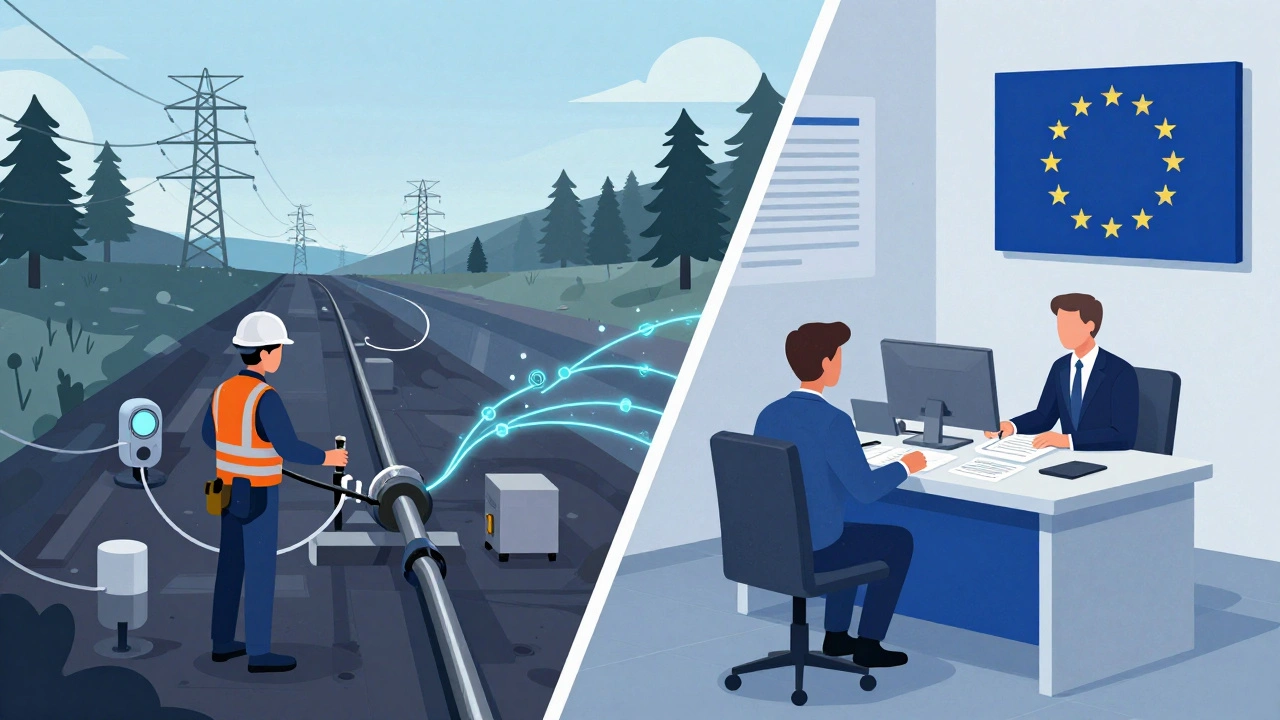
The European Union’s Projects of Common Interest (PCIs) program does this perfectly. Projects like cross-border hydrogen pipelines or CO2 transport networks get automatic priority status. That means faster approvals, access to €5.8 billion in EU funding, and political backing that overrides local opposition. Private companies don’t need to guess if they’ll get permits - they know they will.
The Private Sector’s Edge: Speed, Innovation, and Scale
Why should a company risk billions in a climate project? Because they can make money while doing it.
Renewable fuels? Too expensive to compete with oil on their own. But with a long-term PPA backed by a government guarantee? Suddenly, they’re profitable. Biofuels, green hydrogen, offshore wind - all need this kind of structure to scale.
Private firms bring more than cash. They bring:
- Technical innovation - like AI-driven grid management that cuts energy waste by 15%
- Operational efficiency - private operators maintain infrastructure 20-30% cheaper than public agencies
- Global expertise - companies like Siemens, Ørsted, and Bechtel have built hundreds of climate projects worldwide
The Inter-American Development Bank’s Climate Resilient PPP Toolkit doesn’t just say "include climate resilience." It gives sample contract language. For example: "The operator shall maintain flood barriers at a minimum height of 3.2 meters, verified by quarterly satellite imagery, or forfeit 5% of annual fees." That’s not vague. That’s enforceable.
The Hidden Challenge: Climate Risk Is Always Changing
Here’s the catch: the climate isn’t static. A 20-year contract signed in 2025 might be based on rainfall patterns from 2020. By 2040, those numbers could be off by 40%.
That’s why the best PPPs don’t lock in fixed designs. They build in flexibility.
- Performance clauses that adjust based on actual climate data
- Re-opener clauses that let parties renegotiate if extreme events exceed projections
- Resilience benchmarks tied to real-time monitoring - not just design specs
The World Bank warns that without this, infrastructure like bridges, water pumps, and power lines could fail silently - costing more in repairs than they saved in emissions. A project designed for a 1-in-100-year flood might not survive a 1-in-20-year event by 2035. Contracts must evolve with the climate.
Real-World Success: The EU’s PCI Program
There’s no better example than the EU’s Projects of Common Interest. It’s not a pilot. It’s a system. Since 2021, 190 PCI projects have been approved across 27 countries. They include:
- Ammonia import terminals in Spain and Portugal to replace Russian gas
- Undersea electricity cables connecting Norway’s hydropower to Germany’s factories
- CO2 pipelines in the North Sea to store emissions from industrial hubs
Each one is privately built and operated. Each one gets legal priority. Each one has a 20-30 year revenue guarantee. The result? €180 billion in private investment since 2021 - all for climate-critical infrastructure.
This isn’t charity. It’s smart economics. The EU saved 120 million tons of CO2 in 2024 just from these projects. That’s like taking 26 million cars off the road.
Why Most Climate PPPs Fail - and How to Avoid It
Not every partnership works. Many fail because they try to do too much too fast.
Common mistakes:
- Trying to fund everything with public money - kills investor interest
- Ignoring local communities - leads to protests, delays, and legal battles
- Using outdated climate models - projects become obsolete before they’re built
- Not defining performance clearly - operators game the system
The fix? Start small. Pick one project type. One region. One clear outcome. Build the contract around measurable results. Let success prove the model. Then scale.
Look at LIFE CITYAdaP3 in Europe. It didn’t try to fix every city’s flood risk. It picked three neighborhoods. Partnered with local businesses. Used private funding to install green roofs, permeable pavements, and smart drainage. Within two years, flood damage dropped 60%. Now it’s being copied in six other countries.
The Bottom Line: It’s Not About Money. It’s About Structure.
You don’t need more billions. You need better contracts.
Public-private climate partnerships aren’t about handing money to companies. They’re about aligning incentives. Governments get resilience and emissions cuts. Investors get predictable returns. Communities get reliable infrastructure.
The tools exist. The models work. Germany, the EU, Australia - they’re proof. The question isn’t whether we can build bankable climate projects at scale. It’s whether we’ll stop waiting for perfect conditions and start building them now.