Renewable Energy Career Finder
Find Your Renewable Energy Career Match
Based on current industry demand, salary data, and training requirements from the U.S. renewable energy sector.
Your Best Career Matches
By 2026, the U.S. renewable energy sector isn’t just growing-it’s reshaping how we think about work. Solar panels are going up faster than ever, wind farms are expanding across the Great Plains, and the aging power grid is being rewired with smart technology. But behind every turbine, every solar array, every upgraded substation, there’s a person doing the work. And right now, the industry is struggling to find enough of them.
What’s Really Driving the Hiring Boom?
In 2025, renewable energy added 30.2 gigawatts of new electricity capacity-93% of all new power built in the U.S. that year. Solar and battery storage alone made up 83% of that. That’s not just progress. It’s a full-scale rebuild of the nation’s energy backbone. And it’s creating jobs faster than most people realize.
Between 2025 and 2035, the energy sector will need to fill 32 million hiring events. That’s not just new jobs-it’s replacements. Think about it: nearly half of today’s energy workers are over 45. Many are retiring. The industry is losing experienced technicians, electricians, and engineers faster than it’s training new ones. That’s why hiring isn’t just about growth-it’s about survival.
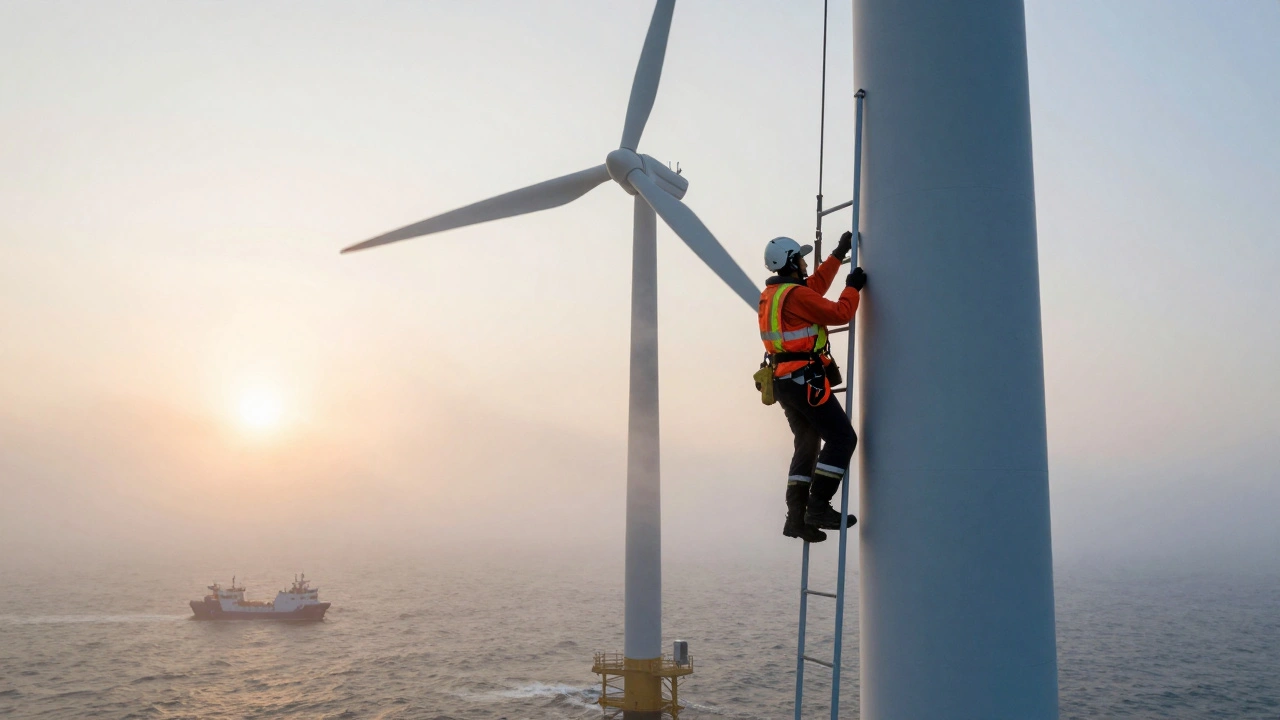
And it’s not just solar. Wind energy is seeing a surge too. Offshore wind projects along the East Coast and Midwest are ramping up. Each project needs dozens of specialized workers-marine engineers, crane operators, cable-laying crews. Meanwhile, grid modernization is pulling in data analysts, cybersecurity experts, and automation specialists who never worked in energy before.
The Solar Workforce: More Jobs, But Not the Same Ones
Solar is still the biggest job creator. As of late 2024, there were over 260,000 solar workers in the U.S. But here’s the twist: the number of jobs hasn’t kept pace with the number of panels installed. Between 2017 and 2022, solar capacity nearly doubled. Jobs only went up 5.4%. Why? Efficiency. Installers are faster. Robotics help with panel placement. Software streamlines permitting. The industry is doing more with fewer people.
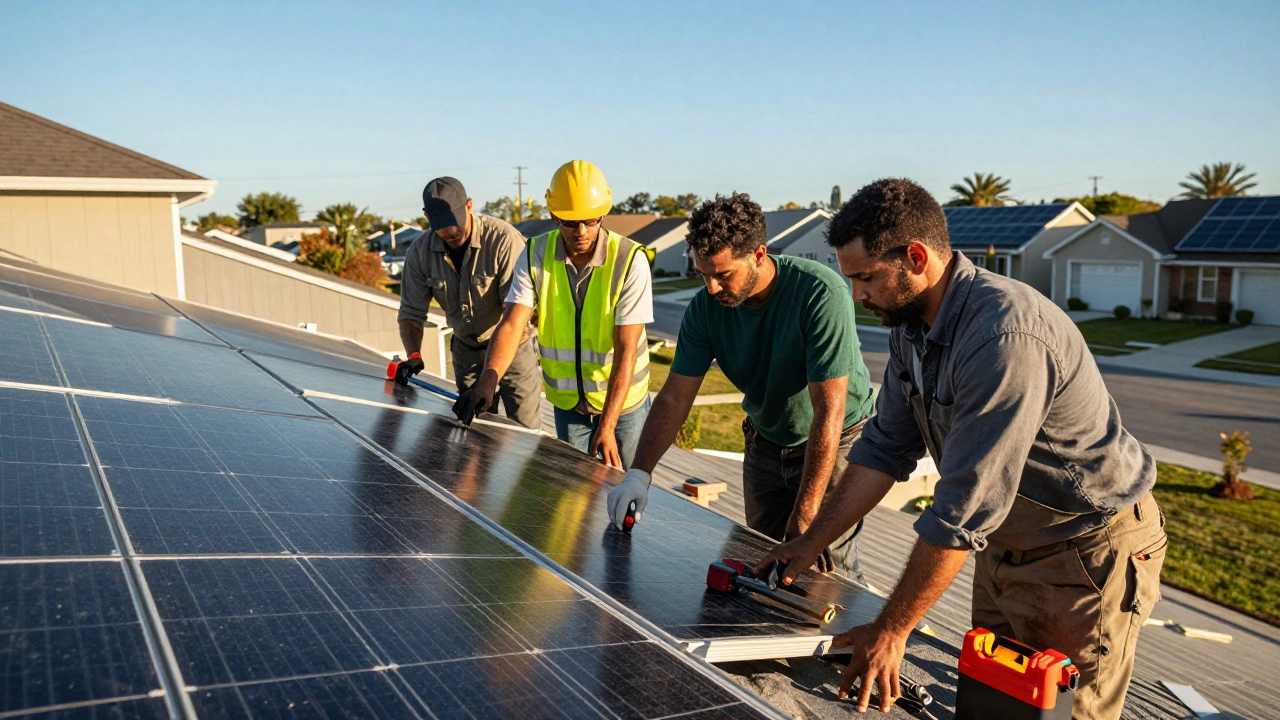
But that doesn’t mean hiring is slowing down. In fact, it’s changing shape. In 2024, 75% of all new electricity capacity came from solar. And with over 82,000 job postings between March and August 2025, demand is still strong. The biggest need? Installation and project development. Nearly two-thirds of all solar jobs are still hands-on-roof installers, ground mount crews, site supervisors. But now, there’s a new priority: operations and maintenance (O&M).
Here’s why: solar systems installed in 2022 and 2023 are now hitting their first major maintenance cycles. Inverter failures, wiring degradation, battery performance drops-these aren’t rare anymore. In 2024, 23% of employers said hiring for O&M roles was “very difficult.” That’s up 16 percentage points from 2023. Companies are scrambling to find people who know how to diagnose a failing string inverter without shutting down an entire farm. These aren’t entry-level jobs. They require training, certification, and experience.
Wind and Grid Modernization: The Hidden Workforce
Wind energy is growing fast, but its workforce looks different. Unlike solar, which can be installed on rooftops or small lots, wind farms need large teams for construction, heavy transport, and offshore logistics. Each 100-megawatt wind project hires 150-200 workers during peak construction. Most are temporary, but the long-term O&M roles are permanent-and hard to fill.
Wind turbine technicians are among the fastest-growing occupations in the U.S., according to the Bureau of Labor Statistics. But the training pipeline is thin. Few community colleges offer wind-specific programs. Many technicians learn on the job, often after serving in the military. That’s why veteran hiring is so high in wind-8% of the renewable workforce are veterans, even though they make up only 5% of the general population.
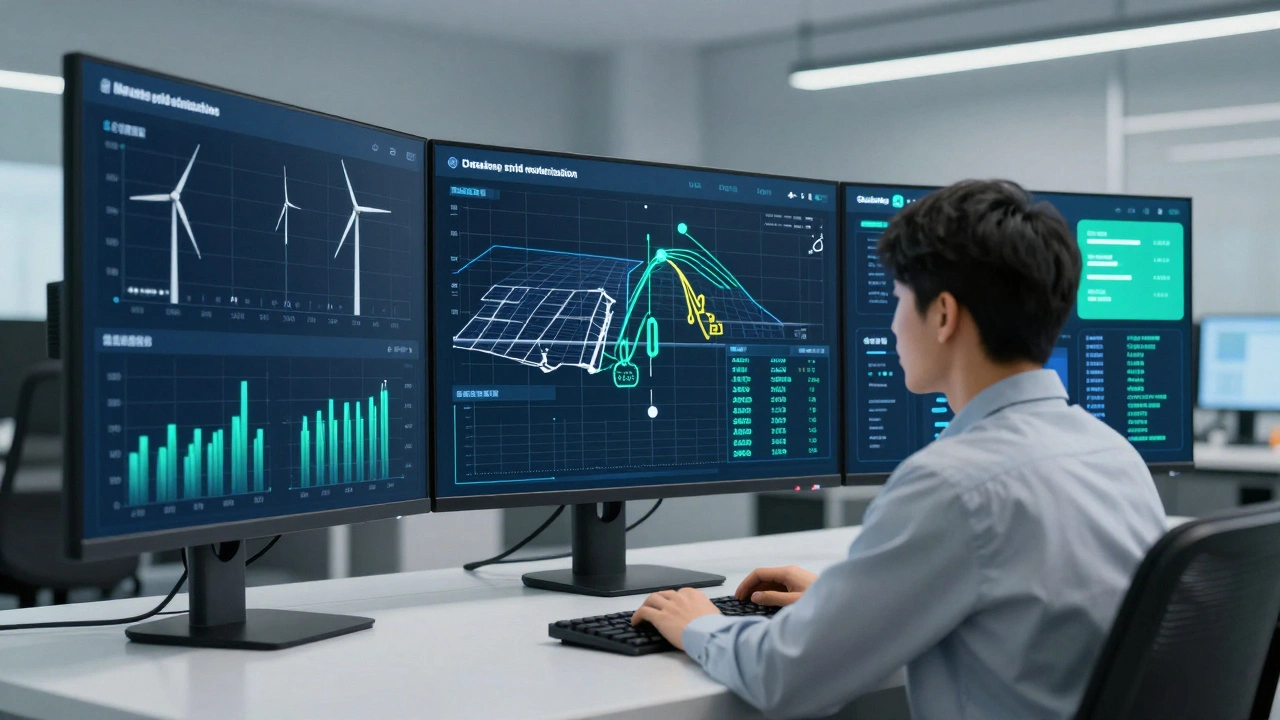
Grid modernization is another silent driver. The U.S. power grid is, on average, 40 years old. It wasn’t built for distributed solar, battery storage, or electric vehicles. Upgrading it means installing smart meters, upgrading substations, and building digital control systems. That’s not electricians with wrenches. That’s IT specialists, data engineers, and cybersecurity analysts. Companies are now hiring people with software backgrounds to manage grid resilience. And they’re paying well for it.
Who’s Getting Hired-and Who’s Being Left Out
The renewable energy workforce isn’t as diverse as it should be. Women make up 47% of the overall U.S. labor force. In solar? Just 31%. In wind? Closer to 25%. The same gap exists for people with disabilities-2.5% in clean energy, 4% in the general workforce. That’s not just unfair. It’s a missed opportunity.
But some groups are overrepresented. Veterans make up 8% of the workforce. That’s not by accident. Many energy firms partner with veteran job programs. The discipline, technical training, and leadership experience they bring are valuable. Employers know this. They’re actively recruiting them.
Age is another issue. Workers under 25? Only 5% of the renewable workforce. Workers between 25 and 34? Just 19%. Meanwhile, workers over 45? Nearly half. That’s a ticking clock. If we don’t bring in younger talent soon, we’ll face a skills cliff by 2030.
Wages Are Rising-and So Are Expectations
Pay in renewable energy is climbing. In 2025, over 51% of renewable workers got raises. One in five got increases of more than 5%. That’s higher than most other industries. For solar installers, median pay is now $58,000. Wind technicians? $65,000. Grid engineers? Often over $85,000.
But money isn’t the only thing people want anymore. A 2025 survey of 5,000 clean energy workers found that 68% said “career growth” mattered more than salary. Flexible hours. Remote work options. Clear promotion paths. These aren’t perks-they’re requirements.
And here’s something surprising: union representation is growing. In 2023, only 6% of new hires in solar were unionized. By 2024, that jumped to 12%. Why? The Inflation Reduction Act requires prevailing wages and apprenticeship programs for projects over 1 megawatt. That means companies must hire through certified training programs-and many of those are union-run. Employers aren’t choosing unions because they like them. They’re choosing them because they have to.
Where the Jobs Are-and Where They’re Not
California still leads in solar jobs, with 15% of all postings. But Texas and Florida are catching up fast. Texas has more wind than any state. Florida’s solar growth is explosive thanks to new state-level incentives. Arizona, Nevada, and Georgia are also seeing surges.
But here’s the catch: job opportunities aren’t evenly spread. If you live in rural Ohio or central Alabama, you’re not going to find many solar installation jobs. But you might find a grid modernization project. Or a wind farm under construction. The industry is moving beyond coastal hubs. The real hiring boom is happening in places where coal plants used to be.
How Employers Are Adapting
Companies aren’t just posting jobs-they’re building pipelines. Community colleges in Ohio and Michigan are partnering with solar developers to create 12-week certification programs. The Department of Energy is funding apprenticeships that pay workers while they train. Some firms now offer signing bonuses, tuition reimbursement, and paid certifications.
One utility in Iowa started a “grid technician bootcamp” for former factory workers. Within six months, 80% of them were placed in jobs managing smart transformers. That’s the kind of innovation the industry needs.
Remote monitoring is also changing the game. Instead of sending a crew to check every solar farm, companies now use AI-powered analytics to spot issues before they happen. That reduces the need for on-site technicians-and shifts the demand toward data analysts who can interpret the alerts.
What’s Next? The 2026 Challenge
By 2026, the U.S. will need over 500,000 new workers just to keep up with solar, wind, and grid upgrades. That’s not a prediction. It’s a math problem. Every gigawatt of new capacity requires 1,500-2,000 workers. We’re adding 30+ gigawatts a year. That’s 45,000-60,000 new hires annually-just for solar.
And it’s not enough to train people. We have to retain them. The turnover rate for solar installers is still high. Why? Many feel stuck in temporary, seasonal work. Employers who offer long-term contracts, health benefits, and clear advancement paths are seeing retention rates jump by 40%.
The next five years will decide whether renewable energy becomes a stable, inclusive industry-or a boom-and-bust cycle. The tools are here. The funding is here. What’s missing? People. And we need them now.
Are renewable energy jobs only for engineers and electricians?
No. While technicians and electricians make up the largest group, renewable energy needs project managers, data analysts, supply chain specialists, legal advisors, sales reps, and even marketing professionals. Solar companies hire customer service teams to help homeowners navigate incentives. Wind farms need environmental monitors and community liaisons. Grid modernization requires cybersecurity experts and software developers. The industry is as diverse as any tech or manufacturing sector.
Can someone without a college degree get a job in renewable energy?
Absolutely. Most solar installation jobs require a high school diploma and a 12-week certification, not a degree. Wind turbine technicians often start with military training or community college programs. Many employers now offer paid apprenticeships that lead to certifications in electrical systems, battery safety, or grid operations. The industry is moving away from degree requirements and toward skills-based hiring.
Why are O&M (operations and maintenance) jobs harder to fill than installation jobs?
Installation jobs are often one-time projects. Once a solar farm is built, the crew moves on. O&M is ongoing. Every solar array, every wind turbine, every battery bank needs regular checks, repairs, and upgrades. These jobs require deeper technical knowledge, familiarity with diagnostic tools, and experience with safety protocols. There aren’t enough trained workers to meet the growing number of systems coming online. Training takes time-and most programs are still catching up.
Is the renewable energy workforce becoming more diverse?
Slowly, but not fast enough. Women and people with disabilities are still underrepresented. But efforts are growing. Programs targeting veterans, returning citizens, and rural communities are expanding. Some states now require diversity metrics in public renewable energy contracts. Employers are also partnering with HBCUs and community colleges to build pipelines. Change is happening, but it’s not automatic-it needs intentional investment.
What’s the biggest barrier to hiring in renewable energy today?
The biggest barrier isn’t pay or location-it’s awareness. Many people don’t know these jobs exist. A high school student in rural Kansas might never hear about wind technician training. A former warehouse worker in Texas might not realize solar installation is a stable career. Employers are struggling to reach these audiences. The solution? Local outreach, partnerships with schools and workforce boards, and clear messaging about career paths-not just job openings.