Scenario Planning Matrix Builder
Key Driving Forces
Enter the key factors that could impact your business in the future. Rate them on impact and uncertainty to build your scenario planning matrix.
Impact vs. Uncertainty Matrix
Plot your key driving forces to identify the most critical uncertainties for scenario planning.
Your key driving forces create scenarios based on your highest impact and uncertainty factors.
No scenarios created yet
No scenarios created yet
No scenarios created yet
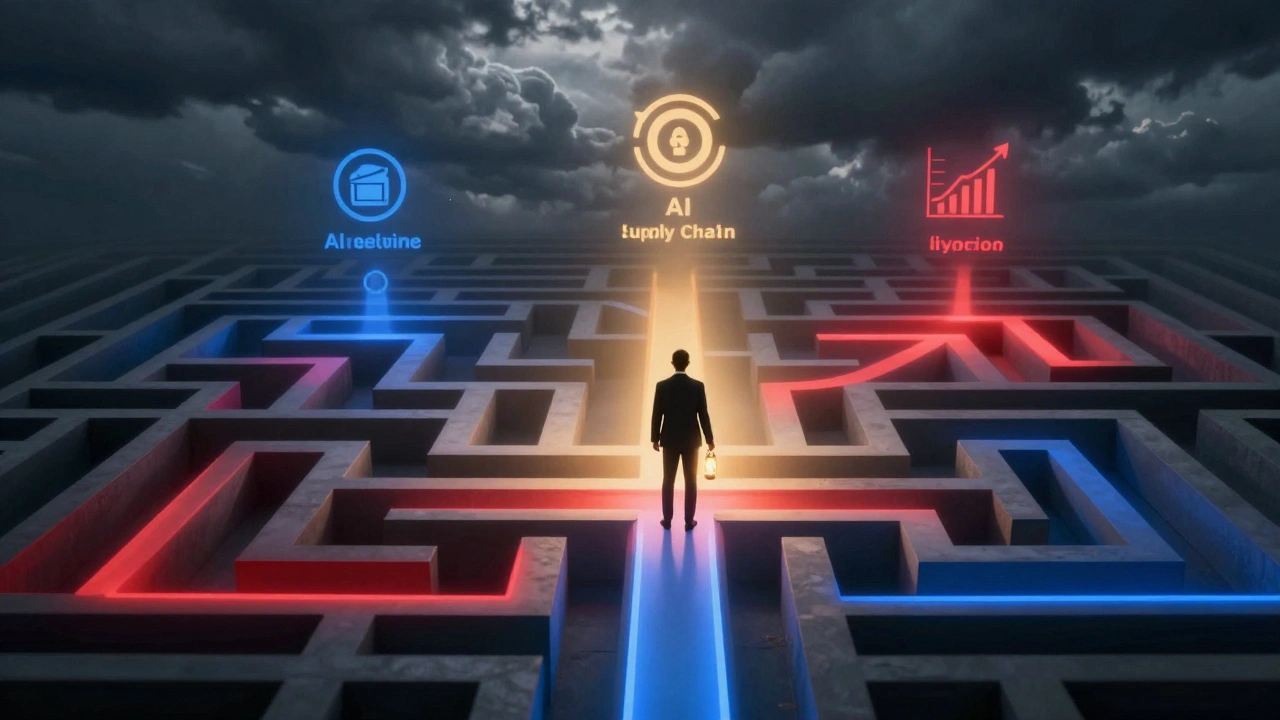
When the world shifts faster than your business can react, traditional forecasts don’t just fail-they mislead. You’ve seen it: a supply chain breaks because no one considered a port strike. A competitor launches a product you didn’t see coming. A regulation changes overnight, and your entire cost model collapses. This isn’t bad luck. It’s the result of planning for one future when there are dozens. Scenario planning isn’t about predicting the future. It’s about preparing for all of them.
Why Traditional Planning Fails in Uncertain Times
Most companies still rely on linear forecasting: take last year’s numbers, add 5%, assume the market stays stable. It’s simple. It’s comfortable. And it’s dangerously wrong in today’s world. In 2025, 78% of technology firms faced regulatory changes they couldn’t model with old-school tools. Financial institutions using only historical trends were caught off guard when inflation spiked to 11.7% in Q2. These weren’t black swans. They were signals ignored because the planning process didn’t allow for them. The problem isn’t data. It’s mindset. Traditional planning treats uncertainty as noise to be smoothed out. Scenario planning treats it as the signal. It doesn’t ask, “What will happen?” It asks, “What could happen-and how will we respond?”The Five Phases of Real Scenario Planning
Effective scenario planning isn’t a workshop with sticky notes. It’s a structured, data-driven process with five clear phases. Skip one, and you’re just storytelling.- Identify Driving Forces: Start broad. List everything that could change: AI regulations, labor shortages, climate events, currency swings, consumer behavior shifts. Most teams list 15-20. Then cut to the 5-7 that actually move the needle. For a hospital system, that might mean staffing availability, Medicare reimbursement rates, and telehealth adoption-not office decor trends.
- Plot Impact vs. Uncertainty: Take those key forces and map them on a grid. One axis: how much they’ll affect your business. The other: how unpredictable they are. The goal? Find the two forces with the highest uncertainty and highest impact. These become your axes. In 89% of successful implementations, these two variables create the entire scenario matrix.
- Build 3-5 Plausible Scenarios: Don’t do “good,” “bad,” and “ugly.” That’s lazy. Build scenarios that are distinct, plausible, and test your assumptions. One might be “Regulated AI, Shrinking Workforce.” Another: “Supply Chains Re-shored, Consumer Spending Drops.” Each scenario needs a name, a timeline, and a narrative. The best ones feel like news headlines from 2028.
- Test Operational Readiness: Now ask: Can we survive this? Do we have the skills? The supply chain buffers? The tech stack? 73% of high-performing firms run skills gap analyses every six months. 68% use modular tech systems that can be reconfigured quickly. If your IT team can’t pivot within 30 days, your scenario plan is just a PowerPoint.
- Set Early Warning Indicators: This is where most fail. A scenario isn’t useful unless you know when to act. Define triggers. If consumer confidence drops below 95.0, activate your recession playbook. If a key supplier’s credit rating falls two notches, trigger alternate sourcing. Track 7-12 indicators per scenario. Update them monthly. Ignore them, and your plan gathers dust.
What Works: Real Examples from 2024-2025
A financial services firm in Chicago ran eight cross-functional workshops over 12 weeks. They built three scenarios around inflation ranging from 2.5% to 11.7%. They didn’t just model revenue. They modeled hiring freezes, loan default rates, and branch closures. When inflation hit 10.1% in Q2 2025, their response time dropped from 90 days to 22. They didn’t guess. They acted. The U.S. Air Force used a method called FSS (Future Scenario System) to test 17 cyber capabilities against five uncertainties. They found three “high-surprise” scenarios-ones no one had considered. Result? $47 million in R&D funding shifted to close those gaps before they became crises. But not all succeed. A major retailer ran a scenario planning exercise in 2024. They had great scenarios. They even had triggers. But leadership treated them as “interesting ideas.” Their 2025 holiday plan? Exactly the same as 2024. When supply chain delays hit and demand dropped, they had no playbook. They lost $120 million.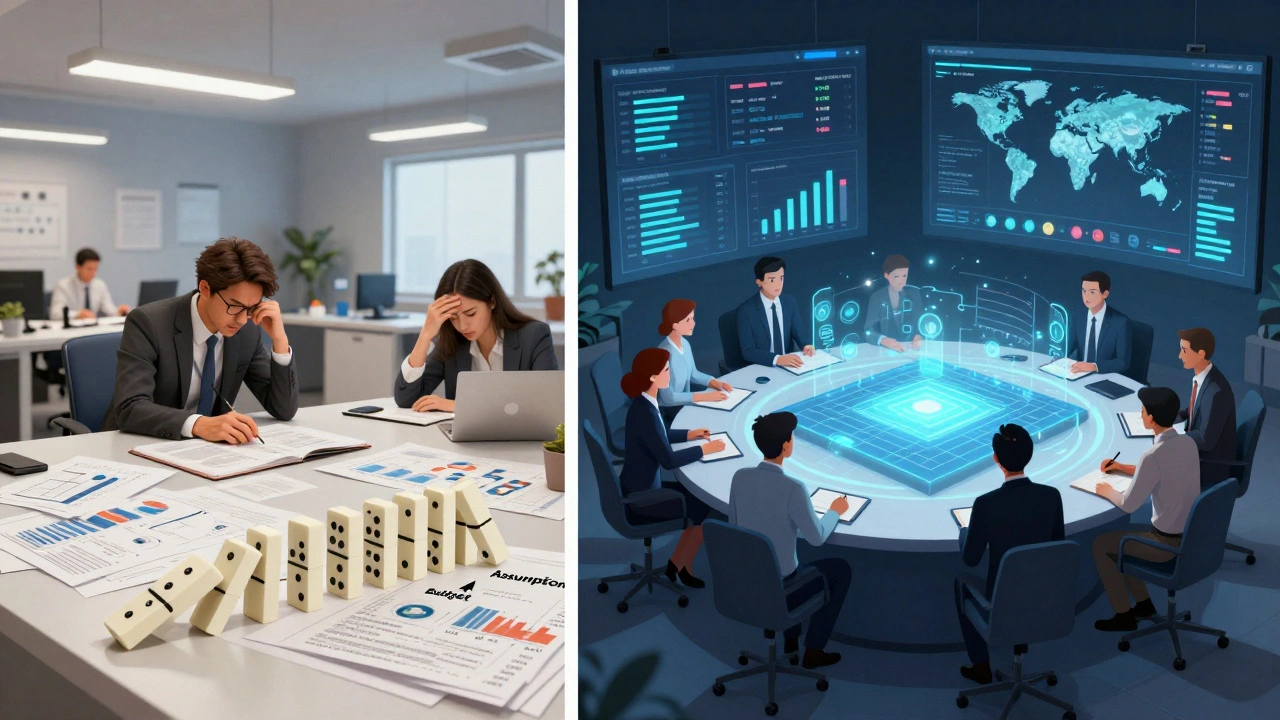
Why Scenario Planning Beats SWOT and Forecasting
SWOT analysis is great for a quick snapshot. But it’s static. It doesn’t account for change over time. Forecasting assumes the future is an extension of the past. Scenario planning assumes the future is a maze. Organizations using scenario planning achieve 23% higher strategic alignment during volatile periods, according to MIT Sloan Review. Why? Because they’ve rehearsed multiple outcomes. Their teams aren’t scrambling. They’re executing. But it’s not easy. Scenario planning takes 30-40% more resources than SWOT. It needs skilled facilitators, cross-functional teams, and executive buy-in. If your CEO doesn’t attend the first workshop, don’t bother.The Hidden Pitfalls (And How to Avoid Them)
You can do everything right and still fail. Here’s what goes wrong-and how to fix it.- Scenario washing: Creating pretty scenarios that don’t challenge assumptions. Fix: Ensure scenarios differ by at least 35% in key drivers. If they all look the same, you’re not planning-you’re pretending.
- Leadership disengagement: 70% of failures happen because executives treat scenarios as academic exercises. Fix: Make scenario outcomes part of quarterly board reviews. Tie them to budget decisions.
- No integration: Scenarios sitting in a folder while operations run on last year’s plan. Fix: Link scenario triggers to your ERP, budgeting, and HR systems. If your budget cycle doesn’t update based on scenario signals, you’re wasting time.
- Scenario fatigue: Running the same exercise every year with no new insights. Fix: Refresh scenarios quarterly. Use AI tools like CBH’s ScenarioBuilder 3.0 to auto-update drivers from real-time data feeds.

Who Should Use This-and Who Shouldn’t
Scenario planning isn’t for everyone. It’s powerful, but only in the right context.- Best for: Organizations facing high uncertainty-tech firms, financial services, energy, defense, and public sector agencies. If you’re dealing with AI regulation, climate risk, geopolitical shocks, or shifting consumer norms, you need this.
- Not ideal for: Highly regulated industries with predictable futures (like utilities with fixed rate structures) or companies with rigid hierarchies that can’t adapt. If your decision-making chain requires seven approvals to change a printer, scenario planning will feel like shouting into a void.
Getting Started: Your First Steps
You don’t need a $500K consultant. Start small.- Get your CEO to sponsor it. No exceptions.
- Assemble a team of 12-15 people from finance, ops, HR, and customer-facing roles.
- Run one workshop. Identify 3 driving forces that keep you up at night.
- Plot them on impact vs. uncertainty. Pick the top two.
- Build two scenarios: one optimistic, one stressful. Write them like a story.
- Ask: What would we do differently if this happened?
- Assign one person to track one leading indicator for each scenario.
The Future of Scenario Planning
AI is changing the game. Tools now auto-generate scenarios by analyzing news, economic data, and social trends. Dashboards update scenario probabilities hourly. In 2026, 78% of leading firms use real-time monitoring systems that pull from 12-15 external APIs. But tech doesn’t replace judgment. It enhances it. The best scenario planners aren’t data scientists. They’re storytellers who can turn uncertainty into action. The goal isn’t to predict the future. It’s to make sure your organization doesn’t just survive it-but thrives in it.What’s the difference between scenario planning and contingency planning?
Contingency planning prepares for one specific event-like a server crash or a key employee leaving. Scenario planning prepares for multiple, complex futures shaped by interacting forces. Contingency plans are like fire drills. Scenario planning is like training for a war where the enemy, the battlefield, and the rules change every week.
How long does scenario planning take to implement?
A full implementation takes 12-16 weeks for most organizations. That includes workshops, data gathering, scenario development, and integration into planning systems. But you can start seeing value in 6 weeks with a focused pilot. The key is not speed-it’s depth. Rushed scenarios are useless.
Do I need special software for scenario planning?
No. You can start with Excel and Google Docs. But advanced tools like CBH’s ScenarioBuilder 3.0 or MIT’s AI-driven platforms reduce development time from 12 weeks to 9 days. They also reduce cognitive bias by 41% by surfacing patterns humans miss. If you’re doing this at scale, software isn’t optional-it’s essential.
How often should we update our scenarios?
High-performing organizations refresh scenarios quarterly. That’s not because the world changes that fast-it’s because your assumptions do. Every quarter, ask: Which drivers have shifted? Which triggers have been hit? Which scenarios are now irrelevant? If you wait a year, you’re planning with last year’s map.
Can small businesses use scenario planning?
Absolutely. You don’t need 500 employees. A small business with 20 people can run a 2-hour workshop to explore two key uncertainties: customer demand shifts and supplier reliability. The goal isn’t complexity-it’s preparedness. One small retailer used scenario planning to avoid a $200K inventory disaster when a key supplier failed. All they did was ask, “What if they go under?” and built a backup plan.
What’s the biggest mistake people make with scenario planning?
Treating scenarios as predictions instead of possibilities. If you start saying, “This one is most likely,” you’ve lost the point. The goal isn’t to guess right. It’s to be ready for anything. The best scenario planners are the ones who say, “We don’t know what’s coming-but we know how to respond.”