Yen Carry Trade Risk Calculator
Yen Carry Trade Risk Calculator
Calculate potential gains or losses from your yen carry trade positions based on exchange rate movements. This tool helps you understand the risk exposure of your positions in the current volatile yen market.
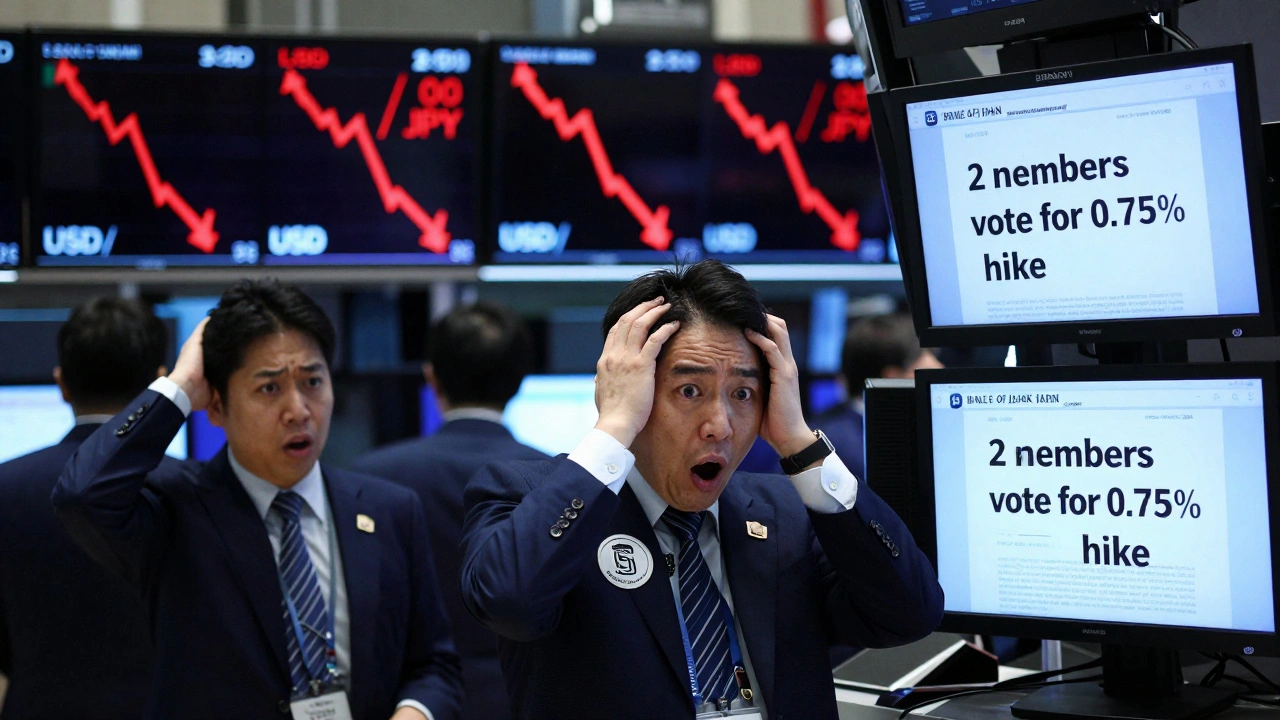
On January 22, 2025, the Bank of Japan did something it hadn’t done in 17 years: it raised interest rates. Not by a quarter point. Not by half. Just 0.1%. But that tiny move sent the yen soaring 4.2% in a single day. Traders who had bet against the yen for years-borrowing cheap Japanese cash to buy higher-yielding assets from Brazil to Australia-watched their positions collapse in under 90 seconds. One Reddit user, TokyoTrader87, lost 68% of his account. A hedge fund in London lost $400 million. And it wasn’t an accident. It was the first real taste of something traders had been warning about for years: Yen shock risk.
What Exactly Is Yen Shock Risk?
Yen shock risk isn’t just about the yen getting stronger. It’s about what happens when the world’s last major economy with negative interest rates suddenly flips the script. For nearly two decades, Japan kept its benchmark rate at or below zero. That made borrowing yen dirt cheap. Investors around the world piled in, borrowing yen to buy U.S. Treasuries, Australian bonds, even emerging market stocks. These are called carry trades. They worked fine as long as the yen stayed weak. But when the Bank of Japan started raising rates-first to 0.1% in January, then 0.25% in March, then 0.5% in July-the whole game changed.By October 2025, the Bank of Japan had officially ended its negative rate policy. The 10-year Japanese government bond yield jumped from 0.7% to 1.85%. The yen was no longer a funding currency-it was becoming a store of value. And every trader who had bet the opposite was now staring at a ticking bomb.
The $1.2 Trillion Problem
According to the Bank for International Settlements, there was $1.2 trillion in global carry trades built on borrowing yen as of mid-2025. That’s more than the entire GDP of Switzerland. Most of it was hidden in hedge funds, institutional portfolios, and retail forex accounts. These trades were profitable as long as the yen stayed low. But now, with the Bank of Japan signaling it might raise rates again-to 0.75%-the pressure is mounting.Here’s the math: a 25-basis-point rate hike on $1.2 trillion in yen loans adds $3 billion in annual funding costs. That doesn’t sound like much until you realize traders were making 3-5% returns on those trades. Suddenly, the profit margin vanishes. And when profits disappear, traders rush to close positions. That means selling the assets they bought with yen and buying yen back to repay the loan. More yen demand = stronger yen. And that’s when the panic starts.
Why This Time Is Different
Past rate hikes by the Bank of Japan were small and expected. This one wasn’t. The central bank didn’t just raise rates-it ended a decades-old policy regime. And it did so without promising to stop. In October 2025, Governor Kazuo Ueda said the next move would come “when the board decides to raise rates to 0.75%.” That’s not a guarantee. It’s a trigger.What makes this dangerous is the lack of clarity. Traders can’t model it. They can’t hedge it perfectly. The Bank of Japan says it’s “data-dependent.” But what data? Inflation at 2.7%? A spike in oil prices? A drop in U.S. growth? No one knows. And that uncertainty is what fuels volatility.
Compare that to the U.S. Federal Reserve, which telegraphs every move with press conferences, dot plots, and forward guidance. The Bank of Japan doesn’t. That’s why USD/JPY swings 3-5% on surprise announcements-while EUR/USD barely moves 1%. The market isn’t just reacting to a rate change. It’s reacting to a black box.

Who’s Getting Hurt-and Who’s Winning
Retail traders are getting crushed. As of December 2025, 82% of retail positions on USD/JPY were still short the yen, according to CME Group. These are often individuals using 15:1 leverage after Japan raised margin rules in April 2025. They don’t have stop-losses. They don’t have risk models. One tweet from a BoJ official can wipe them out.Meanwhile, the big players are preparing. Bridgewater Associates made $1.2 billion in Q1 2025 by betting on yen strength. Institutional investors have cut their yen short positions by 37% since July. And now, 63% of hedge funds are running “shock scenarios” for a 0.75% rate hike. They’re buying USD/JPY put options with 120-125 strike prices. Those options cost 3.5% of position value-but they’re cheaper than losing half your portfolio.
Even the Japanese government stopped intervening in forex markets in 2025. In 2024, they spent $63 billion trying to weaken the yen. In 2025, they didn’t lift a finger. Why? Because the Bank of Japan is now doing the job itself. The market is doing the work. That means there’s no safety net.
The December 2025 Wild Card
The next Bank of Japan meeting is on December 18-19, 2025. Markets are pricing in a 68% chance of another 25-basis-point hike-to 0.75%. That’s the line in the sand. If it happens, $300-400 billion in carry trades could unwind in hours, according to Nomura Securities. That’s enough to push USD/JPY below 130, maybe even 125.And if inflation stays above 2%? The Bank of Japan won’t stop at 0.75%. Former board member Hitoshi Susaki warned that “multiple hikes in quick succession” are the real danger. If the BoJ raises rates again in March 2026, you could see a 10% yen surge in weeks. That’s not speculation. That’s what happened in 2025 after the first hike.

How to Survive Yen Shock Risk
If you’re holding positions tied to the yen, here’s what you need to do:- Check your leverage. If you’re using more than 10:1 on USD/JPY, you’re playing Russian roulette. Japan’s new rules cap retail leverage at 15:1-but that’s still too high for this kind of volatility.
- Buy protection. USD/JPY put options with strikes near 120-125 are your insurance. They’re expensive, but not as expensive as losing your account.
- Watch the Summary of Opinions. The Bank of Japan releases this document at 8:50 a.m. Tokyo time after every meeting. It shows internal splits. If two or more members vote for a 0.75% hike, expect chaos.
- Don’t trust “data-dependent” language. It’s a cover. The BoJ is moving. You need to act before the move, not after.
- Reduce exposure. If you’re still short the yen, cut your position by at least 50%. The trend is no longer your friend.
There’s no magic formula. But there’s one rule: if you’re betting the Bank of Japan won’t raise rates again, you’re already wrong.
The Bigger Picture
This isn’t just about the yen. It’s about the end of an era. For 17 years, Japan was the world’s monetary outlier. Now, it’s becoming normal. And the global financial system is still adjusting. The yen is no longer a cheap loan. It’s a signal. A warning. A force.The Bank of Japan isn’t trying to break markets. It’s trying to fix inflation. But markets don’t care about intent. They care about position. And right now, trillions of dollars are positioned against a central bank that’s finally done playing nice.
When the next rate decision comes, don’t ask if the yen will rise. Ask how many traders will be left standing when it does.
What is Yen shock risk?
Yen shock risk is the danger of sudden, large movements in the Japanese yen’s value triggered by unexpected changes in Bank of Japan interest rate policy. This risk became real in January 2025 when the BoJ ended its 17-year negative rate policy, causing massive losses for traders who had borrowed yen to invest in higher-yielding assets worldwide.
Why is the Bank of Japan raising rates now?
The Bank of Japan is raising rates because inflation has remained above its 2% target for over two years, with core inflation hitting 2.7% in fiscal year 2025. After nearly two decades of ultra-loose policy, the central bank is now focused on normalizing monetary conditions and reducing distortions in financial markets caused by negative interest rates.
How much money is at risk from yen carry trades?
As of Q2 2025, the Bank for International Settlements estimated $1.2 trillion in global carry trades were funded by borrowing yen. Nomura Securities estimates $300-400 billion of those positions are vulnerable to a rapid unwind if the Bank of Japan raises rates to 0.75%.
What happened during the January 2025 BoJ rate hike?
On January 22, 2025, the Bank of Japan raised rates from -0.1% to 0.1%. The yen surged 4.2% intraday against the dollar, triggering massive losses for traders holding short yen positions. One hedge fund lost $400 million, and retail traders reported account drawdowns of 50-90% within minutes.
Is the Bank of Japan likely to raise rates again in December 2025?
Markets are pricing in a 68% chance of another 25-basis-point hike to 0.75% at the December 18-19, 2025 meeting. Governor Ueda has signaled this level is the next threshold for policy action, and internal BoJ discussions suggest a majority of board members support further tightening if inflation remains elevated.
How can traders protect themselves from yen shock?
Traders can reduce exposure to USD/JPY, buy USD/JPY put options with strikes near 120-125, use cross-currency basis swaps, or reduce leverage. Monitoring the Bank of Japan’s Summary of Opinions after each meeting is critical to anticipating policy shifts before they hit the market.
Why is retail trading so risky in this environment?
Retail traders often use high leverage (up to 15:1) and lack proper risk management tools. As of December 2025, 82% of retail positions on USD/JPY were still short the yen, despite clear signs of BoJ tightening. This makes them vulnerable to rapid, unpredictable yen rallies that can trigger margin calls and total account losses.