
AI Risk Assessment Calculator
The EU AI Act classifies AI systems into four risk tiers: unacceptable, high, limited, and minimal. This tool helps you determine which tier your system falls into based on its intended use and impact.
Risk Assessment Results
Based on your selections, your AI system is classified as:
Key Compliance Requirements
- High-risk systems require 14 mandatory controls including documented data governance, human oversight mechanisms, and technical documentation for audits
- All systems must maintain documentation for 10 years after deployment as per ISO 42001
- High-risk systems are subject to €35 million fines or 7% of global revenue under EU AI Act
Organizations deploying artificial intelligence today aren’t just building models-they’re building legal, ethical, and operational systems that can make or break their reputation. The days of rushing an AI model into production without oversight are over. With the EU AI Act fully in force and global regulators demanding accountability, AI governance isn’t optional anymore. It’s the backbone of every responsible AI deployment.
Why AI Governance Isn’t Just a Compliance Checklist
Many companies treat AI governance like a box to tick: hire a consultant, draft a policy, and call it done. But that’s where things go wrong. A 2025 Capgemini report found that organizations treating governance as a one-time task had 37% more compliance incidents than those embedding it into daily operations. Real governance means making decisions before you even train your first model. It’s about asking: Who is accountable if this system denies someone a loan? What happens if its predictions drift over time? How do we prove it’s fair-not just claim it is? The NIST AI Risk Management Framework is a flexible, non-regulatory guide that helps organizations identify, assess, and manage AI risks across four core functions: Govern, Map, Measure, and Manage. It doesn’t tell you what to do-it gives you the structure to figure it out for your context. That’s why 68% of U.S. enterprises use it as their foundation, according to Gartner’s 2025 CIO survey.Breaking Down the Three Pillars: Risk Controls, Model Monitoring, and Responsible Use Policies
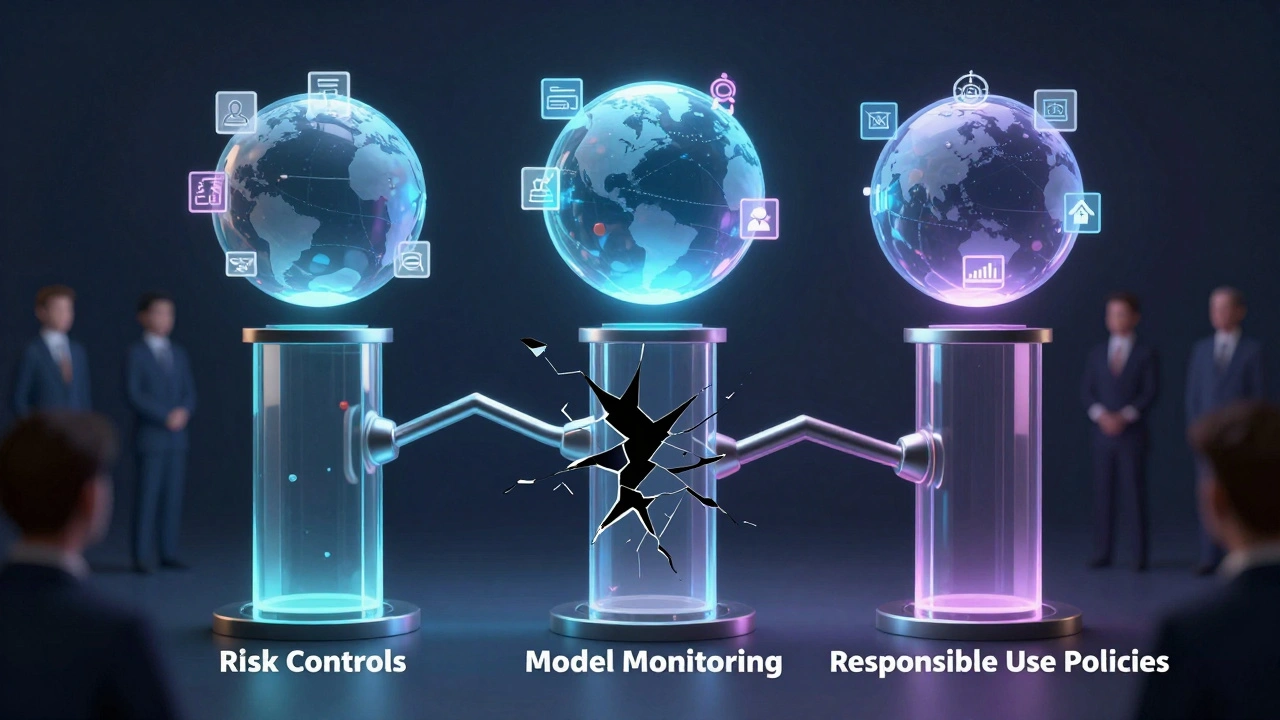
Effective AI governance rests on three interlocking pillars. Miss one, and the whole system wobbles.Risk Controls: Knowing What’s at Stake
Not all AI systems carry the same risk. The EU AI Act classifies AI systems into four tiers: unacceptable, high, limited, and minimal risk, with high-risk systems requiring 14 mandatory controls. High-risk includes systems used in hiring, credit scoring, healthcare diagnostics, and law enforcement. For these, you need documented data governance, human oversight mechanisms, and technical documentation that survives audits. A European bank spent 14 months and €2.3 million just to integrate human oversight into its real-time fraud detection system. Why? Because the EU AI Act requires that humans can intervene before a high-risk decision is finalized. The challenge wasn’t the tech-it was changing workflows that had operated without human review for decades.Model Monitoring: Catching Drift Before It Costs You
Models don’t stay perfect. Data changes. User behavior shifts. Performance degrades. This is called model drift. And if you’re not watching for it, you’re flying blind. The NIST AI RMF 1.1 requires continuous monitoring against 12 key metrics: accuracy, fairness, latency, robustness, and more. Automated alerts trigger when performance drops below set thresholds-like a 5% decline in prediction accuracy. Leading platforms now track these metrics in real time, with tools like AI21’s Governance Suite and Obsidian Security integrating directly into MLOps pipelines like MLflow and Kubeflow. One healthcare provider reduced algorithmic bias incidents by 62% after implementing continuous monitoring. But their computational costs jumped 18% because they added explainability layers to every model. That’s the trade-off: better oversight costs more, but the cost of getting it wrong-lawsuits, reputational damage, regulatory fines-can be far higher.Responsible Use Policies: Setting Boundaries
You can monitor a model all day, but if your team uses it to scan social media for dissenting opinions, you’ve already crossed a line. Responsible use policies define what AI can and cannot do. They answer questions like: Can we use facial recognition in public spaces? Can we automate layoffs? Can we train models on private medical records without consent? Microsoft’s AI Ethics Committee has reviewed 217 AI projects since 2023, approving 189 with modifications and rejecting 28 outright due to unmitigable ethical risks. Their policy isn’t just a document-it’s a decision-making filter. Every project must pass through it before funding is released. The OECD AI Principles established in 2019, remain the global baseline for responsible AI, emphasizing human rights, transparency, and accountability across 42 signatory countries. But principles alone aren’t enough. You need enforceable policies backed by training, audits, and consequences.Comparing the Major Frameworks: EU AI Act, NIST, ISO 42001, and Others
There’s no single “best” framework. The right one depends on your industry, location, and risk profile.| Framework | Type | Key Strength | Key Limitation | Adoption Rate (2025) |
|---|---|---|---|---|
| EU AI Act | Regulatory | Legally binding, clear risk tiers, heavy penalties | Rigid, slow to adapt to new AI types | 78% in EU-based financial services |
| NIST AI RMF | Guideline | Flexible, sector-agnostic, practical risk focus | Not certifiable, relies on self-enforcement | 68% of U.S. enterprises |
| ISO 42001 | Certifiable Standard | Third-party validation, global recognition | Costly (€15K-€50K), complex implementation | 42% of Fortune 500 |
| UK Pro-Innovation Framework | Principles-Based | Encourages innovation, sector-specific | No enforcement, weak accountability | 29% of UK tech firms |
| IEEE 7000 | Technical Standard | Deep engineering guidance for ethical design | Too technical for non-engineers, low adoption | 28% of engineering teams |
Most mature organizations don’t pick one-they combine them. The World Economic Forum’s 2025 toolkit recommends using NIST for risk assessment and ISO 42001 for certification. This hybrid approach, according to Bradley Arant’s analysis of 127 enterprise implementations, leads to 43% better compliance outcomes.
The Human Factor: Who’s Really Running Your AI Governance?
You can have the best framework in the world, but if no one’s accountable, it’s just paperwork. The IAPP’s 2025 AI Governance Profession Report found that only 18% of organizations have dedicated roles filled by people with both AI technical knowledge and regulatory expertise. That’s the gap. Data scientists know how to build models. Lawyers know how to interpret regulations. But few know how to bridge the two. Successful teams have three core roles:- AI Governance Council: 7-12 members including C-suite, legal, compliance, and ethics leads. They set policy and approve high-risk deployments.
- Data Stewards: One per 5-7 data scientists. They ensure data quality, documentation, and fairness checks.
- Compliance Officers: One per business unit. They audit usage, track regulatory changes, and manage audits.
This structure adds 20-30% to personnel costs-but it’s cheaper than a €35 million fine under the EU AI Act.
Implementation Roadmap: From Chaos to Control
Getting started doesn’t mean overhauling everything overnight. Most organizations follow a four-phase maturity path:- Assess: Map all AI use cases to risk levels using the EU AI Act’s four-tier system. This takes 8-12 weeks for mid-sized firms.
- Build: Create your governance council, hire stewards, and select your framework (NIST + ISO 42001 is the most common combo).
- Deploy: Install monitoring tools that track 12-15 key metrics. Ensure your MLOps platform supports integration with MLflow or Kubeflow.
- Improve: Audit quarterly. Update policies. Train teams. Document everything. ISO 42001 requires documentation to be kept for 10 years after deployment.
Companies that follow this path see results. Microsoft’s AI Ethics Committee rejected 28 projects outright because the risks couldn’t be mitigated. That’s governance working as intended-not to block innovation, but to protect people.

What’s Next? The Future of AI Governance
The landscape is moving fast. The NIST AI RMF 1.2 update, due in Q1 2026, will add specific metrics for generative AI risks-something missing in most current frameworks. The EU’s AI Office will require third-party conformity assessments for high-risk systems starting August 2026. And the global AI governance market is projected to grow from $2.1 billion in 2024 to $8.7 billion by 2027. But the biggest challenge isn’t technical-it’s cultural. As Dr. Virginia Dignum warns, many treat governance as a checkbox, not a mindset. True governance means empowering teams to say no. It means valuing safety over speed. It means accepting that some ideas shouldn’t be built, even if they’re technically possible. Organizations that get this right won’t just avoid fines. They’ll earn trust. And in the age of AI, trust is the only competitive advantage that can’t be copied.What’s the difference between AI governance and AI ethics?
AI ethics is about values-fairness, transparency, human dignity. AI governance is about systems-policies, controls, monitoring, and accountability. You can have ethical values without governance, but you can’t have reliable, safe AI without governance. Governance turns ethics into action.
Do small businesses need AI governance frameworks?
Yes-even small teams using AI for customer service chatbots or hiring filters face legal and reputational risks. The EU AI Act applies to any system that affects rights, regardless of company size. Start simple: map your use cases, define one responsible person, and document your data sources. You don’t need a full council-just accountability.
How much does implementing AI governance cost?
Costs vary widely. A small business might spend $20,000-$50,000 on tools and training. A large enterprise could spend $1-5 million, including personnel, monitoring systems, and compliance audits. ISO 42001 certification alone runs €15,000-€50,000. But the cost of a single regulatory fine or public scandal can be 10x higher.
Can I use open-source tools for AI governance?
Yes, but with limits. Tools like AIF360, Fairlearn, and MLflow offer components for fairness testing and model tracking. But they don’t replace governance structure. You still need policies, roles, and oversight. Open-source tools help you execute, but they don’t define your responsibility.
What happens if I ignore AI governance?
You risk fines up to €35 million or 7% of global revenue under the EU AI Act. You risk lawsuits over biased decisions. You risk losing customer trust. And you risk being blocked from markets. In 2025, 83% of organizations have some form of governance. If you don’t, you’re not just behind-you’re exposed.
Is AI governance only for high-risk systems?
No. Even minimal-risk systems can cause harm if misused. A chatbot that gives bad medical advice, a recommendation engine that reinforces stereotypes, or a recruitment tool that excludes certain names-all these can damage trust and reputation. Governance isn’t just about legal compliance-it’s about responsible innovation at every level.