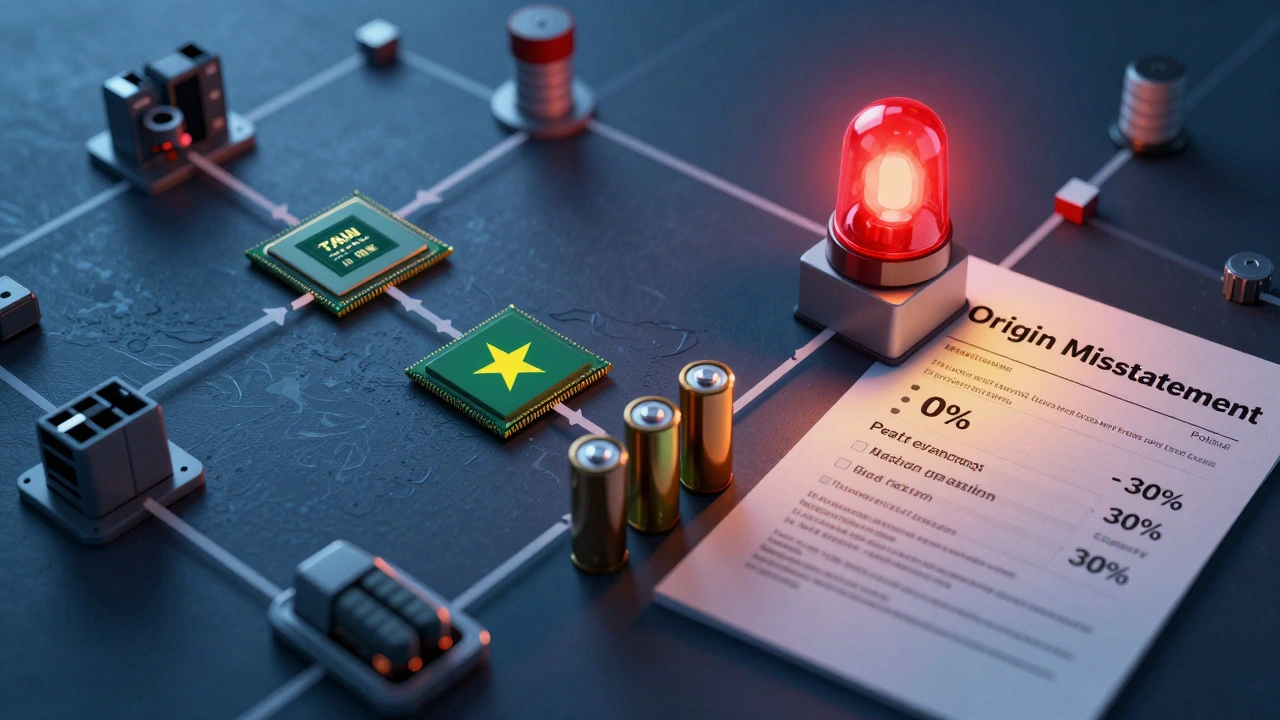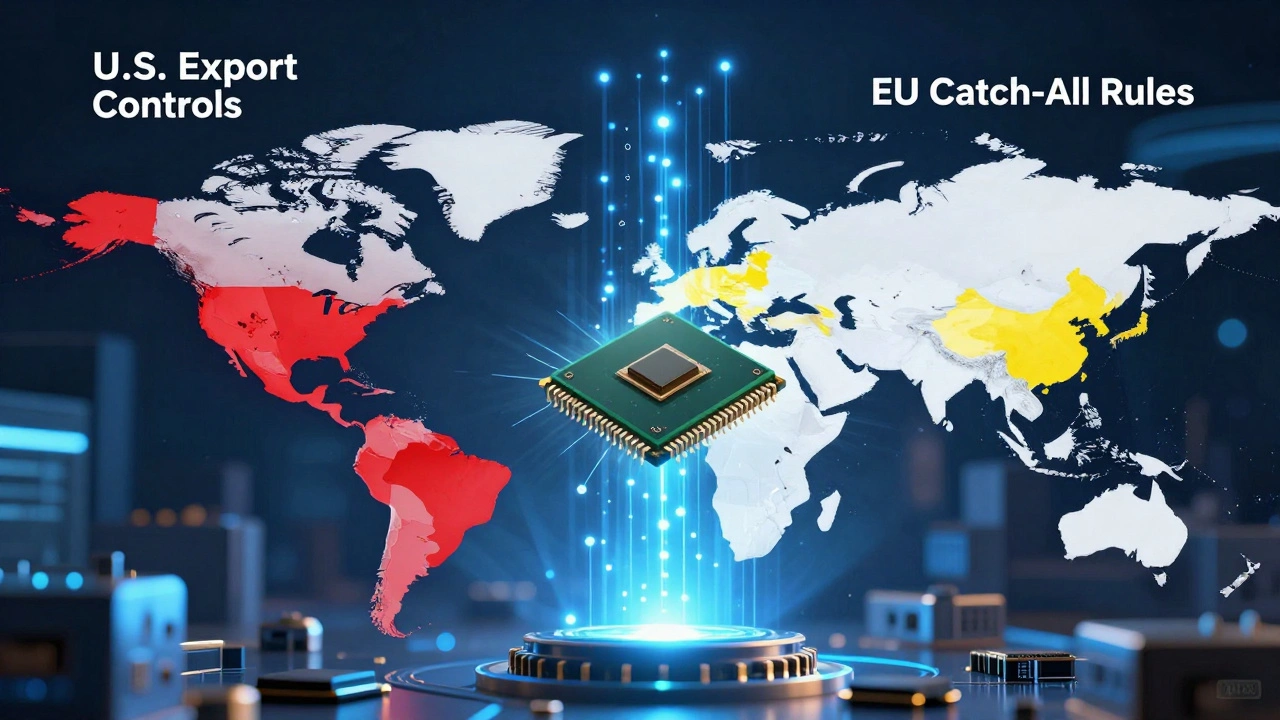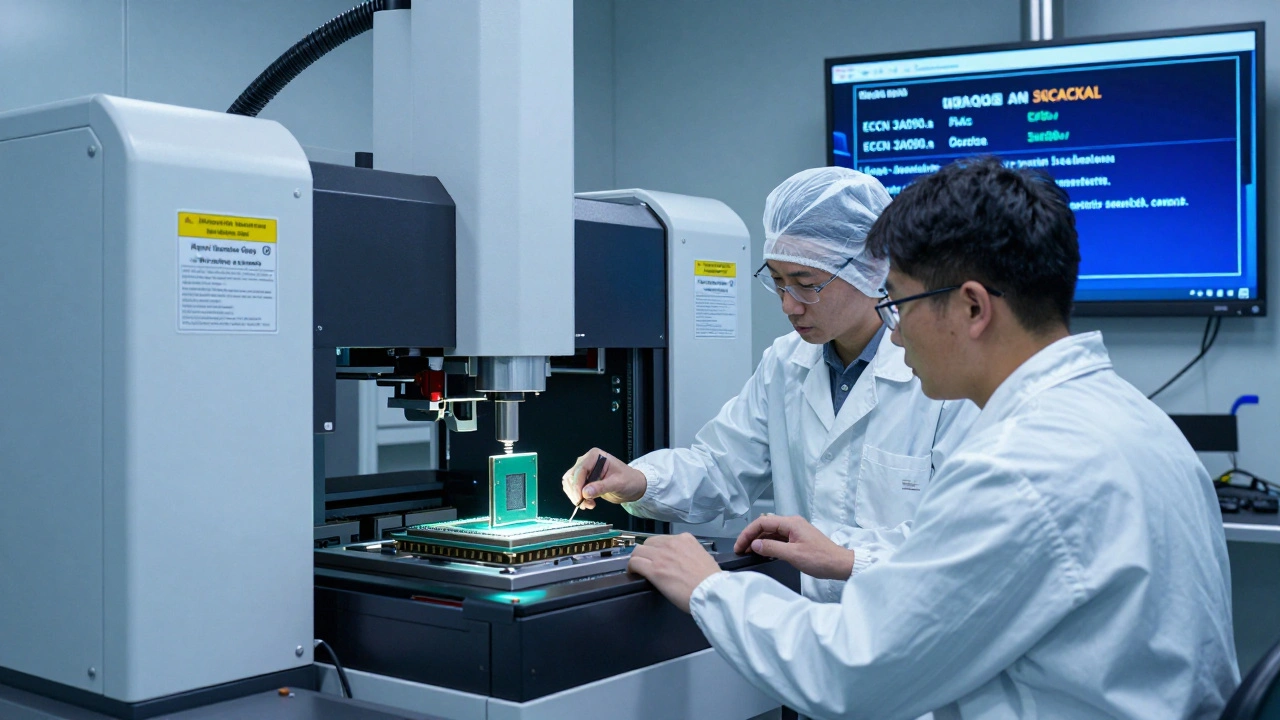
Export Control Compliance Checker
Check Your Technology
Compliance Result
It’s 2026, and the global tech supply chain isn’t broken-it’s been deliberately rebuilt. What used to be a seamless flow of advanced chips, AI models, and quantum hardware across borders is now a patchwork of rules, licenses, and blacklists. The U.S., EU, and China aren’t just tweaking trade policies. They’re rewriting the rules of who can build what, where, and for whom. This isn’t about tariffs. It’s about control over the building blocks of future power.
Why Semiconductors Are the New Oil
Every smartphone, drone, supercomputer, and missile guidance system needs a chip. But now, the ability to make the most advanced ones is tightly locked down. The U.S. Department of Commerce didn’t just add a few new restrictions in 2025-it rewrote the entire playbook. The new ECCN 3A090.a rule requires a license to export any advanced integrated circuit to any country in the world. That’s not targeting China anymore. That’s targeting everyone.
It’s not just about the chips themselves. It’s about the machines that make them. Equipment that can produce Gate-All-Around Field Effect Transistors (GAAFETs)-the next leap in chip design-is now on the export control list. Foundries in Taiwan, South Korea, and even Europe must prove they’re not shipping these tools to restricted entities. And it’s not enough to track the hardware. Companies now have to verify that the IC designers they work with are authorized. If a startup in Berlin uses a chip design from a firm in Shanghai that’s not on the approved list? That’s a violation.
The January 31, 2025 compliance deadline caught many off guard. Smaller firms didn’t have compliance teams. Big ones had to overhaul supply chain tracking systems overnight. Some asked for extensions. Most didn’t get them. The message was clear: if you’re in the semiconductor game, you’re now in the national security game.
AI Model Weights: The First Time Code Became a Weapon
For years, AI models were treated like software-downloadable, copyable, open-source. Then came the January 13, 2025 rule. The U.S. government declared that the weights inside an AI model-the learned parameters that make it work-are controlled technology. Exporting them without a license is now illegal.
This isn’t about training data. It’s not about the code. It’s about the knowledge embedded in the model. A language model trained on medical records, a drone navigation AI trained on battlefield imagery, a financial fraud detector trained on European banking patterns-those weights are now treated like classified blueprints. Even sharing them with a researcher in Germany or a partner in Japan requires a license.
Companies that built AI models for global clients suddenly found themselves in legal limbo. A startup in Toronto that trained an AI for a hospital in Sweden now needs to prove the model’s weights weren’t exported illegally. A U.S. firm that licensed its AI to a Chinese subsidiary has to scrub the weights from their servers-or risk fines. This rule didn’t just slow down AI collaboration. It froze it.
Quantum Computing: The Race That Got Locked Down
Quantum computers aren’t just faster computers. They’re machines that could crack today’s encryption, simulate new materials, or optimize global logistics in seconds. That’s why the U.S. and EU moved fast to control them.
The controls aren’t just on the machines themselves. They cover the materials, cooling systems, control electronics, and even software used to operate them. The EU’s November 2025 update added quantum systems to its dual-use list. The U.S. went further: if a foreign national-say, a PhD student from Russia or Iran-is working on quantum tech in a U.S. lab, that’s considered a “deemed export.” Unless they’re from Country Group A:1 (like Canada or Australia), they need a license just to touch the equipment.
There’s an exception: fundamental research. But the line is thin. If your research has even a hint of military application, or if your lab receives defense funding, you’re in the crosshairs. Universities that once welcomed international talent now screen every visitor. Some have stopped hiring foreign postdocs altogether. The global scientific community is fracturing-not because of politics, but because of compliance risk.
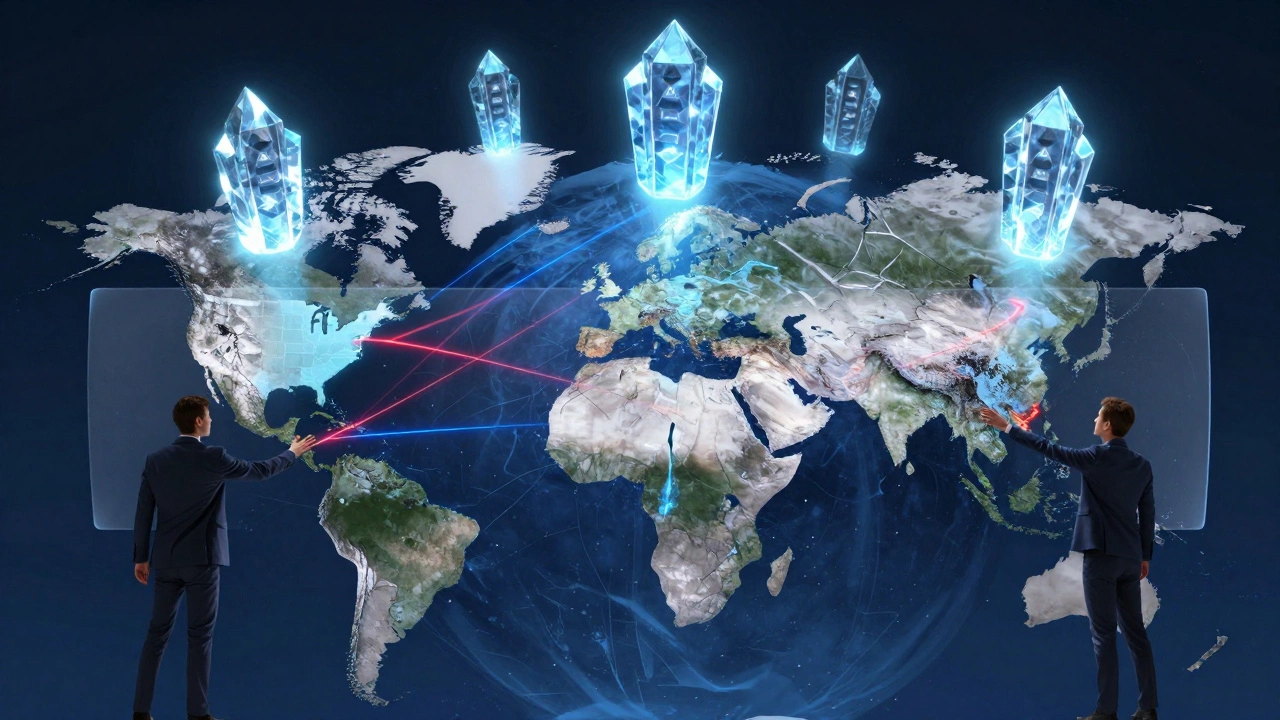
Europe’s Quiet Rebellion
The EU used to follow the U.S. lead on export controls. Not anymore. In September 2025, the European Commission issued a delegated act that let it update its control list without waiting for international consensus. That’s a big deal. It means the EU can act faster than the Wassenaar Arrangement ever allowed.
They didn’t copy the U.S. model. They focused on hardware-semiconductor manufacturing machines, quantum components, and precision sensors. They didn’t touch AI model weights. That’s a deliberate choice. The EU wants to protect its industry without stifling innovation. But the result is the same: companies now have to follow two different rulebooks. A German company exporting to the U.S. must comply with ECCNs. The same company exporting to India must comply with EU rules. And if they’re shipping to China? They have to check both-and hope they didn’t miss something.
This isn’t just about compliance. It’s about sovereignty. The EU is saying: we don’t want to be dragged into every U.S. geopolitical move. But that independence comes at a cost. Supply chains are now more complex, slower, and more expensive.
China’s Flip-Flop Strategy
China didn’t wait to be controlled. It struck first. In December 2024, it announced export controls on medium- and heavy-rare-earth materials-critical for magnets in electric motors, quantum sensors, and advanced chips. It looked like a counterpunch.
Then, in October 2025, it suspended some of those controls. Why? Because the global market reacted. Prices spiked. European and U.S. companies scrambled to find alternatives. China’s own industries-like EV and renewable energy-started facing shortages. The move backfired.
But China didn’t back down. It kept the licensing requirement for exports to third countries. If you’re a U.S. firm buying rare-earth materials from Vietnam, you still need a Chinese license. That’s not a trade barrier. It’s a choke point. China isn’t trying to win the race. It’s trying to make sure no one else can run it without paying.
The Real Cost: Slower Innovation, Higher Prices
These controls aren’t just legal hurdles. They’re economic ones.
Chip prices have jumped 20-35% since early 2025 for advanced nodes. AI model development costs have doubled because companies now need legal teams to review every export. Quantum research labs are cutting international partnerships. A 2026 analysis by MarketsandMarkets shows the quantum computing market will grow to $1.76 billion-but only if companies can navigate the export maze.
Smaller firms are getting squeezed out. Startups can’t afford compliance teams. Big tech can. That means consolidation. The market is becoming a club for giants who can afford lawyers, auditors, and global logistics experts.
And the ripple effects? Companies are moving production closer to home. U.S. firms are investing in domestic chip fabs. European firms are building quantum labs in Poland and Spain instead of partnering with India. China is pushing self-reliance in rare-earth processing. The global supply chain isn’t just fragmented-it’s being rebuilt in isolated bubbles.
What Comes Next?
Don’t think this is over. The U.S. is already working on controls for AI training infrastructure-things like high-bandwidth memory and specialized accelerators. The EU is preparing to expand quantum controls to error correction systems. China might re-impose rare-earth restrictions if it sees an advantage.
There’s no going back. The world has moved from open innovation to strategic isolation. The question isn’t whether these controls will stay. It’s how long it will take for companies to adapt-and how many will fail before they do.
If you’re in tech, your job isn’t just building products anymore. It’s navigating a minefield of export rules, licensing forms, and compliance audits. The next breakthrough won’t come from a lab. It’ll come from a legal department.
Are export controls only targeting China?
No. While China is a major focus, U.S. and EU controls apply globally. The U.S. requires licenses for advanced chips to any country under ECCN 3A090.a. The EU’s rules cover exports to all destinations. Even companies in Canada, Japan, or Brazil must comply if they’re handling controlled tech. The difference is that some countries (like those in Group A:1) get faster approvals, while others face denials.
Can I still collaborate with foreign researchers on AI?
It depends. If you’re sharing AI model weights-especially those trained on sensitive data-you need a license. Basic code or public datasets are fine. But if your model was trained on defense data, medical records, or financial systems, even showing it to a foreign colleague in a lab is considered an export. Many universities now require researchers to sign agreements before working with international partners.
What happens if I accidentally violate an export control?
Fines can reach millions of dollars, and individuals can face criminal charges. The U.S. Bureau of Industry and Security has increased enforcement since 2024. Companies have been penalized for shipping chips to blocked entities via third countries, or for letting foreign nationals access controlled AI models without a license. Ignorance isn’t a defense. Compliance isn’t optional.
Do these controls affect open-source AI models?
Yes, if they include controlled weights. Open-source models trained on sensitive data or using advanced architectures (like those optimized for military applications) are now subject to export rules. Hosting a model on GitHub doesn’t make it exempt. If the weights meet the technical thresholds defined in ECCN 3A090.a or U.S. AI controls, distributing them internationally requires a license-even if you’re not charging for it.
How do I know if my company’s tech is controlled?
Start by checking the U.S. Export Administration Regulations (EAR) and the EU’s dual-use list. Look for ECCN codes like 3A090 for chips, 3A231 for quantum systems, and 3D001 for AI model weights. If your product uses GAAFETs, quantum processors, or AI models trained on classified data, it’s likely controlled. Consult a trade compliance expert-don’t guess. One mistake can shut down your export business.
What Should Companies Do Now?
First, audit your tech. What are you building? Who has access to it? Where is it being used? Map every component against the latest ECCNs and EU dual-use lists.
Second, train your teams. Engineers, researchers, and salespeople need to understand what’s controlled-not just what’s illegal. A PhD student uploading a model to GitHub might not realize they’re violating export law.
Third, build compliance into your product lifecycle. Don’t wait until the last minute. Add export control reviews to your design phase. Work with legal teams early. If you’re exporting, budget for licenses, audits, and legal fees.
Finally, accept that globalization in tech is over. The future belongs to companies that can operate within national boundaries-not those trying to ignore them.